You might be here because you've watched a swing song come on, seen a couple glide, spin, laugh, and somehow make it all look effortless. Part of you wants in. Another part of you thinks, “That looks amazing, but I'd probably mess it up in the first five seconds.”
That reaction is normal.
Most beginners don't struggle because they lack talent. They struggle because swing dancing looks faster and more complicated from the outside than it feels once someone breaks it down properly. The first surprise for many new students is that good swing dance lessons aren't about showing off. They're about learning to hear the beat, move your weight, connect with another person, and have fun before you worry about fancy turns.
That's also why some people fall in love with swing right away. It's social, musical, playful, and full of personality. You don't need a dance background to start, and you don't need to walk in already confident. You just need a place where the teaching is clear and the room feels welcoming.
Ready to Find Your Rhythm
A lot of new students arrive with the same story. They saw swing dancing at a wedding, in a social dance video, or across the floor at a party. They loved the energy, but they also assumed everyone dancing had been doing it forever.
Then they finally try a class and realize something important. Beginners aren't expected to know anything.
That first shift matters. Once the pressure drops, learning gets easier. Instead of asking, “Can I ever look like that?” you start asking the much better question, “What's my first step?”
The feeling most beginners have
It usually sounds like this:
- “I have no rhythm.” It often means they haven't been shown how to count music in a way that feels natural.
- “I'm worried I'll look awkward.” You probably will at moments. Everyone does at first, and that's part of learning.
- “I don't have a partner.” In many beginner programs, that isn't a problem.
- “I'm too late to start.” Adults begin social dancing all the time.
You don't need confidence before your first class. You build confidence by taking the first class.
Swing has lasted because it gives people a reason to move toward the music and toward each other. It's lively without requiring perfection. It's structured enough to teach, but flexible enough to feel personal.
If nervousness is the main thing holding you back, this guide on how to overcome fear of dancing in public can help put that feeling in perspective. The focus in the room is much more on learning than on judging anyone else.
What makes it worth trying
For absolute beginners, the biggest win isn't mastering a flashy pattern. It's discovering that swing can feel approachable. A strong class gives you small successes quickly. You find the beat. You learn where your weight goes. You make one pattern work. Then another.
That's when dancing starts to feel less like a performance and more like play.
Understanding the World of Swing Dance
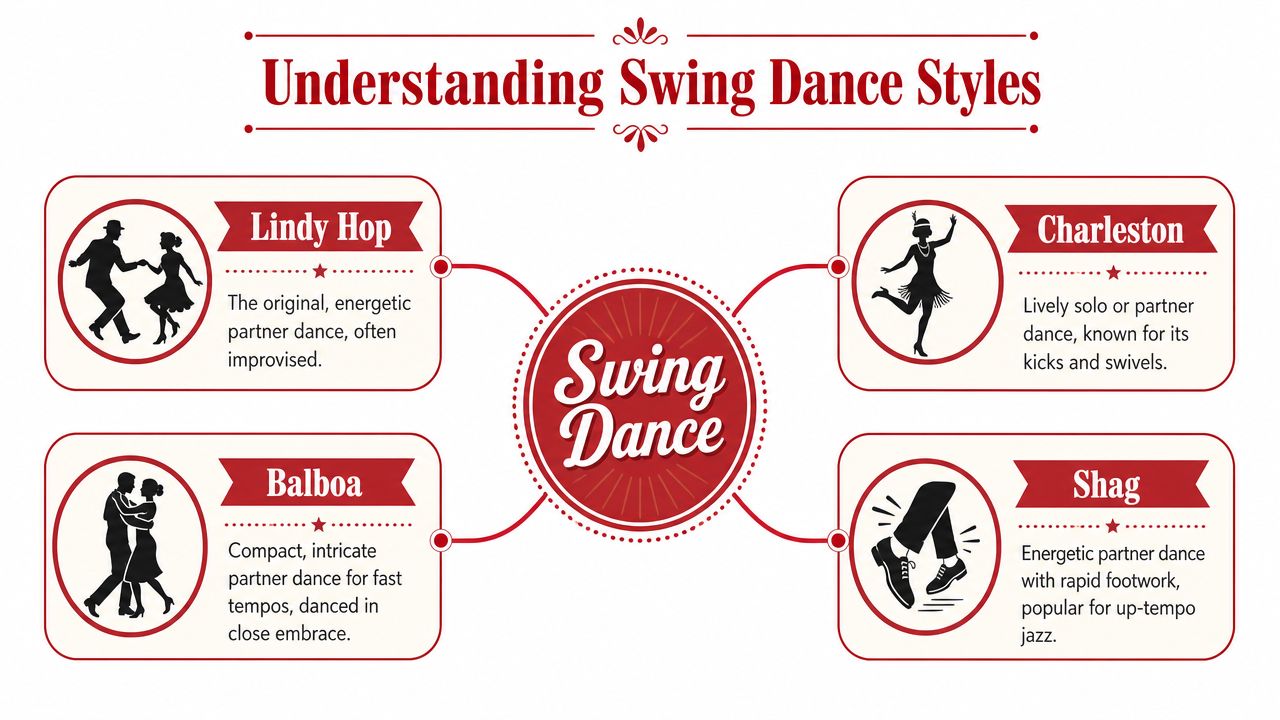
“Swing” is a broad family of dances, not just one fixed style. Historically, swing dance developed alongside swing-style jazz music during the 1920s to 1940s, and styles such as Charleston, Lindy Hop, and Balboa emerged during that period. Later developments included East Coast Swing and West Coast Swing, and those styles still show up regularly in modern class schedules, as outlined in this overview of swing dance history and styles).
A simple way to think about it is this. Swing dances are like related dialects of the same language. They share family traits, but they don't all feel the same in your body.
The three styles most beginners hear about
If you're looking at swing dance lessons for the first time, these are the names you'll probably encounter most often.
Lindy Hop
Lindy Hop is the historic original many dancers think of when they picture classic swing. It has a grounded, elastic feel and a lot of room for improvisation. Some classes lean playful and social. Others include vintage jazz styling and more rhythmic complexity.
Beginners sometimes assume Lindy Hop is “too advanced” because experienced dancers make it look explosive. In reality, a good beginner class starts with pulse, timing, and simple partner connection.
East Coast Swing
East Coast Swing is often the easiest on-ramp for new social dancers. It's commonly taught in beginner programs because the rhythm is clear and the structure is friendly to first-timers. If you want something upbeat that gets you moving quickly, this is often where people start.
It's also one of the reasons swing dance lessons feel accessible. You don't need a huge vocabulary to begin enjoying the dance.
West Coast Swing
West Coast Swing is smoother and more slot-based. It works with a wide range of music and often feels more relaxed on the surface, even though the timing and connection can become very nuanced as you progress.
Students who like musical interpretation and a more modern social dance atmosphere often gravitate toward it. If you want a practical breakdown of the two most common beginner options, this article on the difference between East Coast and West Coast Swing is useful.
How to choose your starting point
You don't need to choose “your forever style” before your first class. Start with the one that matches your current goal.
| Goal | A good place to start |
|---|---|
| You want a classic vintage swing feel | Lindy Hop |
| You want a simple, social beginner entry point | East Coast Swing |
| You want a smoother style with modern music options | West Coast Swing |
Practical rule: Pick the style that makes you want to come back next week. Motivation matters more than getting the “perfect” first choice.
Some students eventually try several styles. That's normal. The important thing at the beginning is not collecting labels. It's getting comfortable with rhythm, weight shifts, and connection.
Group Classes or Private Lessons Which Is Right for You
This decision gets easier when you stop asking which format is better and start asking which format fits your current goal.
Some students want a room full of energy, rotating partners, and a social way to learn. Others want focused feedback, a flexible schedule, and direct help with specific sticking points. Both paths work. They just solve different problems.
What group classes do well
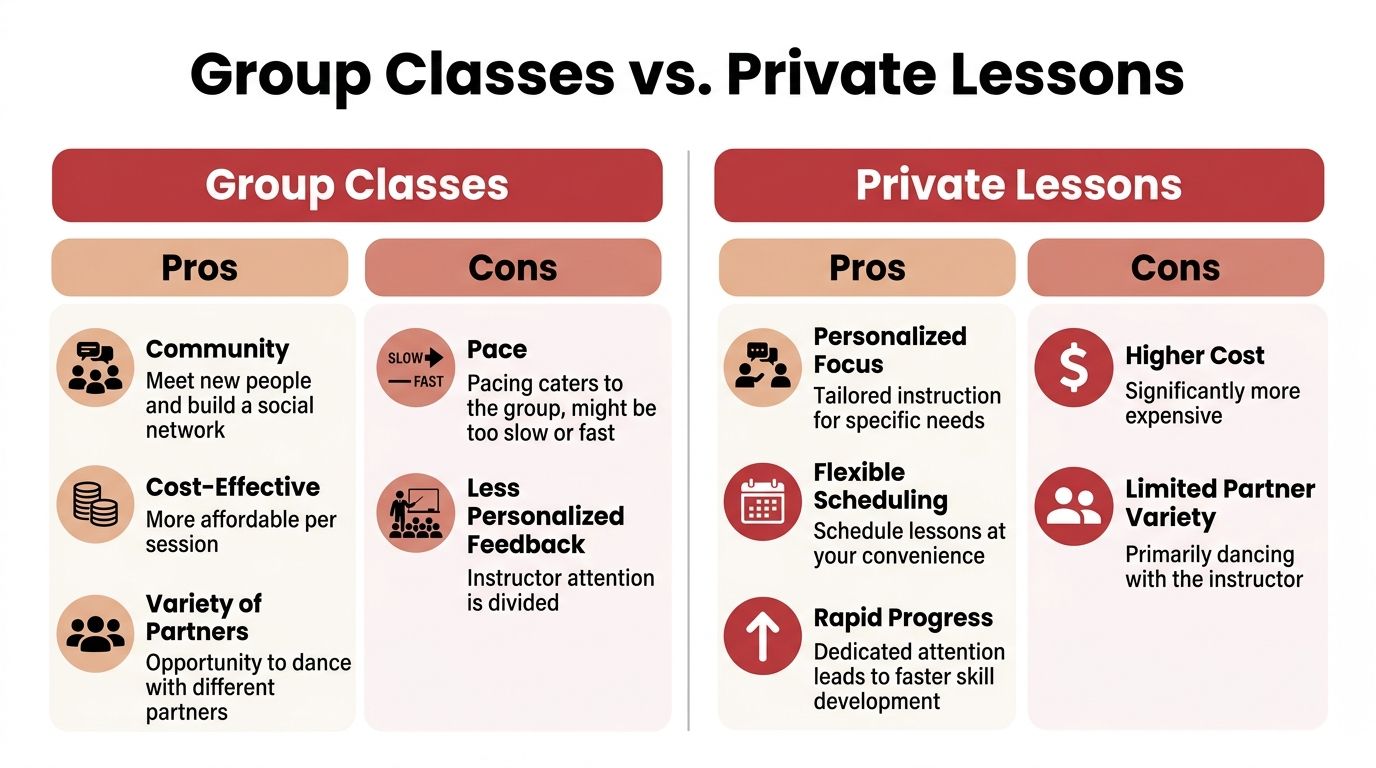
Group classes are excellent for people who want to learn in a lively environment. You hear the music, watch other beginners figure it out too, and get repeated chances to try the same skill with different partners.
That matters in swing. Social dancing isn't about memorizing one routine with one person. It's about building adaptable timing and connection.
Group classes are often a strong fit if you want:
- Community: You'll meet other learners and feel part of a shared process.
- Partner rotation: Dancing with different people helps you become clearer and more responsive.
- A lower-pressure start: Many beginners feel safer blending into a class than being the only student in the room.
What private lessons do well
Private lessons are useful when you want instruction built around you. Maybe you're preparing for a wedding, want to improve faster, or need help with one recurring issue such as timing, frame, or turning.
Private coaching also helps students who get overwhelmed in groups. You can pause, ask questions, and repeat something until it clicks.
Private lessons are often a strong fit if:
- You want personalized feedback: The teacher can respond to your exact habits.
- Your schedule is tight: Private sessions can be easier to place on a busy calendar.
- You have a targeted goal: Wedding dancing, confidence-building, or style-specific work often improves with one-on-one attention.
Group Classes vs. Private Lessons at a Glance
| Factor | Group Classes | Private Lessons |
|---|---|---|
| Cost | Usually more budget-friendly per session | Usually higher cost per session |
| Pace | Set for the group | Set for your learning speed |
| Feedback | Shared across the room | Direct and personal |
| Social atmosphere | Strong social energy | More focused and quiet |
| Partner variety | Usually higher | Usually limited |
| Best for | General learning and meeting people | Specific goals and faster correction |
A lot of students do best with a mix. They take group classes to build comfort and social skills, then add private lessons when they want sharper feedback.
If you freeze in groups, private lessons can open the door. If you overthink in private, a group class can loosen you up.
Neither option is a test of seriousness. It's just a tool choice. Pick the format that makes you most likely to keep showing up.
What to Expect in Your First Swing Dance Lesson
The first class usually feels much less mysterious once you know the flow. You arrive, check in, look around the room, and realize plenty of other people are new too. Nobody expects polished dancing.
Most beginners do best in comfortable clothing and shoes that let them move easily. You don't need a costume or special dance outfit. Start simple.
What happens when class begins
A friendly beginner lesson often starts without a partner requirement. The instructor introduces the basic rhythm, demonstrates the movement, and has everyone try it before adding more detail.
You won't be thrown into a complicated routine. A good teacher gives you one manageable piece at a time.
The room often moves through this sequence:
- Warm up the body with easy movement and listening to the beat.
- Learn the footwork without worrying yet about turns or styling.
- Add partner connection once the rhythm starts to settle.
- Repeat the basic enough times that it begins to feel familiar.
A real example of a beginner pattern
In East Coast Swing, one foundational 6-count pattern is taught as a triple step left, a triple step right, and a rock step. A key technical detail is keeping a forward weight bias during the rock step so you stay connected and flow into the next movement, as described in this breakdown of the basic steps of East Coast Swing.
That sounds technical on paper, but in class it's usually taught in plain language. You might hear something like, “Don't lean away on the rock step. Keep your center ready to come forward again.”
Your first job isn't to look fancy. Your first job is to feel where your weight is.
That one idea helps beginners more than they expect. Once your weight is in the right place, the dance starts to feel smoother and less forced.
Where beginners usually get confused
Most first-day confusion falls into a few predictable categories:
- Counting and moving at the same time: This gets easier with repetition.
- Thinking too much about feet: Many students stare down at the floor at first.
- Trying to lead or follow with the arms only: Connection works better when the body moves first.
- Worrying about mistakes: Everyone misses steps in beginner class.
If the class rotates partners, that can help. You quickly learn that no one perfect partner is carrying the dance. The skill lives in timing, balance, and communication.
What a good first lesson feels like
By the end of class, you probably won't feel “finished.” You will feel more oriented. You'll know what the music feels like, what the basic rhythm sounds like, and how a simple pattern works with another person.
That's a successful first lesson.
You may leave thinking, “I still need practice, but I can do this.” That's the exact mindset that keeps people learning.
How to Choose the Best Dance Studio for You
The right studio doesn't just teach you where to put your feet. It teaches you how the dance should feel.
That distinction matters more than most beginners realize. Students can memorize steps quickly and still feel stiff, late, disconnected, or unsure why the dance isn't working. A stronger learning environment helps you notice weight, balance, momentum, and connection from the start.
One reason this matters so much is that beginners who develop body awareness before memorizing complex steps show a 40% improvement in partner connection and reduced injury risk, and 68% of adult beginners quit within 3 months because they feel robotic, not because the steps are too hard, according to this discussion of body awareness in beginner swing education.
Signs a studio teaches real dancing
When you visit or observe swing dance lessons, listen to what instructors emphasize. Are they only calling out steps, or are they also talking about rhythm, weight transfer, posture, momentum, and connection?
Those words matter because they reveal the teaching philosophy.
Look for a studio where instructors do things like:
- Explain the why: They don't just say “step here.” They explain what that movement creates.
- Use clear feedback: They help students notice what feels balanced and what feels stuck.
- Keep the room encouraging: People learn faster when they aren't bracing for embarrassment.
- Teach connection, not force: Leading and following should look responsive, not pushy.
Questions worth asking before you enroll
You don't need to interview a studio like a detective, but a few practical questions can tell you a lot.
Ask things such as:
- How do you work with absolute beginners?
- Do students need a partner?
- Do instructors focus on connection and musicality, or mostly patterns?
- What should I expect in my first month?
A thoughtful answer is a good sign. Vague answers usually tell you the teaching may be vague too.
A beginner-friendly studio makes you feel challenged without making you feel small.
If you're comparing dance options more broadly in your area, it can help to look at how different studios explain their teaching style. Even outside swing, roundup guides such as find top pole dancing classes Detroit can be useful because they show what strong studio selection criteria look like across movement-based learning.
What to notice in the room
Watch the students, not just the instructor.
Are students smiling between mistakes? Do beginners seem supported? Does the room feel tense or welcoming? Can you tell that the teacher is helping people understand movement, not just survive the hour?
If you want a more detailed checklist, this guide on how to choose a dance studio gives practical things to compare before you commit.
For readers in the Philadelphia area, Danza Academy of Social Dance is one local option offering swing instruction in Center City Philadelphia and Exton, along with private lessons, group classes, wedding dance preparation, and workshops. More important than the label, though, is finding a studio where the teaching helps you build feel, not just memory.
Start Your Swing Dance Journey with Danza Academy
Once you know what to look for, the next step should feel simple. You want a place where beginner swing dance lessons are welcoming, the instruction is clear, and booking a first visit doesn't turn into a chore.
That convenience matters. Online trial class booking available 24/7 and shorter forms improve lead capture by removing friction from the booking process, according to this article on dance studio trial bookings. In plain terms, when it's easy to book, more people take the first step.
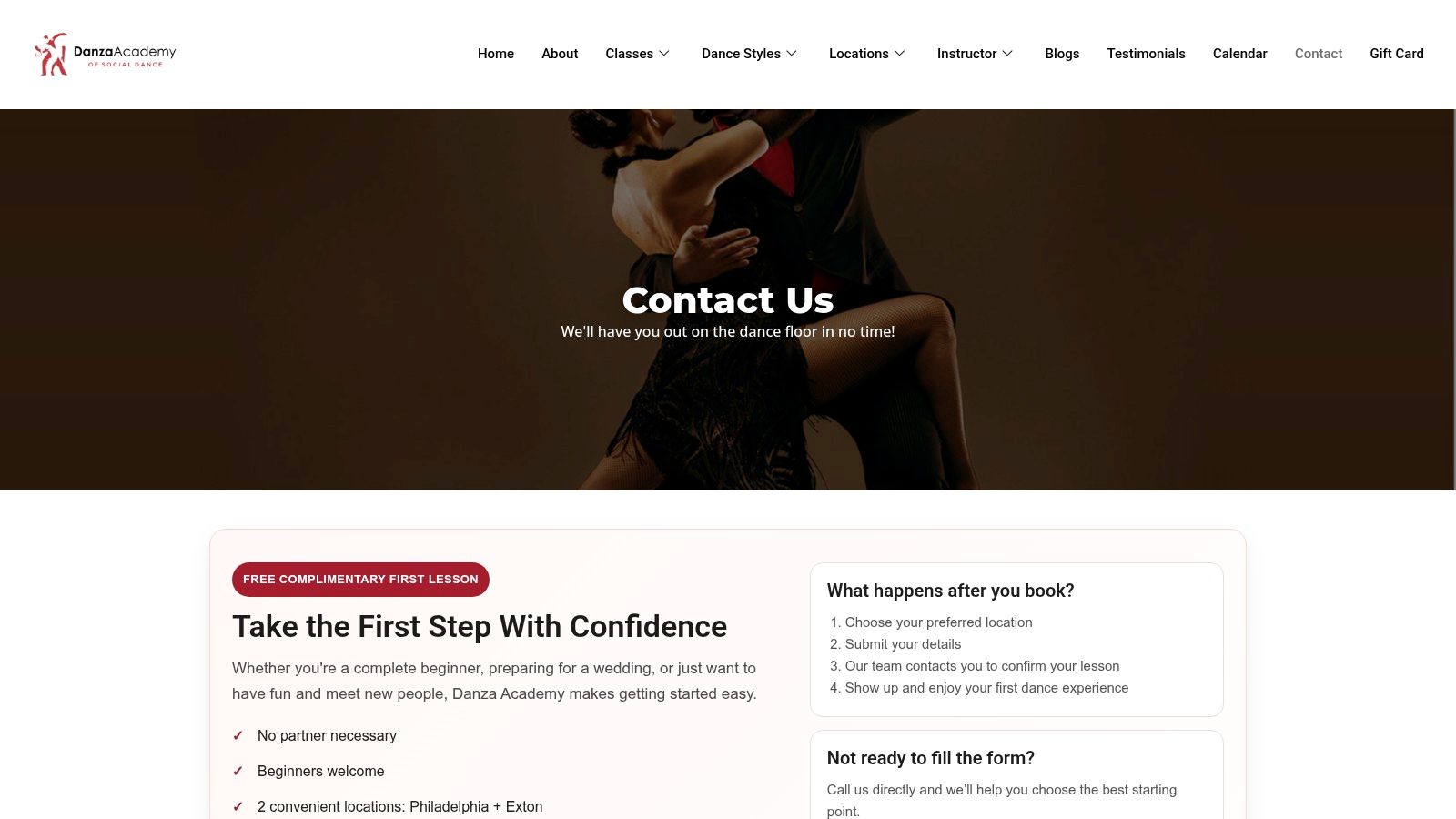
For students around Philadelphia, that first step can include classes in Center City Philadelphia and Exton, plus options for private lessons, group classes, wedding dance preparation, and workshops. If you're curious but still a little unsure, a complimentary first lesson makes sense because it lets you experience the teaching style before making a bigger commitment.
Why a complimentary first lesson helps
Beginners often need one thing more than motivation. They need a low-pressure entry point.
A complimentary lesson gives you a chance to answer the questions that matter in real life:
- Do I feel comfortable in this room?
- Does the instructor explain things clearly?
- Can I picture myself coming back next week?
That first experience tells you far more than scrolling through dance videos ever will.
A practical next move
If swing has been sitting in the back of your mind for a while, don't wait until you feel perfectly ready. That perfect readiness rarely materializes before you begin. Individuals book the lesson, show up a little nervous, and discover that learning is much more enjoyable than they expected.
The easiest way to begin is to book the complimentary lesson directly through the Danza Academy contact page. It's a straightforward way to move from “I've always wanted to try this” to stepping onto the floor.
A complimentary first lesson is a simple way to see whether swing feels right for you. If you're ready to try beginner-friendly instruction in a welcoming setting, book your free lesson with Danza Academy of Social Dance.