
You’re standing at the edge of the floor at a wedding, party, or studio social. You want to join in. You may even know a few steps. But your chest tightens, your body gets stiff, and suddenly holding a drink and pretending you’re “just watching” feels safer than moving.
That reaction is more common than generally admitted. Fear of dancing in public usually isn’t about dance itself. It’s about exposure. Being seen. Getting something wrong in front of other people. For some, it’s simple nervousness. For others, it feels much bigger and can slide into full avoidance.
The good news is that this fear can change. You don’t need a fake confidence speech or a pushy friend dragging you onto the floor. You need a plan that settles your body, changes the way you practice, and helps you face the situation in the right order.
The Dance Floor Doesn't Have to Be Scary
Those who feel scared to dance in public assume they have a personality problem. They tell themselves they’re too shy, too awkward, too old to start, or just “not a dancer.” That’s usually not the truth. What they have is a stress response attached to dancing in front of others.
That matters, because a stress response can be trained. It doesn’t have to run the show forever.
There’s also a strong reason to stick with the process. A 2024 meta-analysis in Ageing Research Reviews found that structured dance was as effective as other physical activities in reducing anxiety, and dance programs had completion rates of 86 to 100 percent, largely because people enjoy them and keep coming back (review details in Ageing Research Reviews). That’s encouraging for beginners because it shows dance isn’t just good for coordination. It can support psychological health too.
What actually helps
If you want to learn how to overcome fear of dancing in public, think in three layers:
- Calm the body first so panic doesn’t hijack your movement.
- Change the practice environment so you build confidence in steps, not chaos.
- Increase exposure gradually instead of throwing yourself into the most intimidating setting.
Practical rule: Don’t try to “be brave” by skipping straight to the hardest version of the problem. Fast overwhelm usually teaches your body to fear dancing more, not less.
A lot of generic advice fails because it jumps straight to mindset. Positive thinking helps, but it won’t do much if your shoulders are locked, your breathing is shallow, and your brain is scanning the room for judgment. Public dance confidence grows when your thoughts, body, and training environment work together.
That’s the shift. You’re not trying to become fearless overnight. You’re teaching yourself that being seen while moving is safe, manageable, and eventually enjoyable.
Understanding the Real Reason You're Afraid to Dance
Fear on the dance floor usually has a story behind it. Sometimes it starts with one embarrassing moment. Sometimes it comes from years of avoiding anything that feels performative. And sometimes it’s perfectionism wearing a dance costume.
A useful way to look at it is this. Most dance anxiety isn’t caused by movement. It’s caused by judgment, uncertainty, and self-monitoring. You’re not thinking, “What does the music feel like?” You’re thinking, “What if I look foolish?”
The three common roots
Here are the patterns I see most often in nervous dancers:
- Fear of judgment: You assume people are watching closely and keeping score.
- Perfectionism: If you can’t do it well right away, you’d rather not do it at all.
- Identity threat: Dancing makes you feel exposed because it’s expressive, not just technical.
When those combine, even a beginner class can feel emotionally loud.
A simple self-check helps. Ask yourself which thought sounds most familiar:
| Thought | What it usually means |
|---|---|
| “Everyone will notice I’m bad” | fear of judgment |
| “I need more practice before anyone sees me” | perfectionism |
| “I feel ridiculous when I move” | discomfort with visibility |
| “I freeze when someone asks me to dance” | pressure and uncertainty |
Why dance can strengthen confidence over time
Dancing asks your brain to do several things at once. You listen, time movement to music, remember patterns, adjust to space, and often respond to another person. That combination is part of what makes dance such a powerful activity.
A 21-year study highlighted by Harvard’s coverage of research from the New England Journal of Medicine found that frequent dancing was the only one of 11 leisure activities studied that significantly lowered dementia risk (Harvard summary of the dancing and brain study). For someone dealing with dance fear, that matters less as a trivia fact and more as a reminder that dance is not frivolous. It’s mentally demanding, socially rich, and highly engaging.
The very thing that intimidates you about dancing, using your mind and body together in front of others, is also part of what makes it so valuable.
If your fear is tied to old beliefs about being awkward, uncoordinated, or “not the type” to dance, it can help to do some belief work alongside physical practice. A thoughtful place to start is 9D Breathwork's guide to breaking free, which explores how limiting beliefs shape behavior long before you step into the moment that scares you.
What doesn’t work well
Two approaches usually backfire.
First, waiting until you feel fully confident. Confidence rarely comes before action. It usually comes after repeated safe exposure.
Second, trying to dance with your attention split between the music and your inner critic. You can’t move freely while mentally grading yourself in real time. That habit creates stiffness, late reactions, and the exact look of discomfort you’re trying to avoid.
The fix starts by treating the fear as a pattern, not a verdict on who you are.
Calm Your Nerves With Mind and Body Techniques
When nerves hit, people often hear, “Just relax.” That advice is too vague to use. If your heart is racing and your hands feel cold, you need something more concrete.
One useful approach comes from a 4-step somatic regulation method rooted in polyvagal theory, which can improve composure by 90 percent among dancers. The same framework notes that assessing physical safety and labeling your fear can reduce amygdala hijacking by up to 40 percent (Amber Haider’s 4-step method for taming nerves).
A pre-dance reset you can actually use
Try this sequence before class, before a social, or right after you feel a wave of panic.
Check safety
Ask, “Am I physically safe right now?” Then ask, “Do I feel safe?” Those are not always the same. This short pause tells your nervous system that you are paying attention instead of being swept away by alarm.
Name the fear
Say it plainly, either out loud or to yourself. “I’m afraid I’ll look stiff.” “I’m afraid I’ll forget the step.” “I’m afraid people will notice I’m new.” Naming the exact fear often reduces its intensity because it stops the swirl of vague dread.
Use a body anchor
Pick one grounding action and repeat it. Two good options are:
- Bilateral tapping: alternate light taps on your thighs.
- Loose arm sway: keep the elbows soft and let your upper body move gently with the beat.
Shift toward the music
Don’t try to impress the room. Listen for the beat and commit to moving with it. Your goal is connection, not display.
A short routine before you enter the floor
This works well in a hallway, restroom, lobby, or quiet corner:
- Feet planted: Feel both feet on the ground for a few breaths.
- Jaw soft: Unclench it. Tight jaw usually means tight shoulders.
- Exhale longer: Let the out-breath slow down your body.
- One sentence only: Use one phrase, such as “I’m safe and I can move freely.”
For many adults, dance helps on the mental health side long before they feel “good” at it. If you want a broader look at that connection, this article on how dance lessons can improve mental health for adults is worth reading.
What to do in the middle of a song
At this stage, people often unravel. They notice one mistake, tense up, and mentally exit even while still standing there.
Use this recovery pattern instead:
Breathe out, find the beat, make one simple movement, and stay with the song.
That simple movement might be a side step, weight change, or basic sway. You’re not trying to rescue the whole dance in one second. You’re trying to stop a spiral.
A final note from the studio floor. The dancers who look calm are not always the dancers who feel calm. Many of them have just learned how to regulate their nerves faster.
Your Step-by-Step Exposure Plan From Home to The Dance Floor
The most reliable way to reduce fear is gradual exposure. That means you face the thing that scares you in manageable layers, not all at once.
Adapted from clinical protocols, a step-by-step exposure method for chorophobia has a 75 to 85 percent success rate, moving from private solo practice to controlled partner work and then small groups (Fred Astaire’s overview of overcoming fear of dancing).
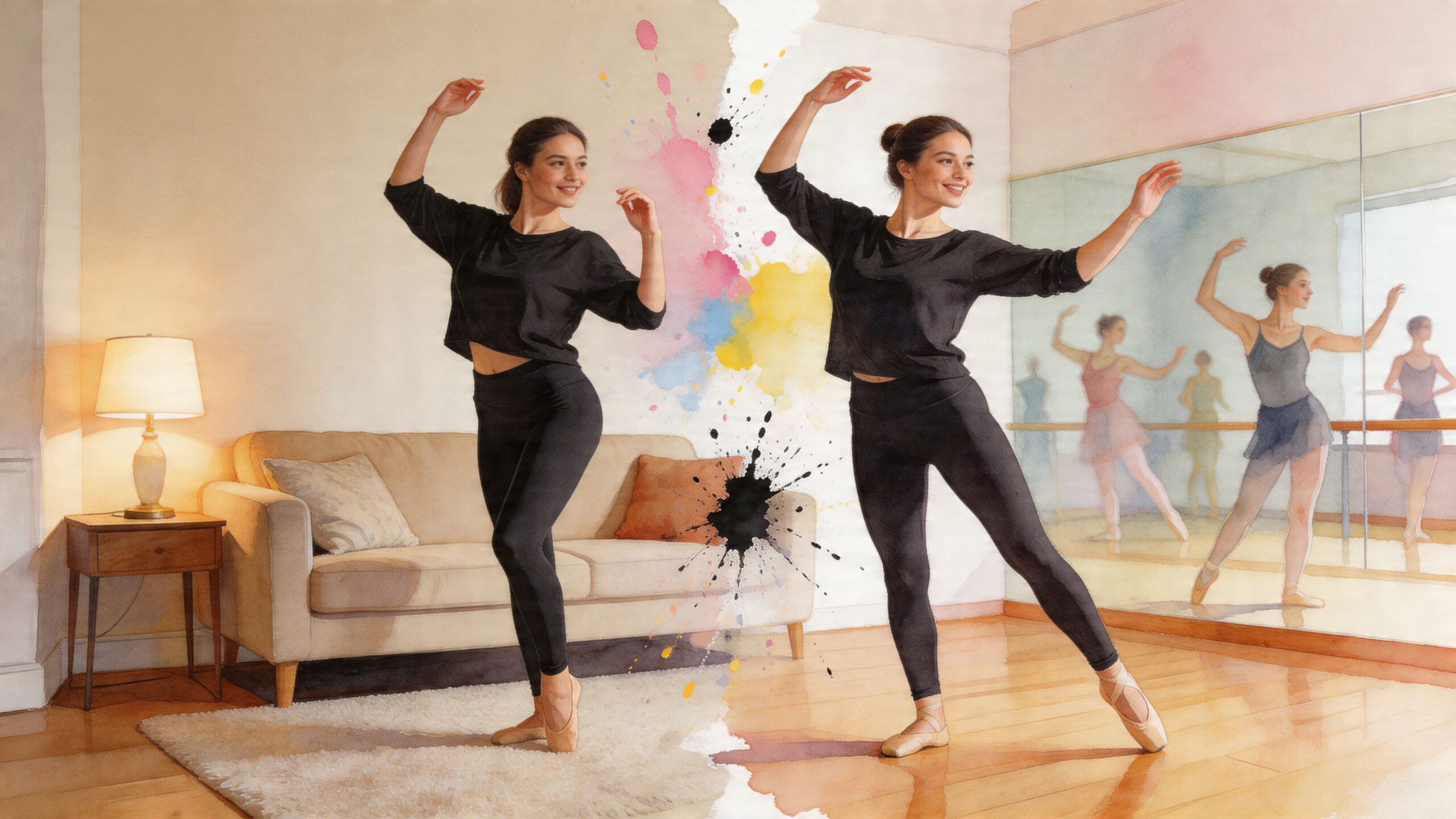
Stage one at home
Start in private. Close the door. Put on one song with a clear beat. Practice a tiny amount of material, not a full performance.
For social dance beginners, that can be:
- a side-to-side basic
- a forward-and-back weight change
- a box step
- a slow sway that stays on beat
Keep your focus narrow. You’re building familiarity, not trying to become impressive in your living room.
A few things matter here:
- Use the same song for several sessions: Familiar music lowers decision overload.
- Practice one transition only: For example, basic step into a turn prep, then stop.
- Look up less often: Mirrors can help, but they can also trigger self-criticism.
Stage two with one safe person
The next step is controlled partner work. That might be a trusted friend, spouse, or instructor. The point is not romance or chemistry. The point is learning how your body reacts when another person is involved.
This stage teaches skills that solo practice can’t fully train:
| Solo practice gives you | Partner practice adds |
|---|---|
| timing with music | responding to another person |
| memory of steps | recovering after small surprises |
| private comfort | being seen while moving |
| repetition | adaptability |
If the idea of a group still feels intense, don’t force it. Stay here until basic movement with another person feels ordinary.
Stage three in a beginner group
A beginner group class is a bridge, not a test. It gives you structure, repetition, and the helpful realization that other people are learning too. If you’re curious why this environment helps many new dancers progress, this breakdown of the pros of group dance lessons for beginners lays it out well.
What works in a group:
- Stand where you can see clearly
- Give yourself one job for the class, such as keeping time
- Rotate without over-apologizing
- Take breaks before you feel flooded
What doesn’t work is comparing your first month to someone else’s third year.
Studio truth: A beginner who stays relaxed and keeps moving learns faster than a beginner who tries to look advanced.
Stage four in a public social setting
Now you’re ready for a lower-pressure social dance, party, or wedding floor. Your goal here is not to dance all night. Your goal is to normalize participation.
A good first challenge is small:
- dance one song
- use one familiar pattern
- leave the floor before you feel overwhelmed
- come back later if you want
That last part matters. Ending on a manageable win teaches your brain, “I did this, and nothing terrible happened.”
Jumping too far too soon often leads to retreat. Gradual exposure feels slower, but it usually gets people to real confidence faster because it avoids the crash that comes from overload.
Your 4-Week Action Plan to Dance Confidently
A good plan is simple enough to follow even on a nervous week. Use this one as written or adjust the pace if you need more time.
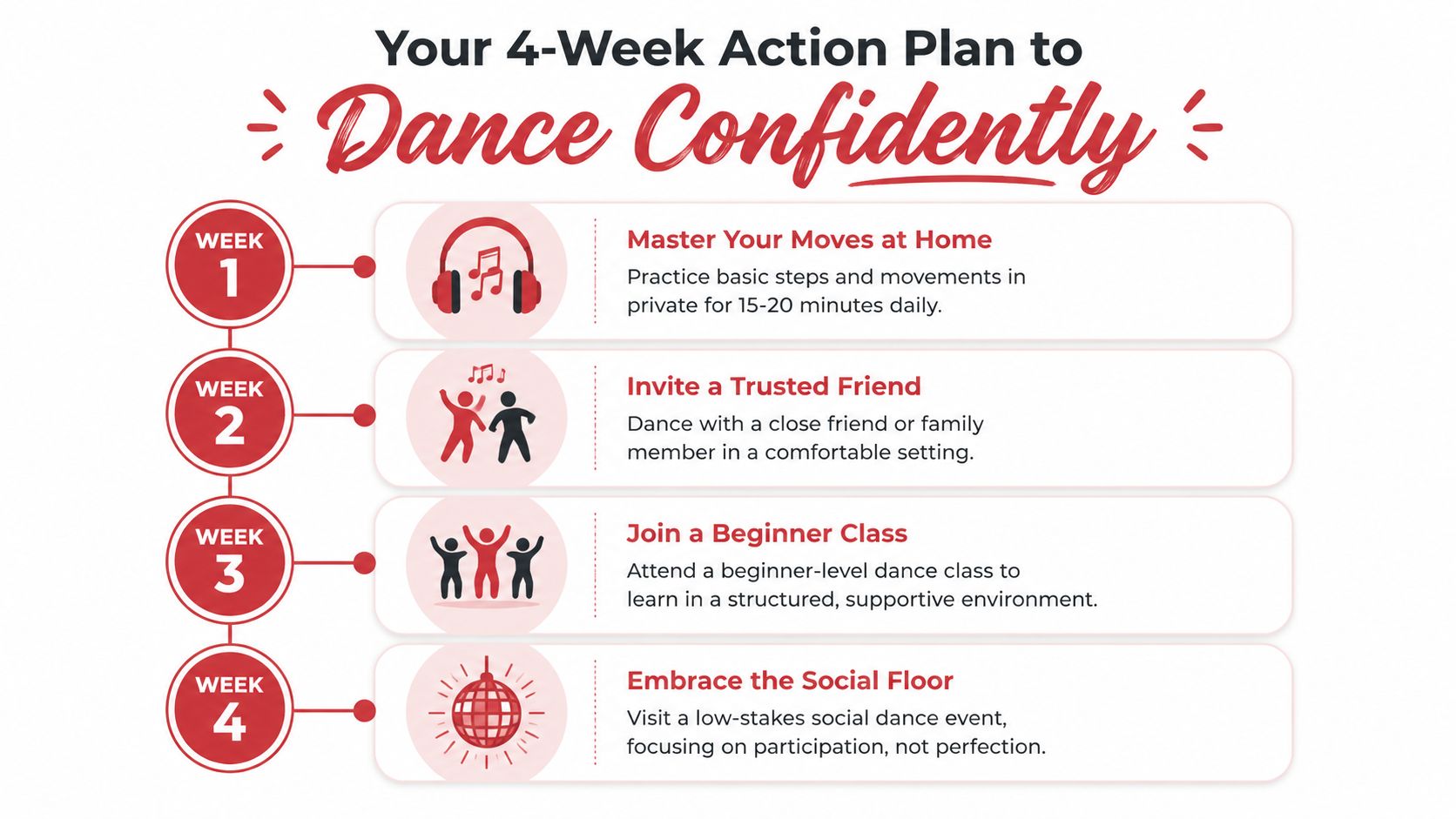
Week one at home
Keep this week private and easy to repeat.
- Daily movement: Practice basic steps for a short session at home.
- Nerve reset: Use the safety check, fear labeling, and body anchor before each practice.
- Mindset focus: “I’m building familiarity, not performing.”
If you need simple material to work on, these 10 easy dance moves anyone can learn are a solid place to begin.
Week two with one other person
Expand the challenge slightly. Dance with one trusted person in a comfortable setting.
Try this approach:
- start with one song
- agree that mistakes don’t matter
- pause and restart without apologizing
- finish before frustration takes over
This is also a good week to work on general social nerves if being seen is your main trigger. Tonen’s article on how to reduce social anxiety offers practical ideas that pair well with dance exposure.
Week three in a structured class
Choose a true beginner environment. Don’t pick the hardest room because you think pressure will make you improve faster.
Your job this week is simple:
- show up
- learn names if you can
- keep your body loose
- leave with one thing you did better than before
Make that improvement concrete. Maybe your timing felt better. Maybe you stayed calmer during partner rotation. Maybe you recovered after a missed step instead of freezing.
Week four on a social floor
Go somewhere low-stakes. Focus on participation, not polish.
Use this checklist before the first song:
- One breath
- One grounding cue
- One basic pattern
- One realistic goal
Confidence grows when you collect completed reps, not when you wait for a magical fearless feeling.
If week four still feels big, repeat week three. Slower progress is still progress. The only plan that fails is the one you abandon because you made it too intimidating to continue.
Troubleshooting Common Dance Floor Hurdles
Even with a plan, awkward moments happen. They happen to brand-new dancers and experienced ones. The difference is that confident dancers recover faster.
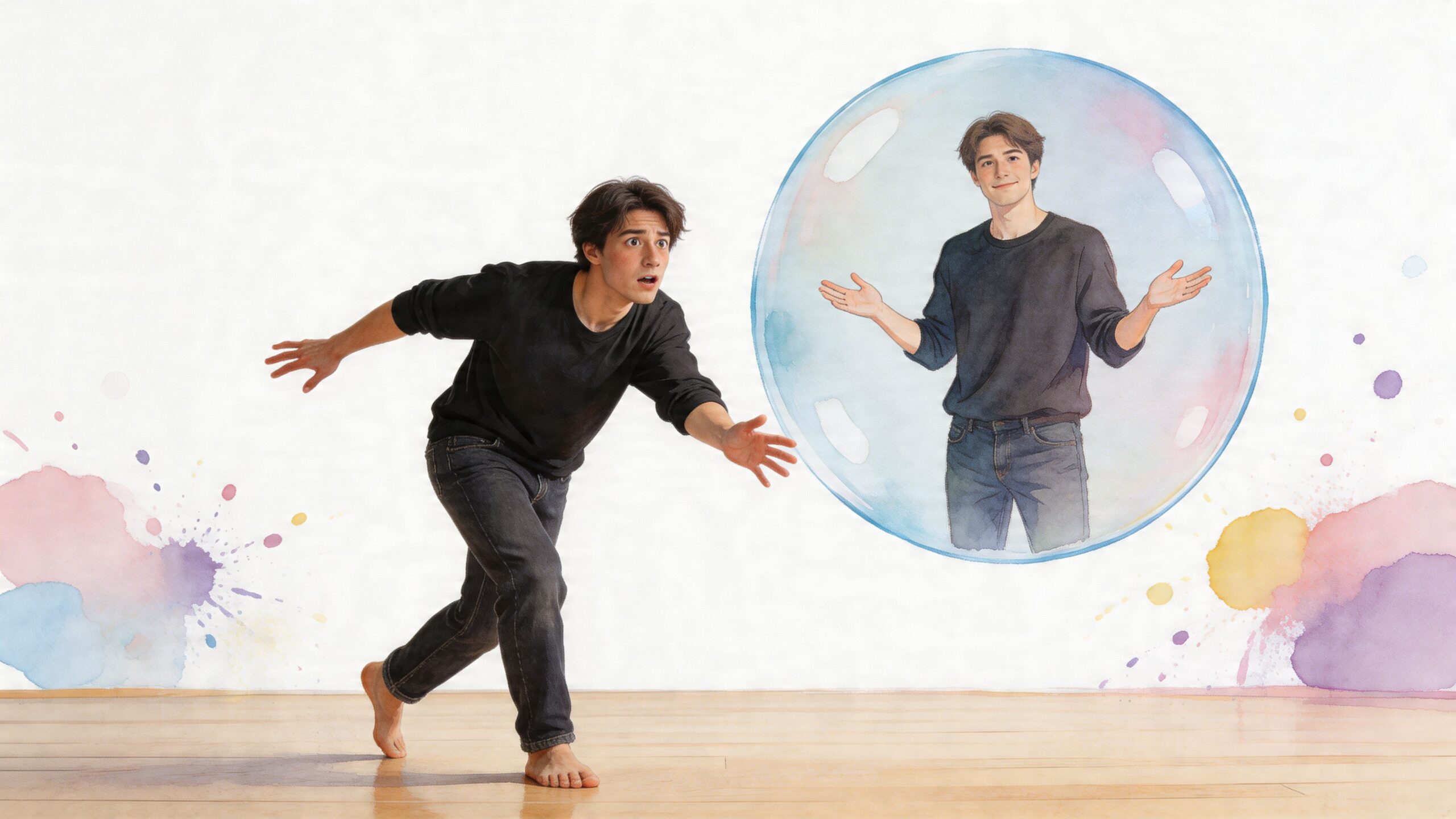
You forgot the step mid-song
Don’t stop and announce it. Return to the most basic movement you know. In partner dancing, that might be a simple basic, sway, or weight change until you hear the structure of the music again.
The recovery skill is more valuable than the missed figure. Social dancing rewards steadiness more than complexity.
You feel awkward with a new partner
This is often less about skill and more about timing, frame, and comfort level. Keep your movement smaller for the first few counts. Let the dance settle before trying anything more ambitious.
A gentle smile and a simple start do more for connection than forcing flashy moves.
You’re afraid of being judged at a wedding or party
Use one familiar move for one song. Don’t treat the whole event as one giant performance. On a social floor, others are occupied with their own experience, not auditing yours.
If you look engaged with the music and keep going after small mistakes, people usually read confidence, even when you feel nervous.
You need to decline a dance
You can be kind and brief. “Thank you, I’m sitting this one out.” That’s enough. You don’t owe a long explanation.
You’re preparing for a first dance
Wedding dancers often make the same mistake. They rehearse the choreography but not the feeling of being watched. Practice the routine in regular clothes sometimes, then in shoes that feel closer to the event itself, and occasionally run it through without stopping after errors. That teaches continuity.
You made one mistake and want to leave
Stay for one more song, even if you only mark basics. Leaving immediately after a mistake can train avoidance. Ending the night on one calm, simple success is often the better move.
Frequently Asked Questions About Dance Anxiety
What if I think I have no rhythm
Rhythm can be trained. Most beginners who say they have no rhythm are really dealing with one of three things: they’re tense, they’re listening for too much at once, or they haven’t practiced enough with clear music. Start by finding the main beat and stepping only on that. Once the beat feels steady in your body, everything else gets easier.
Is it better to start alone or with a partner
Either can work. Starting alone is often easier for nervous people because it removes the pressure of being responsible for someone else’s experience. Starting with a partner can feel more secure if that person is calm and supportive. The best option is the one that gets you practicing consistently instead of postponing the whole thing.
How do I know if my fear is normal nerves or something stronger
Normal nerves usually ease once you get moving. A stronger fear often shows up as intense dread before class, panic symptoms, persistent avoidance, or feeling unable to enter the room even when you want to. If that sounds familiar, a slower exposure approach can help. In more severe cases, working with a mental health professional alongside dance training may be the smartest path.
Should I take private lessons or group classes first
If your fear is high, private instruction is often the gentler starting point because it lowers social pressure. If your fear is mild and you like learning with others, a beginner group can work beautifully. Many people do best with both. Private lessons build security. Group classes build adaptability.
What if I make mistakes in front of everyone
You will. Everyone does. The key is changing what a mistake means. Inexperienced dancers think a mistake is proof they don’t belong. Experienced dancers treat it as part of the dance and keep going. Recovery is a skill, and you can practice it on purpose.
How do I find a studio that feels welcoming
Look for signs of true beginner support. Clear class levels, instructors who explain without shaming, an environment where no partner is required, and a culture that values progress over showing off all matter. A good studio should make it easy to ask questions and easy to start small.
Can adults really become confident dancers if they start later
Absolutely. Adult beginners often learn well because they listen carefully, practice with intention, and understand why consistency matters. The biggest obstacle is usually not age. It’s self-consciousness. Once that eases, progress tends to pick up.
If you’re ready to stop sitting on the sidelines, Danza Academy of Social Dance offers a free complimentary lesson that gives you a low-pressure place to begin. It’s a practical first step if you want supportive instruction, clear guidance, and a welcoming environment where you can build confidence at your own pace. You can book your complimentary lesson through the Danza Academy contact page.