
The biggest difference between East Coast and West Coast Swing boils down to energy and shape. Think of East Coast Swing as the bouncy, circular dance you see in old rock 'n' roll movies. West Coast Swing, on the other hand, is the smooth, linear style that looks so cool with modern R&B and pop music. One is all about high-energy spinning, the other is a sleek, elastic conversation between partners.
East Coast Swing vs. West Coast Swing: A Quick Comparison
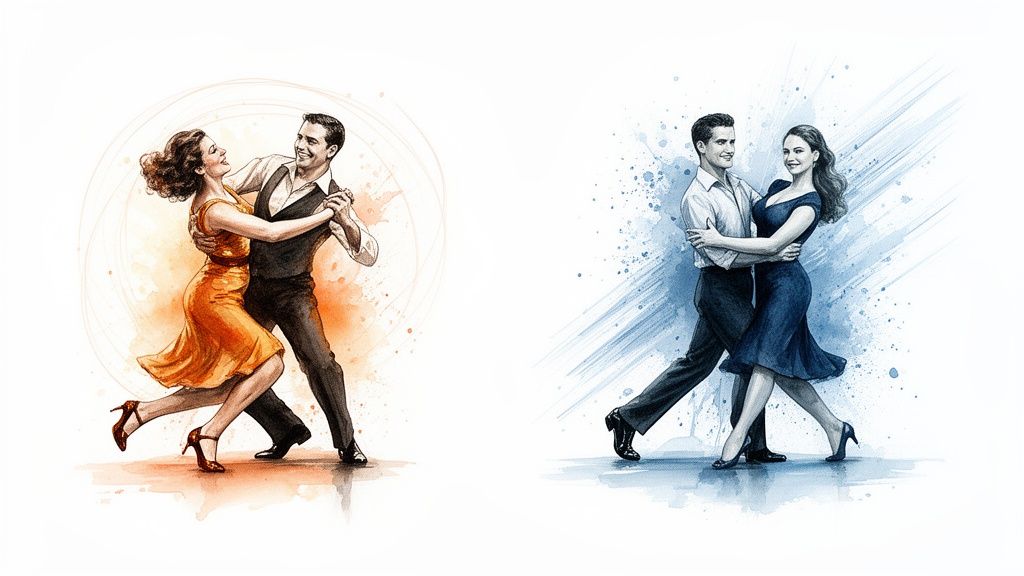
When you step onto the dance floor, the music sets the scene, and your dance is how you tell the story. Both East Coast Swing (ECS) and West Coast Swing (WCS) grew from the same Lindy Hop roots, but they took completely different roads, developing their own distinct personalities. Let's break down what makes them unique so you can find your own rhythm.
East Coast Swing is famous for its happy, high-energy, and rotational movement. It's often the first style new dancers learn because its 6-count basic is pretty intuitive and fits a massive range of upbeat music. The connection between partners tends to be firm, which helps create crisp turns and fun, predictable patterns, making it a go-to at any social dance.
In contrast, West Coast Swing is all about that smooth, grounded feel. The entire dance happens in a linear "slot," where the follower travels back and forth along a straight line. This dance is known for its incredible elastic connection—a "compression and release" technique that feels like stretching a rubber band. This elasticity opens the door for tons of improvisation and musical expression.
If you're looking to explore the wider world of swing, you'll find more in our general guide to swing dancing.
East Coast Swing vs. West Coast Swing At a Glance
The quickest way to really get the core differences between East Coast and West Coast Swing is to see their main characteristics side-by-side. These elements, from the music they favor to their basic steps, are what give each dance its unique flavor.
| Characteristic | East Coast Swing (ECS) | West Coast Swing (WCS) |
|---|---|---|
| Movement | Circular and rotational, with high energy and bounce. | Linear and slotted, with a smooth, grounded feel. |
| Basic Count | 6-count basic (triple step, triple step, rock step). | 6-count basic (walk, walk, triple step, triple step). |
| Music Tempo | Fast-paced (136-144 BPM), ideal for big band and rock. | Slower and more versatile (90-120 BPM), perfect for pop and R&B. |
| Partner Connection | Firm frame, more structured and lead-driven. | Elastic "compression-release," highly conversational. |
| Vibe | Energetic, bubbly, and a perfect party starter. | Sophisticated, improvisational, and deeply musical. |
This table gives you the technical details, but the real difference is something you have to feel.
The most impactful difference for a beginner is the feel. East Coast Swing feels like a joyful, energetic celebration, while West Coast Swing feels like a cool, creative conversation with your partner and the music.
Don't just read about it—feel the difference for yourself! The best way to find your perfect swing style is on the dance floor. Click here to book your free complimentary lesson at Danza Academy through our contact page. Our expert instructors are excited to guide you.
Understanding the Origins of Each Dance
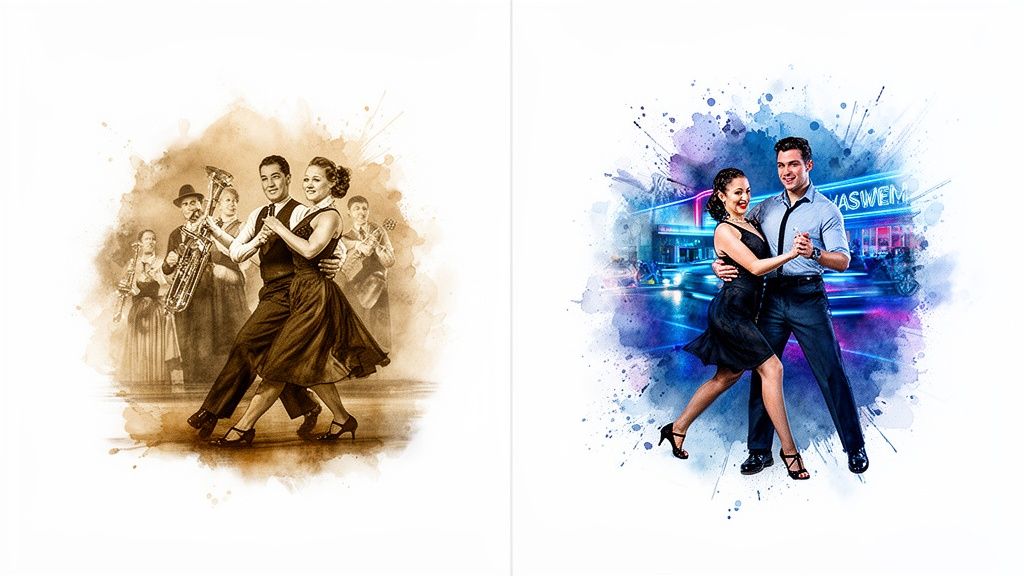
To really get what makes East and West Coast Swing so different, you have to look at where they came from. Both dances share roots in the Lindy Hop, but they grew up on opposite sides of the country and took completely different paths.
Their separate histories explain everything—from their energy levels to their basic steps and the way partners connect on the dance floor.
East Coast Swing: The Bouncy, Accessible Classic
East Coast Swing’s story is all about making a wild dance accessible to everyone. The original Lindy Hop was complex, improvisational, and frankly, a little intimidating for beginners. Dance studios knew they had to simplify it to get more people on the floor.
So, they took the intricate 8-count footwork of Lindy Hop and trimmed it down to a much simpler 6-count basic pattern. This change made the dance incredibly easy to teach and learn, helping it explode in popularity.
This happened at the perfect time. The formalization of East Coast Swing by studios like Arthur Murray around 1942 set the stage for the rock 'n' roll explosion a decade later. The high-energy music was the perfect soundtrack for this bouncy, rotational new dance. It quickly became the go-to style for sock hops and parties, cementing its place in American culture.
The whole point of East Coast Swing was to capture the fun spirit of Lindy Hop in a package that anyone could learn. This focus on accessibility is exactly why it became the dominant social dance of its time.
This history is why the dance feels so structured and energetic. It was designed from the ground up to be fun, flashy, and easy to lead. If you want to dig deeper into how the styles diverged, you can explore the detailed evolution of American swing styles.
West Coast Swing: Smooth, Slotted, and Always Evolving
While the East Coast was standardizing swing, something entirely different was happening out in California. Dancers there, heavily influenced by the legendary Dean Collins, were creating a smoother, more laid-back version of Lindy Hop.
Instead of the circular, rotational movement of its cousin, this "California Swing" was linear. It moved back and forth in a "slot," creating a cool, sophisticated connection between partners. This wasn't a dance for high-flying aerials; it was all about the conversation between the lead and follow.
This slotted framework also made West Coast Swing incredibly adaptable. As music changed from big band to blues, R&B, and even today's pop and hip-hop, the dance evolved right along with it.
The elastic connection and freedom for improvisation are what define West Coast Swing. It’s a true "conversational" dance where the lead and follow roles can feel much more fluid. The style was officially named West Coast Swing in the early 1960s, finally giving a name to this smooth, stylish dance that stood apart from its energetic East Coast relative.
Ready to see which dance's story speaks to you? The only way to truly understand is to try it yourself. We invite you to claim your free complimentary lesson at Danza Academy. Simply visit our contact page to schedule your first dance.
Decoding the Music and Rhythm
The music you dance to is the soul of the experience. It’s what sets the tone, the energy, and the connection between partners. Nothing highlights the difference between East Coast and West Coast Swing more than the tunes that get you on the floor.
Think of the raw, joyful energy of a 1950s rock 'n' roll song. That’s the classic soundtrack for East Coast Swing.
The High-Energy Pulse of East Coast Swing
East Coast Swing is all about speed and power. Its classic bounce is fueled by fast, driving rhythms that make you want to jump and jive. The tempo is a dead giveaway.
- Tempo Range: You'll typically find ECS music clocking in at a brisk 136-144 beats per minute (BPM). This pace is what gives the dance its high-energy, athletic feel.
- Signature Genres: The quintessential pairings are Big Band jazz, Rockabilly, and classic 1950s Rock 'n' Roll. We're talking Elvis Presley, Jerry Lee Lewis, and the Glenn Miller Orchestra.
- Modern Applications: While its roots are vintage, don't be afraid to dance ECS to modern pop or retro-revival bands. As long as it has a strong, fast backbeat, you’re good to go.
The music for East Coast Swing is straightforward. It gives you a clear, energetic foundation for all those fun rotations and lively triple steps. The rhythm practically pulls you onto the dance floor and makes it impossible not to smile.
The Versatile Groove of West Coast Swing
Now, let's switch gears. West Coast Swing is the chameleon of the dance world, and its music is just as adaptable. This dance is known for its smooth, elastic feel, which comes from a slower and much more varied musical landscape.
While East Coast Swing loves a fast track, West Coast Swing settles into a cooler, bluesier groove, usually between 90-120 BPM. This slower tempo isn’t about being lazy; it’s about creating space. It gives dancers time to play, improvise, and have a "conversation" with the music and each other.
In fact, at most WCS events today, around 70% of the music is contemporary R&B, hip-hop, and pop fusion. The slower tempo allows for that signature elastic connection and opens the door for more intricate, stylized footwork. You'll often hear it danced to tracks with a distinct shuffle beat.
- Musical Palette: You can dance WCS to almost anything. Pop, R&B, Blues, Hip-Hop, Lyrical, and Acoustic tracks are all fair game.
- The "Conversation": This dance is huge on musicality. Leaders and followers are encouraged to interpret the lyrics, hit the instrumental breaks, and play with the rhythm in their own way.
- Endless Playlists: One minute you could be dancing to John Legend, the next Ed Sheeran, and then The Weeknd. It’s that versatile. Check out our guide to West Coast Swing for a deeper dive into the style.
Ultimately, East Coast Swing is a joyful, high-energy blast from the past, while West Coast Swing is your canvas for modern, creative expression.
So, which rhythm is calling your name? The only way to know for sure is to feel it for yourself. Come on in and find out.
Sure, the music and history are different, but the real dividing line between East Coast and West Coast Swing is how they feel on the dance floor. It all boils down to the core movement and the connection you have with your partner. One is like a spinning top, all bright, bouncy energy, while the other is a slinky, elastic conversation.
The most obvious visual difference is how dancers travel. East Coast Swing is a rotational dance at its heart. You and your partner move in a circular path, constantly spinning and turning with a lively energy that fills the space around you.
West Coast Swing throws that idea out the window. It’s a linear dance, strictly contained within a straight line called the "slot." The leader steps just off to the side, creating a clear lane for the follower to travel back and forth. This creates a sleek, almost cat-like effect that’s incredibly cool to watch.
The Buoyant Lilt vs. The Smooth Glide
Think about how a dancer's body moves. East Coast Swing has a trademark buoyant "lilt" or bounce. This comes from constantly compressing and releasing your knees and ankles in time with the triple steps. The dance travels up and down just as much as it travels around.
That bounce is what gives East Coast Swing its happy, carefree vibe. It’s the perfect match for the driving pulse of big band and early rock 'n' roll. The goal is to look light, airy, and full of life from head to toe.
West Coast Swing, however, is all about eliminating that bounce. The goal is a smooth, gliding motion. You want your upper body to stay calm and level, like it’s floating on a cushion of air while your feet do all the complex work underneath. It’s the definition of effortless cool.
This isn't just a minor style choice; it's fundamental. East Coast Swing’s circular, high-energy rotations contrast sharply with West Coast Swing's sleek, linear slot. About 60% of East Coast Swing patterns are rotational, accented with flicks and kicks and usually danced in a 10 to 15-foot circle. Meanwhile, West Coast confines nearly 90% of its movement to a straight 'slot' where the follower travels 6 to 10 feet. This contained space allows for 35% more footwork variations like the famous sugar push. You can get more insights on how these styles differ on the dance floor.
Frame vs. Elasticity: The Heart of the Connection
How you connect with your partner is probably the biggest factor that separates these two dances. The lead and follow feel completely different.
East Coast Swing Connection:
- Firm Frame: The connection is more structured. Leaders provide a firm, consistent frame with their arms, making it easy to guide the follower through fast, predictable patterns.
- Rotational Energy: That frame is used to create momentum for all the spins and turns. It feels like a solid, reliable handle for both leading and following.
- Predictability: The firm connection is essential for staying on the same page, especially when the music gets fast.
West Coast Swing Connection:
- Compression and Release: This is the legendary "rubber band" connection. Partners gently stretch away from each other (release) and then come back together (compression).
- Elastic Feel: This constant give-and-take creates a tangible elasticity that allows for incredible improvisation and musicality. It’s a physical back-and-forth conversation.
- Responsive and Fluid: Instead of a rigid frame, the connection is soft and adaptable. It lets the lead suggest a move and gives the follow room to interpret it with their own style.
The connection in East Coast Swing feels like holding hands while spinning on the playground—it's fun, fast, and secure. The connection in West Coast Swing feels like stretching a rubber band—it has tension, release, and a dynamic snap that opens the door to endless creativity.
Feeling the difference between a firm frame and an elastic connection is a huge "aha!" moment for every dancer. It's the point where you stop just doing steps and start truly communicating with your partner without saying a word.
Your "aha!" moment is waiting. Book your free complimentary lesson at Danza Academy by visiting our contact page, and we'll show you exactly how it feels.
Choosing the Right Swing Dance for You
So, you’re ready to dive into the world of swing, but you're standing at a fork in the road: East Coast or West Coast? The difference between east coast and west coast swing is more than just footwork; it’s about the music that gets your feet moving and the kind of experience you want on the dance floor.
Let's figure out which path is right for you.
Ask yourself this: are you looking for a dance you can learn fast and use almost anywhere—parties, weddings, you name it? Do you light up when you hear those classic, high-energy rock 'n' roll tunes? If you’re nodding your head, then East Coast Swing is your perfect starting point.
Its 6-count basic is your ticket to getting on the dance floor quickly. It’s bouncy, fun, and something you can share with a partner even if they’ve never danced a step in their life. Think of it as your go-to social dance, perfect for a lively wedding reception or just cutting loose when a classic jam comes on.
When to Choose West Coast Swing
But what if your playlist is full of today's chart-toppers, soulful R&B, or smooth blues? If that sounds more like you, West Coast Swing is probably calling your name. This dance is less of a quick trick and more of a lifelong journey into creative expression.
West Coast Swing is the way to go if you:
- Love Modern Music: You want to move to the songs you hear on the radio today, from pop and hip-hop to acoustic and lyrical tracks.
- Seek Creative Freedom: You’re excited by the idea of improvisation and having a unique "conversation" with your partner and the music each time you dance.
- Crave a Challenge: The thought of a dance with endless depth, where you can spend years perfecting your style, sounds exciting.
The learning curve is a bit steeper, no doubt. But the payoff is a seriously smooth, versatile, and sophisticated dance that will never get boring. It’s a stunning choice for a modern wedding dance to a song by someone like Ed Sheeran or John Legend, creating an intimate and impressive moment.
This simple flowchart breaks it down visually. Are you drawn to energetic, rotational movement, or a smooth, linear flow?
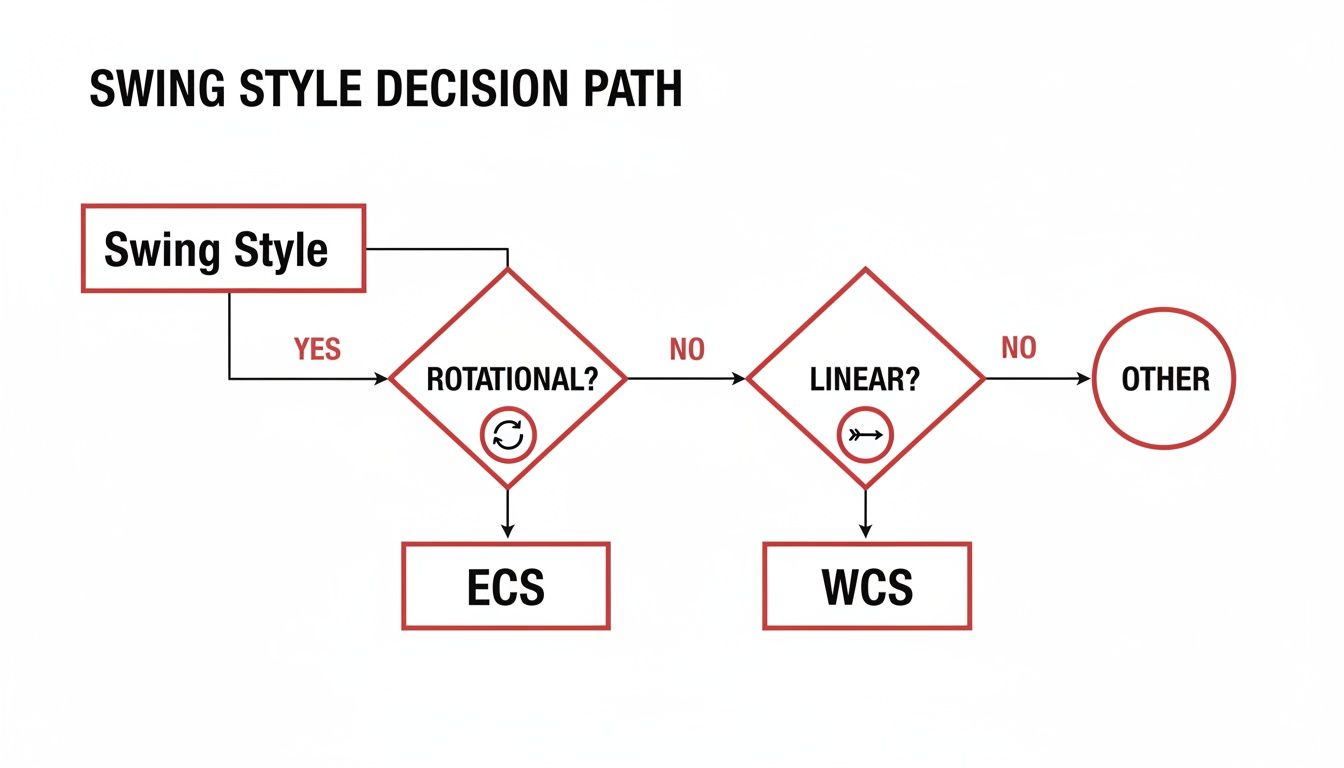
As you can see, if you love that spinning, high-energy vibe, East Coast Swing is your dance. If you'd rather glide down the floor with a smooth, expressive style, West Coast Swing is waiting for you.
Making the Right Choice for Your First Dance
Picture your wedding day. What’s the soundtrack? Is it a rockabilly band playing a retro hit, or a DJ spinning a slow, soulful R&B track for your first dance?
For a retro-themed, high-energy celebration with a classic song, East Coast Swing will light up the room. For a modern, romantic, and uniquely personal first dance, West Coast Swing offers unparalleled elegance and connection.
Ultimately, the best dance is the one you’re most excited to learn. Both offer amazing social opportunities and a great way to express yourself. The key is to follow the music you love and start your journey to becoming the dancer you want to be.
Of course, you can read about it all day, but nothing beats actually trying it. Feeling the rhythm and connecting with a partner is the only way to truly know.
Ready to find out which style clicks for you? We want to help you take that first step with confidence. Come on in for a free complimentary lesson—it’s the best way to feel the music, try the steps, and get some expert advice. Book your lesson today by visiting our contact page at danzaacademy.com/contact.
Start Your Swing Journey with Danza Academy
You've read about the difference between east coast and west coast swing, but reading only gets you so far. The real magic happens when you stop thinking and start moving. Both dances are fantastic, and our instructors are ready to show you the ropes.
Here at Danza Academy, we’ve been helping people find their rhythm for over 40 years. Our studios in Center City Philadelphia and Exton are all about creating a fun, supportive space where you can learn the right way and build real confidence.
Whether you're looking for the energy of a group class or want one-on-one coaching in a private lesson, we've got you covered. Our goal is simple: get you comfortable and having a great time on the dance floor.
Feel the Difference Firsthand
So, which will it be? The bouncy, circular energy of East Coast or the smooth, slot-based vibe of West Coast? The only way to know for sure is to try them. Let one of our pros guide you through the steps and feel how each connection works.
The most important step in your dance journey is the first one you take through our studio doors. It’s the moment you decide to invest in yourself, meet new people, and discover a new passion.
And that first step is easy. You don’t need a partner. You don’t need any experience. Just show up ready to have some fun.
Your Invitation to the Dance Floor
Stop wondering which swing style is for you and come find out. Your journey into the world of swing is just a click away, and we're so sure you'll love it that the first lesson is on us.
Here’s what you get with our special offer for new students:
- Experience Our Studio: Feel the welcoming atmosphere of our community.
- Meet Our Instructors: Get personalized guidance from seasoned professionals.
- Try the Steps: Discover which swing style makes you want to keep dancing.
We have a ton of programs for every age and skill level. To see everything we offer, check out our guide on adult dance classes in Philadelphia.
Don’t let another song pass you by. Book your free complimentary lesson at Danza Academy today by visiting our contact page at https://danzaacademy.com/contact. Let’s get you on the floor and dancing.
Your Top Swing Dance Questions, Answered
It's natural to have a few questions before you step onto the dance floor for the first time. In fact, we get them all the time from new dancers. We've gathered the most common ones right here to give you the confidence you need to get started.
Do I Need a Partner to Learn Swing Dancing?
This is probably the number one question we hear, and the answer is a resounding no! So many of our students walk in solo, and it’s actually one of the best ways to learn.
In our group classes, we constantly rotate partners. This isn't just about being social—it’s a powerful learning tool that sharpens your lead or follow skills faster than sticking with one person. If you'd rather go the private lesson route, you get the dedicated, one-on-one attention of a professional instructor.
Which Swing Dance Is Better for a Wedding First Dance?
This really boils down to your song and the kind of moment you want to create. There's no single "better" choice, only what's better for you.
East Coast Swing is a fantastic, crowd-pleasing option for those classic, high-energy songs from artists like Elvis Presley or Frank Sinatra. It's pure fun and joy.
On the other hand, if your song is more modern, slow, or lyrical—think Ed Sheeran or John Legend—West Coast Swing offers a beautifully intimate and impressive dance. It perfectly showcases the difference between east coast and west coast swing by adapting to a totally different musical feel.
How Long Does It Take to Get Good at Swing Dancing?
You’ll be dancing your first basic steps by the end of your very first lesson—we promise! East Coast Swing is often easier for beginners to grasp for immediate fun on the social dance floor.
West Coast Swing has a slightly steeper learning curve at the beginning, but that initial investment opens up an incredible world of musicality and creativity.
The real key to progress isn't just time; it's consistency. Dancers who come to class and practice regularly usually feel confident and ready to hit the social dance floor in just a few months.
Can I Learn Both East Coast and West Coast Swing at the Same Time?
While you certainly can, we generally suggest picking one to start with. Building a solid foundation in a single style helps you avoid getting the footwork and connection signals crossed.
Many dancers find it helpful to start with East Coast Swing to really nail the core rhythm and partner connection. Once that feels natural, adding West Coast Swing becomes a much smoother and more intuitive process to expand your dance vocabulary.
Ready to stop wondering and start dancing? The team at Danza Academy is here to guide you. The absolute best way to understand the difference is to feel it in your feet.
Don't wait! Click here to claim your complimentary first lesson on our contact page. Let our world-class instructors show you the way. You can book your spot by visiting us at: https://danzaacademy.com/contact