
You’ve picked a competition, your name is on the entry list, and the excitement lasts about five minutes. Then the important questions show up. Is your routine strong enough? Are you rehearsing enough? Are you rehearsing too much? Do you need more stamina, sharper technique, a better costume plan, or all of it at once?
That moment is normal. Every serious competitor hits it, from first-time students to experienced dancers moving into higher-level heats. The difference between a stressful buildup and a confident one usually comes down to structure. A good performance isn’t built from random extra practice. It’s built from a plan that tells you what to work on, when to push, when to clean, and when to stop adding and start refining.
At Danza, the dancers who improve fastest aren’t always the ones doing the most. They’re the ones doing the right work at the right time. They know what judges reward, they rehearse with purpose, and they treat logistics and mindset as part of training, not as afterthoughts.
Your Journey from Studio to Stage
You finish a run in the studio, and it feels solid. Then you picture the same routine under bright lights, one shot in front of judges, no stopping for corrections, and the gaps become obvious fast. A novice dancer starts to wonder whether the counts will hold. An intermediate couple worries about control once adrenaline kicks in. An advanced competitor knows the choreography cold and still has to prove it will read cleanly on stage.
That shift matters.
Studio dancing and competition dancing are not the same job. In the studio, you can pause, reset, and fix a missed lead, a late arm, or a dropped center. On stage, judges only see the version you can repeat under pressure. That is why strong preparation starts with an honest assessment of your current level, your timeline, and the studio support you should be using.
At Danza, I tell competitive students to stop asking, "How many times should I run it?" and start asking, "What is this rehearsal for?" Full run-throughs have value, but they are a poor tool for fixing specific problems. If your turns break down after the first minute, if your frame softens when you get tired, or if your expression disappears once the routine gets physically demanding, repeated top-to-bottom runs will reinforce those habits.
A better approach is level-specific preparation. A first-time competitor usually needs a longer runway for counts, spacing, and basic performance confidence. An experienced dancer often needs fewer total reps and more targeted work, such as mock judging, video review, and pressure rounds in costume shoes. That trade-off is real. More practice is not always better practice.
Use your studio resources early. Private lessons help isolate technical leaks before they become part of the routine. Supervised practice sessions help you clean timing and transitions without guessing. Mock judging panels are one of the fastest ways to expose what looks stronger in your head than it does from the audience. Dancers who wait until the final week to get outside feedback usually spend that week reacting instead of refining.
Injury prevention belongs in this stage too, especially once rehearsals get more repetitive and intensity starts climbing. Good competitors do not just train hard. They train in a way their body can sustain. Danza students who add recovery work, mobility, and load management early tend to stay more consistent through the final push. For a useful outside reference, this guide for sportspeople's injury prevention covers the kind of habits that keep training weeks productive.
The dancers who look settled on competition day usually built that calm weeks earlier. They knew what level they were preparing for, followed a timeline that matched it, and used coaching feedback before mistakes became automatic. That is the journey from studio to stage. Not more effort. Better-directed effort.
Building Your Competition Training Blueprint
Two dancers can walk into the same event with the same amount of talent and leave with very different results. The difference is usually the plan. One dancer has spent weeks building the right habits in the right order. The other has been rehearsing hard, but without a structure that matches their level, event format, or recovery capacity.
A useful blueprint starts with judging priorities, as noted earlier. Judges tend to reward two things first: clean technique and performance quality. Your training plan should reflect that. Early sessions should fix alignment, timing, balance, and clarity of movement. Later sessions should test whether those corrections still hold when the body is tired and the pressure is higher.
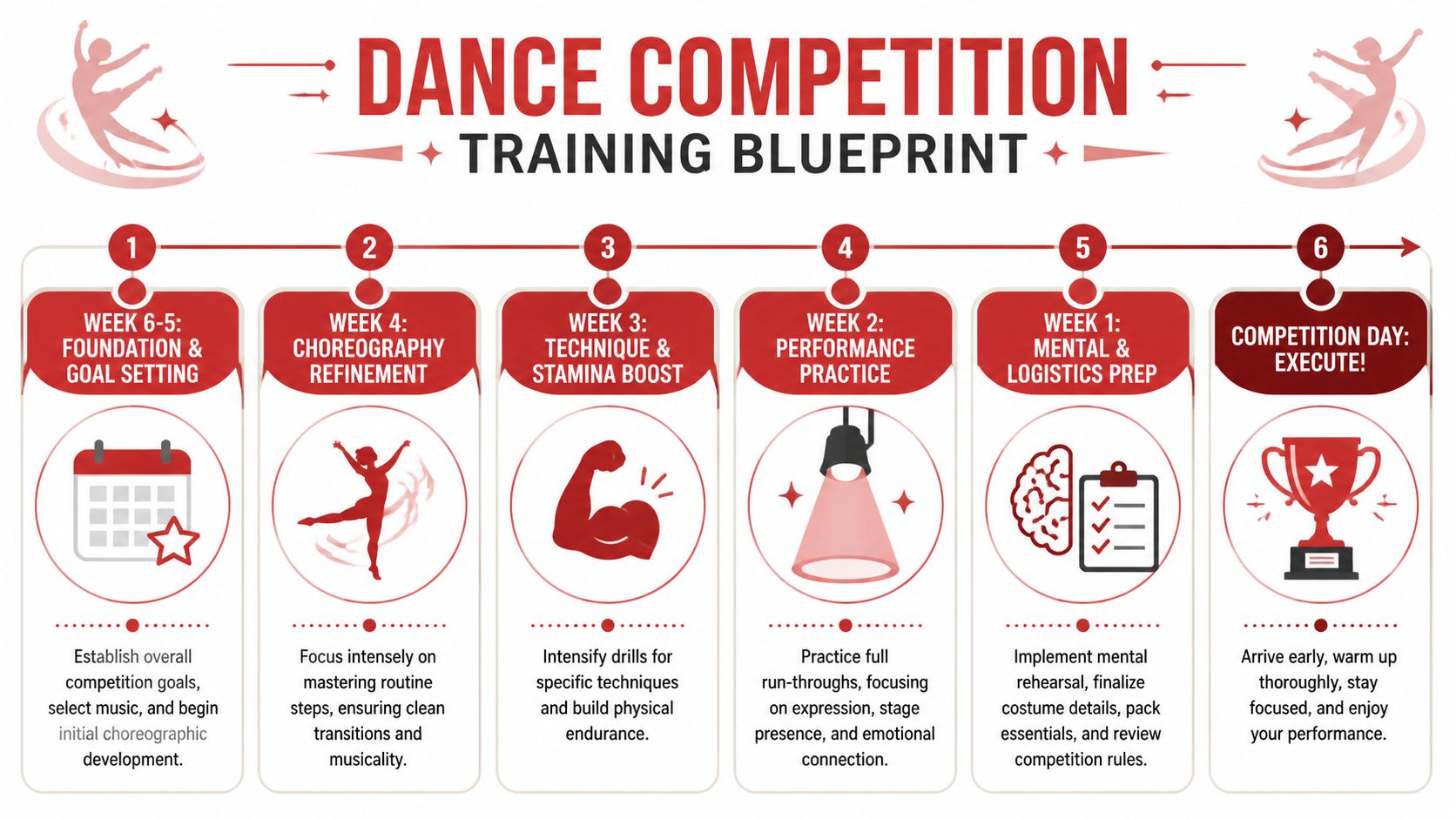
The three-phase approach
I coach competition prep in three phases because the job changes as the date gets closer. A flat routine of “practice more every week” usually wastes time.
| Phase | Main focus | What you should be doing |
|---|---|---|
| Foundation | Accuracy and routine ownership | Learn sections cleanly, set counts, confirm music, fix posture, and make transitions readable |
| Build and repeat | Consistency under load | Connect phrases, rehearse with intention, sharpen timing, and improve stamina without turning every session into a full-out grind |
| Performance week | Delivery and control | Run full rounds, rehearse in competition conditions, confirm warm-up plans, and tighten logistics |
The first phase is where dancers either save time or lose it. If the choreography is still fuzzy and the body positions are inconsistent, every later rehearsal gets more expensive. You are not polishing yet. You are still repairing.
Sample timelines by experience level
The right timeline depends on how much has to become automatic.
A novice competitor usually needs more runway because basic tasks still take attention. Counts, floor pattern, entrances, exits, and recovery after a mistake all need to be rehearsed until they stop feeling new. A simple plan is to spend the first stretch learning and cleaning, the middle stretch linking sections without stops, and the final stretch practicing calm execution.
Intermediate dancers can shorten the learning phase and spend more time on score separators. That includes transitions that stay clear at speed, stronger body lines, steadier musical timing, and better energy management from start to finish. Video review matters here because many timing errors are small enough to miss in the room.
Advanced dancers need a sharper blueprint, not always a longer one. At that level, the routine is often learned quickly. The critical work is in detail and repeatability. Partner connection, rhythm precision, foot articulation, floorcraft, and expression need to hold up every round. This is also where studio support becomes a real advantage. Technique-focused dance classes help isolate issues that group rehearsals often hide, especially if the weakness is showing up in posture, balance, or movement quality rather than memory.
Here is the trade-off I give Danza Academy students clearly. Novices usually benefit from more guided repetitions. Advanced dancers usually benefit from fewer total reps and more targeted pressure tests.
How to use studio resources in the plan
A training blueprint works better when each studio resource has a job.
Private lessons are best used early and mid-cycle. They catch technical leaks before they settle into the routine. One focused correction on turnout control, frame, spotting, or weight transfer can save weeks of messy repetition.
Supervised practice sessions are where dancers should clean spacing, counts, and transitions. These sessions work best with a narrow goal. Fix one section. Test it. Repeat it correctly.
Mock judging panels belong before the final week, not inside it. They show what reads from the audience side, what drifts under pressure, and which parts of the routine still look unfinished. For serious competitors, I like at least one mock panel in the build phase and one closer to the event after key corrections have been made.
What a strong training week includes
A good week has range. It should not feel random, and it should not feel punishing for the sake of feeling serious.
Technique work
Use this time to improve posture, alignment, foot pressure, balance, frame, and directional changes.Choreography sessions
Rehearse with a purpose. Isolate a problem, correct it, then test whether the correction stays in place when the phrase speeds up.Conditioning and recovery
Competition prep gets repetitive fast. Dancers who schedule mobility, recovery, and load management early miss fewer sessions later. If you want a broader physical care reference outside the studio, this guide for sportspeople's injury prevention is a practical companion.Pressure rehearsal
Practice entrances, restarts, floor spacing, and how to finish clean after a mistake. Confidence usually comes from familiarity, not from hoping the nerves stay away.
Group routines need one more layer. If one dancer is late, the whole picture changes. Synchronization, spacing, and shared attack should be trained as score-bearing skills, not treated as finishing touches.
The best blueprint is one you can repeat week after week without breaking your body or dulling your focus. That is what turns practice into competitive readiness.
Polishing Your Choreography and Technique
Once the schedule is in place, the essential work is polishing what the audience sees. At this stage, routines stop looking rehearsed and start looking competitive. Most dancers don’t lose points because they forgot everything. They lose points because transitions blur, timing softens, lines change from one pass to the next, or the routine never fully settles into muscle memory.
Break the routine before you build it
One of the most useful rehearsal models is simple. Break the dance into 8 to 16 bar phrases, clean those sections with video review, then move into full costume run-throughs in the final month. According to Move Dancewear’s competition preparation guidance, that structure can reduce memory lapses by up to 80% compared with cramming.
That matters because full runs can hide problems. A dancer can survive a messy transition in a full pass and barely notice it. Isolated phrase work doesn’t let you hide. It shows exactly where the body gets late, unstable, or disconnected from the music.
Try this rehearsal loop:
- Run one phrase slowly: Fix foot placement, alignment, and timing.
- Run it at performance speed: Keep the correction under real tempo.
- Watch the video immediately: Don’t trust how it felt. Watch what it did.
- Repeat only after naming the fix: “Stronger standing leg,” “cleaner head turn,” “closer partner connection,” or “finish count eight.”
What to clean first
Not every flaw deserves equal time. Start with the corrections that change how the whole routine reads.
Timing and transitions come first. If the movement lands late, everything after it looks uncertain.
Body organization comes next. In ballroom that may mean frame and shape. In Latin or social styles it may mean grounded timing, ribcage control, hip action, and clean weight transfer.
Then clean the details that separate average from polished:
- Feet and legs: Pointed feet where appropriate, straight supporting leg when intended, articulate use of the floor
- Upper body clarity: No drifting elbows, collapsed chest, or disconnected arms
- Facial focus: Expression has to match the routine, not disappear when concentration spikes
- Partner matching: Timing, rise and fall, attack, and finish need to look shared
Rehearsal should answer a clear question. “Can I do the dance?” is too broad. “Can I hit this turn and arrive balanced enough to sell the next phrase?” is useful.
Use studio resources strategically
Private lessons help most when they’re used to solve specific problems. Don’t walk into one saying you just want to “work on everything.” Bring a short list. A shaky promenade transition. A Cha-Cha lock that loses timing. A Quickstep section where your heel lead changes under pressure. That gives the coach something precise to fix.
Group rehearsal helps with spacing, shared timing, and recovery. Mock judging helps dancers learn what reads from the outside, which is often different from what feels dramatic on the inside. For dancers who need more focused technical work between rehearsals, these technique dance classes can support the correction side of training rather than just the performance side.
Don’t ignore costume, props, or music edits
Competition polish isn’t just movement quality. If a skirt changes your turn speed, if a tail suit alters your timing, or if a prop enters the routine awkwardly, that has to be rehearsed before the event. The same goes for music. A clean edit can sharpen an entire routine. A sloppy cut can make even strong choreography feel awkward.
The rule is simple. If it will be on the floor with you, rehearse with it before competition day. That includes accessories, shoes, hair, and any entrance or exit pattern tied to the music.
Mastering Your Mental Game and Performance
Two dancers can arrive with similar technique and get very different results because one of them performs under pressure. Competition rewards skill, but it also rewards access to skill when adrenaline rises. That access is trainable.

Mental preparation isn’t a soft extra. For competitive dancers, it can boost placement rates by up to 40%, and daily visualization of 10 to 15 minutes is used to improve movement recall. A pre-competition ritual that includes the 4-7-8 breathing method can also help channel nerves into focused energy, as outlined in this performance preparation article.
Build a repeatable pre-performance system
Confidence is more reliable when it comes from routine, not mood. The goal isn’t to feel zero nerves. The goal is to know exactly what you do when nerves show up.
A useful ritual often includes:
- A set arrival pattern: Same check-in flow, same shoe prep, same warm-up order
- Breathing before performance: Use the 4-7-8 method instead of burning energy by pacing or over-talking
- A short cue phrase: Something direct like “lift and breathe,” “trust timing,” or “finish every line”
- One focus for the round: Not ten. One. Maybe posture. Maybe attack. Maybe connection
Dancers who don’t have a ritual usually improvise emotionally. Some rush. Some freeze. Some start comparing themselves to everyone in the room. None of that helps.
Visualization only works if it’s specific
General positive thinking won’t carry a performance. Visualization works best when it is concrete. See the floor. Hear the music. Feel the first weight change. Rehearse the exact entrance, the first phrase, the spot where you usually tense up, and the recovery if a mistake happens.
That last part matters. Strong competitors don’t visualize a perfect day only. They also visualize a resilient day. A slight slip, a missed hand connection, a momentary blank. Then they see themselves continuing without visible panic.
The audience often notices your reaction before it notices the mistake.
Mock judging panels are useful here because they bring pressure into the room before the actual competition does. A studio can simulate waiting, floor entry, being watched, and receiving notes on projection rather than just mechanics. That’s where many dancers learn that “performing bigger” doesn’t mean forcing expression. It means committing clearly enough that the last judge in the room can read it.
If stage nerves are getting in the way of your training, this piece on how to overcome fear of dancing in public gives a useful framework for turning visibility into something manageable.
Here’s a quick mental reset tool to practice between rounds or before going on:
What winning performance quality actually looks like
Performance quality is often misunderstood. It isn’t random smiling. It isn’t “more energy” in a vague sense. Judges usually read performance through commitment, timing intention, emotional clarity, and how fully you occupy the space.
A few signs your performance quality is landing:
- Your movement finishes, rather than fading out.
- Your face matches the dance instead of showing concentration only.
- Your stage entry already looks decided.
- You keep dancing through small errors instead of announcing them with your body.
The value of serious preparation becomes clear. When choreography is secure and technique has been drilled properly, the mind can shift from self-monitoring to communication. That’s the moment a routine starts to look competitive instead of merely correct.
Finalizing Logistics and Your Competition Day Plan
The final day isn’t the time to solve avoidable problems. It’s the time to protect the work you’ve already done. Strong dancers still lose sharpness when the shoe bag is incomplete, the costume hasn’t been tested, or the morning becomes rushed before they even reach the venue.
Judge feedback from multi-heat social and ballroom events suggests that up to 60% of lower scores can come from unrehearsed costume adjustments or mishaps, and weekly costume rehearsal helps prevent visual disruptions, according to this discussion of competition presentation issues. That’s why logistics belong in training, not just on a packing list.
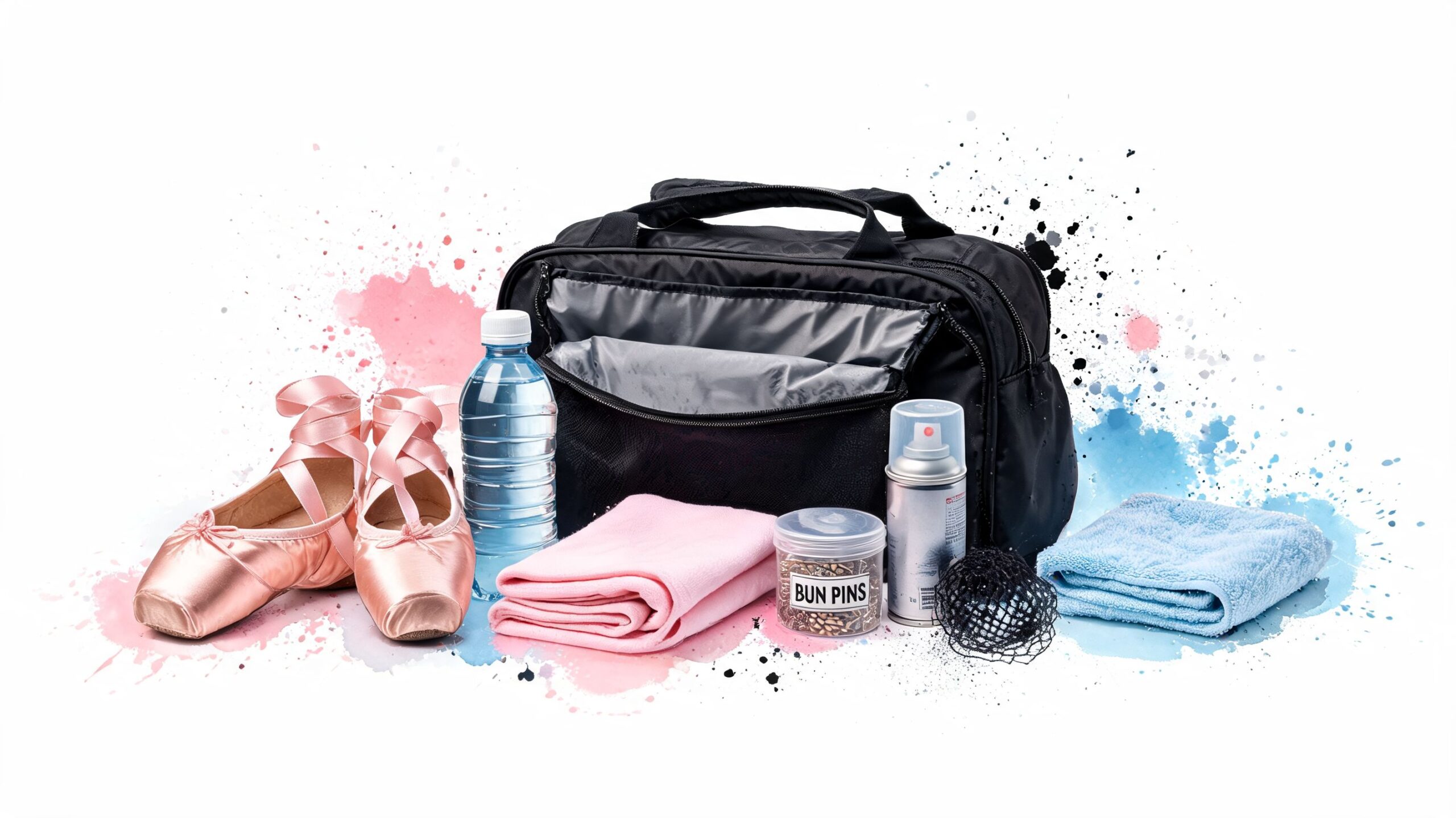
Your competition bag checklist
Pack for performance, repair, and waiting time. Those are three different categories.
- Performance items: Costume, shoes, backup shoes if possible, music copy if required by the event, accessories, makeup, hair tools
- Repair items: Safety pins, fashion tape, extra laces, heel protectors, small sewing kit, towel
- Body support items: Water, easy-to-digest snacks, any personal recovery tools you normally use, warm layers
- Admin essentials: Schedule, entry confirmation, ID if needed, payment details for venue extras if applicable
If you compete in partnered styles, check each other’s items. One missing cuff link, hairpiece, or shoe accessory can create stress for both dancers.
The day-before routine
The best day-before plan is calm and boring. That’s a good thing.
Use a short checklist:
- Do a light run-through. Confirm spacing and musical confidence without draining yourself.
- Lay out every costume piece. Don’t assume it’s all in one bag.
- Check travel timing. Know where you’re parking, when doors open, and when you need to be warm.
- Prepare food and water. Waiting hungry is one of the easiest ways to lose focus.
- Go to bed with decisions made. Morning should be execution, not problem-solving.
The on-site timeline
Arrive early enough to settle physically and mentally. Rushed arrivals create sloppy warm-ups, and sloppy warm-ups show up in the first round.
A solid on-site flow looks like this:
- Check in first
- Walk the space if allowed
- Start your warm-up gradually
- Put on costume after your body is ready
- Run small key sections, not the whole dance over and over
- Focus before you go on instead of watching every other competitor nervously
Coach’s note: A good warm-up should make you feel awake, mobile, and ready. It shouldn’t leave you tired before the music starts.
If your prep has included dress rehearsals, this part feels familiar. If it hasn’t, competition morning can feel much harder than the routine itself. That’s one reason dancers benefit from a specific dance injury prevention approach during training. Good preparation reduces the chance that panic, fatigue, or a rushed body position turns into a preventable physical problem.
Take Your First Step Toward the Podium
Winning performances usually don’t come from one magical rehearsal. They come from a system. You build technique early, repeat it until it stays clean under pressure, sharpen performance on purpose, and remove as many preventable problems as possible before competition day arrives.
That’s the core of how to prepare for a dance competition. Train in phases. Rehearse smarter than you rehearse hard. Use video. Use feedback. Practice in costume. Build a mental routine that holds up when the room gets loud and the stakes feel real.
Most dancers don’t need more random effort. They need a clearer plan and honest coaching. That’s especially true if you’re trying to figure out where your current weak point is. Sometimes it’s timing. Sometimes it’s stamina. Sometimes it’s presentation. Sometimes the routine is fine, but your preparation is too scattered to let it show.
If you want to compete well, start by getting a real assessment. A coach should be able to look at your dancing, identify what will matter most on the floor, and help you organize your training around that. That’s how good dancers become reliable competitors.
Book a free complimentary lesson with Danza Academy of Social Dance if you want help turning this blueprint into a real competition plan. It’s a practical first step. You’ll get a clearer sense of your level, what needs the most work right now, and how to structure your training so your next performance looks prepared, polished, and ready for the floor.