
You’re probably here because one of two things is happening.
Either you’re excited for your wedding reception and worried the dancing part could feel awkward, or you’re already hearing the song in your head and thinking, “We have no idea what to do once everyone is staring at us.”
That’s normal. Most couples don’t need to become dancers. They need a simple plan for how to dance at a wedding reception without freezing during the first dance, wandering off the floor after one song, or spending the whole night wishing the dancing part were over.
The good news is that wedding dancing is much more manageable than people think. You don’t need a complicated routine. You need a first dance that feels like you, a few reliable social moves for the rest of the night, and enough comfort with your body, your partner, and the room to enjoy yourself.
Why Your Wedding Dance Matters More Than You Think
A lot of couples treat dance prep like a small item on a wedding checklist. Then the week of the wedding arrives, and suddenly it becomes the thing they’re most nervous about.
That reaction makes sense. The first dance tradition began in 17th-century Europe, but today it’s less of a formal opener and more of a personal spotlight on the couple. That spotlight matters because 81% of wedding guests say entertainment is what they remember most about a wedding, according to this overview of first dance etiquette and history.
What guests remember isn’t technical perfection. They remember what the room felt like. They remember whether the couple looked connected, relaxed, and happy to be there.
Dancing sets the emotional temperature of the reception. If you look comfortable, your guests relax with you.
That’s why I tell couples to stop thinking about dancing as a performance test. Think of it as a memory-making tool. Your first dance starts the room. Your body language gives people permission to celebrate. Your willingness to get back on the floor later often matters more than the exact steps you use.
If you’re still shaping the overall guest experience, it helps to look beyond music alone and think about the full atmosphere. This round-up of unforgettable wedding entertainment ideas is useful for couples who want the reception to feel lively without relying on one single moment.
What couples usually get wrong
The biggest mistake isn’t having zero dance skill. It’s assuming the dance floor will somehow take care of itself.
Couples often spend months on decor, timing, and seating charts, then leave dancing until the last minute. That creates pressure. A little preparation changes everything because confidence on a wedding day rarely appears by accident. It comes from familiarity.
Planning Your Unforgettable First Dance
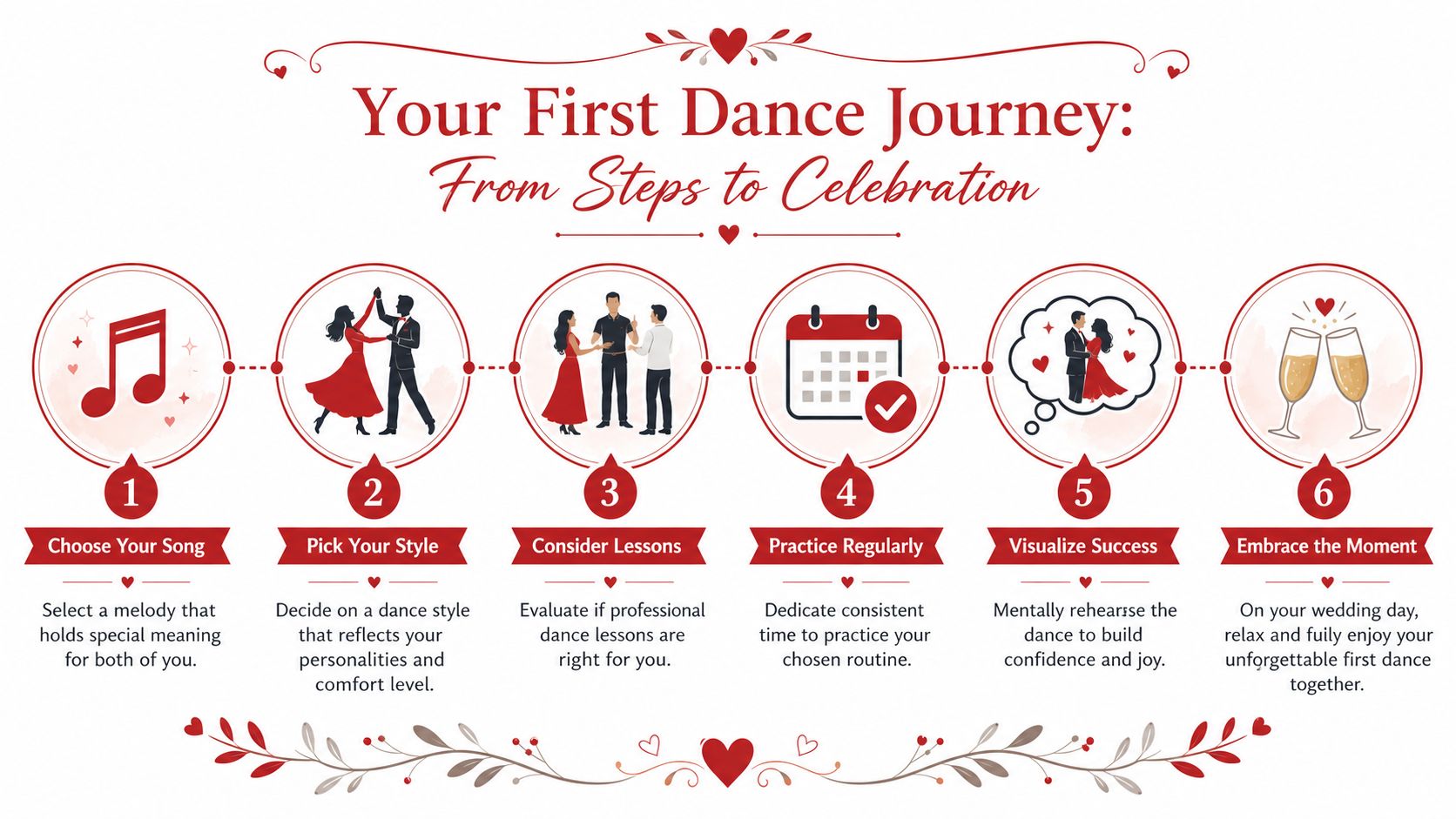
Your first dance doesn’t need to be flashy. It needs a clear shape, a tempo you can handle, and enough repetition that your body knows what to do when nerves show up.
Start with the song, not the moves
Song choice drives everything. It determines pace, emotional tone, and how much room you have to breathe.
A slow song can feel romantic, but it also exposes every hesitation. A medium-tempo song often gives beginners a little more flow. Before you commit, try this:
- Stand together and sway through the full track. If the song feels long, it probably is.
- Listen for obvious musical sections. You want a beginning, a middle, and an ending you can recognize.
- Notice whether the beat feels clear. If you can’t find the pulse easily, choreography gets harder fast.
A good first dance song supports you. It shouldn’t fight you.
Choose a style that fits your real comfort level
Most couples do better with simple elegance than with ambitious tricks. Clean walking, a turn, a dip that feels safe, or a few directional changes often look better than choreography that’s too dense.
A useful way to decide is to pick one lane:
- Soft and classic. Think smooth movement, gentle turns, and a calm frame.
- Playful and social. Think natural movement, less formality, and more personality.
- Lightly choreographed. Think memorable moments placed into a simple structure, not a routine packed with nonstop content.
If you want professional guidance while sorting out style and music, wedding dance teachers at Danza Academy work with couples on both basics and customized choreography.
Practical rule: Your choreography should look slightly easier than what you can do in practice. Wedding-day nerves make everything feel one level harder.
Use a short, realistic lesson plan
Professional instructors consistently find that 4 to 6 private lessons are the sweet spot for first dance success, and couples who complete four or more lessons show a 75 to 85% reduction in stage-fright behaviors such as rushing or missed steps, based on this wedding dance instruction guide.
That works because the timeline is structured, not random.
A simple progression that works
- Lesson 1: Pick the song, define the feel, and set expectations.
- Lessons 2 and 3: Build posture, frame, timing, and easy lead-follow patterns.
- Lessons 4 through 6: Shape the actual dance. Add entrances, turns, transitions, and a clean finish.
At home, keep practice short. Frequent, calm repetitions beat one long session where both of you end up frustrated.
Build a dance with a beginning, middle, and end
Many couples finally relax at this stage. Choreography sounds intimidating until you realize it’s just structure.
Your first dance can be as simple as:
- Beginning: Walk on, settle, connect, start moving.
- Middle: Repeat your core pattern with one or two featured moments.
- End: Finish in a position that feels intentional and photogenic.
That’s enough. You don’t need to fill every beat.
Rehearse under wedding-like conditions
Practice in the shoes you’ll wear, or something close to them. If there’s a long dress, jacket, or fitted suit involved, rehearse with clothing that changes how you move. The floor, lighting, and adrenaline all affect timing.
Couples who feel the calmest on the wedding day usually haven’t practiced harder. They’ve practiced more realistically.
Mastering Simple Moves for the Entire Reception
The first dance is one moment. The rest of the reception is where you either stay relaxed and social, or retreat to your table because you only prepared for one song.
That’s why couples should learn a small toolkit, not one isolated routine. DJs typically build energy gradually, often starting with songs in the 100 to 116 BPM range before moving into higher-energy music, and having a few simple moves for both slow and medium tempos helps you stay on the floor as the music changes, as noted in this guide to the order of dances at a wedding reception.
Quick Guide to Social Wedding Dances
| Dance Style | Vibe & Feel | Best for Music Like | Basic Move |
|---|---|---|---|
| Waltz box | Romantic, floating, formal | Ballads with a smooth rise and fall | Forward-side-close, back-side-close |
| Two-Step | Relaxed, steady, easy to lead | Country, mid-tempo pop, easy social tracks | Quick-quick-slow-slow traveling pattern |
| Sway and side step | Simple, intimate, beginner-friendly | Slow songs, acoustic tracks, sentimental favorites | Weight shift side to side with gentle rotation |
| Salsa basic or party basic | Lively, playful, social | Latin-pop, upbeat crossover songs, party music | Small forward-back or in-place rhythm pattern |
What works best for beginners
Most wedding couples do well with three categories of movement.
First, have one slow dance option for romantic songs. This can be a box step or a steady sway with turns.
Second, have one traveling pattern for medium-tempo music. Two-Step is useful because it gets you moving around the floor instead of staying stuck in place.
Third, have one upbeat basic for party songs. This doesn’t need to be technical. A small salsa basic, side-to-side groove, or step-touch pattern gives you something consistent when the energy rises.
If you can dance comfortably to a slow song, a medium song, and one upbeat song, you can handle most of the reception.
Match the move to the music
The biggest social dancing mistake is forcing the same movement onto every song. A slow sway on a lively track feels flat. Fast, choppy steps on a romantic song feel disconnected.
Use this quick decision filter:
- If the song feels smooth, choose longer steps and softer turns.
- If the beat is clear and moderate, use a traveling social step.
- If the song is punchy and upbeat, shorten your steps and keep your rhythm compact.
If you’re still building your playlist, this guide to essential wedding reception music can help you think through which songs call for slower partner movement and which ones invite more open, playful dancing.
Keep your move vocabulary small
You do not need ten dances. You need a few reliable patterns you can repeat without thinking.
A reception is not the place to test material you barely know. The couples who look most natural usually repeat a handful of familiar actions. They turn. They walk. They reset. They laugh. It looks effortless because the menu is small.
Look the Part and Own the Dance Floor
A lot of dancing problems start before the music does. Shoes slip. hems catch. jackets pull across the shoulders. Then people assume they’re bad dancers when the actual issue is that their outfit won’t let them move naturally.
Modern receptions also move differently than they used to. Average wedding dance sets have shrunk from 45 to 60 minutes down to 20 to 30 minutes, the first dance has shortened too, and only about 30% of guests are on the dance floor at any one time, according to this look at wedding dance trends over the decades. That means you don’t need marathon endurance. You need comfort, mobility, and good floor awareness.
Dress for movement, not just photos
Good wedding dance style starts with function.
- Choose stable shoes. If you can’t walk comfortably in them, dancing won’t improve the situation.
- Break them in early. New shoes often create cautious movement, and cautious movement kills rhythm.
- Test your outfit in motion. Try turning, stepping backward, and lifting your arms.
- Plan for fabric management. Long skirts, trains, and wide jackets all change spatial awareness.
For grooms who want formalwear that looks sharp but still moves well, this groom's guide to tailored suits is a helpful reference.
Share the floor well
Crowded wedding floors reward small, controlled movement. Huge steps and showy patterns don’t just look out of place. They create collisions.
Use a simple etiquette rule set:
- Keep your steps compact when the floor fills up.
- Rotate or travel only when you can see the space around you.
- Stay aware of older guests, children, and people stepping on and off the floor.
- If a dance invitation doesn’t feel right, decline warmly and politely.
A wedding dance floor works best when everyone leaves room for everyone else.
Know when less looks better
Because dancing now tends to be woven throughout the evening instead of happening in one long block, you’ll likely return to the floor multiple times. Save your energy. Sit down when you want to. Then come back strong for the songs that matter to you.
That rhythm feels much better than treating every dance set like a test of stamina.
From Jitters to Joy How to Handle Nerves
Those who search for how to dance at a wedding reception are not asking about footwork. They’re asking how to stop feeling exposed.

Nerves show up in predictable ways. People rush. They stop breathing. Their shoulders lift. They stare at the floor or at the crowd instead of at each other. None of that means you can’t dance. It just means your body is doing what nervous bodies do.
For a deeper look at the mental side of performance, this article on how to overcome fear of dancing in public is worth reading before your wedding week.
Use recovery, not perfection, as your goal
Confident couples are not the couples who never make mistakes. They’re the couples who recover so smoothly that nobody notices.
That’s why every beginner should have one fallback move ready. If you lose your place, return to something simple and musical.
Good recovery options include:
- A basic sway: Reset your timing and reconnect physically.
- A box step or side step: Buy a few beats without looking stuck.
- A gentle turn-out and return: It reads as intentional and gives you a fresh restart.
When you forget the choreography, don’t freeze. Return to your home base move and keep the music going through your body.
Three go-to moves for absolute beginners
These are the moves I’d trust for almost anyone.
The side-to-side weight shift
Shift weight from one foot to the other. Keep your knees soft. Let the upper body breathe instead of locking up. This works for slow songs, casual songs, and moments when you need to calm yourself down.
The slow box
A box step gives structure to a romantic song and helps both partners feel where the next action is coming from. It’s useful because it looks more polished than random swaying, but it’s still manageable.
The in-place party basic
For upbeat music, step small and stay grounded. You don’t need to travel all over the floor. A compact rhythm pattern with relaxed shoulders looks social and natural.
This short visual can help if you want to watch movement instead of just reading about it.
Make the dance floor inclusive
Not every guest will want or be able to dance the same way. A significant portion of wedding guests, especially older relatives, may have mobility limitations, and simple options such as seated upper-body dancing or small weight-shift steps help more people join in, as discussed in this article on dancing at weddings with practical adaptations.
That matters. Celebration should not belong only to people with full mobility.
If you’re dancing with a guest who has physical limitations, keep the invitation easy and pressure-free. A seated groove, hand connection, shoulder movement, or small side step can be joyful, musical, and completely appropriate. The point is participation, not range of motion.
Start Your Wedding Dance Journey Today
The couples who enjoy their reception most are rarely the ones who memorize the most material. They’re the ones who prepare just enough that the dance floor stops feeling threatening.
That means a first dance with a clear plan. A few social moves that fit different songs. Shoes and clothing you can move in. One or two recovery patterns for nerves. And the mindset that connection matters more than perfection.
If that sounds manageable, it is.
Private instruction can speed up the process because it removes guesswork. Instead of wondering whether a song is too fast, whether your choreography is too ambitious, or whether your movement suits the room, you get direct feedback and a plan that fits your timeline. For couples and adults who want that kind of support, private dance lessons for adults offer a straightforward way to build confidence before the wedding.
You do not need to become performers. You just need to feel at ease in your own celebration.
Book a free complimentary lesson with Danza Academy of Social Dance if you want expert help turning wedding dance nerves into a simple, realistic plan. It’s a low-pressure first step where you can talk through your song, your comfort level, your timeline, and what you want the reception to feel like. A good lesson gives you more than steps. It gives you clarity, confidence, and a clear path toward enjoying the dance floor all night long.