
Salsa is a vibrant Latin partner dance originating from Cuba, and it's built on six weight changes over eight beats of music. It's also a social dance more than a single fixed syllabus, which is why two salsa classes can look completely different and still both be salsa.
A lot of beginners ask what type of dance salsa is after watching one video where the couple moves in a straight line, then another where the dancers seem to orbit each other in circles. That confusion is normal. You're not seeing one dance done “right” and another done “wrong.” You're seeing different branches of the same dance family.
If you've ever stood at the edge of a Latin night wondering whether salsa is ballroom, club dance, Latin street dance, or something else entirely, the short answer is yes, in pieces. Salsa lives in social clubs, studios, performances, weddings, and community events. It has technique, timing, partner connection, musical structure, and a lot of personality.
What makes salsa so exciting is also what makes it confusing at first. The name covers related styles that share rhythm and partner dancing, but differ in timing, floor pattern, and feel. Once you understand that, the dance floor starts making a lot more sense.
What Is Salsa Dancing
You hear percussion, someone counts under their breath, and a couple glides past you with easy smiles while another pair spins with sharp precision. That's usually the moment people realize salsa isn't just “fast Latin dancing.” It's a partner dance with structure, rhythm, and social conversation built into it.
Salsa dancing involves a partner and follows a repeating musical phrase. The most basic structure is a six step pattern spread across eight counts, often described as step, step, step, pause, step, step, step, pause. That pattern gives beginners something reliable to hold onto even when the music feels busy.
More than steps
Salsa is often the first dance people try when they want something social rather than formal. You don't need a stage mindset to enjoy it. You need a beat, a few fundamental steps, and a willingness to connect with another person.
For that reason, salsa feels different from many dances people first imagine. It's not only about memorizing patterns. It's about:
- Listening to rhythm so your body moves with the music rather than fighting it
- Sharing movement with a partner through lead and follow
- Staying relaxed enough to enjoy the interaction, not just survive the counts
Practical rule: If you can keep the basic rhythm and stay connected to your partner, you're already doing something real in salsa.
Why beginners get mixed messages
A newcomer might learn one salsa basic in class, then open social media and see a completely different version. That happens because salsa is an umbrella term. Some dancers travel in a straight slot. Others move in a circle. Some break on one beat, others on another.
That doesn't make salsa vague. It makes it culturally rich.
So when someone asks, “What type of dance is Salsa?” I usually answer this way: it's a social Latin partner dance family with shared rhythm and multiple recognized styles. Once you stop expecting one universal template, salsa becomes much easier and much more fun to learn.
The Cultural and Musical Roots of Salsa
You hear a salsa song at a party before you ever take a class. Someone starts moving with easy confidence. Another couple joins in, but they do not look exactly the same. One pair travels around each other in a relaxed circle. Another looks more direct and structured. That moment confuses a lot of beginners, and it also reveals something important. Salsa grew from living music and social communities, so it carries more than one way of moving.
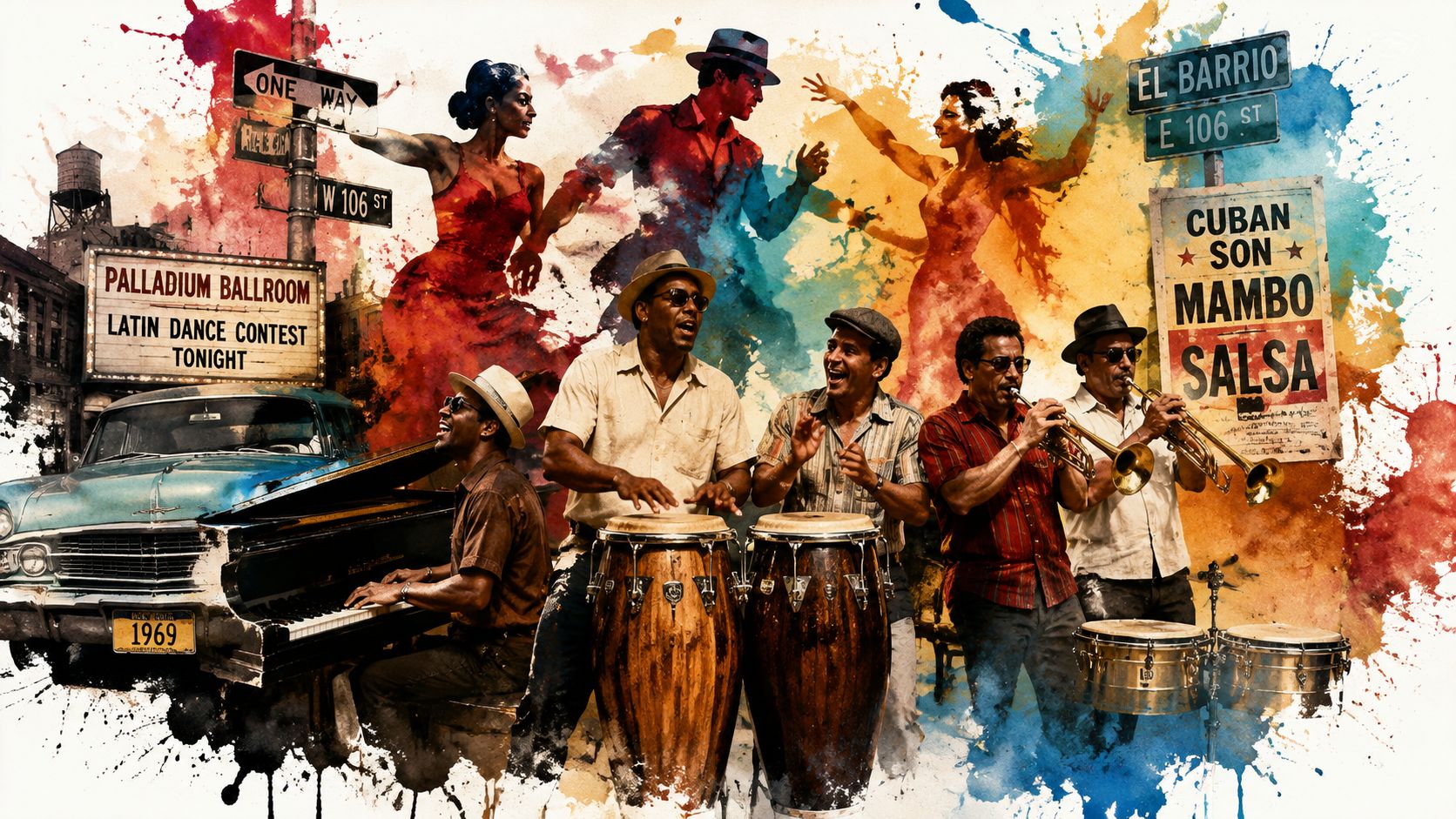
Salsa began as a cultural mix, not a single fixed formula. Its roots reach into Cuban music and partner dance traditions, then expand through Latin communities in places such as New York, where musicians, dancers, and social clubs helped shape the salsa identity many people recognize today. That history helps explain why salsa feels broad. The umbrella is one name, but under it you find related styles with different movement habits, different timing preferences, and a different feeling in the body.
Music comes first.
A beginner often tries to learn salsa by watching feet, but the music explains more than the shoes do. Salsa songs are built on layered rhythm. Instead of one heavy beat telling you exactly what to do, the instruments talk to each other. Your job as a dancer is to join that conversation.
A few sounds are especially helpful to notice:
- Congas create a grounded pulse that makes the dance feel earthy and alive
- Timbales bring bright accents that often spark sharper, more playful movement
- Claves organize the rhythm underneath the song, almost like a guide rail for the music
If that sounds technical, keep it simple. Salsa music works like a group conversation at a lively table. One voice sets the pulse, another adds excitement, and another keeps the whole exchange organized. When new dancers start hearing those roles, salsa stops feeling random.
The cultural side matters just as much. Cuban social dance traditions gave salsa much of its circular partner awareness, body movement, and playful relationship to the music. In New York, salsa developed a strong club and performance identity, which helped shape a cleaner linear look in many spaces. That is one reason beginners get mixed messages. They are often seeing different branches of the same family tree.
If you are curious about the circular partner feel that comes from Cuban tradition, a Cuban dance class at Danza can help you experience how the music, the partner connection, and the rounder floor pattern fit together.
This history also makes beginner confusion completely normal. A newcomer may ask, “Which salsa is the original one?” The better question is, “Which salsa style am I looking at, and where did it come from?” Once you ask that, the dance starts making sense. You are no longer comparing one correct version with a wrong one. You are learning how related styles grew from different social settings and musical habits.
That is why salsa feels so joyful on a social floor. It carries history, community, and shared rhythm all at once. Learn the roots, and the movement stops feeling like a puzzle. It starts feeling like an invitation.
Exploring the Main Salsa Styles
You walk into a salsa night for the first time. One couple glides back and forth as if they are sharing a narrow hallway. Another couple turns around each other as if they are tracing a small circle. Both are dancing salsa, and that is exactly where many beginners get confused.
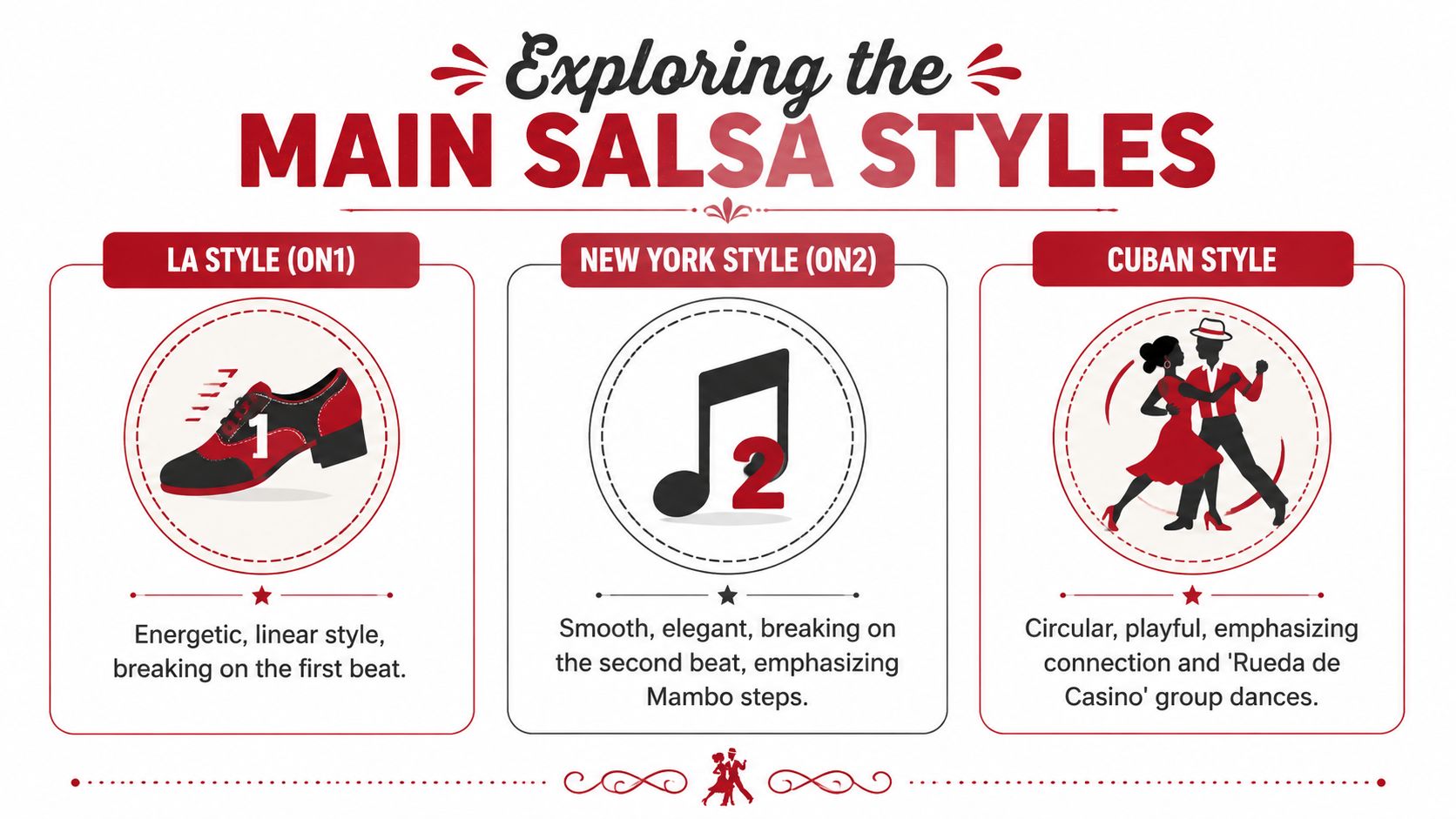
Salsa is an umbrella term. The music family connects the styles, but the movement rules are not identical. A beginner often expects one universal version, then feels lost when one teacher shows a straight-line pattern and another teaches a rounded, rotating partner dance.
The easiest way to sort it out is by floor pattern. Some salsa styles are linear, which means the partners mostly move along a slot. Others are circular, which means the partners travel around each other more often. The rhythm can feel related while the geometry feels completely different.
LA Style and New York Style
LA Style and New York Style are the two forms beginners usually meet first in many studios. Both are generally taught as linear salsa. The couple shares a lane, often using the cross-body lead as a central pattern, so the dance looks clean and directional.
To a new student, the difference between LA and New York is often easier to feel than to explain. LA Style is commonly described as sharper and more driving. New York Style often looks smoother and more layered with the music. They are close relatives, not opposites.
Here is a simple beginner snapshot:
| Style | Floor pattern | Usual first impression |
|---|---|---|
| LA Style | Linear | Sharp, energetic, showy |
| New York Style | Linear | Smooth, elegant, musical |
| Cuban Style | Circular | Playful, conversational, rotational |
That table is only a starting point. Real dancers bring their own personality, and social floors do not always look as neat as studio labels suggest.
Cuban Style or Casino
Cuban salsa, often called Casino, organizes the partnership in a different way. Instead of sending the follower up and down a clear slot, both dancers often rotate around a shared center. The result feels more like a conversation in motion than traffic moving in a single lane.
This is why a dancer trained only in linear salsa can feel disoriented at a Cuban social. The beat still feels familiar, but the body keeps asking a different question: "Am I clearing a path, or am I turning with my partner?" Once that clicks, the style starts to feel much more natural.
Beginners usually relax when they hear this. Confusion does not mean they are struggling. It usually means they are seeing two valid salsa languages spoken with different accents.
Why all of them are called salsa
The name salsa covers several related styles rather than one fixed syllabus. Salsa Vida's guide to salsa dance describes multiple recognized styles, including LA On1, NY On2, Cuban Casino, Rueda, Caleña, and Choke. That wider view helps explain why classes, clubs, festivals, and videos can all look different while still belonging to the same dance family.
This matters for beginners because it removes the idea that one teacher is right and another is wrong. Very often, they are teaching different branches of salsa. A good dance academy helps students tell those branches apart early, so they do not spend months wondering why social dancing feels different from class.
There is also a gap between studio structure and social-floor reality. A discussion of street-style salsa in this video on social salsa and street style points out that many social dancers use a more feeling-based approach that does not always match formal classroom patterns. That is why a student might say, "I learned salsa, but the club looked different." In many cases, they learned one style in a structured setting and then saw another style, or a looser social version, in the wild.
A simple way to choose a starting point
Start with the room you want to dance in most often.
- Choose linear salsa if you enjoy clear lines, cross-body patterns, and the look common in many studio classes and performance spaces.
- Choose Cuban salsa if you like circular movement, a more roaming social feel, and partner interaction that feels playful and shared.
- Stay flexible if you are brand new. Your first style is your entry point, not your final identity.
The goal is not to find the one "real" salsa. The goal is to find a style that helps you hear the music, connect with a partner, and enjoy the social floor with confidence.
Understanding Salsa Timing and Rhythm
The music usually scares beginners more than the steps. They hear a fast song and think they need to move constantly. They don't. Salsa has a repeating structure, and once you feel that structure, the dance becomes much easier to follow.
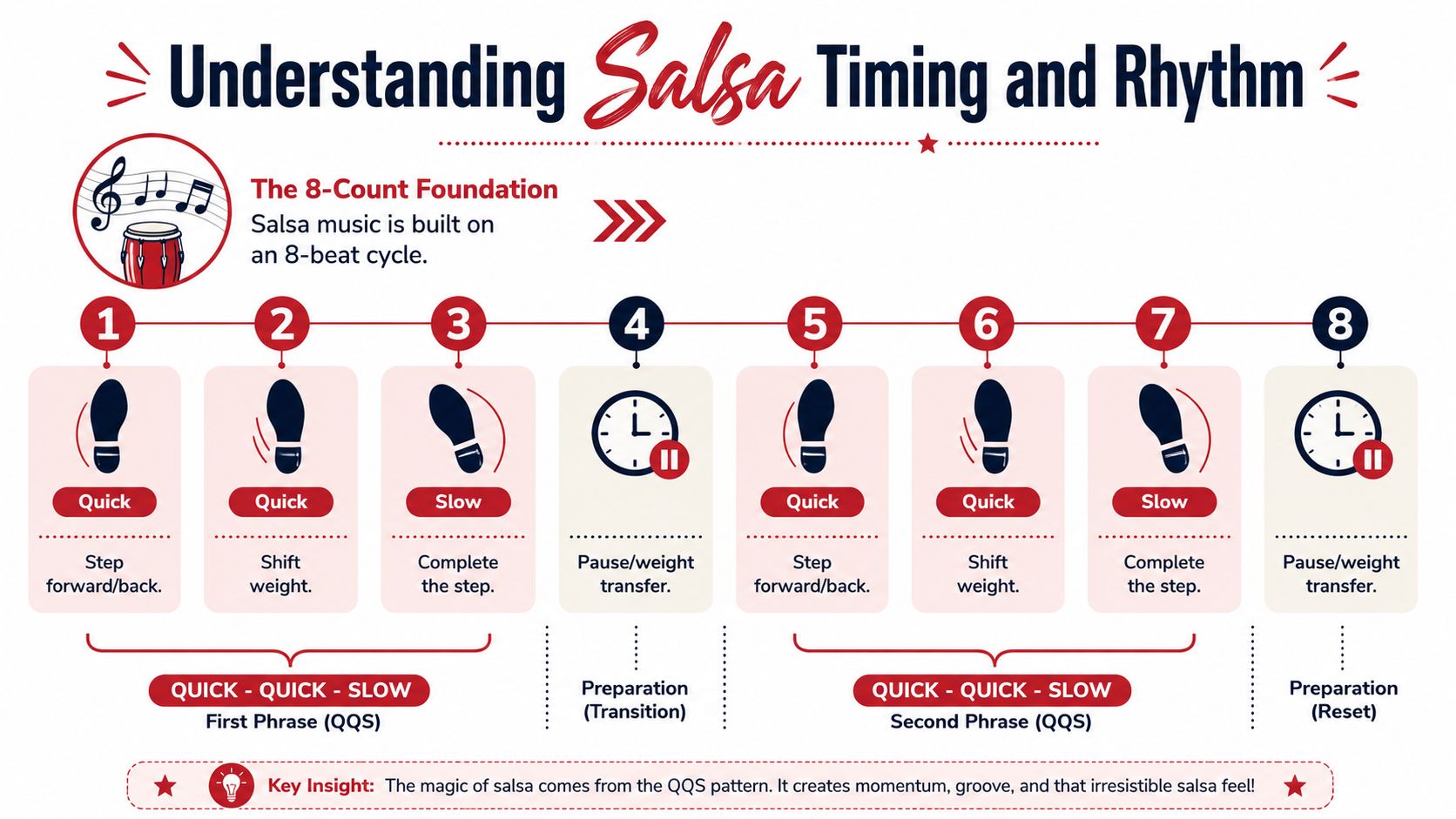
A University of Washington explanation states: salsa is defined by six weight changes over eight beats, with dancers stepping on 1-2-3, pausing on 4, then stepping on 5-6-7 and pausing on 8, all within the song's eight-beat phrase, as described in this University of Washington overview of salsa timing.
How to count it without panic
If you're standing in your kitchen trying to make sense of salsa timing, count like this:
- Step
- Step
- Step
- Pause
- Step
- Step
- Step
- Pause
That pause matters. It gives salsa its breathing room. New dancers often rush through all eight counts and accidentally turn the dance into a jog.
What the break step means
The break step is the moment your direction changes. That's the key to timing labels like On1 and On2. The same University of Washington source explains that in On1, the break lands on 1 and 5, while in On2, it shifts to 2 and 6.
You don't need to master that distinction on day one. You just need to know that timing names refer to where that change of direction happens.
Count the music until your feet stop feeling random. Then let the rhythm carry the count instead of the other way around.
Why timing changes the look of the dance
Two couples can dance to the same song and use the same broad family of movement, yet look very different because they break on different beats. An overview of salsa timing notes that On1 is the most prevalent timing across North America, Latin America, and Europe, while On2 is especially associated with New York City and Asia, as explained in this Dance Dojo article on salsa timing.
For a beginner, that means this: if one class feels different from another, it may not be because you're doing it badly. You may be learning a different timing system.
Essential Salsa Technique for Beginners
Beginners often try to make salsa look good by adding more movement. The opposite works better. Start smaller. Good salsa technique comes from weight transfer, posture, and control, not from throwing the body around.
One of the most important ideas is Cuban Motion. A technical breakdown describes it as a biomechanical chain where bending and straightening the knees on each weight shift causes the hips to rotate in a circular figure-8 path, giving salsa its signature action, as demonstrated in this technical video on Cuban Motion.
Start with the basic step
Your first goal is simple. Shift your weight clearly and completely. If your weight never arrives over the standing leg, your basic will always feel unstable.
Try these beginner checkpoints:
- Keep your steps small so you can change weight without falling behind the music
- Use your knees naturally instead of locking your legs
- Let the hips respond to weight transfer rather than forcing a wiggle
- Stay upright through the torso so your partner can read your movement clearly
For a closer breakdown of first patterns and foot placement, these salsa dance steps for beginners can help you connect the counts to actual movement.
Partner connection matters more than tricks
New dancers sometimes think salsa is mostly spins and dramatic dips. Social salsa works better when both people can feel each other's timing and direction. Small, readable movement is far more useful than flashy movement.
A practical safety guideline from beginner salsa instruction is to avoid lifts, tricks, and complicated dips unless both dancers are experienced professionals, because social dancing depends on control and shared balance rather than risk.
What confident beginners usually do
They don't necessarily know many patterns. They do a few fundamentals well.
- They finish each weight change
- They keep their frame calm
- They watch less and feel more
- They dance the music they hear, not the move they hoped to force
That's why technique matters. It doesn't make salsa less joyful. It makes joy easier to share with a partner.
Your First Step onto the Dance Floor
Most adults don't hesitate because salsa looks boring. They hesitate because they're worried about feeling awkward. They don't want to be the person who loses the beat, turns the wrong way, or shows up without a partner.
That fear is common, and it fades faster than anticipated.

What your first month usually feels like
Early salsa learning is structured enough to be reassuring. According to a beginner salsa timeline, within the first 4–6 weeks, beginners typically master the basic step, right and left turns, and simple partner work, while reaching an intermediate level generally takes one year of consistent practice, based on this beginner salsa progress timeline.
That's a healthy expectation. You do not need to become impressive immediately. You need repetition, patience, and a place where you can practice without embarrassment.
A few things help right away:
- Go in expecting to learn, not perform
- Take group class seriously, but lightly
- Dance socially as soon as you can
- Accept that confusion is part of the process
You do not need a partner to begin
This is one of the biggest myths in dance. Many adults delay for months because they think they need to arrive as a couple. You don't. Plenty of students start solo, and that's often the easiest way to focus on your own timing and confidence.
If nerves are the obstacle, this guide on how to overcome fear of dancing in public speaks directly to what many first-time students feel before class.
If you enjoy the social side, photos and short clips can also make early progress feel more tangible. After socials or events, some organizers use tools that help distribute photos to event attendees so dancers can relive the experience and stay connected with the community.
What helps people stay with salsa
Consistency beats intensity. One calm lesson each week, plus some listening and a little practice, goes a long way. So does finding instruction that explains the difference between linear and circular salsa instead of treating all salsa as one identical system.
Later, it helps to watch real movement in action:
For local learners who want in-person guidance, Danza Academy of Social Dance offers salsa as part of its social dance curriculum in the Philadelphia area, with instruction for adults learning partner dance in a studio setting.
If you've been stuck at the stage where you keep searching “what type of dance is Salsa” but haven't tried it, the next useful step isn't more scrolling. It's one lesson. Once your feet meet the music, the labels stop feeling abstract.
If you're ready to stop wondering and start dancing, book a free complimentary lesson with Danza Academy of Social Dance. It's a simple way to experience salsa in a welcoming setting, ask questions about styles like LA, New York, and Cuban salsa, and find the right starting point for your goals.