
Learning salsa dance steps for beginners is way simpler than you might think. It all boils down to the basic forward-and-back motion. If you can master this single movement, which follows a simple quick, quick, slow rhythm, you've already unlocked the foundation for every other step in salsa. You don't need a partner or fancy shoes to start—just a willingness to feel the music.
Your First Steps into the World of Salsa
Jumping into salsa can feel like learning a new language, but the core vocabulary is surprisingly small. Forget about the complicated turns and spins you see online. The real secret is getting a handle on three fundamental things: the music's rhythm, the basic footwork, and your connection to the floor. These are the building blocks that make everything else possible.
The journey starts with your ears, not your feet. We'll break down the classic 8-count beat later in this guide, but for now, just know that salsa has a distinct pulse. Once you start to feel that rhythm, the simple forward-and-back motion becomes your first real conversation with the music. Don't worry about being perfect; the goal right now is just to get comfortable and build a little confidence.
Why Salsa Captures Hearts Worldwide
Salsa isn't just a dance; it's a global phenomenon. In fact, salsa stands as the undisputed king of partner dances, captivating over 200 million enthusiasts worldwide according to Facebook data. That's more than the combined likes for bachata, swing, and tango. This massive community is why studios like Danza Academy of Social Dance right here in Philadelphia are thriving, drawing beginners who are eager to master those foundational steps in a fun, supportive space.
This incredible popularity means you're joining a huge, welcoming community. No matter where you travel, you can almost always find a place to dance salsa and connect with new people.
The best dancers aren’t the ones with the most moves, but the ones who have the most fun. Your primary goal is to enjoy the process of learning and let the music guide you.
Getting Ready for the Dance Floor
Feeling a little nervous is totally normal, but a little preparation goes a long way. Honestly, the right mindset is your most important asset. Just embrace the idea that making mistakes is part of the deal. Focus on progress, not perfection. To get even more comfortable, check out our guide on how to prepare for your first private dance class.
Ready to turn your curiosity into confidence? The absolute best way to learn is with an expert by your side. Claim your free complimentary lesson at Danza Academy and feel the music in person. Our instructors provide the one-on-one feedback you need to start strong from day one. Book your spot now—it's completely free!
How to Find the Beat in Salsa Music
Before you can learn a single step, you have to connect with the music. Feeling the rhythm is the absolute foundation of every great salsa dancer, but don't worry—you don't need a music degree to find the beat. It’s all about making it feel as natural as walking.
The heart of salsa music is its classic 8-count structure: you dance on 1, 2, 3, pause on 4, then dance again on 5, 6, 7, and pause on 8. This little pause is what gives salsa its unique pulse and gives you a moment to prepare for your next move.
Our goal is to get that 1, 2, 3… 5, 6, 7 rhythm out of your head and into your body, so you don't even have to think about it.
What to Listen For in the Music
Salsa is a rich mix of sounds, and trying to hear everything at once can be overwhelming for a beginner. The trick is to tune out the noise and zero in on the instruments that keep the time.
Focus your ears on one of these rhythm-keepers:
- The Conga Drums: Listen for those deep, booming tones. The congas play a steady rhythm called the "tumbao," which clearly marks the beats. You’ll hear a pattern that almost sounds like it’s saying, "one, two, three-and-four."
- The Cowbell (Campana): This is your best friend when you're starting out. The sharp, high-pitched "clang" of the cowbell cuts right through the other instruments and often hammers out the main beats (1, 3, 5, 7). It's a fantastic guide.
- The Clave: This is the soul of salsa. It's a distinct two-bar pattern played on wooden sticks. It’s a bit trickier to pick up at first, but once your ear gets trained to hear the clave, you’ll understand the music on a whole new level.
Next time you hear a salsa song, just listen. Don't dance. Just try to isolate the sound of the cowbell or the congas. Tap your fingers along with it. This is the first step to building that crucial mind-body connection.
On1 vs. On2: What a Beginner Needs to Know
Sooner or later, you’ll hear dancers talking about dancing "On1" or "On2." All this means is which beat of the music you "break" (change direction) on. With On1 style, the leader steps forward on the first beat of the music. On2, you guessed it, the break happens on the second beat.
While you'll find passionate dancers who swear by both, On1 is almost always the most intuitive style for beginners. Why? Because that first beat is typically the strongest, loudest beat in the measure, making it much easier to hear and feel right away.
At Danza Academy, our instructors focus on building a strong, confident foundation. We primarily teach the On1 style in our beginner classes because we've seen it helps new dancers connect with the music faster and get comfortable on the dance floor.
Don't get tangled up in the On1 versus On2 debate just yet. The most important thing is simply learning to hear that 8-count phrase. Once you've got that down, trying other styles later in your dance journey becomes a piece of cake.
Drills to Help You Internalize the Rhythm
The best part is, you can practice finding the beat anywhere, anytime. You don't even need a dance floor. The goal is to immerse yourself in the rhythm until it becomes second nature.
Try these simple exercises throughout your day:
- Active Listening: Put on a salsa playlist while you’re driving or cooking. Tap your fingers on the steering wheel or countertop to the 1, 2, 3… 5, 6, 7 count.
- Count Out Loud: This might feel a little silly, but it works. Say "1, 2, 3, (pause), 5, 6, 7, (pause)" along with the music. Vocalizing it helps lock the timing into your brain.
- March in Place: When you have a moment, just stand up and march gently in place, stepping on each of the six beats (1, 2, 3, 5, 6, 7). This starts to connect the musical timing directly to your feet.
Feeling the beat is a skill, and like any skill, it gets stronger with practice. This is the single most important step you can take before you even worry about fancy footwork.
Want to make sure you're hearing the rhythm correctly? The fastest way is with an expert's ear. Book your free, no-obligation complimentary lesson on our contact page and let one of our world-class instructors help you find that beat in minutes.
Learning the Foundational Salsa Footwork
Okay, you can feel the rhythm. Now it’s time to get that rhythm into your feet. This is where the real fun begins—where you stop just listening to salsa and actually start dancing it. And here's the best part: almost every flashy, complex move you'll ever see on the dance floor is built from just three foundational patterns.
Getting these core steps down is less about memorizing and more about building muscle memory. We’re going to break down the essentials: the Forward & Back Basic, the Side Basic, and the Back Basic. Think of these as the alphabet of salsa. Once you know them, you can start forming words, sentences, and eventually, have entire conversations on the dance floor.
The Cornerstone of Salsa: The Forward and Back Basic
This is it. The quintessential salsa step. It's the move that forms the absolute backbone of the dance. It’s a simple rocking motion that moves you forward and backward over the full 8-count of the music.
The secret here isn't just shuffling your feet, but fully transferring your weight with each and every step. This commitment to each movement is what makes your dancing look—and feel—confident and intentional.
For the Leader (Typically Starting with the Left Foot):
- Count 1: Step forward with your left foot. Really land on it, putting all your weight there.
- Count 2: Rock your weight back onto your right foot, which has stayed in place.
- Count 3: Bring your left foot back to meet your right, returning to where you started.
- Count 4: Pause. This is your moment to breathe and reset.
- Count 5: Step backward with your right foot. Again, commit your full weight.
- Count 6: Rock your weight forward onto your left foot, which hasn't moved.
- Count 7: Bring your right foot forward to meet your left, back to the start.
- Count 8: Pause again. You've completed the basic!
For the Follower (Typically Starting with the Right Foot):
Followers do the mirror image of the Leader's movement. When the Leader steps forward, the Follower naturally steps back. It’s a perfect dance conversation.
- Count 1: Step backward with your right foot, transferring your weight fully.
- Count 2: Rock your weight forward onto your left foot.
- Count 3: Bring your right foot forward to meet your left.
- Count 4: Pause.
- Count 5: Step forward with your left foot, landing with purpose.
- Count 6: Rock your weight back onto your right foot.
- Count 7: Bring your left foot back to meet your right.
- Count 8: Pause.
Try this slowly at first, even without music. Just get the feel of shifting your weight completely from one foot to the other.
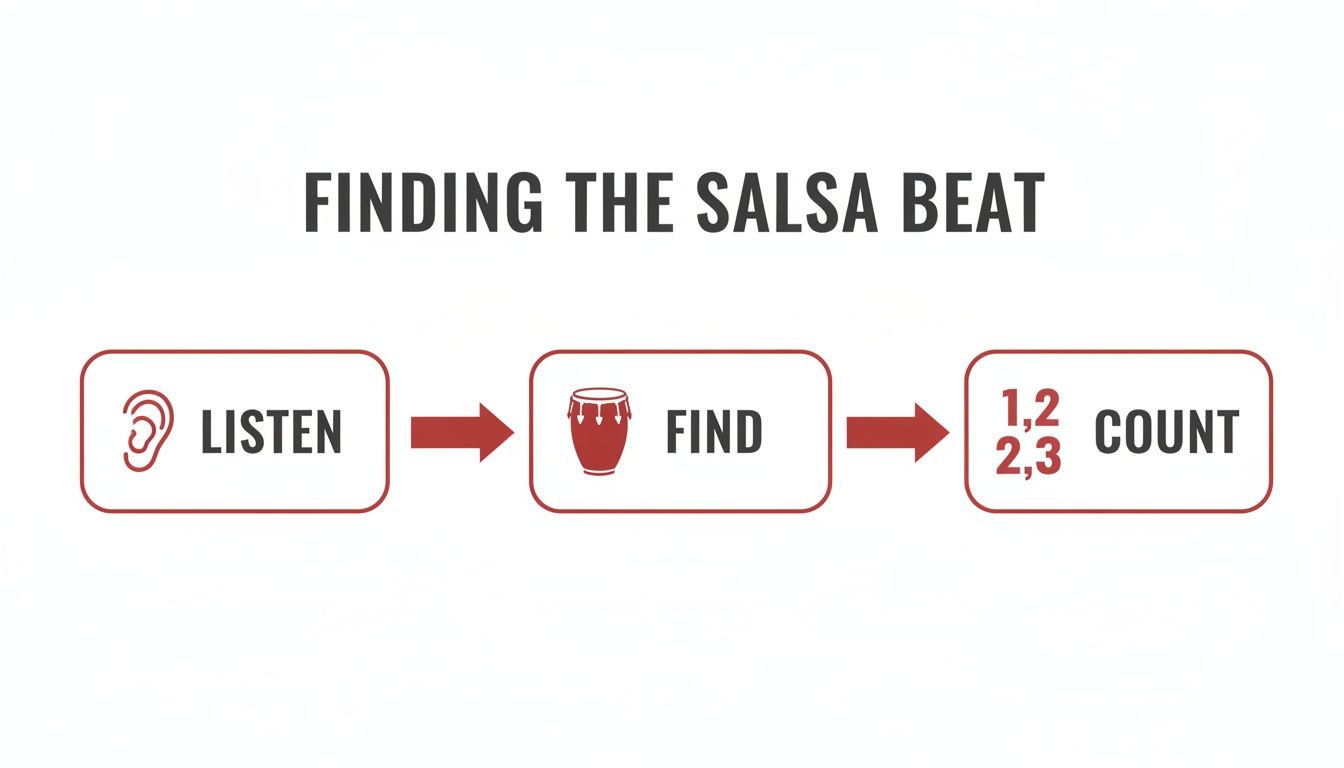
This graphic is a great reminder that before your feet even move, you have to connect with the music. Listen, find that core beat, and count along. It's the essential prep work that makes the footwork click.
Adding Variety: The Side Basic
Once the Forward & Back Basic starts to feel second nature, you can mix in the Side Basic. This step is a lifesaver on a crowded dance floor and also works as a stylish little transition between other patterns. The idea of a full weight transfer is just as important here.
The movement is straightforward: step out to the side, rock your weight, bring your feet back together, and then repeat on the other side. It all follows that same familiar "quick, quick, slow" rhythm.
"To show true colors, you must feel comfortable. Being relaxed lets you pick up the music’s feeling. It’s okay to mess up—just reset and keep going."
This is so true. Foundational footwork is about feeling the groove, not just executing mechanical steps. The Side Basic is a perfect chance to relax, breathe, and feel the natural sway of the music.
Leader's Side Basic:
- On count 1, step directly to your left with your left foot.
- On count 2, shift your weight back onto your right foot.
- On count 3, bring your left foot back to the center next to your right.
- On counts 5, 6, 7, do the exact same thing to your right, starting with your right foot.
Follower's Side Basic:
The Follower mirrors the Leader, starting by stepping to their right.
- On count 1, step directly to your right with your right foot.
- On count 2, shift your weight back onto your left foot.
- On count 3, bring your right foot back to the center.
- On counts 5, 6, 7, repeat the sequence to your left, starting with your left foot.
This simple move is more versatile than you might think. Exploring different basics is a fun way to build your dance vocabulary. In fact, if you're enjoying this, you might like our guide on 10 easy dance moves anyone can learn to expand your repertoire.
An Essential Variation: The Back Basic
The Back Basic is a subtle but critical twist on the main pattern. Instead of the Leader stepping forward on count 1, both the Leader and Follower "break back." You'll see this all the time in clubs, and it’s the foundation for a ton of different moves and turns.
The footwork feels almost identical to the Forward & Back Basic—you’re just starting in a different direction.
Leader's Back Basic:
- Count 1: Step backward with your left foot.
- Count 2: Rock forward onto your right foot.
- Count 3: Bring your left foot back to center.
- Count 5: Step forward with your right foot.
- Count 6: Rock back onto your left foot.
- Count 7: Bring your right foot back to center.
Follower's Back Basic:
- Count 1: Step backward with your right foot.
- Count 2: Rock forward onto your left foot.
- Count 3: Bring your right foot back to center.
- Count 5: Step forward with your left foot.
- Count 6: Rock back onto your right foot.
- Count 7: Bring your left foot back to center.
Drilling these three basics at home, even for just five minutes a day, will build the muscle memory you need to feel comfortable on the dance floor. Don't worry about speed or fancy styling just yet. Focus on clean, intentional weight transfers on the correct counts.
Executing Your First Turns and the Cross-Body Lead
Once you've got the basic footwork down and it's starting to feel more natural, you're ready for the good stuff. This is where salsa gets really exciting—when you start moving beyond stationary steps and begin to travel and interact with your partner. We're going to break down the first fundamental turns and the single most important pattern in all of social salsa: the Cross-Body Lead.
Think of these moves as the first real sentences in your dance conversation. They add flair, create visual interest, and give you the tools to navigate the dance floor with confidence. Nailing these is the key to unlocking endless combinations and really starting to play with the music.
Unlocking the Follower's Right Turn
One of the very first turns you'll learn is the Right Turn for the follower. It’s elegant, simple, and a staple you'll use constantly. The magic here isn't in complicated footwork, but in a clear, gentle lead.
For the follower, the footwork is just a forward basic, but instead of moving in a straight line, you pivot. The leader makes it happen by raising their left hand on counts 1, 2, 3, creating a little archway for the follower to walk under. Then, the follower simply walks forward under that raised arm, pivoting to the right on counts 5, 6, 7 to complete a full rotation and face their partner again.
Followers, the key is to keep your steps small and your frame engaged. Imagine you're walking down a narrow hallway—this keeps the turn tight and controlled. Leaders, remember your job is to guide, not to push or pull. Your hand simply shows the way.
Mastering the Leader's Left Turn
Leaders get to spin, too! The Left Turn is your chance to add your own stylish rotation. Just like the follower's turn, the footwork is built on that familiar forward basic, just with a pivot thrown in. This move is typically self-led, meaning you decide when to do it without needing a special signal from your partner.
Here’s the breakdown for the leader:
- Counts 1, 2, 3: You start your basic step but begin angling your body slightly to the left. As you step forward on 1, you initiate the pivot.
- Counts 5, 6, 7: This is where the main rotation happens. You'll continue turning to your left, using these three steps to complete the spin and end up facing your partner, ready for whatever comes next.
A great tip for leaders is to "spot" while turning. Pick a fixed point (like your partner's shoulder) and keep your eyes on it for as long as you can. This simple trick dramatically improves your balance and prevents dizziness, making your turns look smooth and effortless.
Feeling confident in these basic turns is the first major milestone for any new dancer. It’s that "aha!" moment when you realize salsa isn't just about steps; it's about flowing, moving, and connecting with another person.
The Cross-Body Lead: The Language of the Dance Floor
If there is one single move that defines the structure of salsa, it’s the Cross-Body Lead (CBL). This isn't just another pattern; it's the fundamental tool for changing places with your partner and navigating a busy social dance floor. Think of it as the traffic controller of salsa.
The whole point of the CBL is for the leader and follower to trade places. The leader guides the follower across their body from one side to the other, almost like they're walking down a track.
Leader’s Role in the CBL:
On counts 1, 2, 3, the leader steps forward and slightly to the side, opening up a clear lane. On 5, 6, 7, they pivot as the follower passes in front of them, finishing the move in the follower's original spot.
Follower’s Role in the CBL:
The follower just walks a straight line forward on 1, 2, 3, right through the space the leader created. On 5, 6, 7, they complete their basic step, now facing their partner from a new position.
Learning the CBL is an absolute game-changer. It's the foundation for hundreds of more advanced combinations and is absolutely essential for social dancing.
Why These Moves Are More Than Just Steps
Mastering turns and the CBL isn't just about getting the mechanics right; it's about unlocking the health and social benefits that have made salsa a global phenomenon. Since evolving from its Latin American roots in the 1960s, salsa has become the world's favorite partner dance. It now represents the largest slice of the social dance industry, with studios and festivals thriving everywhere—including right here in Danza Academy's welcoming Philadelphia community.
A huge part of this popularity comes from the incredible health perks; dancers burn 400-600 calories per hour while boosting their cardiovascular fitness, coordination, and social connections. To learn more, you can discover more insights about the rising popularity of salsa dance communities.
Practicing these core salsa dance steps for beginners gives you a fantastic workout, sharpens your mind, and connects you with a vibrant community. The feeling of leading or following a perfect Cross-Body Lead is what gets people hooked for life.
Feeling inspired? Don't wait to try these moves in person. At Danza Academy, our expert instructors make learning fun and simple. Claim your free introductory lesson now and experience the thrill for yourself. Visit our contact page to schedule your session and let's get you spinning on the dance floor!
Common Beginner Mistakes and How to Fix Them
Look, every single new dancer stumbles. It’s not just part of the process—it’s the most important part. Those early missteps are your first real lessons in disguise, and recognizing these common habits gives you a massive head start.
Let's be honest: your body is going to want to do a few things that feel totally natural but actually work against the flow of salsa. We're going to tackle these head-on, not just by telling you what not to do, but by giving you practical fixes you can start using right now.
Mistake 1: Looking at Your Feet
It’s the most common beginner instinct on the planet. You’re trying to make sure your feet are doing the right thing, so naturally, you look down. The problem? The second you do, your posture breaks, you disconnect from your partner, and your balance goes right out the window.
Good salsa dancing happens from the chest up. Your feet will figure it out, I promise.
Instead of gluing your eyes to the floor, try this: focus your gaze softly over your partner's right shoulder. This simple shift keeps your head up, your spine aligned, and your attention exactly where it needs to be—on the connection you're building.
The fastest way to look like you know what you're doing is to maintain good posture and eye contact. Seriously. Even if your feet are a complete mess, a confident frame tells a story of control and presence.
You can drill this at home easily. Stand in front of a mirror and just practice your basic step. Keep your chin up and lock your eyes on your own reflection. It builds the muscle memory you need to keep your focus elevated when you finally have a partner in front of you.
Mistake 2: Taking Steps That Are Way Too Big
Another classic. Beginners often take huge, lunging steps, maybe thinking it looks more dramatic. In reality, it just slows you down, kills your energy, and makes it almost impossible to stay on beat. Salsa is danced on the balls of your feet with small, efficient, and quick steps.
Think of your feet as gliding just above the surface of the floor. Your steps should be compact—small enough that you could change direction in an instant if you had to.
Quick Drills for Smaller Steps:
- The Tape Box Drill: Grab some masking tape and make a small square on the floor, about the size of a dinner plate. Now, practice your entire forward-and-back basic without letting your feet step outside that square. It’s harder than it sounds!
- The "Hot Coals" Analogy: Picture the dance floor covered in warm coals. You wouldn't stomp down and get burned; you’d tap the floor quickly and lightly, transferring your weight without hesitation. That's the feeling you're after.
This efficiency is what allows you to keep up with faster songs and nail quick turns without getting wobbly.
Mistake 3: Dancing with a Stiff, "Robot" Frame
When new dancers are so focused on getting their feet right, their arms and upper body tend to lock up. You become rigid, like a mannequin, which makes for a tense and awkward experience for both partners. Your "frame"—the connection you create with your arms and shoulders—needs to be toned and engaged, but never, ever stiff.
Think of your arms like the shock absorbers on a car. They should have a slight, natural bend and be able to absorb movement without collapsing or becoming rigid. This is how a leader clearly signals a turn and how a follower can receive that signal instantly.
A great way to practice this is to find a friend and work on the basic salsa hold. Stand facing each other and gently press into each other's hands until you find a comfortable state of active resistance. It’s a connection that’s both firm and flexible. This one skill is vital when you venture onto the social dance floor, which is a massive scene here in the U.S.
In fact, the United States is the number one country in the world for salsa dancing, with more socials, festivals, and events than anywhere else. This vibrant community, with hotspots from New York to Miami and our own Philly scene, is incredibly welcoming to new dancers. You can learn more about the top countries for salsa dancing and see just how big this world you're joining really is.
Fixing these mistakes on your own is a fantastic start, but nothing beats personalized feedback. An experienced instructor can spot tiny issues you’d never notice—and correct them instantly. The fastest way to build good habits is with expert guidance. Book your free complimentary lesson on our contact page, and we'll help you build a confident foundation from your very first step.
Putting It All Together on the Dance Floor
Learning the individual steps is just the beginning. The real magic of salsa happens when you finally connect those moves to the music on a real dance floor. We've walked through the rhythm, the core footwork, and the essential turns—you officially have the building blocks for a lifetime of fun. Think of your dance journey as a marathon, not a sprint.
The best way to make all this new information stick is to practice consistently in a supportive setting.
Your journey starts with a single step. But the real growth happens when you take that step on a real dance floor, surrounded by music and fellow dancers.
Here at Danza Academy, our instructors in Philadelphia and Exton are masters at creating a welcoming community where you can truly grow and feel comfortable. Ready to feel the difference for yourself? Take the first step and book your free complimentary lesson today! Simply visit our contact page to schedule your spot. Let's get you dancing.
Your Top Salsa Questions, Answered
Jumping into something new like salsa always brings up a few questions. Feeling a little nervous or just plain curious is totally normal, and honestly, it's a good sign! It means you're ready to learn. We've heard just about every question in the book from new students, so let's tackle the big ones right now.
First off, let's bust a myth: you do not need "natural rhythm" or any dance experience to learn salsa. Think of it like learning an instrument or a language. It’s a skill you build over time. Consistency and good instruction will always beat so-called natural talent. Everyone starts at the same place: step one.
Do I Need to Bring a Partner to Take Lessons?
Absolutely not! This is probably the biggest misconception out there about partner dancing.
Our group classes are designed for everyone to rotate partners. This is actually the fastest way to become a better leader or follower. You learn to adapt to different people, which is exactly what you'll do when you go out social dancing. Plus, it's a great way to meet people.
What Should I Wear to My First Class?
The golden rule is comfort. Wear clothes you can move in easily without feeling constricted—think workout gear or casual clothes with some stretch.
As for shoes, the most important thing is that they don't stick to the floor. Avoid sneakers with thick rubber grips. For your first few classes, any comfortable shoes with a smooth, non-grippy sole will work just fine. Don't feel like you need to rush out and buy special dance shoes.
Your first classes are all about getting the feel for the music and the basic steps. It’s not a fashion show! Just come ready to move, learn, and have a good time.
How Long Does It Take to Get Good at Salsa?
This is the million-dollar question, and the answer is… it's different for everyone. But we can give you a pretty good idea.
Most of our students feel comfortable with the basic steps and a few core turns after just a handful of classes. Give it a few months of consistent practice, and you'll likely have the confidence to hit a salsa social and dance the night away. The key is to enjoy the process and celebrate the small wins along the way.
Ready to stop asking questions and start dancing? The best answers are found on the dance floor. At Danza Academy of Social Dance, our world-class instructors are here to guide you through every single step.
There's no better way to start than with a free lesson. See for yourself how fun and easy it can be. Book your complimentary first class now and let's get started! Just visit us at https://danzaacademy.com/contact.