
Taking up ballroom dance lessons for beginners is a fantastic way to get moving, connect with new people, and build a kind of confidence that you can carry with you everywhere. It’s your chance to learn a timeless skill in a space designed for people who are starting from scratch.
Why Start Ballroom Dancing Now?
Have you ever watched a couple glide across the floor and thought, "I could never do that"? The truth is, you absolutely can. Ballroom dancing isn't some exclusive club for professionals or people who started as toddlers. It's a social activity for everyone, no matter your age, fitness level, or even if you're convinced you have two left feet.
A lot of people hold back, worried they'll look awkward or won't have the coordination. But studios like Danza Academy are built around creating a welcoming place where being a beginner is the whole point. It's not about nailing every step perfectly; it's about connecting—with the music, with a partner, and with a new community.
The Growing Appeal of Dance
If you're curious about dancing, you're in good company. More and more adults are looking for fun, engaging hobbies, and dance is booming worldwide.
The dance training market hit a value of USD 15 billion in 2024 and is projected to climb to USD 25 billion by 2032. This isn't just a fleeting trend; it shows a real shift in how people want to spend their free time. You can learn more about this growth in this detailed market analysis. People are catching on to the unique blend of benefits that only dancing can offer.
Ballroom dancing is more than just learning steps; it's the perfect mix of mental and physical exercise. It’s a workout that doesn’t feel like a chore, a social night out, and a creative outlet all rolled into one. For many of our students, it becomes a surprising source of joy and personal growth.
The only way to know if it’s for you is to give it a try. Hear the music, meet an instructor, and just feel the fun of learning something new. It all starts with that one simple step onto the floor.
Ready to see what it's all about? Your first lesson is on us. Experience the fun for yourself with a no-obligation complimentary class. Claim your spot now and book your free introductory class to start your dance journey today.
Finding a Dance Style That Fits You
Choosing your first dance style feels like a huge commitment, but it really boils down to one simple thing: what music makes you want to get up and move? Don't get bogged down in technical terms or what you think you should learn. The world of ballroom is massive, with everything from slow and elegant to fast and fiery.
Most beginners are pleasantly surprised when a style just clicks with them. Do you dream of gliding across the floor like royalty in a classic movie? Or are you drawn to the infectious, playful energy of a Latin club? Answering that one question is the perfect place to start.
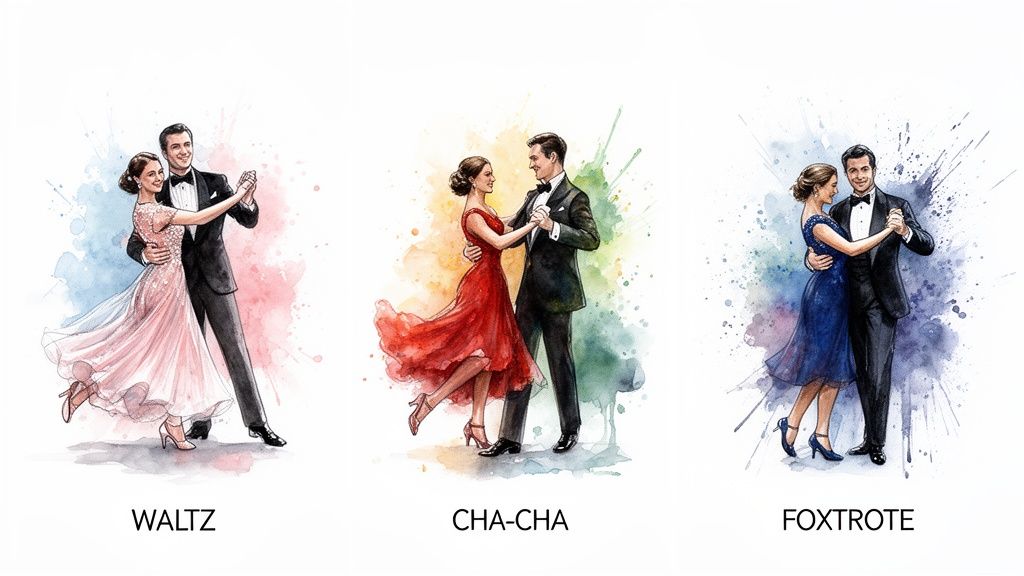
Smooth Dances: The Classic Styles
The "smooth" dances are exactly what they sound like—graceful, flowing, and elegant. Think old Hollywood romance. These styles travel around the dance floor with long, sweeping movements that feel incredibly sophisticated.
- Waltz: This is the quintessential ballroom dance, famous for its romantic "rise and fall" motion. Danced in 3/4 time, it’s all about elegant turns and sweeping steps. If you love classic, melodic music and dream of graceful movement, the Waltz is a perfect starting point.
- Foxtrot: Picture Frank Sinatra or Michael Bublé crooning in a tuxedo. That's the vibe. The Foxtrot is wonderfully versatile and smooth, characterized by long, gliding steps. It feels like taking a beautiful walk with your partner, making it one of the most practical and useful social dances you can learn.
Rhythm Dances: The Playful Styles
On the flip side, "rhythm" dances are energetic, flirtatious, and mostly stay in one spot on the floor. These styles are all about hip action (Cuban motion) and syncopated, punchy beats that get your heart pumping.
- Cha-Cha: If upbeat, infectious music gets your feet tapping, the Cha-Cha is for you. It’s a fun, flirty, and energetic dance with a catchy "one, two, cha-cha-cha" rhythm. Its playful character makes it an instant favorite for beginners who just want to let loose.
- Salsa: While technically a club dance, Salsa is a non-negotiable staple in any social dance studio. It's passionate, rhythmic, and incredibly social. Danced to complex Latin rhythms, it involves intricate turn patterns and a vibrant connection with your partner that's hard to beat.
Still not sure which one calls to you? The table below breaks down the basics to help you find your perfect match.
Beginner Ballroom Dance Styles at a Glance
| Dance Style | Tempo & Feel | Best For Beginners Who… | Music You'll Hear |
|---|---|---|---|
| Waltz | Slow, elegant, romantic | Want a classic, fairytale experience and love graceful movement. | Classical, old standards, modern ballads in 3/4 time. |
| Foxtrot | Smooth, classy, relaxed | Want a practical social dance that feels like a "walk to music." | Frank Sinatra, Michael Bublé, big band, jazz standards. |
| Cha-Cha | Upbeat, playful, sassy | Love high-energy music and want to have fun with flirty steps. | Latin pop, rock, and disco with a steady beat. |
| Salsa | Fast, energetic, passionate | Are looking for a lively, social dance with lots of turns and rhythm. | Modern Latin music from artists like Marc Anthony and Celia Cruz. |
Ultimately, there’s no right or wrong answer here. It’s all about what gets you excited to be on the dance floor.
If you want to dive even deeper into these styles and a few others, check out our full guide to the 10 traditional dances of ballroom dance.
Your first dance choice isn't a lifelong commitment. The goal is to pick one that excites you enough to get on the floor. Many dancers find that the skills from one style easily transfer to others, opening up a whole new world of movement.
Still on the fence? The best way to find out is to feel the music and try the steps yourself. Our instructors will introduce you to the basics during your first lesson—which is completely free. Take the first step and book your free complimentary lesson on our contact page. There’s no pressure, just a fun opportunity to discover your rhythm.
What Really Happens in Your First Class
Walking into a dance studio for the first time can feel like stepping into a whole different world. It’s totally normal to feel a mix of excitement and a few butterflies, but let’s pull back the curtain on what actually goes down in a beginner ballroom class. The reality is far less intimidating—and way more fun—than you might imagine.
The first ten minutes or so are all about getting comfortable. Your instructor will greet you, show you where to put your things, and probably introduce you to a few other students. This isn't a test; it's just about breaking the ice and helping you relax before the music even starts. You’ll quickly realize you’re in a room full of people who are in the exact same boat.
Your First Moves and What to Expect
Once everyone’s settled, the class kicks off with a simple warm-up. This isn’t some high-intensity workout; think gentle movements designed to get your body ready to dance. We’re talking simple side steps, weight shifts, and maybe a few easy stretches to get your muscles loose and ready to go.
From there, the instructor will introduce the basic rhythm of whatever dance is on the agenda for the day. They'll break it down slowly, often having you learn it on your own at first so you can focus entirely on your feet. You might learn a simple pattern, like the Waltz Box Step, piece by piece. Forget about perfection—the goal is just to get familiar with the timing and direction.
Many beginners walk in expecting to struggle, but they're often surprised by how quickly they pick up the basic rhythm. The key is to trust your instructor, relax, and just let your body respond to the music.
Understanding Partner Rotation
One of the most common questions we get is, "Do I need to bring a partner?" The answer is a definite no. In our group classes, we use a system called partner rotation. After practicing a step for a few minutes, the instructor will ask one line of dancers to move down to the next person.
This is a core part of learning social dance for a few really good reasons:
- It makes you a better dancer, faster: Dancing with different people helps you adapt your lead or follow, making you much more versatile on any social dance floor.
- It’s social! You get to meet everyone in the class, which creates a really friendly and supportive atmosphere.
- It keeps everyone moving: Nobody is left standing on the sidelines waiting for someone to dance with.
Rotation keeps the class dynamic and ensures you're learning to connect with all kinds of dance partners, which is the whole point of social dancing. For more tips on getting ready, check out our guide on how to prepare for your first private dance class—many of the same ideas apply to group settings, too.
Your first class isn't an audition, it's an invitation to have fun and try something new. Our entire focus is on creating a positive, no-pressure experience. The best way to see for yourself is to simply step onto the floor.
Learning Your First Foundational Steps
Alright, now for the fun part—actually moving your feet. The idea of learning choreography can feel a little intimidating at first, but your initial lessons are all about simple, repeatable patterns. Think of it less like complex dance moves and more like a new, more musical way to walk.
We're going to break down the first few foundational movements you'll likely encounter in class. Forget the confusing diagrams and technical jargon for now. This is how an instructor would explain it in plain English, giving you a sneak peek into what you’ll actually feel on the dance floor. The goal here is to build a little muscle memory, not to achieve perfection on day one.
Every dance class follows a pretty simple, repeatable flow. This visual breaks down the three core phases you'll experience in each lesson, from getting ready to hitting the floor.
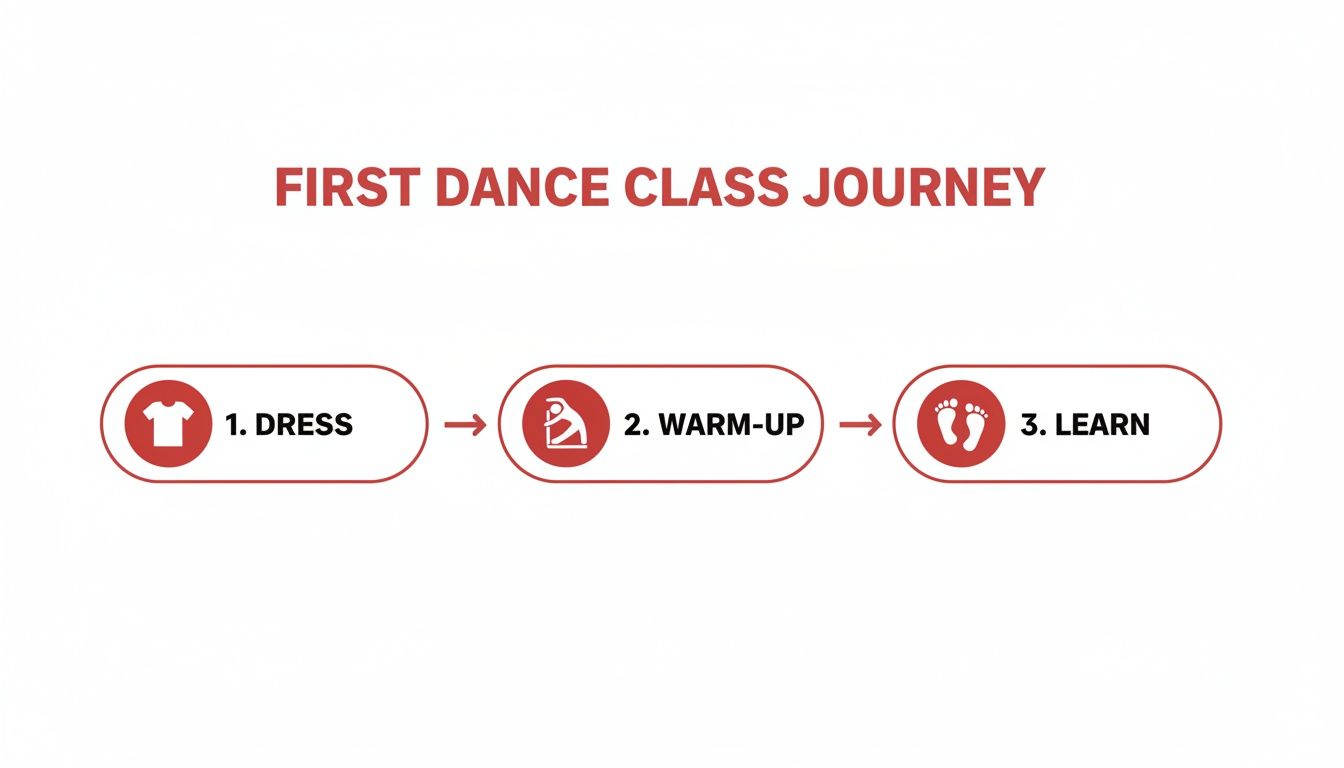
As you can see, the process is really straightforward. It’s designed to ease you into the movements comfortably and build your confidence step by step.
The Elegant Waltz Box Step
Waltz is often the first dance beginners learn because its timing is simple and the movement is so graceful. Its core pattern is the Box Step, which feels exactly like it sounds—you’re basically drawing a small square on the floor with your feet.
Here’s how it works for the Leader (the person guiding the dance):
- Step forward with your left foot.
- Step to the side with your right foot.
- Bring your feet together by moving your left foot to meet your right.
- Now, step back with your right foot.
- Step to the side with your left foot.
- Finally, bring your feet together again.
The Follower’s part is simply the natural opposite, starting by stepping backward with the right foot. It all flows to a steady "one-two-three, one-two-three" count, matching that classic, dreamy Waltz rhythm.
The Smooth Foxtrot Basic Rhythm
Foxtrot is the ultimate social dance. It feels like a relaxed, stylish walk across the floor, making it perfect for weddings and parties. Its foundational rhythm is usually taught as “slow, slow, quick, quick.” This simple pattern can be moved forward, backward, or used to make turns.
Just imagine walking to a steady beat. The "slow" steps each take up two beats of music, while the "quick" steps take just one. It's this change in timing that gives the Foxtrot its signature smooth, gliding look. Once you get that rhythm in your head, you can navigate a crowded dance floor with total ease.
A little insider tip: Many newcomers think the footwork is the hardest part. It's not. It's learning to relax! Your instructor will encourage you to loosen your arms and fully shift your weight onto each foot. That's the secret sauce that transforms stiff steps into fluid, confident dancing.
The Playful Cha-Cha Side Basic
Ready for a little more energy? The Cha-Cha is all about a fun, syncopated rhythm counted as "one, two, three, cha-cha." The core movement is a quick side-to-side action called a Chasse (pronounced sha-SAY), which creates that final "cha-cha" sound with your feet.
It starts with a simple rock step, and both partners are essentially mirroring each other:
- Leader: You’ll rock forward on one foot, then back onto the other, and finish with a "side-together-side" step (the Chasse) to your left.
- Follower: You’ll mirror the leader, rocking back first, then forward, before doing your Chasse to the right.
The key here is keeping your steps small and compact, right underneath your body. This allows for the quick weight changes and that signature Cuban hip motion that makes the Cha-Cha so much fun.
These basics are the building blocks for countless other patterns you'll eventually learn. Getting comfortable with them gives you a massive head start and builds the confidence you need to truly let go and enjoy your time on the floor.
Feeling inspired to try these steps with an expert guiding you? We make it easy and completely risk-free. Your first lesson at Danza Academy is on us, giving you a chance to get personalized feedback and experience the joy of dancing firsthand.
Book your free complimentary lesson today by visiting our contact page and let us guide you through your very first dance.
How to Make Real Progress and Enjoy the Journey
That first dance lesson is a fantastic start, but the real magic happens in the weeks and months that follow. True progress isn’t about making giant leaps overnight; it’s about showing up, putting in the time, and learning to love the process itself. This is how you turn those first few hesitant steps into movements that feel confident and natural.
Consistency is everything. I can't stress this enough. Even just five minutes of practice a day at home can make a monumental difference. You don't need a partner or a ballroom-sized living room. Just put on some music and walk through the basic steps you learned in class. This is what builds muscle memory, which helps your body remember the rhythm and footwork without you having to constantly think about it on the studio floor.
Finding Your Learning Rhythm
Everyone learns differently and at their own pace, so it’s important to find a combination of instruction that really clicks for you. Group classes are wonderful for building a solid foundation and meeting new people, but you might eventually hit a plateau where a specific move just isn't working.
That’s often the perfect time to add a private lesson into your schedule. A one-on-one session gives your instructor the chance to focus entirely on you, breaking down tricky techniques and offering personalized feedback. Think of it as a targeted boost to complement the fun, social energy of your group classes. If you're weighing your options, you can read more about the pros of group dance lessons for beginners.
As you get comfortable with the steps, developing your musicality can also be a game-changer. Believe it or not, resources like these 8 essential songwriting tips for beginners can deepen your understanding of rhythm and structure, which translates directly to the dance floor.
Celebrate Your Milestones
Recognizing your own progress is a huge part of staying motivated. It won’t happen all at once, but trust me, you'll start to notice the small victories along the way.
- You stop looking down: All of a sudden, you realize you're holding a conversation while doing a Foxtrot basic without staring at your feet.
- The music clicks: You’ll hear a song on the radio and your brain will automatically hear the "slow, slow, quick, quick."
- You feel the connection: Instead of guessing what's next, you start to naturally anticipate and respond to your partner's lead.
These little moments are your milestones. They’re the proof that your hard work is paying off. For some dancers, this newfound confidence sparks an interest in performing or even dipping a toe into the world of competition. It's a huge and growing scene, with the dance competition market hitting USD 2.47 billion globally in 2024.
At Danza Academy, we host regular social parties and showcases. These events are the perfect, low-pressure way to try out your new skills, celebrate how far you've come with fellow students, and just enjoy the pure fun of social dancing.
Ready to start your own journey and feel that progress for yourself? Your free complimentary first lesson is waiting for you. Book it now on our contact page and let's get you on the dance floor.
Ready to Take Your First Step?
So, you've gotten a glimpse into the world of ballroom dance lessons for beginners—from the different styles and basic steps to the incredible community that’s waiting to welcome you.
But reading about dancing is like listening to someone describe a delicious meal. The only way to truly know if you'll love it is to take a bite yourself. You have to feel the music, meet the instructors, and experience that pure joy that only comes from moving across the floor. It's a chance to step out of your everyday routine and into a world of rhythm, connection, and fun.
We want to make that first step as easy and exciting as possible.
Your Invitation to the Dance Floor
Come see what Danza Academy is all about with a free, no-obligation trial lesson. You don’t need a partner and you absolutely don’t need any experience—just an open mind and a willingness to have some fun. This is your moment to get on the floor and see where the music takes you.
The hardest step for any new dancer is the first one through the studio doors. After that, it’s all learning, laughter, and fun.
Ready to stop watching from the sidelines and start your own dance adventure? Click the link below to schedule your free complimentary trial lesson. There's no cost and no commitment—just a fun, welcoming introduction to the world of dance.
Book Your Free Complimentary Lesson at Danza Academy
Got Questions? We’ve Got Answers
Stepping onto the dance floor for the first time can feel a little mysterious, and it’s totally normal to have a few questions swirling around. We get it. Clearing those up beforehand helps you walk into your first lesson feeling relaxed, confident, and ready to have a great time.
Here are a few of the things we hear most often from dancers who are just starting out.
A big one these days is whether in-person lessons are really necessary. With so many dance videos online, some people wonder if they can just learn from their living room. And while those resources can be a fun supplement, the explosion of digital options actually proves just how special studio instruction is. This analysis of the online dance market highlights the growth, but for social dances like ballroom, nothing can replace the immediate, personalized feedback and real partner connection you get with an instructor.
"But What If I Have Two Left Feet?"
If we had a dollar for every time we’ve heard this, we could retire to a private island! This is the number one worry for new dancers, and honestly, it’s a myth.
Having "two left feet" just means your body hasn't learned these specific patterns yet. That's it. Our instructors are experts at breaking down every single step into simple, manageable pieces. You'll build confidence from the moment you start.
Every incredible dancer you admire was a beginner once. The secret is just giving yourself grace, trusting your instructor, and focusing on the fun of it, not on being perfect.
Do I Need to Buy Special Shoes or Clothes?
Not for your first few lessons, no. The most important thing is comfort.
Just wear clothes that you can move in easily and shoes that will stay securely on your feet. Think comfortable flats or dress shoes, and definitely avoid flip-flops, clunky boots, or sky-high heels.
As you get more into it, your instructor will likely recommend getting a pair of proper dance shoes. They really do make a world of difference for turns and glides, but there’s no rush to get them right away.
Your dance journey is just one step away. Here at Danza Academy, we've guided countless beginners from their first nervous step to finding a passion they never knew they had. The only way to know if it's for you is to give it a try.
We’d love for you to be our guest. Book your complimentary first lesson and see for yourself what it's all about. It’s completely free and there's absolutely no obligation.
Just head over to our contact page to get started: https://danzaacademy.com/contact