For most adults, the slow waltz is the easiest classic ballroom dance to learn. Its basic follows a steady 1-2-3 count, making it a practical starting point for a first lesson or a wedding dance. If you want lively social dancing, prefer a different kind of music, or feel uncomfortable in a close hold, another dance may suit you better.
There isn't one easiest choice for every goal. Match the dance to the music you enjoy and the setting where you want to use it. Start with slow waltz unless those preferences point elsewhere, then try a lesson to see how the rhythm and movement feel.
Slow Waltz Is the Easiest Starting Point
If you want a traditional ballroom dance with a clear beginner rhythm, start with slow waltz. Its basic uses three beats in 3/4 time, counted “1-2-3,” as described in the Britannica overview of ballroom dance. The count repeats, giving you a steady pattern to return to as you learn.
At 90 beats per minute, each beat lasts about 0.67 seconds, and a three-count basic takes roughly two seconds. That slower pace leaves room to notice your balance and posture while staying with the music.
What Teachers and New Dancers Report
Many teachers and new dancers consider waltz one of the least physically demanding dances to begin with. That does not make it effortless. It gives you a manageable place to start building timing and posture.
There is no single difficulty ranking that suits every beginner. Use this table to choose by rhythm, pace, and the kind of dancing you want to do.
Beginner dances compared by timing and fit
| Dance | Time | Typical BPM | Basic count | Best first if |
|---|---|---|---|---|
| Slow waltz | 3/4 | 84–90 | 1-2-3 | You want classic ballroom or a wedding dance |
| Foxtrot | 4/4 | 112–120 for learning | slow-slow-quick-quick | You like walking patterns at a reduced tempo |
| Viennese waltz | 3/4 | 174–190 | continuous turning 1-2-3 | You already turn comfortably; not a first dance |
| Quickstep | 4/4 | 192–208 | quick-quick-slow | Speed is the goal later, not lesson one |
| Hustle | 4/4 | 100–120 for practice | rock step and walking steps | You want upbeat social dancing in a more open hold |
| East Coast swing | 4/4 | 100–120 for practice | rock step, then two triple steps | You want a rewarding social dance to faster music |
| Salsa | 4/4 | 100–120 for practice | forward and back basic on 1-2-3, 5-6-7 | Latin music is what will keep you practicing |
| Merengue | 2/4 | 100–120 for practice | marching step | You want the lowest complexity first success |
How to Read the Last Column
Choose the row that fits where you expect to dance soon. A couple preparing for a reception at a hilltop retreat in wine country may prefer a calm, repeatable basic that fits a small space. Someone planning to go to Friday socials may be more motivated by swing, even if its count takes longer to settle.
Practical rule: Start with the dance you are most likely to practice. For classic ballroom, slow waltz is a strong first choice; for a different musical or social goal, another row may fit better.
Why a Repeating Three Count Is Easier
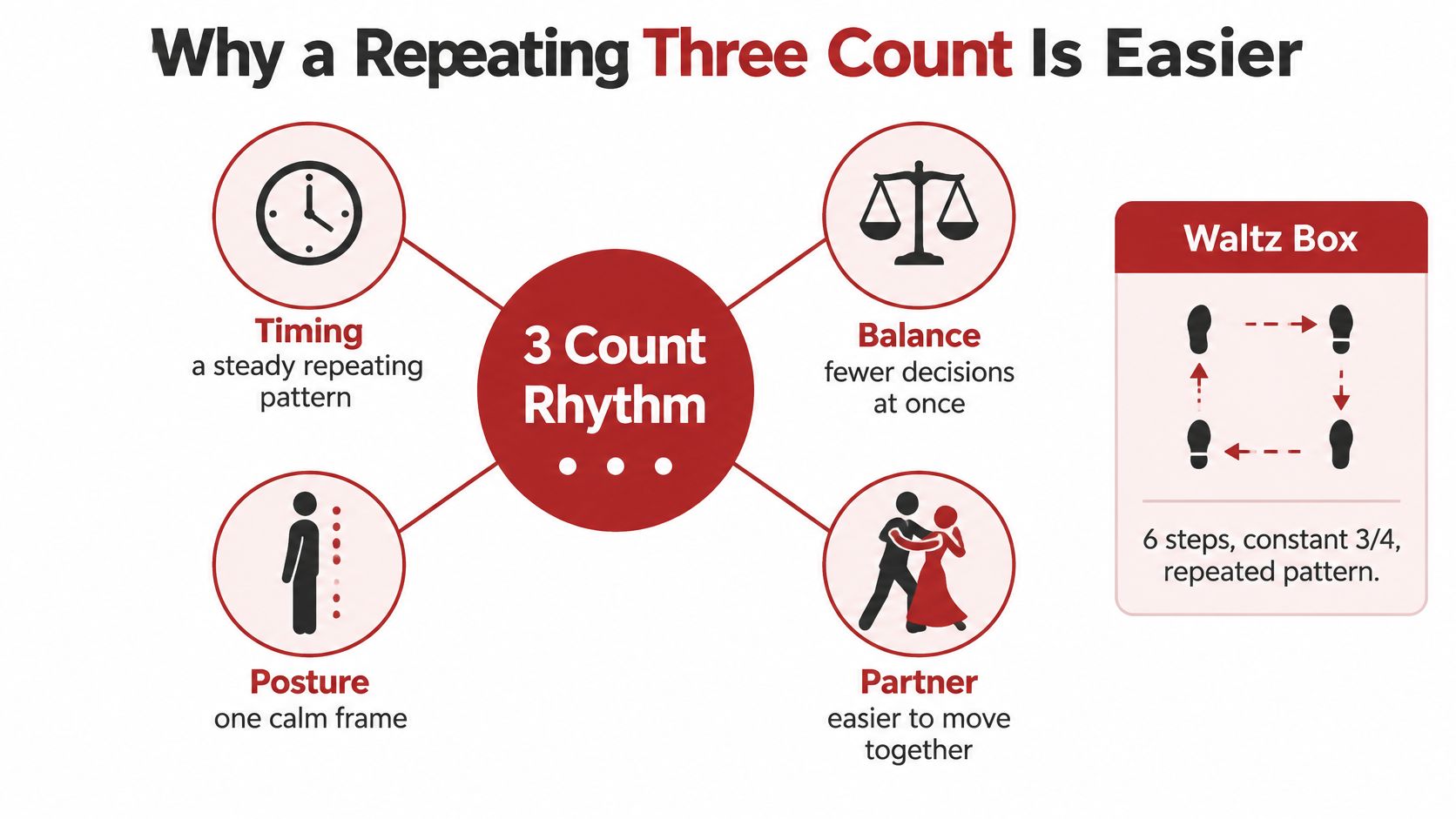
A beginner has four jobs at once. You must hear timing, keep balance, hold posture, and move with a partner. If the rhythm keeps changing, your attention goes to the feet and the other three jobs collapse.
Teachers call that problem motor learning load. In plain language, it's how many new decisions your brain must make before the next beat arrives. A regular count lowers that load, so you can spend attention where a teacher can help you.
What the Box Pattern Asks of You
The waltz box uses a predictable six count cycle, mostly weight transfers and walking sized steps. You count 1-2-3, 1-2-3, forward, side, close, then back, side, close. The second half mirrors the first, so a mistake doesn't send you into a new pattern.
Contrast that with a dance that asks for syncopation, fast direction changes, or pronounced hip action in lesson one. None of those is wrong. They're just extra jobs placed on feet that aren't reliable yet, and guessing quickly becomes a habit.
Research on novice dancers summarized in the PubMed record on rhythmic synchronization found that participants synchronized more accurately when movement was guided by clearly separated single beats, and performance deteriorated as rhythmic patterns became more mixed and subdivided. That fits studio practice. Even beats give a new dancer a clean target.
An Empty Lot Before Traffic
Think of learning to drive in an empty lot. You practice starting, stopping, and turning with long gaps between decisions. Nobody learns those basics by merging into fast traffic on day one, even though traffic is the eventual goal.
Slow waltz is the empty lot version of ballroom. The gap between beats lets you correct a late weight change before it becomes a stumble. Faster dances shrink that gap, so small timing errors stack up.
The Order of a Sensible First Lesson
- Weight changes only: Shift from foot to foot on the count, without traveling.
- Rise and fall kept very small: Stay level enough that balance stays simple.
- Slow tempo: Keep the music calm while the box becomes familiar.
Rotational turns, frame refinement, and musical phrasing come after the basic runs without constant thought. If a teacher adds them too early, you'll look busy and feel lost.
Success in week one isn't a polished pattern across the floor. It's an even count you can repeat alone, start again after a pause, and keep while standing tall. Once you can do that, partner work has something solid to build on.
How Speed Changes the First Lesson
Tempo isn't a vibe. It's the amount of time you get to finish each action. When students ask what is the easiest ballroom dance to learn, I translate beats per minute into seconds they can feel.
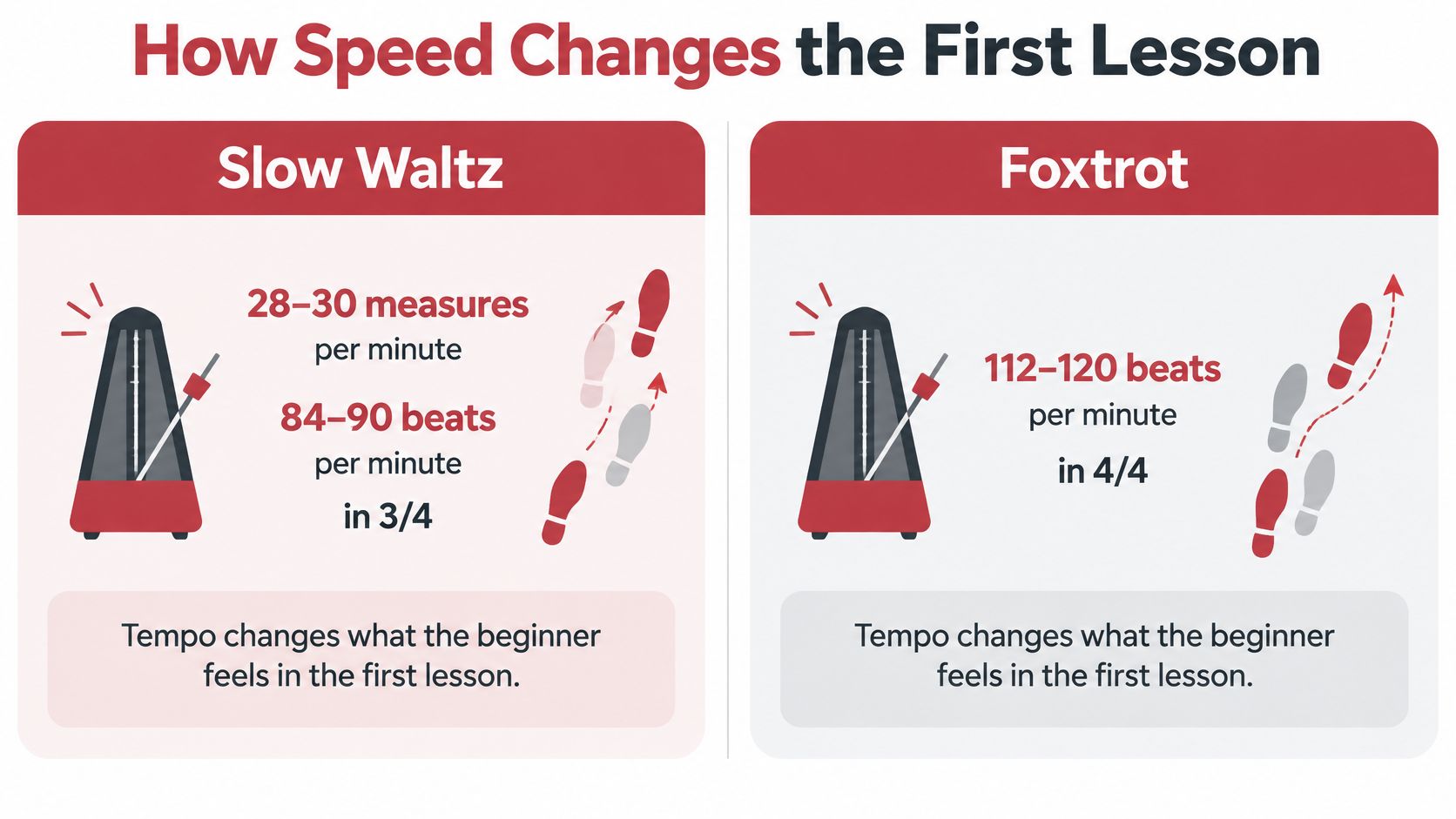
Slow waltz runs at 28–30 measures per minute in 3/4 time. Foxtrot gives you four beats per measure and a walking feel, but the music moves sooner. Quickstep and Viennese waltz cut your decision time sharply.
Foxtrot Can Be Slowed Down
Foxtrot is in 4/4 time, with beginner counts such as slow-slow-quick-quick or slow-quick-quick. A teacher can start with plain walks, hold the tempo down, and raise it only after your timing stays put. That flexibility makes foxtrot a reasonable second candidate, especially if you prefer walking to a three count sway.
Our guide to dance music tempo helps you hear why the same steps feel calm in practice music and rushed in a full speed song. Don't judge foxtrot by a fast recording. Judge it by whether you can keep the slows long and the quicks unhurried at practice speed.
- Slow waltz: Even beats, so every step gets similar time.
- Foxtrot: Long and short values, so you must stretch the slows.
- Quickstep: Short values at high speed, so errors arrive quickly.
When a Familiar Count Stops Feeling Slow
Viennese waltz still uses 1-2-3, but continuous turning at high speed changes the job completely. Your feet may know the count while your balance and orientation fall behind. A familiar number pattern doesn't rescue a first lesson if rotation never lets you reset.
Quickstep is clearer still. The LoDance tempo guide places quickstep at about 48–52 measures per minute, or roughly 192–208 beats per minute, compared with slow waltz at 84–90 beats per minute. The difference is approximately 108–124 beats per minute.
Do that subtraction in your body. In quickstep you must find the beat, transfer weight, keep posture, avoid other couples, and stay connected, all with far less time per action. Floorcraft alone can overwhelm a new dancer on a busy floor.
Tempo isn't the only difficulty. Posture and rotation still need instruction, and a slow dance danced with a tense frame won't feel easy. Tempo is the clearest mechanical reason to save quickstep and Viennese waltz for later, while foxtrot can be reduced for learning and slow waltz starts calm.
What the First Lessons Feel Like
Charts don't tell you what your body will notice. These short scenes do. Read them and ask which one you'd willingly repeat, because repetition is where learning happens.
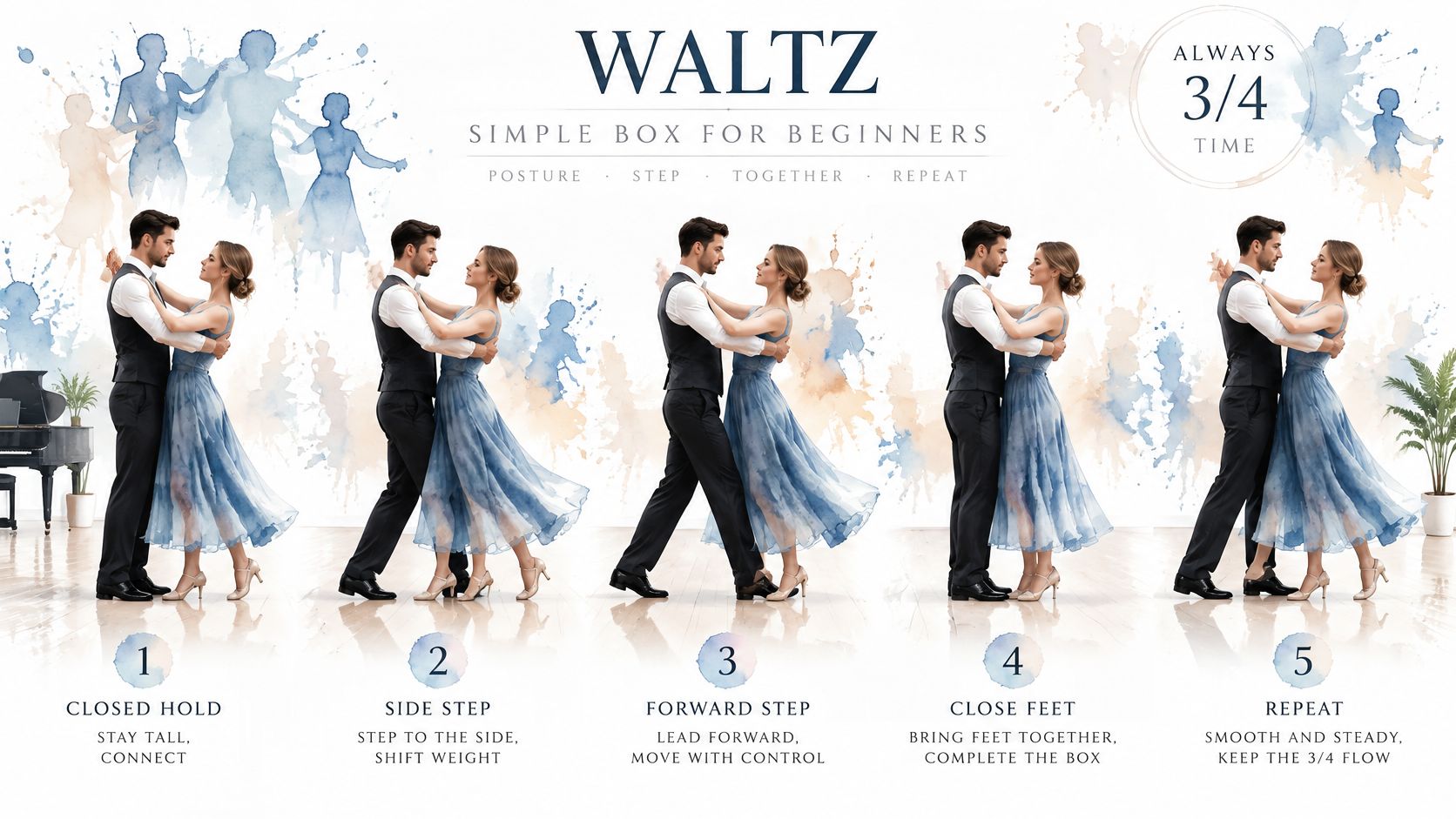
The diagram below shows the waltz box and the posture points a teacher checks while you repeat it.
Slow Waltz and Foxtrot
In slow waltz, you trace a small box and mostly change weight. The surprise is how much discipline it takes not to rush beats two and three. A 2023 Fred Astaire article describes slow waltz as having a straightforward box step pattern and constant 3/4 tempo, while noting that partner technique requires practice.
Foxtrot feels like a stroll. You take longer steps on the slows and shorter steps on the quicks, traveling gently around the room. It stays pleasant while the music is slowed, then the quicks bunch together if you shorten the slows to keep up.
Watch the basic below once for the shape of the movement, not for styling. Notice how little happens besides weight change, direction, and timing.
Merengue, Swing, Hustle, and Salsa
Merengue feels like marching in place to music. Many students can join in within minutes, which builds confidence fast. The risk is boredom, since a pattern that feels too plain may not hold your interest long enough to become social dancing.
Hustle and East Coast swing give you a bounce, a rock step, and more space between partners. They feel social quickly, especially if you like upbeat music. Their syncopation punishes guessing, though, so you need to hear where the rock step lands instead of bouncing hopefully.
Salsa starts with a forward and back basic that matches music many adults already love. You can feel successful without hip action or turns in lesson one. Those details become later problems, after your feet can find the basic without stopping.
Looking competent at a first dance usually comes from repeating one pattern cleanly, not from collecting figures.
That's the test. Choose the scene you can picture practicing for a month, with music you like and a hold that doesn't make you tense. The easiest first lesson is the one you'll attend again next week.
Choose by Goal Music and Comfort
Most beginner lists crown waltz, foxtrot, rumba, East Coast swing, or merengue and stop there. That leaves out the reason you're learning, the music you'll hear, your mobility, and whether you'll dance with a regular partner. Those details can change the answer.
A Dance With Me guide to beginner friendly dances is useful background for the common candidates, but you still need to separate outcomes. Fastest first success, easiest social use, and best foundation for broader ballroom learning aren't the same prize.
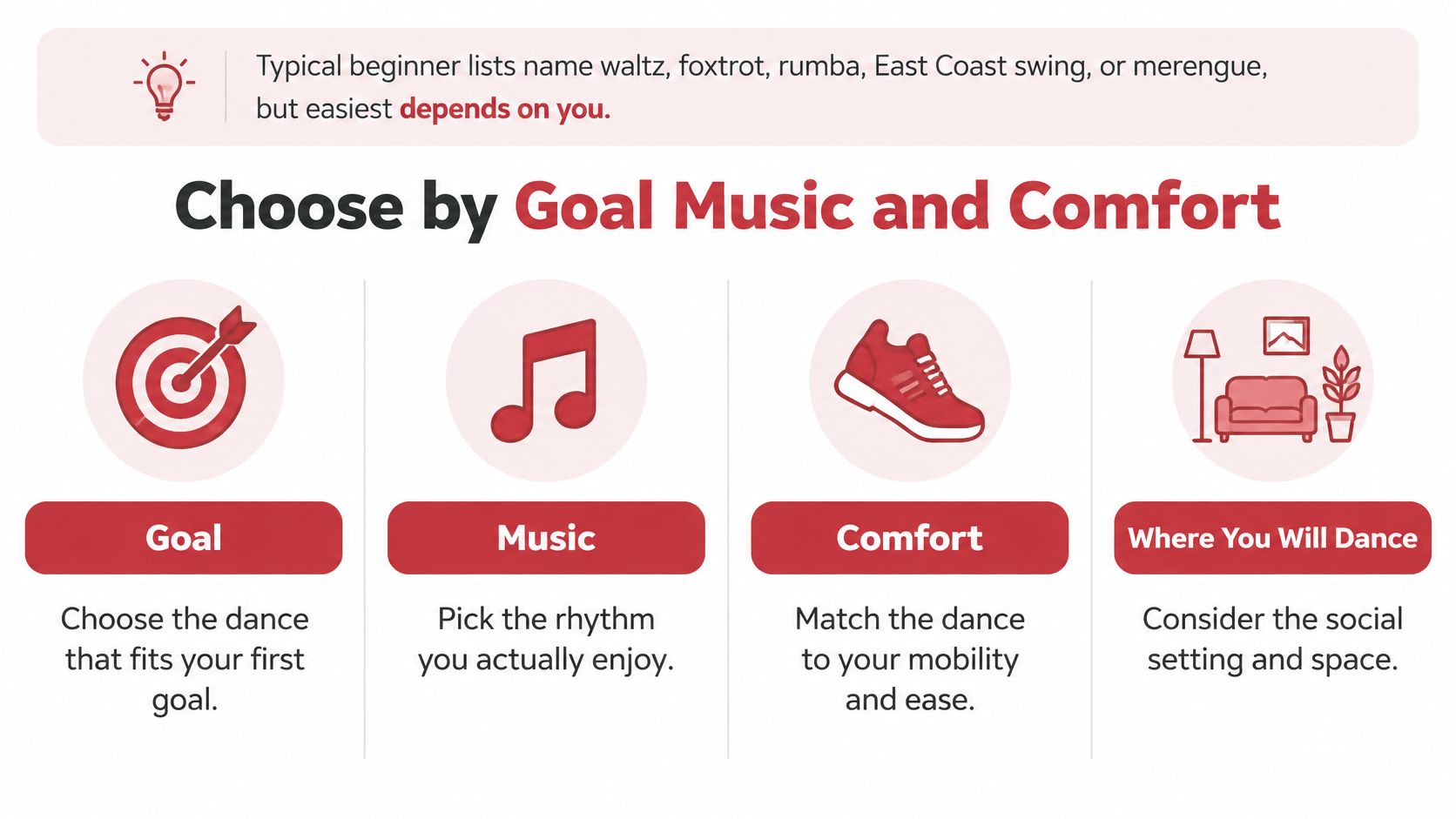
Three Outcomes, Three Answers
For fastest first success, merengue's marching pattern and the slow waltz box keep pattern complexity low. You spend the lesson moving, not memorizing. That early win matters if nervousness is your main barrier.
For social use, East Coast swing or hustle often wins because the music is upbeat and an open position is available. For a ballroom foundation, slow waltz trains weight change, posture, and partner movement before faster standard dances demand them.
Which first dance fits the goal
| Your situation | Start with | Why this is easier for you |
|---|---|---|
| Fastest first success | Merengue march or slow waltz box | Few pattern changes and an even count |
| Social night out | East Coast swing or hustle | Upbeat music and a more open hold |
| Wedding first dance | Slow waltz, or foxtrot if you prefer walks | Recognizable music and a teachable basic |
| Foundation for more ballroom | Slow waltz | Predictable 3/4 timing before faster standards |
| Uneasy with close contact | Hustle or an open position salsa basic | Less closed frame at the start |
| Strong rhythm already | Foxtrot or salsa | Uneven counts feel natural instead of confusing |
Comfort Is Not a Footnote
If you're an older adult or you have limited mobility, slower music and smaller steps reduce rushing. Balance, turning, and standing posture still need scaling by a teacher. Tell the studio about sore knees, dizziness with turns, or a fear of a close hold before the lesson starts.
If you don't have a regular partner, choose a basic you can practice solo between classes. Waltz box, merengue march, and salsa forward and back all work alone. A weekly class habit matters more than picking the theoretically perfect style name.
Enjoyment decides whether you continue. The technically simplest dance isn't always the easiest to sustain, because you won't practice music you dislike. Pick one row from the table and ignore the other dances until that basic feels comfortable.
How Long the Learning Curve Takes
Don't measure progress by a promised number of weeks. Students arrive with different balance, rhythm, practice time, and goals. Measure it by checks you can see and feel.
Our overview of how long ballroom learning takes follows the same idea. A date on a calendar can't tell you whether your weight change is on time.
Four Stages to Watch
Stage one, the first lesson: You learn the count, basic weight changes, and one pattern at a slow tempo. The check is simple. Can you start on count one without watching the teacher's feet?
Stage two, solo repetition: You repeat the basic alone until it runs without looking down. Most beginners underestimate this stage, yet it's where timing becomes yours instead of borrowed from the instructor.
Stage three, partner work: You add a light practice frame or open hold. Now timing, posture, spacing, and connection must hold together, and small rushes become easier to spot.
Stage four, expansion: You add turns, a fuller tempo, and musical phrasing. This stage works only after the earlier checks feel automatic, not merely familiar.
What Speeds the Curve
- Weekly class habit: Regular correction stops a timing error from becoming muscle memory.
- Short daily counting practice: Five calm repetitions beat one long, frustrated session.
- Music at the right tempo: Practice tracks should let you finish each weight change.
- Early teacher feedback: A small posture fix now saves relearning later.
An easier dance shortens stage one. Syncopated dances such as hustle or salsa may lengthen stage two because the count is less predictable. That doesn't make them bad choices, it tells you where patience will be needed.
How to Practice Your First Pattern
Use one routine for the first month. It works for waltz as written, and the swaps for foxtrot, merengue, swing, hustle, or salsa are noted in the steps. Changing dances every week resets stage one and makes every dance feel hard.
Our advice on learning ballroom dancing at home fits this routine because the count and weight change can be trained alone. A missing partner isn't a reason to wait.
A Seven Step Home Routine
- Pick one outcome and commit: Choose from your goal, then keep that dance for the first month. The usual mistake is sampling five styles and mastering none.
- Choose music you like at the right speed: Use slow waltz music in its normal calm range, or a slowed foxtrot track if foxtrot was your pick. Latin learners building a practice playlist can try Baila Radio on OohYeah for songs to count against at home.
- Practice weight change only: Stand in socks or dance shoes, count 1-2-3 out loud, and shift weight without traveling. For foxtrot, count slow and quick instead, but keep the feet just as plain.
- Add the basic shape: For waltz, go forward, side, close, then back, side, close, with walking length steps. Merengue learners march, salsa learners step forward and back, and swing learners keep the rock step small.
- Reset when you rush: Mark a line on the floor, and stop if your feet beat the count to the next step. Restarting cleanly teaches more than pushing through a muddled repetition.
- Add a partner last: After the pattern is automatic, use a light practice frame or open hold and repeat the same basic. Don't let partner work become an excuse to add turns.
- Keep styling tiny: Keep rise and fall small, skip underarm turns, and stay at the slow tempo for several weeks. Collecting advanced figures in week one usually breaks the count.
You'll know it's working when you can finish the basic without looking down. You can pause, breathe, and start again on count one. That check matters more than how many patterns you can name.
Book a Complimentary Lesson to Test It
A three-count can look simple on the page and feel different once you try it. Use a lesson to test your choice, whether that is slow waltz or another dance that fits your music. A teacher can adjust the tempo and help you notice when your steps start to rush.
Danza Academy welcomes beginners, and you do not need a partner to take lessons. Come on your own or bring someone along. Your first lesson is complimentary and easy to book, and the academy has studios in Philadelphia and Exton, PA.
What to Say When You Book
Start with your goal: a wedding first dance, social dancing, or a ballroom foundation. Mention any concerns about balance, turning, or close hold. Naming music you enjoy can also help the teacher choose a comfortable starting tempo.
Expect to work on weight changes and a basic pattern at a measured pace. Afterward, ask yourself: Could you repeat the basic, and would you enjoy practicing it again next week? That is a more useful test than counting how many figures you learned.
If waltz does not suit you, a lesson can help you compare it with a style that better matches your music. Book your complimentary first lesson using the “BOOK your free lesson” button on the Danza Academy home page.
If slow waltz sounds right, start there. If swing, Hustle, Foxtrot, or Salsa feels like a better fit, tell your teacher which one you want to try. Danza Academy offers lessons in Philadelphia and Exton, with instruction for beginners.