
You hear a song at a wedding, a party, or in your kitchen and think, “I love this. But can I dance to it?” That question stops a lot of people before they ever take the first step.
The answer usually comes down to tempo. Not talent. Not fancy footwork. Not whether you've danced before.
Tempo is the part of the music that tells your body how fast to move, how long to stay grounded, and how much time you have to connect with a partner. Once you understand it, songs stop feeling random. You start hearing structure. Your feet get clearer instructions. Dancing gets less intimidating and a lot more fun.
The First Step to Musicality
A beginner often thinks dance starts with steps. In practice, it starts with listening.
When a song comes on, your body reacts before your brain explains anything. Maybe your shoulders loosen. Maybe your foot taps. Maybe you feel like swaying, walking, or bouncing. That reaction is your first clue about the music's tempo.
Tempo is the speed of the beat. BPM, or beats per minute, is the number used to measure that speed. If a song has a lower BPM, the beat feels calmer and gives you more time between steps. If the BPM is higher, the beat arrives faster and asks for quicker movement.
For dancers, that number matters because it changes what feels comfortable. A slow, romantic song might invite long, smooth motion. A bright, punchy track might ask for compact, quick steps. Neither is better. They just create different movement conversations.
A lot of musicality becomes easier once you stop treating music like a blur and start hearing its pulse. If you want a deeper foundation for that skill, this introduction to musicality in dance is a helpful next read.
Practical rule: If you can identify the beat consistently, you can start dancing. You don't need to know everything about music theory first.
The good news is that tempo isn't a secret language meant for musicians. It's a practical tool for everyday dancers. It helps you decide whether a song suits Waltz, Cha Cha, Swing, or a relaxed social sway. It helps leaders time their signals and followers recognize when movement should stretch or sharpen.
Most of all, it helps you move from “I hope I'm doing this right” to “I know what this music is asking for.”
Understanding Tempo and BPM for Dancers
Think of BPM like a heartbeat. A calm heartbeat feels steady and spacious. A racing heartbeat feels urgent and energetic. Music works the same way.
A lower tempo usually feels like a walk with long steps and breathing room. A higher tempo can feel more like a brisk jog, where your body has to react sooner and with more precision. Dancers don't need to memorize every BPM number they hear. They need to learn what those numbers feel like in the body.
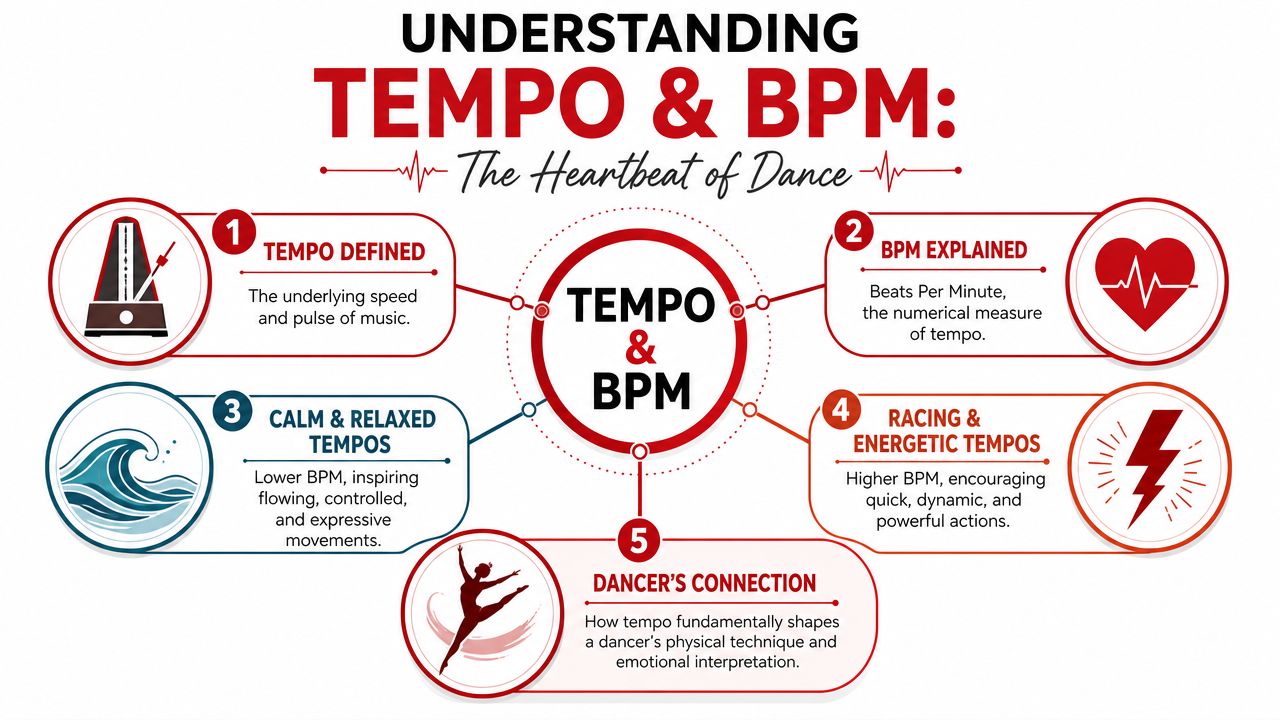
How BPM feels in motion
If a song is slow enough for you to settle your weight fully before the next beat, it will usually feel grounded and expressive. That's why slower dances often look smooth and controlled.
As the BPM rises, each beat arrives with less waiting time. Your steps get smaller, your reactions get sharper, and your balance has to be more organized. Fast dancing isn't just “slow dancing but quicker.” It requires a different use of the body.
A useful skill is learning to find the beat in music without overthinking. Start by clapping the pulse. Then walk to it. Then shift weight side to side. Those three layers make tempo feel physical instead of abstract.
Why so much dance music sits in a familiar range
Researchers studying dance music found a strong preference around 128 bpm, describing it as a point that “aligns with the natural resonance of human movement” and creates a physiological center of gravity for dancer engagement in this dance movement and tempo study. That idea makes sense on the floor. At the right speed, people don't feel rushed, but they also don't lose momentum.
Another long-term study of dance music found that the predominant natural tempo for social dancing is 128 bpm, with a consistent main peak there across the dataset. The same research reported a mean tempo of 121.9 bpm, a median tempo of 124 bpm, and a mode of 130 bpm, appearing in 5,521 pieces or 4.4% of the total set, as shown in the University of Ghent research paper. For dancers, the takeaway is simple. Music often clusters where human movement feels efficient and satisfying.
A tempo number isn't there to impress you. It's there to tell your body how much time it has.
That's why tempo matters so much in social dancing. It isn't just about speed. It's about comfort, control, and connection.
A Practical Guide to Dance Tempos by Style
You put on a song that sounds right for Waltz, start gliding across the floor, and within a few measures the dance feels oddly cramped. The steps are correct, but the music is asking your body to move differently. That is why tempo matters by style. It does more than set speed. It changes how a dance breathes, how a partnership connects, and whether the movement feels natural or forced.
Different dances live in different tempo neighborhoods. Learn those neighborhoods, and choosing music gets much easier. More important, you start to understand why one song supports a dance and another fights it.
Ballroom and smooth styles
Waltz needs room to travel. The rise and fall, turning action, and suspended feeling all depend on having enough time to move through each measure instead of rushing to the next step. A compiled dance tempo reference lists Waltzes at 115 to 165 bpm, with an average around 140 bpm. That wide span helps explain why some Waltzes feel soft and floating while others feel more progressive and driving (dance tempo archive).
If you're learning that rise-and-fall feeling, seeing the movement in context helps. This guide on how to dance the Waltz gives a strong visual starting point for matching motion to music.
Standard tempo matters in ballroom because technique depends on timing you can trust. If the song runs too fast, dancers clip the ends of movements and lose the flowing quality. If it drags too much, they often hang on shapes too long and the dance starts to feel heavy. The right tempo gives each action enough space to finish cleanly.
Latin tempos and character
Latin dances can confuse beginners because the music often sounds relaxed while the body action is very specific. Cha Cha needs quick, sharp rhythm. Samba needs elastic bounce. Rumba needs time to settle into the floor and stretch the partnership without stalling.
The same compiled reference lists Cha Cha at 120 to 124 bpm, Samba at 96 to 100 bpm, Swing at 136 bpm, and Rumba at 128 to 144 bpm for Bronze, with 120 to 128 bpm for other levels. Those numbers are useful because they point to movement quality, not just speed. At the right tempo, Cha Cha feels crisp, Samba has spring, and Rumba has space for control and expression without losing flow.
On the floor: If a Latin dance feels awkward, the problem may be the song speed rather than your step pattern.
Social and club tempos
Social dancers also benefit from broad genre ranges. Ableton's tempo and genre overview notes that House often sits at 115 to 130 bpm, Techno and Trance at 120 to 140 bpm, and Drum and Bass at 160 to 180 bpm. You can feel that difference right away. One track invites a grounded groove with a partner. Another pushes the energy so high that the dance becomes more about stamina than connection.
That same contrast shows up in traditional social forms too. Contradance is often kept in a moderate range because the goal is shared enjoyment over time, not maximum speed. On a busy floor, a comfortable tempo helps dancers stay relaxed, hear the phrasing, and keep the set moving without turning the whole evening into a workout.
Dance Style Tempo Guide
| Dance Style | Typical BPM Range | Feel & Energy |
|---|---|---|
| Waltz | 115 to 165 bpm | Flowing, turning, buoyant |
| Cha Cha | 120 to 124 bpm | Crisp, playful, syncopated |
| Samba | 96 to 100 bpm | Bouncy, elastic, rhythmic |
| Rumba Bronze | 128 to 144 bpm | More driving, expressive |
| Rumba other levels | 120 to 128 bpm | Controlled, settled, romantic |
| Swing | 136 bpm | Lively, athletic, upbeat |
| House | 115 to 130 bpm | Steady groove, club energy |
| Techno and Trance | 120 to 140 bpm | Driving, continuous, high momentum |
| Drum and Bass | 160 to 180 bpm | Very fast, high output |
| Contradance | Moderate social range | Social, comfortable, sustainable |
Use this table as a starting map, not a strict rulebook. A song slightly outside the usual range can still work if the pulse is clear and the movement quality fits the dance. For practice, though, staying close to these tempo ranges makes learning much easier because your body gets to feel the dance the way experienced instructors intend it to feel on the floor.
How Tempo Influences Technique and Connection
Technique changes when tempo changes. So does partner connection.
A slower song gives both dancers more time to complete weight transfers, finish lines, and feel the rise and fall of movement. A faster song removes that extra space. If your technique stays the same while the tempo speeds up, your dancing usually starts to feel late, heavy, or crowded.
Slow tempo asks for completion
In a slower dance, the challenge isn't just moving later. It's moving fully.
Take a Waltz-like feeling versus a more compact social dance. In slower music, dancers have time to extend through the standing leg, shape the upper body, and finish a turn with intention. Leaders can give gentler information because the follower has room to receive and complete it. Followers can sense the direction of movement earlier and respond with smoother timing.
That doesn't mean slow dancing is easy. Slow tempo exposes balance issues. If your weight hangs between feet or your frame collapses, the music gives everyone time to notice.
Fast tempo asks for efficiency
Fast music rewards clean organization. You can't waste movement.
Leaders need earlier, clearer signals because the next beat arrives quickly. Followers benefit from staying toned and ready instead of waiting passively. Both dancers must reduce extra motion. Big steps often become a problem because they take too long to complete.
This demonstration is worth watching with that idea in mind.
Connection lives in shared timing
Partner dancing works best when both people feel the same pulse. Tempo is the meeting place.
If one dancer hears the beat as relaxed and the other hears it as urgent, the connection gets blurry. The lead may feel pushy. The follow may seem delayed. Usually, both dancers are trying. They're just responding to the music differently.
A simple way to improve connection is to match the size and tone of your movement to the song's speed before you attempt anything fancy. Small, quick steps in fast music often feel better than large, dramatic ones. In slower music, giving a movement time to breathe usually creates more elegance than rushing to the next figure.
Connection isn't only about your hands or frame. It's about whether both bodies agree on how fast the conversation is happening.
Finding Your Rhythm and Practicing with Tempo
You don't need a live band or a packed ballroom to improve your timing. You need a repeatable way to hear the beat, move with it, and notice when you drift.
That's where simple tools help. A metronome can act like a private rhythm coach. It strips away lyrics, production, and emotional distraction so you can practice pure timing. Then, when you return to real music, your body recognizes the pulse more quickly.
Build timing before speed
Beginners often think they should practice at full song speed right away. That usually creates tension and mistakes.
A smarter approach is to slow the task down. Teachers do this all the time. They use slower music so students can understand weight changes, directional changes, and partner timing without panic. Once the movement is organized, they increase the speed.
Try this practice sequence at home:
- Clap the beat for one full song without stepping.
- Walk the beat around the room with even weight changes.
- Mark one basic pattern with your feet only.
- Add arms or partner frame after the feet feel automatic.
- Increase speed gradually only when the timing stays clean.
Start at a tempo where you can succeed. Confidence grows faster than correction.
Use music in layers
The best home practice doesn't rely on one favorite song. Use a mix.
- Metronome practice: Pick a comfortable setting and do a basic step until the timing feels dependable.
- Original track practice: Dance to the full song and notice whether lyrics or accents pull you off the beat.
- Different versions of the same song: If you can find a slower version and a more energetic remix, you'll train adaptability instead of memorizing one exact feel.
- Recorded self-checks: Film a short round and see whether your feet land with the beat or slightly after it.
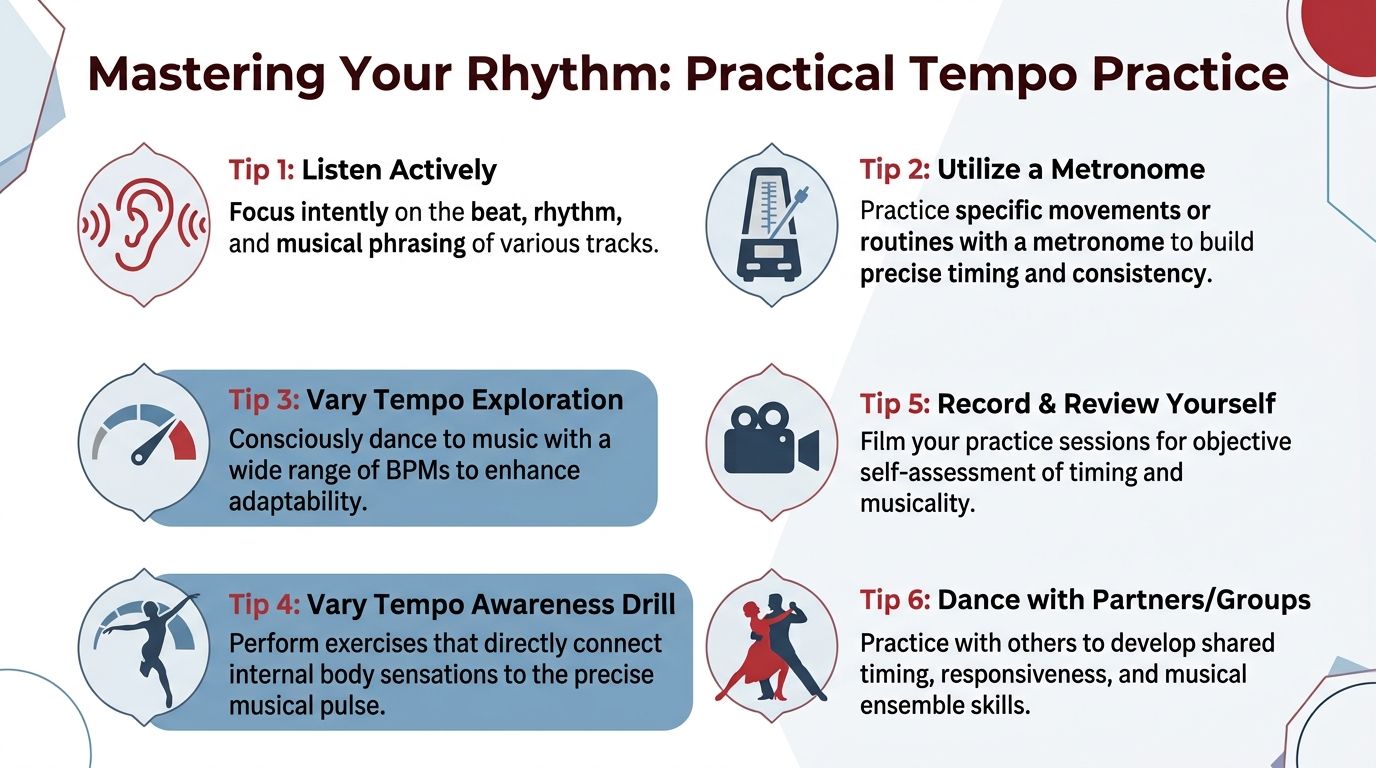
Practice with your body, not just your ears
Tempo becomes reliable when your body learns it physically.
Try small drills such as weight shifts, side steps, or quarter turns to a steady beat. Then pause and ask yourself one question: did the music pull you, or did you choose the beat clearly? That question trains awareness.
Group practice helps too. When you move with another person, timing gets less theoretical. You feel immediately whether your rhythm matches theirs. That shared pulse is one of the fastest ways to improve musicality.
Choosing the Perfect Tempo for Classes and Weddings
A song can be beautiful and still be hard to dance to. That matters in class, and it matters even more at a wedding where everyone is watching and emotions are already high.
For social dancers, choosing a workable tempo means more enjoyment and less guessing. If the song feels steady and the beat is easy to hear, you'll usually have a better dance than if you force a favorite track that fights your timing.
For classes and social dancing
When you hear a new song, don't ask only, “Do I like it?” Ask a more useful question. “Can I comfortably find the beat and complete my basic step?”
If the answer is yes, the song may be workable even if it isn't perfect. If the answer is no, the problem might be tempo, unclear rhythm, or both. Sitting one out is sometimes the smart choice, especially when a song is technically possible but not enjoyable for your current level.
For weddings and first dances
Couples often choose a song by lyrics first and danceability second. That order causes trouble. A meaningful song with an awkward tempo can make a first dance much harder than it needs to be.
Bring a short list of songs, not just one, and test each one by moving to the beat together. Can you walk naturally to it? Can you sway without feeling rushed? Can simple turns fit the musical pulse? Those questions reveal more than romance alone.
If you're narrowing options, a thoughtful guide to wedding music choices can help you compare songs from a practical point of view as well as an emotional one.
The best first dance song isn't only memorable. It's a song that lets you look at each other, breathe, and move with confidence.
A great wedding dance usually feels easier than guests expect. That ease often starts with the right tempo.
Feel the Music and Start Dancing
Dance music tempo isn't just a technical topic for DJs or musicians. For dancers, it's the map. It tells you how fast to move, how much space to use, and how to connect your body to the beat.
Once you start hearing tempo clearly, a lot of confusion disappears. Songs stop blending together. You begin to recognize why one track feels smooth, another feels playful, and another feels too rushed for the dance you had in mind. That awareness changes the way you practice, the way you choose music, and the way you dance with a partner.
You also don't have to master all of this at once. Most dancers improve one layer at a time. First, they hear the beat. Then they step with it. Then they shape movement to match the song's character. That's real progress.
The best part is that tempo is learnable. It isn't something you're born knowing. With the right music, clear feedback, and patient repetition, your timing gets stronger and your dancing gets more relaxed.
If you're ready to turn all of this from theory into movement, book a free complimentary lesson with Danza Academy of Social Dance through the contact page. It's a welcoming way to feel the beat in person, get expert guidance, and find the right tempo for your goals, whether you want social confidence, sharper technique, or a first dance that feels natural.