
A lot of adults meet the waltz at the same moment. The DJ announces a slow ballroom song, couples drift onto the floor, and suddenly that graceful turning dance looks a lot harder than it did from the table.
At lessons, I hear the same worries over and over. “I have no rhythm.” “We’re different heights.” “We just need something simple for the wedding.” Students don’t need more inspiration. They need a clean way into the dance, with steps that make sense and technique that feels doable.
That’s good news, because how to dance the waltz is much less mysterious than it looks. The dance grew from folk roots in the German-speaking regions of Europe, especially Bavaria, Tyrol, and Styria, around 1750, evolving through the Ländler into a distinct 3/4-time couples dance that shocked high society with its close hold before spreading across Europe by the late 18th century, as outlined in the history of the waltz. What once felt daring now feels timeless.
If you’re curious how the waltz fits into the bigger ballroom family, this overview of traditional ballroom dances gives helpful context. But if your real goal is simpler, to move with confidence at a wedding, social dance, or first lesson, the path starts with posture, timing, and a box step you can trust.
Introduction to Dancing the Waltz
The first thing to understand is that the waltz is built on three beats. You hear it as 1-2-3, 1-2-3, and you feel it as a smooth swing rather than a march.
Beginners usually make one of two mistakes. They either freeze because they think everything has to be perfect, or they rush because they assume elegance comes from moving fast. Neither works.
What the dance should feel like
A useful goal for your first few practices is not “look advanced.” It’s this:
- Stay balanced
- Transfer weight clearly
- Match the music
- Keep the partnership comfortable
If those four things are happening, the dance already reads as waltz.
The waltz looks flowing from the outside because the mechanics underneath are clean.
That matters even more for wedding couples. Most aren’t training for competition. They want a dance that feels calm, connected, and polished enough to enjoy in front of family and friends.
Why beginners often learn faster than they expect
The waltz has structure. Once your feet learn the recurring pattern and your body starts hearing the three-count naturally, the dance becomes much easier to repeat.
That’s why I teach it in layers:
- Stance and hold first
- Box step with clear counts
- Rise and fall
- Simple turn
- Practical adjustments for dance situations
That last part matters more than most tutorials admit. Real couples don’t come in matching height, matching dance experience, or matching confidence. Good waltz training accounts for all of that from the start.
Essential Preparation and Stance
Your stance decides whether the dance feels smooth or awkward. Before the first step, get the frame right.
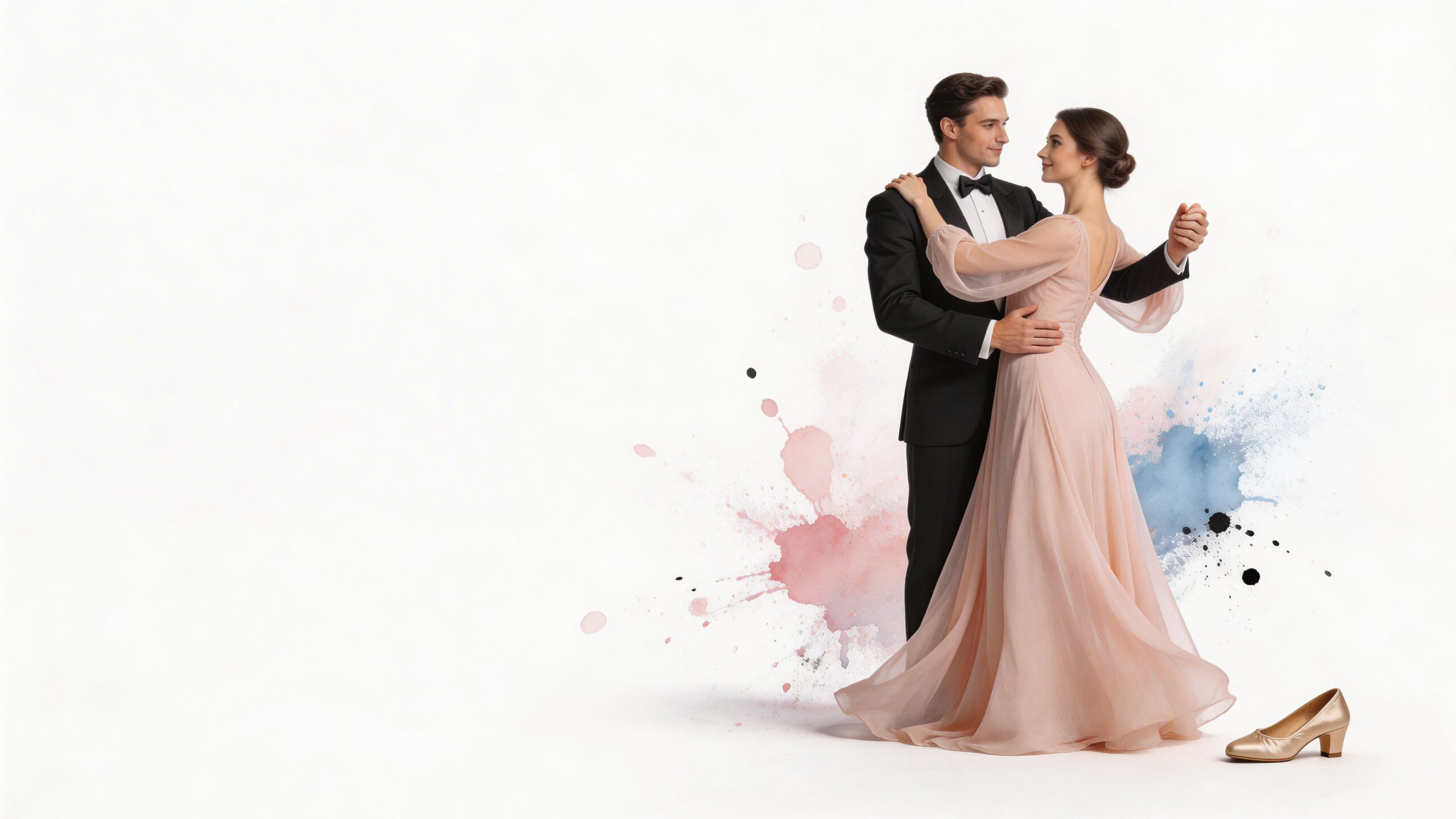
What to wear for practice
You don’t need formalwear to learn well. You do need clothes that let you move and shoes that don’t fight the floor.
A practical setup:
- Clothing: Wear something you can turn in without tugging or adjusting.
- Shoes: Choose supportive shoes that stay secure on the foot.
- Avoid: Sticky rubber soles, heavy boots, and anything that makes pivoting feel forced.
If one partner is testing wedding shoes, bring them in for part of practice, not the entire session. Learn the movement first, then test the styling.
Build a closed hold that actually works
In standard closed position, the leader places the right hand on the follower’s back around shoulder blade level. The leader’s left hand connects to the follower’s right. The follower’s left hand rests on the leader’s upper arm or shoulder area, depending on the style being taught.
Keep these points simple:
- Stand tall through the spine
- Keep the ribs quiet
- Let the elbows float, not droop
- Connect through the body, not by squeezing the hands
The mistake I see most is over-gripping. Tight hands create stiff shoulders, and stiff shoulders kill the softness people associate with waltz.
Height differences need adjustment, not apology
A lot of couples assume a height gap means they’re bad at partnering. Usually, they just need a smarter frame.
According to this discussion of height adaptation in waltz, mismatched partner heights account for 30% of beginner dropouts, and Google Trends showed “waltz height difference” searches spiked 25% since 2023, which is why adaptive holds like slight knee bends or subtle arm lifts matter in practice (reference).
Try these fixes:
| Situation | What helps | What usually fails |
|---|---|---|
| Leader is much taller | Soften knees slightly, widen through the back, avoid collapsing forward | Hunching down from the neck |
| Follower is much taller | Lift the shared hand line naturally, keep both sides broad | Forcing the taller partner to shrink |
| Big arm-length difference | Shorten the frame slightly and prioritize body alignment | Reaching to “find” each other |
Practical rule: Adjust from the legs and frame first. Don’t solve a height issue by twisting the upper body.
When the hold fits the couple, the box step gets easier immediately.
Learning the Box Step and Musical Timing
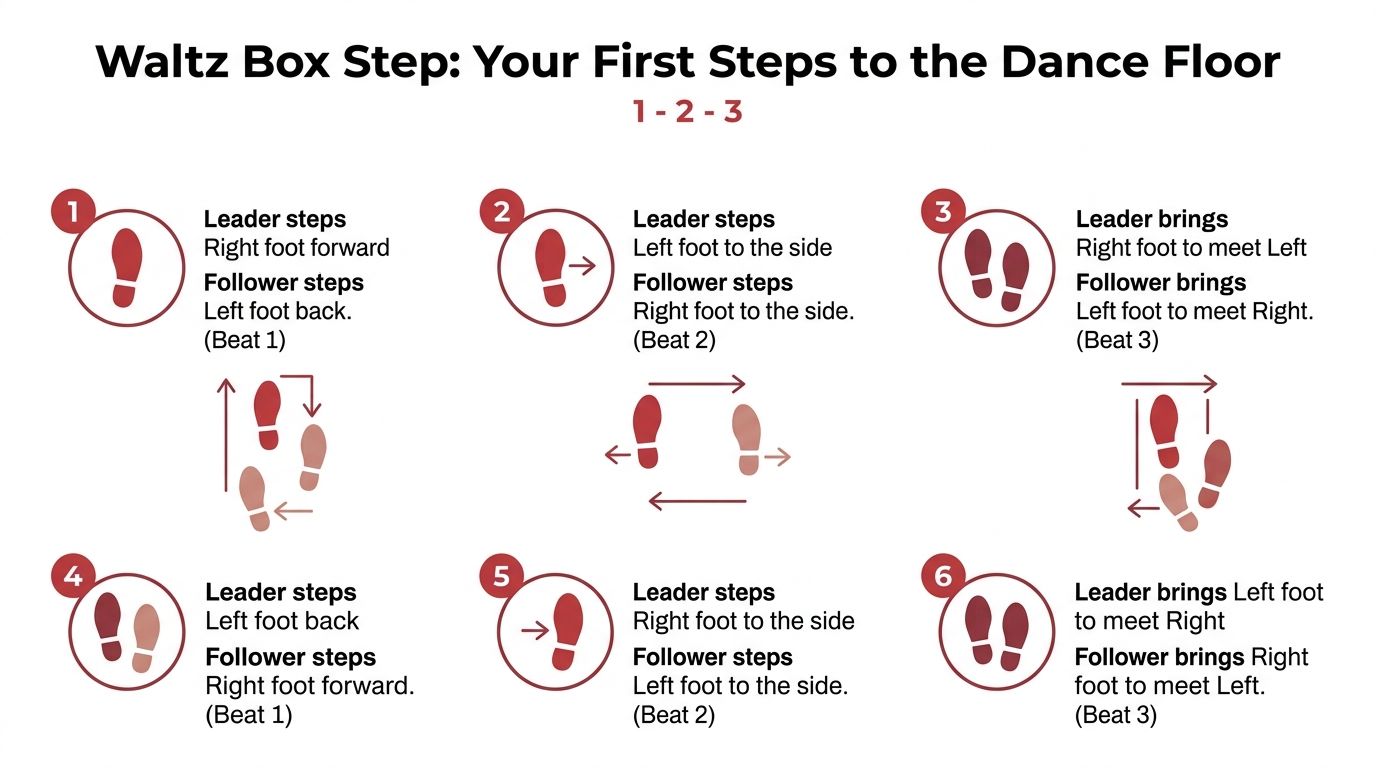
Most of the confusion around the waltz disappears when the box step is taught with clear weight changes. The pattern has six actions, but it’s really two halves that mirror each other.
This visual can help before you try it full speed.
The count under your feet
The International Standard Waltz box step uses a strict weight-transfer pattern with a slow-quick-quick count, and delayed rise on count two with controlled lowering on count three can improve figure flow by up to 40% according to this box step technique breakdown.
That sounds technical, but the felt version is simple:
- Count 1: Commit your weight
- Count 2: Travel and begin to rise
- Count 3: Close the feet and lower with control
A lot of online tutorials teach the step shape but skip the weight timing. That’s why dancers know where to put the feet but still don’t feel the dance.
For a quick visual lesson, this video is useful to watch before drilling counts aloud:
Leader footwork
For the leader, the classic box step goes like this:
- Left foot forward on 1
- Right foot side on 2
- Left foot closes to right on 3
- Right foot back on 1
- Left foot side on 2
- Right foot closes to left on 3
Think less about drawing a perfect geometric box and more about making clean directional choices. Forward means forward. Side means side. Close means collect the feet without slamming them together.
Follower footwork
The follower mirrors that action:
- Right foot back on 1
- Left foot side on 2
- Right foot closes to left on 3
- Left foot forward on 1
- Right foot side on 2
- Left foot closes to right on 3
Followers often improve quickly when they stop guessing and start waiting for the leader’s center to move. If the lead feels vague, don’t compensate by stepping early. That usually creates collisions.
A better way to practice timing
When couples struggle, I take away the music for a minute and use voice counts. That exposes whether the issue is musicality or foot placement.
Try this progression:
- Round one: Walk the pattern solo while saying “1-2-3.”
- Round two: Dance with a partner and pause after every close.
- Round three: Remove the pauses but keep the spoken count.
- Round four: Add slow music and keep the steps smaller than you think.
Small steps are your friend at first. Oversized steps make it harder to transfer weight and easier to lose the frame.
What smooth timing feels like
Here’s the trade-off most beginners need to hear. If you chase “big sweeping movement” too early, you usually lose balance. If you stay compact and precise, the sweep appears later on its own.
Don’t try to decorate a step you can’t yet land.
A good self-check is simple. On each count of 1, ask whether your standing leg has accepted your weight. If the answer is no, the next two counts will feel rushed.
Applying Rise and Fall with Simple Turns
Once the box step is stable, the waltz starts looking like the dance people recognize. That happens when the body begins to rise and lower with control, and when the couple adds a basic turn without breaking the frame.
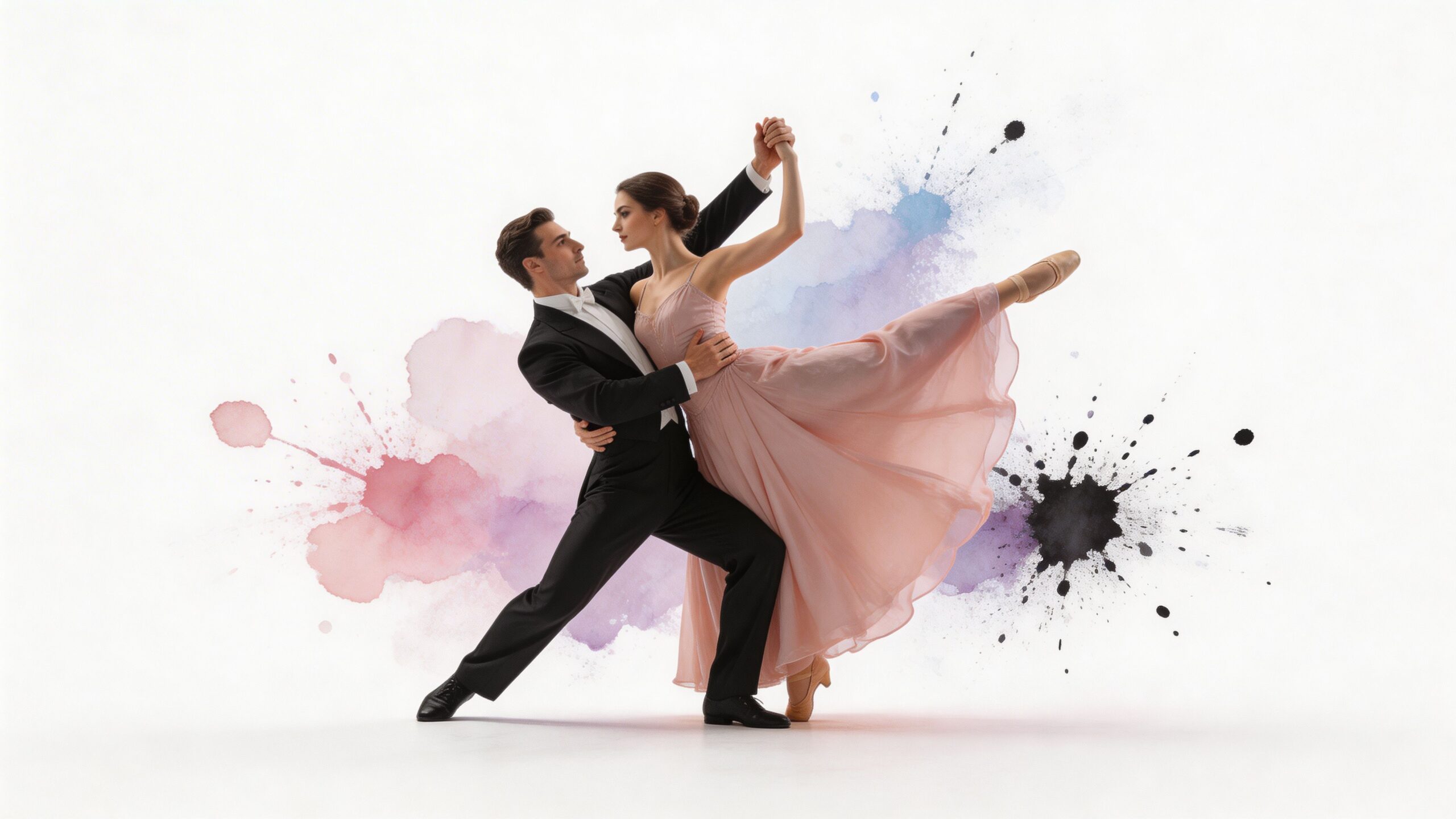
Rise and fall without bouncing
Rise and fall isn’t a hop. It comes from coordinated use of feet, ankles, knees, and body timing.
The easiest way to feel it:
- On 1, move with a grounded leg and full commitment of weight.
- Toward 2, allow the body to rise.
- On 3, collect and lower with control into the next action.
If you pop up too soon, the dance looks jumpy. If you wait forever to lower, the next step gets stuck.
A good cue is “float, don’t lift.” The body should travel as it rises.
Add a simple turning action
By the mid-1800s, Johann Strauss II had helped popularize the waltz as a symbol of Viennese elegance, and early 20th-century codification led to the International Standard Waltz with figures such as the Natural Turn and Chassé, danced at 28 to 30 bars per minute, as described in this history of competitive waltz development.
For beginners, the Natural Turn is often the first turning figure worth learning. It teaches rotation while preserving the same core ideas as the box step.
Think of it this way:
| Focus | What to do | What not to do |
|---|---|---|
| Rotation | Turn from the body and standing leg | Spin the shoulders first |
| Partnership | Keep the frame consistent through the turn | Let elbows collapse inward |
| Travel | Let the turn move across the floor | Turn on the spot with no direction |
A drill that cleans up turning fast
Use a landmark in the room. A doorway, mirror edge, or corner works well.
Practice this sequence:
- Dance one half box
- Begin a gentle turn
- Finish closed and balanced
- Pause and check where the partnership is facing
That pause matters. It reveals whether the couple turned together or whether one person dragged the other through the shape.
“If your turn feels rushed, reduce the size before you increase the rotation.”
That single adjustment fixes a lot. Most couples don’t need more force. They need better alignment.
Keep the body organized
Simple turning works when these pieces stay true:
- Head stays calm: Don’t whip it around.
- Center stays active: Lead from the torso, not the hands.
- Feet stay underneath: Reaching kills the turn.
- Top line stays open: Don’t fold inward when the room starts moving.
If dizziness is the problem, shorten the turn and keep your eyes soft on a visual reference between repetitions. Waltz should feel like gliding through a curve, not surviving a spin.
Troubleshooting Mistakes and Practice Drills
Most waltz problems aren’t random. They come from a small set of habits that show up again and again. The fix is to isolate the mistake instead of dancing the whole pattern badly for twenty minutes.
Mistake one: stepping without finishing weight transfer
This is the classic “I know the pattern, but it still feels messy” problem. The feet move, but the body never fully arrives over the standing leg.
Try this drill:
- Dance the box step solo.
- Freeze after every count of 1.
- Ask, “Could I lift my free foot without falling?”
- If not, the weight didn’t transfer.
This teaches commitment. Waltz punishes half-steps.
Mistake two: rising too early
People hear that waltz has rise and fall, then start climbing on the first beat. That usually creates a perched, unstable look.
Use a delayed rise drill. Dance only counts 1 and 2, then reset. Focus on staying grounded through the first action and allowing the rise to appear later.
A useful comparison:
| If you do this | You’ll feel | Result |
|---|---|---|
| Rise immediately | Light too soon | Bouncy and rushed |
| Delay rise naturally | Stable then floating | Smoother travel |
Mistake three: closing the feet with tension
A hard close on 3 makes the dance look clipped. It also tightens the hips and shoulders.
Use a brush-close drill. Instead of snapping the feet together, let the closing foot skim in with control. Keep the knees soft and the upper body quiet.
Mistake four: frame gets rigid or collapses
Some couples hold on for dear life. Others let the arms go slack. Both make leading and following harder.
Try a frame-release exercise:
- Take closed hold.
- Walk three slow steps without using the hands to pull.
- Reset and repeat with slightly more body tone.
- Keep the fingers light.
The point is to feel connection through the body. Hands transmit information. They shouldn’t do all the work.
Mistake five: height difference creates awkward angles
This shows up in the neck first. One partner cranes down, the other reaches up, and the whole partnership gets uncomfortable.
Use a height-adaptation drill for one song:
- Dance in place first
- Adjust elbow height
- Test a slight knee softening from the taller partner if needed
- Keep both chests lifted
- Then add travel
This is more effective than trying to “power through” with standard frame geometry that doesn’t fit your body pair.
Check this: If either partner feels neck strain after a few minutes, the hold needs adjustment before the choreography needs work.
A simple weekly practice format
Unfocused repetition is the slow route. A short, targeted session works better.
Use this structure:
- First block: Solo footwork with counts out loud
- Second block: Partnered box step without music
- Third block: One technical focus only, such as rise timing or frame
- Last block: One full song at comfortable size
End by naming one thing that improved and one thing to fix next time. That keeps practice honest.
Tips for a Seamless Wedding First Dance
Wedding waltz training works best when the dance fits the couple, the room, and the music. A routine that feels elegant in a large studio can feel crowded fast on a reception floor.
Choose music you can actually move to
Many couples pick a song emotionally first, then discover the phrasing is hard to dance. That’s not a disaster, but it changes what choreography makes sense.
Look for music with:
- Clear three-count feel
- Steady phrasing
- Enough space to breathe between lyrics
If you’re planning more than one featured family dance, song planning helps the whole reception feel intentional. A list like Top Father Daughter Dance Songs can be useful when you want matching mood and pacing across the evening.
Build a routine for the floor you’ll have
Wedding spaces vary. Some are wide and open. Some have tables, candles, and a photographer standing where your turn was supposed to go.
That means your first dance should include:
- A safe starting pose
- A basic traveling section
- One turn you trust
- A finish that photographs well
If you’re planning your dance and want examples of what couples usually prepare, this page on wedding dance lessons is a helpful reference for the process and lesson format.
Rehearse for real-life stress
A polished first dance doesn’t come from marathon sessions. It comes from consistent, shorter rehearsals where the couple remembers transitions under mild pressure.
I usually suggest couples practice:
- In regular clothes first
- In wedding shoes later
- With the exact song edit they’ll use
- In a space smaller than the studio, at least once
That last point matters. If you can stay calm in a tighter practice space, the actual venue often feels easier.
Have a scaled-down version ready
This is one of the smartest wedding habits. Keep a “small room version” of your dance in your back pocket.
If the floor is crowded, your dress is heavier than expected, or nerves hit, strip the routine down to:
- Entrance
- Basic box with sway
- One simple turn
- Closing pose
Guests respond to connection more than complexity. They remember whether the dance looked comfortable and heartfelt.
Next Steps and Private Lessons Call to Action
Learning the waltz online can get you started. It can’t always tell you why one shoulder keeps lifting, why a turn drifts, or why a height difference feels awkward in closed hold.
That’s where private coaching helps. A teacher can shorten the trial-and-error phase by spotting the exact issue, then giving you a drill that matches your body and your goal.
For couples preparing a first dance, that feedback is especially useful. One pair might need help hearing the count. Another might need floorcraft for a tight venue. Another might need a comfortable frame because one partner is much taller. Those aren’t generic problems, so generic advice only goes so far.
If you want structured coaching, private dance lessons are one practical option for working on ballroom fundamentals, wedding choreography, and partner-specific technique at your own pace. And if you’re organizing the rest of your celebration, details like flowers and visual styling often connect closely with the feel of the first dance, so wedding planning resources such as Fiore’s wedding services can help keep the larger event cohesive.
A good lesson should leave you with fewer guesses. You should know what to practice, how to practice it, and what to stop doing.
If your goal is to feel steady, elegant, and comfortable on the floor, start before the event is close enough to create panic. The waltz rewards calm repetition and clear correction.
Book a free complimentary lesson with Danza Academy of Social Dance and get personalized help with your waltz, whether you’re learning the basics, adjusting for a partner height difference, or preparing a wedding first dance. You can reserve your lesson on the contact page.