
You know that feeling when a big ensemble number starts and the whole stage seems to wake up at once? The music swells, the dancers hit the same accent together, and suddenly the story feels bigger than words. Many people watch that and think, “I love this, but I could never do it.”
You can learn it.
Not all at once, and not by magic. But step by step, with the right training, dance for musical theatre becomes much less mysterious than it looks from the audience. Adults can start from scratch. Kids can build confidence through character and movement. Social dancers can borrow the storytelling and performance quality that make Broadway choreography so memorable.
The biggest shift is this. Musical theatre dance is not about looking perfect. It’s about making movement mean something. Once beginners understand that, progress gets much less intimidating.
From the Audience to the Stage
Many beginners come to dance for musical theatre from one of three places.
They love watching musicals. Their child keeps dancing around the living room after a show. Or they already enjoy social dance and want more personality, performance, and stage presence in how they move.
All three starting points are valid.
Musical theatre dance can look polished to the point of being unreachable, particularly when you watch a cast move in clean lines and perfect timing. But those performers didn't begin there. They built skills in layers. First posture. Then rhythm. Then coordination. Then character. Then the confidence to perform without freezing.
A good beginner mindset: treat musical theatre dance like learning a new spoken language. You don't start with a speech. You start with a few useful phrases, then you learn how to say them clearly.
That comparison helps because beginners get confused about what they’re supposed to focus on first. Should you work on turns? Flexibility? Big facial expressions? Fancy footwork?
Usually, no.
The first job is simpler. Learn how to connect music, movement, and intention. If you can walk with purpose, change direction on a beat, and show a clear emotion in your body, you're already working on the essential foundation.
Many adults worry they're starting too late. Parents worry their child needs years of prior training. Social dancers worry they aren't “theatre people.” Those fears are common, but they don't have to stop you.
Musical theatre dance welcomes a wide range of learners because it isn't one single style. It's a performance skill that combines movement with story. That means your personality matters. Your musical ear matters. Your willingness to try matters.
The stage version may look grand, but the training starts small. One count. One gesture. One phrase of movement at a time.
What Exactly Is Musical Theatre Dance
Musical theatre dance is storytelling through movement.
That sounds artistic, but it’s also practical. In a musical, dance doesn't exist just to decorate the stage. It tells you who a character is, what they want, how a scene feels, and sometimes what the script leaves unsaid.
Acting in motion
If ballet is about form and line, and concert dance may focus on movement for its own sake, dance for musical theatre has a different job. It must serve the scene.
A simple example helps. Two performers can do the same grapevine step. One does it with relaxed shoulders, a smile, and playful energy. The other does it with tension, urgency, and sharp focus. Same step. Different story.
That’s why beginners hear teachers say things like “Don't just do the combo. Say something with it.”
In musical theatre, the body becomes part of the script.
Why history matters
This storytelling role didn't always belong to dance in such a central way. According to Human Kinetics' history of musical theatre dance, The Black Crook (1866) is cited as the birth of musical theatre because it was the first show to run for over a year by integrating elaborate dances into a narrative framework. That 5½-hour production helped shift dance from intermission filler into a central feature of the theatrical experience.
That history still matters in the studio today.
When students treat choreography as decoration, they tend to look flat. When they understand that Broadway dance grew into a storytelling tool, their movement changes. The focus becomes clearer. Gestures get more specific. Transitions stop looking accidental.
Dance in a musical isn't asking, “Can you move?” It's asking, “Can you move with purpose?”
What beginners misunderstand
Many people assume musical theatre dance means one look. Jazz hands, big smiles, maybe a top hat. Sometimes, yes. But the category is far broader than that.
What makes it musical theatre isn't a single technique. It's the combination of movement and intention inside a dramatic world.
Here’s a useful test:
| Question | If the answer is yes |
|---|---|
| Does the movement reveal character? | You're in musical theatre territory |
| Does it support the scene or song? | You're in musical theatre territory |
| Does expression matter as much as steps? | You're definitely there |
That’s why even beginner classes should include more than counts and footwork. They should include choices. Who are you? Where are you? What just happened before the music started?
Once you start asking those questions, dance for musical theatre makes much more sense.
The Core Dance Styles of Broadway
A Broadway choreographer works like a chef with a full spice rack. One show may call for crisp jazz, grounded contemporary movement, a touch of ballet control, and character work that makes the scene feel alive. That mix is part of what makes musical theatre dance exciting for professionals and so rewarding for beginners.
You do not need a Broadway contract to train this way. Adults coming from social dance, children building coordination, and beginners trying their first theatre class can all learn these styles as practical tools. The goal is not only stage readiness. It is confidence, range, and the fun of stepping into different worlds through movement, as noted in this Broadway choreography overview.
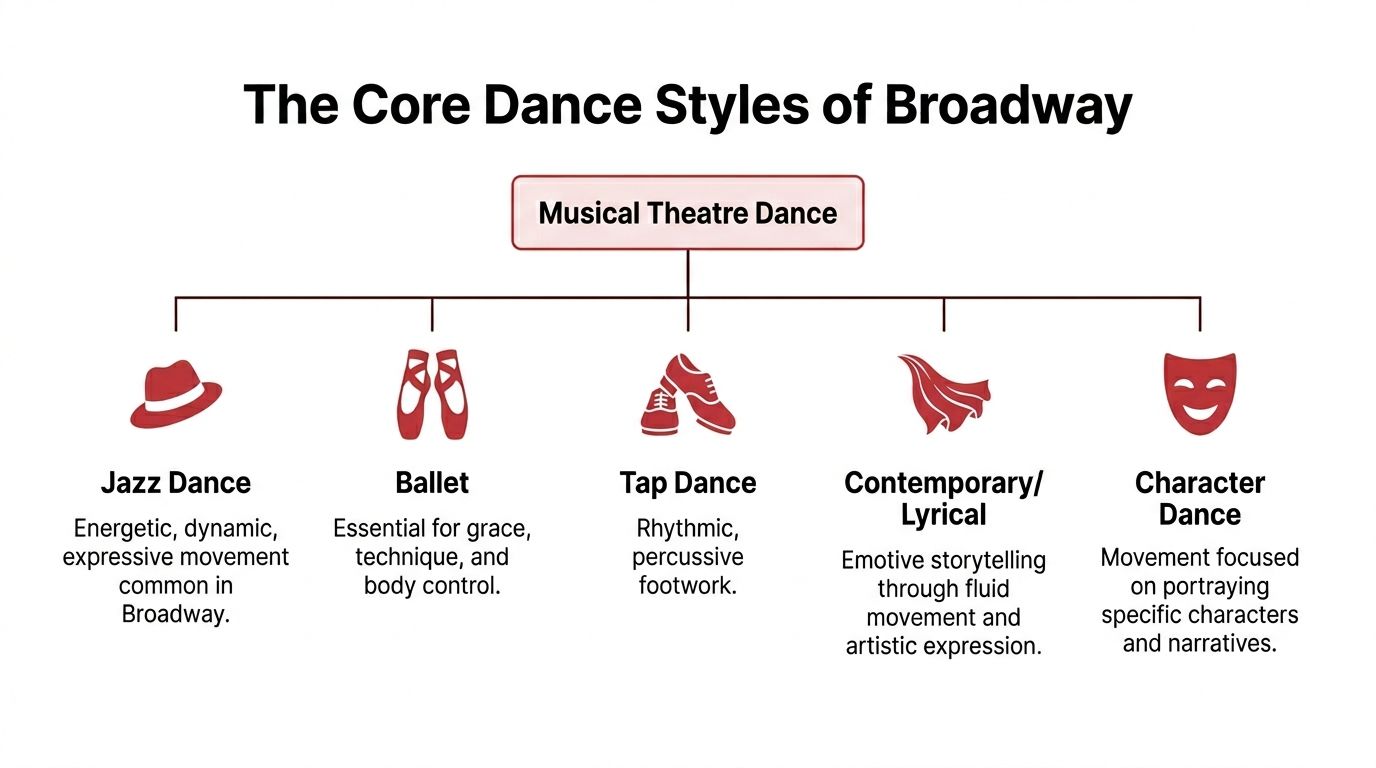
Jazz gives Broadway its spark
Jazz is frequently the clearest entry point into musical theatre dance because it teaches attack, rhythm, and performance presence all at once.
Jazz works like bold punctuation in a sentence. It adds snap to a turn, clarity to a pose, and excitement to a chorus section. In class, beginners commonly notice that jazz asks the body to change direction quickly and stay visually clear while doing it.
That challenge is useful.
Jazz training helps students build:
- Dynamic energy through accents and sharp changes
- Performance quality through posture, focus, and projection
- Coordination because the upper body and lower body frequently do different things at the same time
For adults and social dancers, jazz can feel unfamiliar at first because it is more presentational than partner-based dance. With practice, that “look at the audience” quality becomes far more comfortable.
Ballet builds the frame
Ballet gives musical theatre dancers structure.
If choreography is the sentence, ballet works like grammar. It organizes placement, balance, and line so movement reads clearly from a distance. Even in shows that do not look traditionally balletic, dancers use ballet habits every time they stand on one leg, turn cleanly, or travel across the floor with control.
Beginners occasionally worry that ballet is exclusively for advanced dancers or young starters. It is not. Adults gain much from basic ballet training because it improves posture, foot strength, and body awareness. Those same benefits support theatre dance and everyday movement. For a broader look at those training benefits, see this guide on how dance classes improve fitness, flexibility and focus.
Broadway has used ballet-based storytelling for decades, particularly in dream sequences and dramatic ensemble scenes. You do not need to master that material right away. You need the habits underneath it. Lift through the spine. Place your feet carefully. Finish each transition instead of rushing past it.
Tap turns feet into percussion
Tap changes the dancer's job because the feet are making music, not only following it.
That idea can confuse beginners at first. In jazz or ballet, the soundtrack carries most of the rhythm. In tap, your weight shift, timing, and clarity create part of what the audience hears. The body becomes both dancer and drummer.
Tap is not only about speed. Good tap starts with clean sounds and steady rhythm. A slower exercise done accurately will help a beginner more than a fast combination done in a blur.
If jazz asks the audience to watch, tap asks them to listen.
For children, tap sharpens timing. For adults, it improves coordination and mental focus. For theatre performers, it adds a distinct kind of stage confidence because every sound gives immediate feedback.
Contemporary adds emotional texture
Contemporary and lyrical movement frequently appear in newer musicals when the story needs space, softness, or emotional tension.
Where jazz tends to be crisp and front-facing, contemporary frequently moves through curves, suspension, release, and shifting weight. The feeling is less about presenting shapes and more about letting motion travel through the body. That makes it particularly useful for scenes about memory, longing, conflict, or change.
Beginners frequently count contemporary too mechanically. A better approach is to treat breath like part of the choreography. Inhale can lift the body. Exhale can soften it. That simple adjustment makes movement look more honest and less forced.
Character dance gives movement a point of view
Character dance answers a question many beginners forget to ask. Who is moving?
The same grapevine, turn, or walk can read in completely different ways depending on the character's age, status, mood, or social setting. A proud queen does not enter like a nervous student. A comic servant does not cross the stage like a romantic lead. Character work gives steps a personality.
This style matters well beyond professional theatre. It helps shy beginners come out of their shell. It helps children use imagination instead of copying shapes mechanically. It helps social dancers become more expressive and specific.
A quick guide:
| Style | What it contributes |
|---|---|
| Jazz | Attack, flair, theatrical punch |
| Ballet | Placement, strength, line |
| Tap | Rhythm, timing, sound |
| Contemporary | Emotional depth, fluidity |
| Character | Specific personality and story |
Once these styles start to feel like tools instead of labels, Broadway choreography becomes far less mysterious. You are no longer trying to fit into one dance identity. You are learning which movement quality serves the moment best.
Essential Skills Every Performer Needs
Steps matter, but they aren't the whole job. A performer can know every count and still look disconnected.
What brings dance for musical theatre to life is the set of skills underneath the choreography.
Musicality
Musicality is your ability to hear structure in the music and show it in your body.
That means noticing the difference between a sharp brass hit and a long vocal phrase. It means understanding when a movement should land exactly on a beat and when it should stretch slightly through it. Beginners can practice this by clapping accents before dancing them.
If your timing feels fuzzy, don't panic. Musicality improves with repetition and listening. Helpful cross-training can come from rhythm-based classes and focused movement work. If you want a broader look at how dance training supports body awareness and concentration, this piece on how dance classes improve fitness, flexibility and focus is a useful companion read.
Acting through movement
Musical theatre performers don't stop acting when they stop speaking.
A head turn can show suspicion. A lifted chest can show pride. A collapse in the spine can show defeat. Beginners frequently overdo facial expression because they think “acting” means making big faces. Sometimes it does. More often, it means clear intention in the whole body.
Try this test with any simple combination. Do it once as if you're thrilled. Do it again as if you're trying to hide fear. The steps stay largely the same. The performance changes completely.
Retention and adaptability
Auditions and rehearsals move fast. Dancers frequently need to learn material quickly and keep it clean.
Modern Broadway also asks for more than the classic triple threat. According to Playbill's discussion of ensemblist demands, performers increasingly need special skills such as tumbling, voguing, or playing an instrument while dancing. That shift reflects the rise of the quadruple-threat performer who can sing, dance, act, and offer another mode of storytelling.
That doesn't mean every beginner needs to tumble tomorrow. It does mean versatility matters.
What to train besides steps
- Memory under pressure by learning short combinations in a few repetitions
- Directional awareness so you know where front, diagonal, and side feel in your body
- Stylistic flexibility so the same dancer can handle polished jazz one day and grounded groove the next
- Recovery skills because live performance includes mistakes, and professionals keep going
Here’s a strong visual example of performance detail in action:
Partnering and awareness
Even when you aren't doing lifts, you're dancing with other people.
That means sharing space, reading timing, and avoiding the beginner habit of dancing as if no one else exists. In theatre choreography, group awareness is part of performance quality. You need to know your spacing, your traffic pattern, and whether your energy matches the scene.
Practical rule: don't aim to “do more” than everyone else. Aim to be clear, connected, and responsive.
Those are the habits that make a cast look cohesive instead of crowded.
Your Training Path From Beginner to Performer
Not everyone needs one generic class. They need a starting point that fits their age, confidence level, and goal.
That’s particularly true in dance for musical theatre, where a seven-year-old beginner, a returning adult, and an aspiring performer all need different kinds of support.
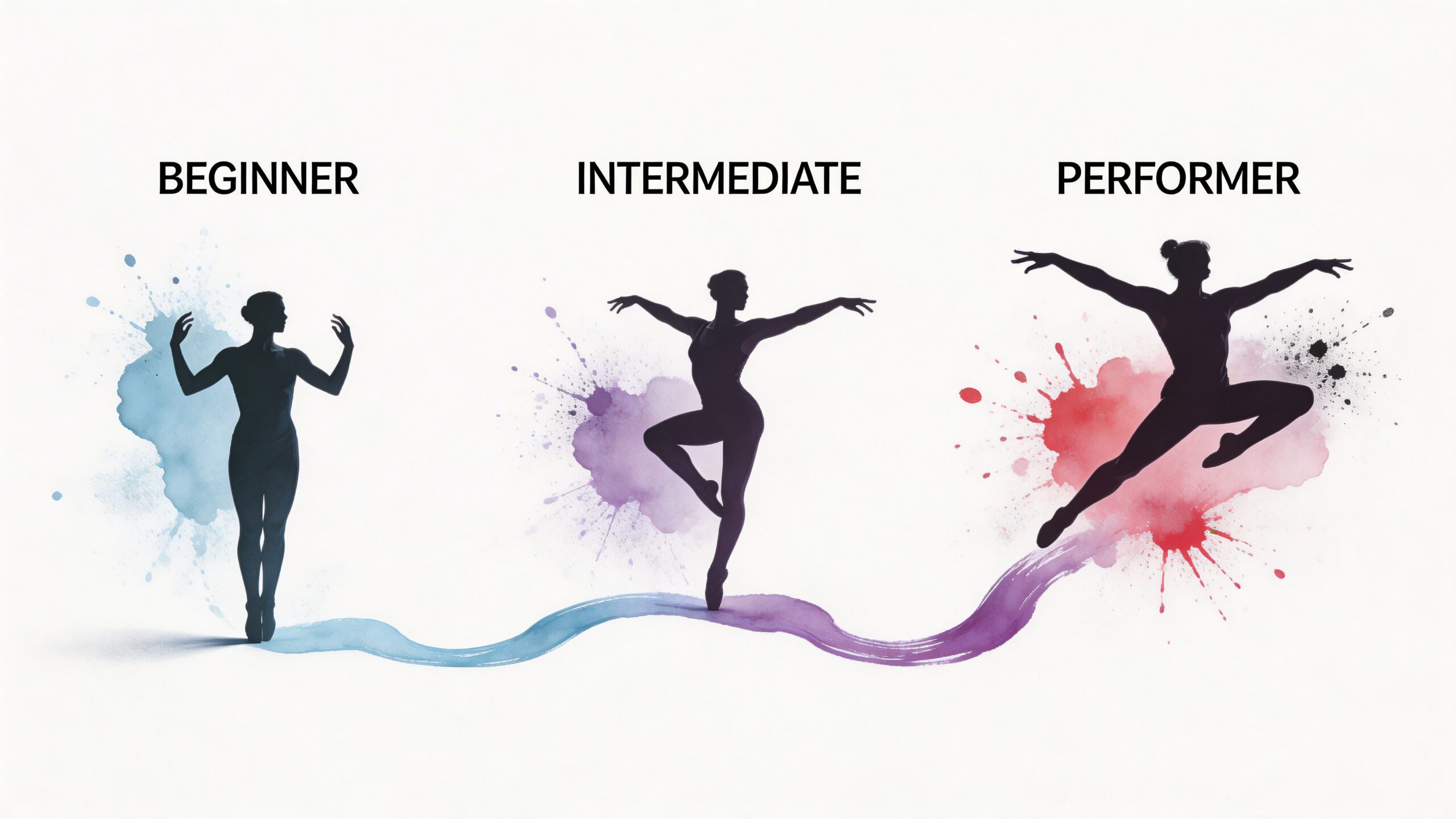
For kids
Children do best when musical theatre training feels structured but playful.
They don't need pressure to “perform Broadway” right away. They need rhythm, coordination, listening skills, and the confidence to make bold choices without shutting down. Character games work well here because they turn performance into something concrete. Walk like a royal. Sneak like you're hiding a secret. Freeze like you just heard shocking news.
For parents, the biggest marker of a good class isn't whether a child memorizes a flashy routine fast. It's whether they become more focused, more expressive, and more comfortable being seen.
For adult beginners
Adult beginners frequently need permission to start imperfectly.
Many walk into class carrying old stories about themselves. “I'm not flexible.” “I'm not a performer.” “I missed my chance.” Those stories can be louder than the music. Good adult training quiets that noise by giving clear fundamentals and a welcoming pace.
A strong adult path frequently looks like this:
- Learn posture and alignment so movement feels supported, not shaky.
- Build rhythm first with walking patterns, simple weight changes, and counts.
- Add theatre quality through focus, expression, and intention.
- Increase complexity gradually with turns, directional changes, and longer phrases.
If you're looking for a welcoming place to begin, resources like beginner dance lessons in Philadelphia can help you understand what first steps look like in practice.
For aspiring performers
More advanced students need a different challenge. They must sharpen technique, stamina, and stylistic range while also becoming more castable in the room.
That means training with purpose, not just taking more classes randomly.
A useful comparison:
| Goal | Training focus |
|---|---|
| Cleaner execution | Technique drills and alignment |
| Better auditions | Fast pickup and performance under pressure |
| More stage presence | Acting choices and musical specificity |
| Greater range | Exposure to contrasting styles |
For social dancers who want more performance quality
This group frequently gets left out, but they shouldn't.
If you already enjoy salsa, swing, ballroom, or Latin styles, musical theatre training can add projection, storytelling, sharper phrasing, and stronger use of the upper body. You don't need to be pursuing a stage career for those skills to matter. They make social dancing more expressive and more fun.
Some adults also want theatrical movement for parties, showcases, weddings, or community theatre. That path is equally valid as a professional one. Learning dance for musical theatre can be a way to move with more confidence and personality.
Audition Tips and Practical At-Home Exercises
Audition prep gets easier when you stop treating it like a mystery. Judges, teachers, and choreographers commonly want the same core things. Clear timing. Strong focus. Believable storytelling.
That lines up with formal musical theatre dance adjudication, where the Thespy musical theatre dance rubric emphasizes dance performance, characterization, execution, and precise timing within a strict time limit that is often five minutes. Even small timing issues can hurt results, which tells beginners something useful. Precision isn't picky. It's part of communication.
Try these at-home drills
You don't need a full studio to start building skill.
- Isolation practice: Put on a cast album and move only your shoulders, then only your ribs, then only your head. This teaches control.
- Story walk drill: Cross the room four times. Once as a hero, once as a villain, once as someone hiding nerves, once as someone late for a train.
- Eight-count memory game: Learn one short phrase, pause the music, then mark it. This builds retention.
- Spotting basics: Practice turning your head to one fixed point before doing full turns. It helps balance and reduces dizziness.
Wear rehearsal clothes that let you move but still show your lines. Baggy layers can hide alignment problems.
Walk into the room ready
For any audition, even a local showcase, treat preparation as part of performance.
Bring shoes that fit the style. Arrive warm. Stand where you can see and be seen. If you make a mistake, keep going. Choreographers notice recovery.
Presentation matters too. If you're auditioning for theatre projects, a strong headshot supports the whole package. This guide on how to get headshots for acting that casting directors love is helpful because it explains what makes a photo feel professional without looking stiff.
For more detailed dance-specific prep, this guide on how to prepare for a dance audition tips offers practical ways to organize your practice and calm nerves.
What to remember under pressure
A useful audition order is simple:
- Listen first: hear the rhythm before forcing the movement
- Mark the pattern: know where you're traveling
- Choose a point of view: decide who you are in the combo
- Commit fully: hesitant dancing reads weaker than imperfect but confident dancing
That last point matters significantly. In musical theatre, confidence helps the audience understand what you're trying to say.
Start Your Dance Journey at Danza Academy
You watch a Broadway number, feel that spark, and wonder whether this kind of training is only for young performers or people already chasing auditions. For many beginners, that question marks the true starting line.
Much dance education is built for children on a competitive track or for performers already collecting credits. Adults frequently want something different. They want stronger posture, clearer musicality, more confidence, and the fun of telling a story through movement. Parents frequently want structure and creativity for their children without turning every class into pressure. Social dancers and couples may want the polish of stage performance without changing their whole lives around a professional goal.
That middle ground matters. BroadwayWorld's discussion of accessible dance programming points to the broader need for dance training that welcomes underserved students and opens the door to dance theatre in a more inclusive way. The same idea applies here. Musical theatre dance should not feel like a closed club. It can be a skill set people build for joy, confidence, expression, and community.
That is why studio culture matters as much as curriculum.
Danza Academy of Social Dance is a strong fit for this kind of learner because its teaching model already focuses on encouragement, musicality, personal instruction, and practical progress. A good class works like learning a song at the piano. You do not start with the full concert version. You learn rhythm first, then phrasing, then expression. Dance follows the same pattern.
Students who frequently do well in this setting include:
- Adult beginners who want to move with more confidence and expression
- Kids who respond well to structure, imagination, and performance-based learning
- Social dancers who want stronger projection, cleaner timing, and more theatrical presence
- Couples who want a showcase or wedding dance to feel polished, connected, and story-driven
Comfort matters too, because consistency grows from feeling supported enough to come back next week. Good shoes, sensible pacing, and clear coaching make a significant difference, particularly in the first month. If you are breaking in new dance footwear, this guide on preventing shoe blisters can help you stay focused on dancing instead of sore feet.
You do not need to arrive stage-ready. You need a place that can meet you at your current level and show you the next step.
Book your complimentary first lesson with Danza Academy of Social Dance and begin in a welcoming, encouraging environment. Whether you are an adult beginner, a parent exploring classes for your child, a social dancer who wants more performance quality, or a couple preparing for a special event, this free lesson gives you a low-pressure way to start. You can schedule it on the contact page and see how personalized instruction can help you learn, move, and shine.