You’re probably here because your child has started dancing around the living room, asked for ballet shoes, or watched one class and immediately said, “I want to do that.”
That moment is exciting. It can also be confusing.
Many parents type “young dancers academy” into Google and quickly discover that every studio seems to promise confidence, discipline, technique, and fun. The words sound similar. The programs don’t always.
As a dance educator, I’d encourage you to slow down and look at one big question first. Is this a place that offers dance classes, or is it a place that develops children over time? That difference matters more than the style list on the website.
A good academy doesn’t just teach steps. It teaches children how to listen, try again, work with others, manage nerves, and feel at home in their own bodies. Those lessons often matter just as much as the choreography.
Beyond Dance Class What a Young Dancers Academy Offers
A young dancers academy is more than a weekly activity. It’s a structured learning environment where children build skills in sequence, with guidance that matches their age and stage.
The easiest comparison is sports. A child kicking a ball in the backyard is active and happy. A child joining a youth league enters a system with coaches, progression, rules, team habits, and a clearer development path. Dance works the same way.
Class menu versus curriculum
Some studios operate mostly as drop-in programs. That can be a fine starting point for families who want a light commitment.
An academy model usually looks different. It tends to include:
- Progressive training: Teachers build one concept on top of another instead of treating each week as a separate event.
- Age-based placement: Children enter a level that suits their physical coordination, attention span, and emotional readiness.
- Consistent expectations: Students learn routines for entering class, listening for corrections, warming up, and working respectfully with peers.
- Longer-term goals: The child isn’t just attending class. They’re moving through a pathway.
That pathway doesn’t mean every child is being pushed toward a professional career. It means the program has a plan.
A strong academy gives children room to enjoy dance while still taking their growth seriously.
What parents often misunderstand
A lot of families assume “academy” means intense, strict, or only for naturally gifted children. It doesn’t have to.
In healthy programs, structure supports children rather than pressures them. A shy child may feel safer when class routines are predictable. A high-energy child often does better when expectations are clear. A child who struggles with frustration benefits from hearing, “You’re not behind. You’re learning.”
That’s one reason parents often find it helpful to read about what to expect from a top dance academy in Philadelphia before choosing a studio. The name matters less than the experience inside the room.
What an academy should develop
When I evaluate a youth program, I’m not only looking for clean technique. I’m looking for whether the academy builds the whole child.
A worthwhile young dancers academy should support:
| Development area | What it looks like in practice |
|---|---|
| Physical awareness | Balance, posture, coordination, spatial control |
| Learning habits | Listening, memory, sequencing, patience |
| Emotional growth | Confidence, resilience, comfort with feedback |
| Social development | Turn-taking, teamwork, respect, empathy |
| Artistic expression | Musicality, storytelling, creative choices |
That’s why families often stay with dance for years. The value isn’t limited to recital day. The child changes in quieter ways first. They stand taller. They focus longer. They begin to trust themselves.
More Than Moves The Lifelong Benefits of Early Dance Training
One of the biggest shifts for parents happens when they stop seeing dance as “extra” and start seeing it as part of a child’s development.
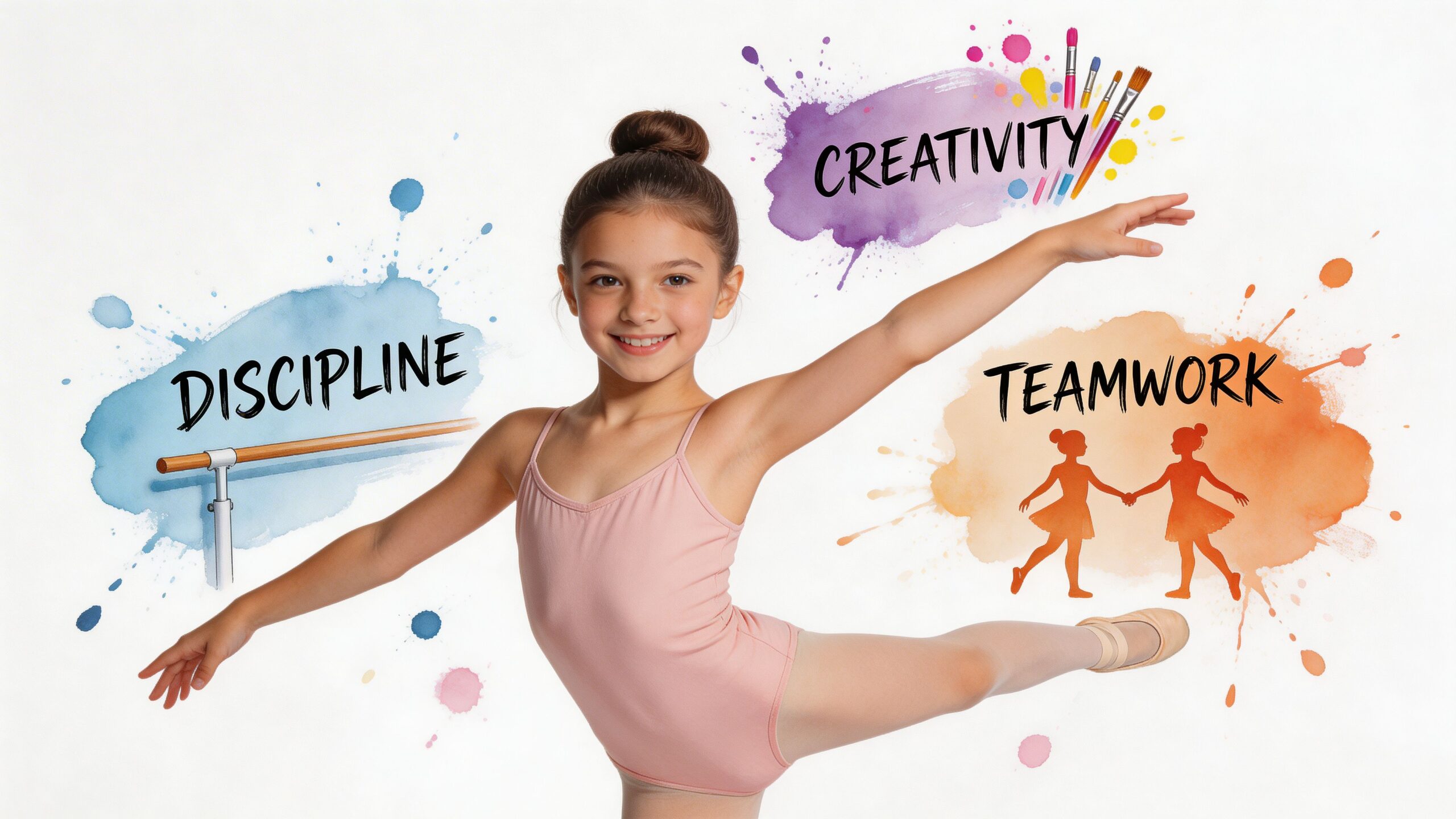
A child in dance class is doing far more than copying a teacher. They’re learning how to notice, respond, remember, and adapt. Those are life skills.
Confidence grows through doing hard things
Children don’t usually become confident because an adult tells them they’re amazing. They become confident because they try something challenging, stick with it, and realize they can improve.
I’ve seen quiet children start a season barely willing to raise their hand. Months later, they walk onstage with a group and perform in front of an audience. That doesn’t happen because dance magically removes shyness. It happens because repeated, supported practice teaches courage.
Focus and self-control improve in practical ways
Dance asks a child to hear music, track timing, remember patterns, and control movement all at once. For some children, that’s the first place they learn to channel restless energy into purposeful action.
A child who fidgets during homework might do very well in a structured movement class. Why? Because they aren’t being told only to “sit still.” They’re being taught how to organize attention through the body.
Parents who want a broader look at activities that support emotional and social growth may also like Top Group Activities for Children to Boost Wellbeing. Dance fits naturally into that larger conversation about healthy group experiences.
Dance teaches children how to belong
In youth dance, children learn that their actions affect other people. They hold lines. They wait for turns. They enter and exit together. They begin to understand, “I matter, and so does everyone else.”
That’s a powerful lesson for kids who are still figuring out friendships.
- A duet teaches awareness: A child learns to notice spacing, timing, and cooperation.
- A group routine teaches reliability: If one student misses a formation, others feel it.
- Class etiquette teaches respect: Listening while someone else gets corrected is part of being in the room.
Practical rule: If a program only talks about trophies, photos, or costumes, ask harder questions about character, classroom behavior, and emotional support.
The physical benefits are real, but they’re not the whole story
Yes, dance supports strength, flexibility, coordination, and body awareness. It also helps children understand alignment, rhythm, and how to move with control. Families exploring that side of training can learn more about how dance classes improve fitness, flexibility, and focus.
But the deeper gift is this. Dance shows children that effort changes them.
That’s why early training can stay with them even if they don’t dance forever. They carry the habits into school, friendships, presentations, sports, and later work.
A short visual can help make that clearer:
Children often come to class for the music and movement. They stay because they begin to feel capable.
Finding the Right Fit A Guide to Program Types and Age Groups
Not every child should enter dance the same way. Age matters. Readiness matters. Personality matters.
Parents often get overwhelmed by class names because studios use different labels. One program might say “Creative Movement.” Another says “Tiny Dancers.” Another says “Primary Ballet.” The names vary, but the developmental goals are usually more important than the branding.
Typical Dance Program Progression by Age
| Program Type | Typical Age Range | Primary Focus |
|---|---|---|
| Creative Movement | Ages 2 to 4 | Rhythm, imagination, balance, classroom comfort |
| Pre-Ballet or Introductory Dance | Ages 5 to 7 | Basic positions, musical listening, coordination, simple class structure |
| Graded Technique Classes | Ages 8 and up | Formal technique, strength, memory, style-specific training |
| Youth Training Programs | Varies by academy | More consistent progression, performance readiness, advanced foundations |
Ages 2 to 4
At this age, the class should feel playful but purposeful.
Children are learning how to separate from a parent, follow simple directions, move through space safely, and connect movement to music. If a teacher expects perfect turnout or long periods of stillness from a toddler, that’s not strong instruction. That’s mismatched instruction.
Look for activities such as marching, skipping, jumping, animal movement, shape-making, and simple rhythm games.
Ages 5 to 7
This is often the sweet spot for introducing more recognizable dance structure.
Children can start learning basic positions, posture, arm pathways, and class etiquette. They’re still young, so the class should keep warmth and imagination, but they’re usually ready for more repetition and correction.
This stage matters because it teaches the habits that support later training:
- Waiting and watching
- Remembering combinations
- Starting on the music
- Understanding personal space
- Trying again after feedback
Ages 8 and up
Around this stage, many children are ready for more formal technique classes in ballet, jazz, contemporary, or ballroom, depending on the academy.
The emphasis becomes clearer. A teacher may focus on alignment, foot articulation, turns, traveling steps, and how movement quality changes by style. Students can also begin to understand why details matter, not just what the shape looks like.
Some academies expand the menu with additional forms. For example, Maryland Youth Ballet’s summer training for ages 10 to 16 includes daily ballet technique and pointe for some levels, along with Jazz, Modern, Flamenco, Ballroom, conditioning, and music classes, with full 5-week attendance required for the Summer Festival and a minimum of 3 years of consistent ballet training at 3 days per week for entry into that intensive track (Maryland Youth Ballet Summer Festival). That kind of structure tells parents something useful. Serious programs match opportunity with readiness.
Why age-appropriate progression matters
A child doesn’t need to do everything early. They need the right challenge at the right time.
That’s true in dance and in other youth training fields. Parents who like seeing how skill development should build gradually may appreciate this article on age-appropriate training progressions. The sport is different, but the principle is the same. Children thrive when adults respect sequence.
If your child is new, don’t ask, “How fast can they advance?” Ask, “Is this level helping them succeed and enjoy learning?”
For families comparing local options, this guide to dance classes for kids near me and how to choose the right studio can help narrow the search.
The best fit is rarely the flashiest program. It’s the one where your child is challenged, supported, and placed appropriately.
A Week in the Life Sample Curriculum and Skill Progression
Parents often watch a polished performance and assume children learned the routine in a few exciting rehearsals. In reality, strong dance education is built from many ordinary classes.
A child might spend weeks working on posture, weight placement, arm coordination, and timing before any of that looks “show-ready.” That slow layering is exactly what makes the training valuable.
What a beginner week can look like
For a young student in an academy setting, a week might include one or two classes that feel consistent in shape.
A typical class often includes:
Arrival routine
Shoes on, belongings put away, body and mind settling into class.Warm-up
Gentle movements to wake up feet, legs, torso, and focus.Foundational technique
Simple exercises for balance, alignment, footwork, and coordination.Across-the-floor work
Traveling steps that teach direction, rhythm, and confidence in space.Creative or performance work
Musical games, expression tasks, or learning part of a routine.Reverence or closing ritual
A respectful end to class that reinforces routine and gratitude.
How one step grows over time
Take a plié. To a new parent, it may look like “just bending the knees.”
To a dance teacher, it’s a building block.
Early on, a child learns to bend with control, keep posture lifted, and coordinate arms. Later, that same movement supports jumps, turns, landings, and transitions. The student isn’t repeating basics because the teacher has run out of ideas. They’re repeating basics because basics become everything else.
Small movements are often doing the biggest teaching.
What progression looks like across a year
September usually feels simple. Children learn names, routines, spacing, and class expectations.
By midyear, they start connecting skills. The child who once needed help finding first position now starts moving with more clarity. They hear counts more quickly. They recover from mistakes faster.
By spring, the changes can be striking. Not always dramatic. Often more subtle than parents expect. Better posture. Cleaner timing. Stronger concentration. More confidence entering the room.
Structured programs make that growth visible through level design. CityDance’s Young Training Program for ages 7 to 10 uses three levels called YTP I, YTP II, and YTP III, combining ballet, contemporary, and repertory or performance work, with dancers typically advancing one level per year as they build core strength, musicality, and performance readiness (CityDance Young Training Program).
What not to worry about
Parents sometimes worry when class doesn’t look “busy enough” every single minute. But repetition, stillness, and correction are part of the process.
A child may spend one class learning how to start on the correct musical cue. Another class may focus on lines or pointing the feet. That’s not slow progress. That’s real training.
Some programs also branch into styles beyond ballet. As one example among many local options, Danza Academy of Social Dance offers children’s dance programming in ballroom and social dance formats, which can help young students work on rhythm, partner awareness, and confidence in a structured setting.
Growth in dance is cumulative. You usually don’t notice it in one class. You notice it when your child does something in May that would have felt impossible in September.
Your Parent Checklist for Choosing a Great Academy
A polished lobby doesn’t tell you much. Neither does a fancy recital photo.
When you’re choosing a young dancers academy, look for evidence that the studio takes children seriously as learners and protects them as children. That means paying attention to the environment, not just the marketing.
Start with what you can observe
Walk in and notice the room.
Is the front desk organized? Do teachers greet children kindly? Are students supervised between classes? Does the studio feel calm, or does it feel chaotic and performative?
Parents often underestimate how much they can learn before asking a single question.
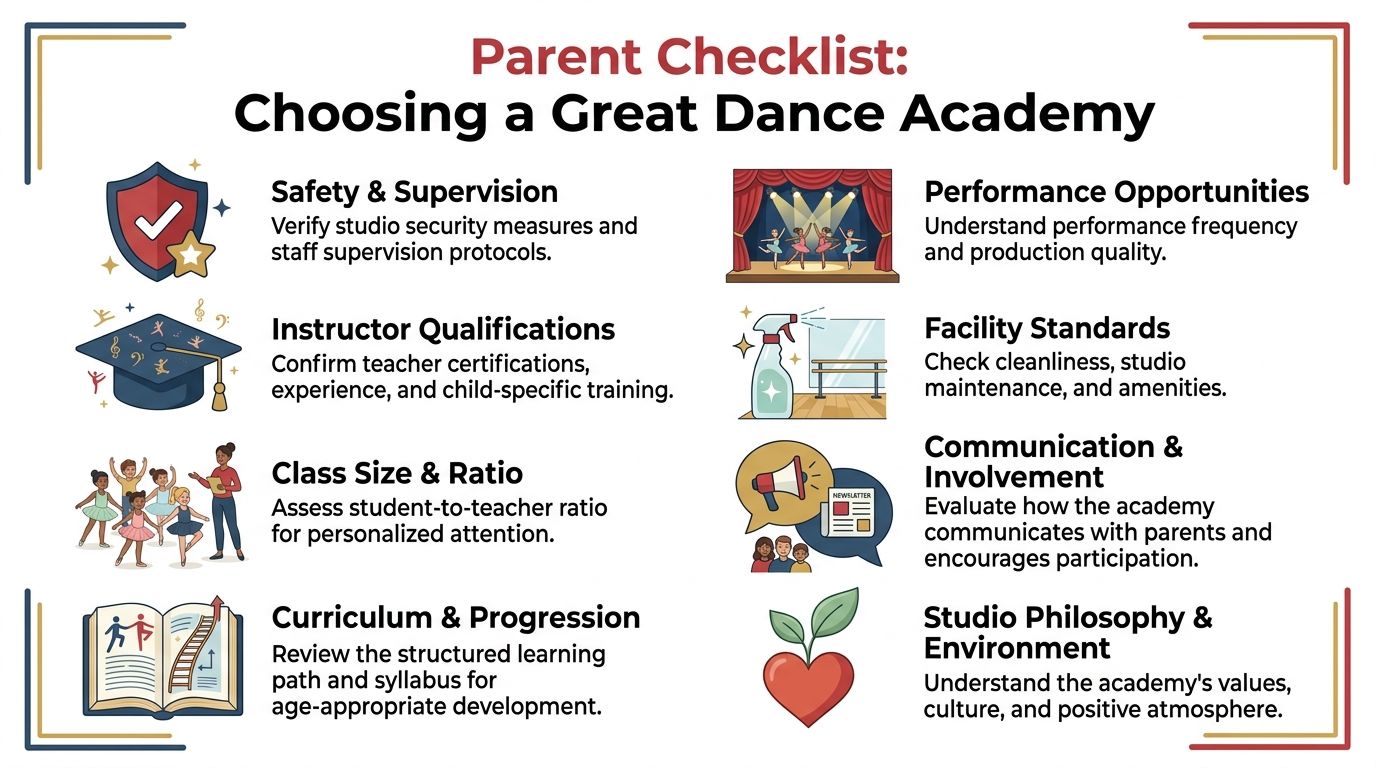
Essential Checklist
Use this list when touring or speaking with staff.
Safety and supervision
Ask how children are checked in and out, who supervises transitions, and what happens if a parent is late. Watch whether the floors appear appropriate for dance and whether the space is maintained well.Instructor qualifications
Ask who teaches your child’s age group and what experience they have teaching children, not only performing themselves. Teaching a six-year-old requires different skills than dancing professionally.Class size and attention
Ask how many students are typically in the room. A child doesn’t need a tiny class to learn well, but they do need enough teacher attention to be seen and corrected.Curriculum and progression
Ask how students move from one level to the next. You want to hear a clear explanation, not vague promises.Communication with families
Ask how schedule changes, costume details, performance notes, and teacher feedback are shared. Good communication lowers stress for everyone.Studio culture
Listen to how staff speak about students. Do they sound respectful and child-centered, or overly focused on image, winning, or comparison?Performance philosophy
Ask what performances are for. A strong answer includes learning, teamwork, stage experience, and joy. A weak answer sounds like selling tickets.
Ask one question most parents forget
Ask, “How do you support a child who is struggling?”
The answer tells you more than almost anything else.
A good academy should be able to explain how they help a nervous beginner, a child who needs extra time, or a student adjusting to group learning. You want a place that teaches through difficulty, not one that labels children too quickly.
Some of the best studios aren’t the loudest. They’re the ones where children feel safe enough to keep learning.
External validation can matter
Parent impressions are important, but outside review can also be helpful.
For example, the former Young Dancers Academy in London received an “Outstanding” overall effectiveness rating from Ofsted in both 2013 and 2017, which is notable because that judgment came from an external government inspection process rather than internal marketing (Ofsted report on Young Dancers Academy).
That doesn’t mean every great studio will have that exact kind of recognition. Many won’t. But it does show why objective standards matter.
Red flags worth taking seriously
A few warning signs should make you pause:
- Teachers use humiliation as motivation
- Students look fearful rather than focused
- There’s no clear placement process
- Parents can’t get direct answers about policies
- The studio pushes performance expenses before discussing education
- Children seem to be treated as a brand asset instead of learners
What a healthy studio usually feels like
It feels orderly, but not cold.
Children know what to do. Teachers correct without shaming. Families understand the calendar. Expectations are real, but they aren’t weaponized. Students work hard and still leave class smiling.
That balance is what you’re after. Not softness. Not harshness. Steady, respectful guidance.
Understanding the Investment Pricing and Attendance Expectations
Dance is an investment of money, time, energy, and family scheduling. It helps when parents go in with open eyes.
What you’re usually paying for
Tuition covers more than the hour your child spends in the studio.
It may reflect teacher time, curriculum planning, music preparation, administrative support, facility costs, and performance preparation. In community-based arts organizations, those costs can be substantial. For example, Young Dance reported total income of $398,504.39 and expenses of $431,925.16 in its 2023 to 2024 fiscal year, including $313,298.26 in program costs, $62,673.52 for studio lease, and $5,580.34 for theater space rental, while serving over 1,500 individuals and reaching 1,399 artists and students outside its studio through 1,080 class meetings during the school year (Young Dance Annual Report 2024).
Those figures don’t set your local tuition. They do show that dance education involves real operating costs behind the scenes.
Costs families should ask about upfront
Before enrolling, ask for a written list of likely expenses.
That list may include:
- Tuition structure: Monthly, term-based, or annual
- Registration fees: Sometimes charged once per season
- Dress code items: Shoes, leotards, practicewear, or uniform pieces
- Performance costs: Costumes, tickets, rehearsal fees, or media fees
- Make-up class policy: Important if your family schedule is busy
Why attendance matters so much
Children progress through repetition. If they miss class often, they don’t just miss “today’s steps.” They miss the sequence that makes next week’s lesson understandable.
Attendance also affects the group. Dance classes often work like teams even when they aren’t competitive teams. A student who knows spacing, cues, and choreography helps everyone else rehearse well.
Parent note: Consistency matters more than intensity. One well-attended class each week is often more productive than a bigger plan a family can’t realistically maintain.
The best approach is to choose a schedule your household can sustain. Children do best when dance is a regular part of life, not a constant scramble.
Answering Your Questions Parent FAQs
Parents often have important questions they don't voice. Here are direct answers.
What if my child has never danced before
That’s normal.
A good beginner program assumes children are learning from the ground up. Your child doesn’t need prior experience to start. They need age-appropriate teaching, patience, and a level that matches their readiness.
Is my child too shy for a group class
Usually, no.
Shy children often do very well in dance because the structure helps them know what to expect. They don’t have to talk a lot to participate. They can join through movement first, then confidence often follows.
What’s the difference between recreational and competitive tracks
Recreational programs usually emphasize enjoyment, foundational learning, and manageable commitment. Competitive or intensive tracks often require more classes, more rehearsal time, and stronger attendance expectations.
Neither path is automatically better. The right path is the one that fits your child and your family well.
How can I tell if the program is delivering results
Don’t rely on applause alone.
Look for specific changes. Is your child listening better, remembering more, moving with greater control, recovering from mistakes more calmly, and showing more confidence over time? Those are meaningful outcomes.
It’s also reasonable to ask whether a studio tracks progress in a concrete way. A critical concern in youth arts education is that many programs rely heavily on testimonials without showing long-term outcomes. One benchmark often cited in this conversation is that The Wooden Floor reports 100% of its graduates enroll in higher education (American Dance Movement information page). Not every children’s dance program should be judged by that exact metric, but the bigger point stands. Parents are right to ask how success is defined.
Does my child need to be serious about dance to join an academy
Not at all.
Many children start because they’re curious. Seriousness often grows after they feel competent and connected. The academy’s job is to nurture commitment gradually, not demand instant ambition.
If you're looking for a warm, structured place for your child to begin, Danza Academy of Social Dance offers a free complimentary lesson that you can book through their contact page. It’s a simple way to see how your child responds to the studio, meet the instructors, and ask the practical questions that matter before making a longer commitment.