
You’ve probably typed “couples dance classes near me” because regular date night has started to feel a little too regular.
Dinner is nice. A movie is easy. But a shared activity that gets you off the couch, laughing together, and learning something new feels different. It gives you a story. It gives you a skill. It gives you a reason to look at each other instead of your phones.
That is what partner dancing does so well. It is practical enough for beginners, social enough to stay fun, and personal enough to strengthen a relationship. If you are engaged, it can solve a very specific problem. If you are just looking for a better way to spend time together, it can become the highlight of your week.
More Than Just Steps Why You Should Dance Together
Most couples do not start dance lessons because they want perfect technique.
They start because they want something shared. Something playful. Something that belongs to both of them.

A better kind of quality time
When two people dance together, they practice attention in a very real way.
One person leads a movement. The other responds. Then both adjust. You cannot fake that kind of teamwork. Even simple patterns ask you to listen with your body, not just your ears.
That is why dancing often feels refreshing so quickly. You are not just “taking a class.” You are doing something that asks for presence, patience, humor, and trust.
For couples who want a fresh way to celebrate milestones, dancing also pairs beautifully with other thoughtful plans. If you are brainstorming unique anniversary celebration ideas, adding a lesson or social dance night can turn a nice evening into a memory you will talk about later.
Connection comes first
Many people assume dance classes are mainly about footwork.
Footwork matters, of course, but the deeper benefit is connection. A 2021 Journal of Aging and Physical Health study found that regular partner dance participation improves cardiovascular fitness and that couples reported 28% higher relationship satisfaction scores after 12 weeks of classes (rhythmaddictdance.com).
That finding makes sense in the studio. Couples who dance regularly learn how to recover from mistakes together. They stop treating every missed step like a problem and start treating it like part of the process.
A good dance lesson is not a test. It is guided practice in staying relaxed, communicating clearly, and enjoying each other.
If you want a deeper look at why this works so well, this article on dancing with your partner is a strong companion read: https://danzaacademy.com/top-ten-reasons-why-you-should-dance-with-your-partner/
Decoding the Dance Styles Ballroom Latin or Social
Beginners often get stuck on the same question.
What kind of dance class are we even looking for?
That confusion is normal. “Couples dance classes near me” can lead you to everything from formal ballroom to salsa nights to swing workshops. The easiest way to sort your options is to think in three broad categories.
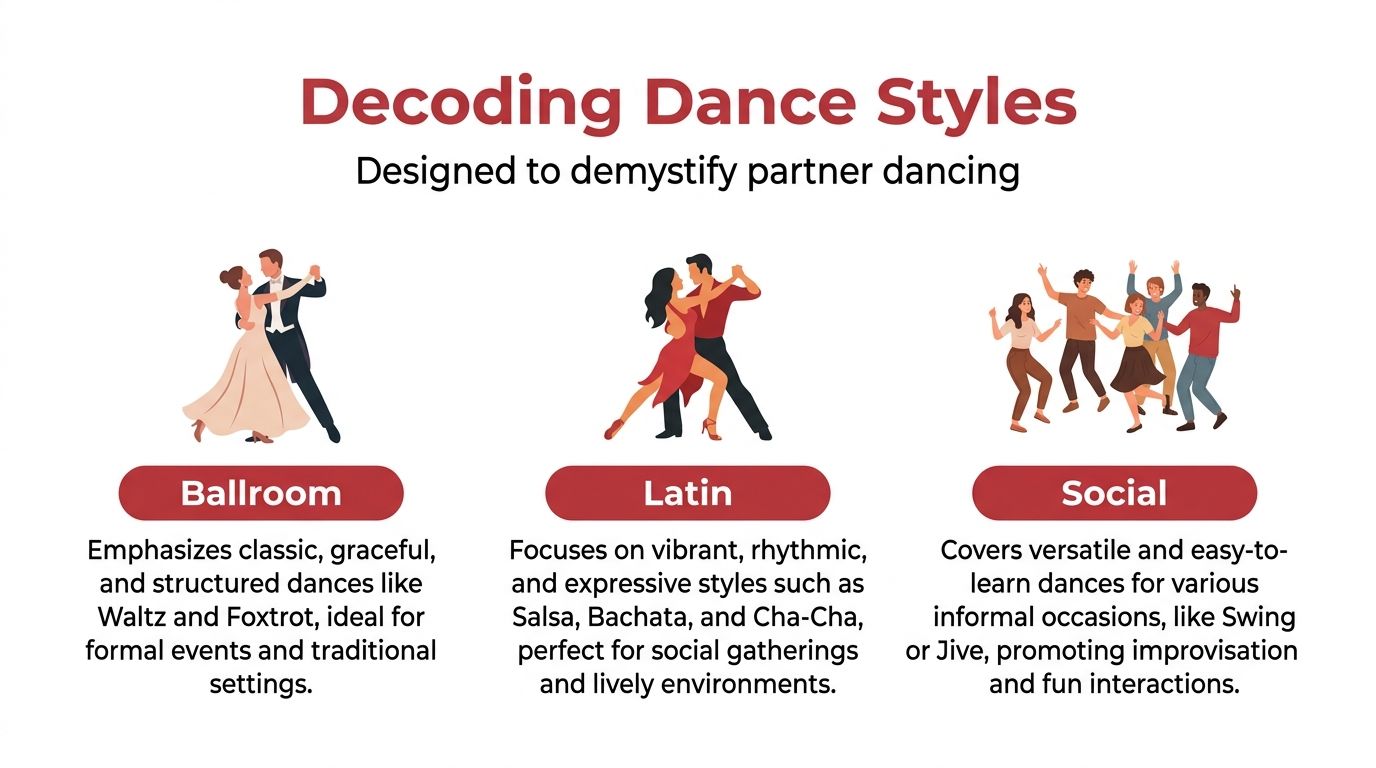
Ballroom for elegance and structure
Ballroom styles usually feel smooth, polished, and classic.
Think Waltz and Foxtrot. These dances suit couples who like clear structure, graceful movement, and music that feels timeless. If your goal is to feel comfortable at weddings, galas, or formal events, ballroom is often the easiest place to start.
Ballroom also tends to appeal to beginners who like predictability. The patterns are organized. The posture is intentional. You can feel progress in a very tangible way.
A simple way to picture it is this. Ballroom feels like dressing up for a special evening. It has shape, control, and a little romance built in.
Latin for energy and expression
Latin styles bring more rhythm through the body.
Salsa, Cha-Cha, and Rumba often attract couples who want something lively, social, and expressive. If you hear music and want to move right away, this category may fit you best.
These dances are not only about speed. Rumba can feel slow and connected. Cha-Cha can feel playful. Salsa can feel upbeat and social. The common thread is rhythm and personality.
Some couples choose Latin because they want a date-night activity that feels less formal. Others pick it because they want a style they can use at parties and celebrations.
Social styles for versatility and fun
Social styles are often the easiest way to lower the pressure.
Swing, Hustle, and similar social dances are great for couples who want fun first and formality second. These classes often feel relaxed, friendly, and beginner-friendly.
If one of you is nervous, social dancing can be a smart entry point because the atmosphere usually feels casual. The goal is not to look perfect. The goal is to keep moving and enjoy the music.
How lead and follow work
A lot of new students worry that partner dancing means memorizing endless signals.
It is much simpler than that. In partner dances, the lead-follow dynamic relies on physical communication, including subtle torso rotation from the leader. Intermediate couples can reach 95 to 98 percent synchronization after 20 to 30 hours of training, reducing timing errors to under 100 milliseconds (fredastaire.com/richmond-shortpump).
You do not need to master that on day one. What matters at first is understanding that partner dancing is not mind-reading. It is a skill you build.
If you can walk to music, pause, and shift weight cleanly, you already have the raw ingredients for partner dancing.
A quick way to choose
If you are deciding between styles, use this simple filter:
| Style family | Best for | Typical feel |
|---|---|---|
| Ballroom | Formal events, elegance, clear technique | Smooth and classic |
| Latin | Expressive movement, social nights, rhythm lovers | Vibrant and connected |
| Social | Casual fun, easy entry, low pressure | Relaxed and playful |
If you still feel torn, that is fine. Many couples discover their favorite style only after trying one in person.
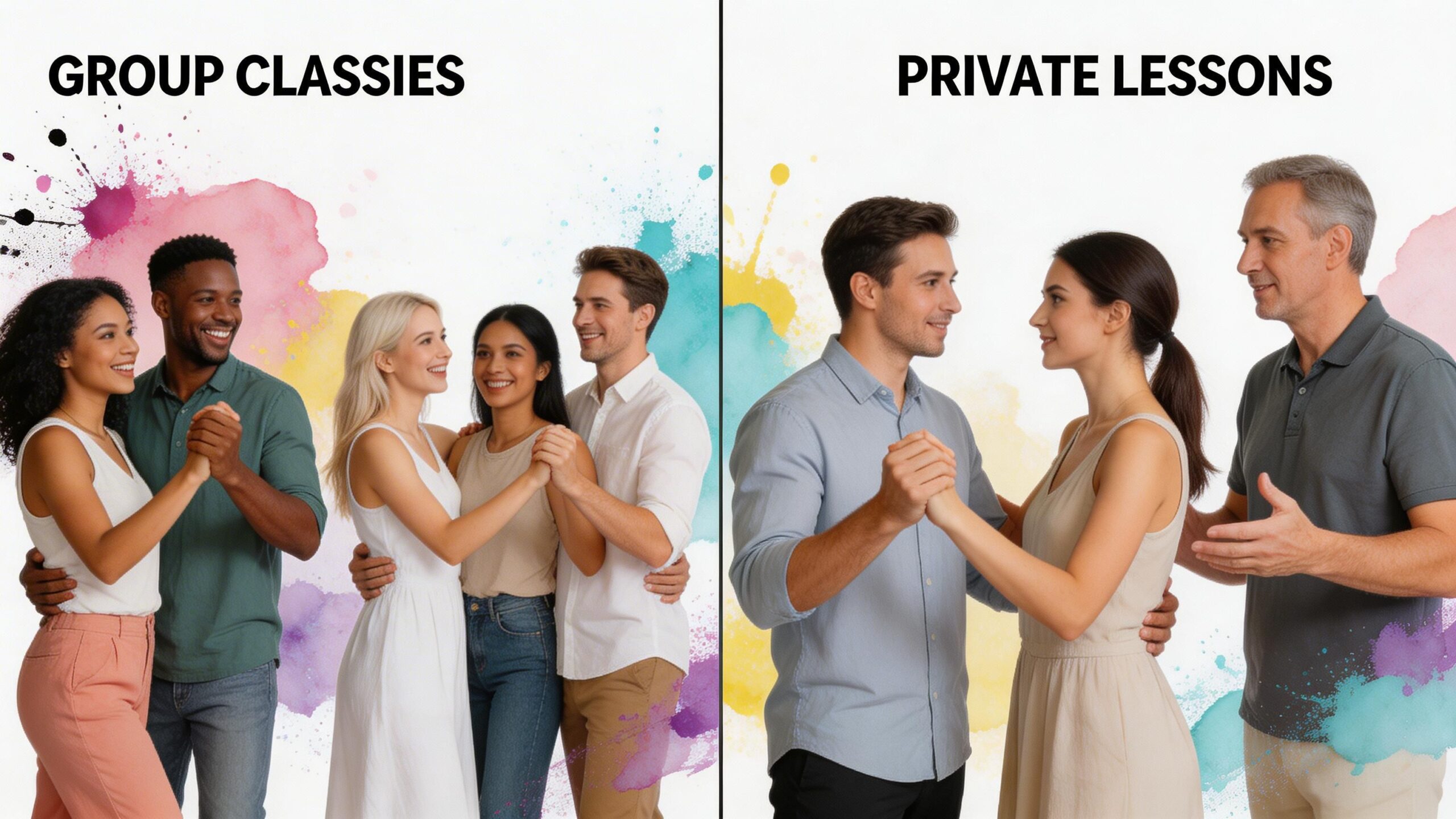
Group Fun vs Private Focus Choosing Your Class Format
Once you have a style in mind, the next decision is about format.
This choice matters more than people expect. Two couples can take the same dance style and have completely different experiences depending on whether they join a group class or book private lessons.
When group classes make the most sense
Group classes work well for couples who want dancing to feel social from the beginning.
You learn alongside other people, hear common questions, and get to practice in a room with real energy. For many beginners, that takes the edge off. You realize very quickly that nobody walked in already knowing what to do.
Group classes are a good fit when you want:
- A fun shared hobby that gets you out of the house
- A lower-pressure start where mistakes feel normal
- A social atmosphere with other couples and dancers
- A broad introduction before choosing a specialty
This format is often ideal for couples who are curious but not yet committed to one specific goal.
When private lessons are the smarter pick
Private lessons are more focused.
They give you direct feedback on your posture, timing, connection, and any habits that keep tripping you up. If one partner learns faster, the instructor can manage that difference in real time instead of letting frustration build.
Private lessons are often the better choice when:
- You have a deadline, such as a wedding or event
- You want faster progress
- You feel self-conscious learning in front of others
- You need choreography suited to your song or goals
The format is not a status symbol
Some people assume private lessons are for serious dancers and group classes are for casual dancers.
That is not a useful way to think about it. The better question is, what kind of support will help you enjoy learning enough to keep going?
A lot of couples do best with a mix. They take private lessons for personal guidance and group classes for repetition and confidence. If you want a fuller comparison, this breakdown is useful: https://danzaacademy.com/group-vs-private-dance-classes-which-is-right-for-you/
Choose the format that makes you feel likely to return next week. Consistency beats ambition.
How to Choose the Right Dance Studio in Philadelphia
Finding a good dance style is one thing. Finding a studio where you feel comfortable is another.
This is a point where many people freeze. They search “couples dance classes near me,” open several websites, and end up looking at the same polished photos and vague promises. A better approach is to score each studio against a few practical standards.
Start with the beginner experience
A studio may have excellent dancers on staff and still be a poor fit for first-timers.
Pay attention to how they talk about beginners. Do they explain what happens in the first lesson? Do they make it clear whether you need a partner? Do they sound warm, or do they sound like they expect you to already know the culture?
Ask direct questions such as:
- How do you help absolute beginners feel comfortable?
- What happens if one partner is more experienced or learns faster?
- Do you offer both private and group options?
Those answers tell you a lot about the teaching philosophy.
Look for pricing clarity
Price matters, but clarity matters even more.
Many studios do not publish pricing, which creates a barrier for engaged couples and other high-intent beginners. A helpful approach is explaining package structures and the return on investment, including that most couples reach a “wedding-ready” first dance in 6 to 8 private lessons (fredastaire.com/paradise-valley/blog/featured-blog/fun-romantic-dance-classes-for-couples-in-paradise-valley).
Even if exact pricing is not listed online, the studio should be willing to explain:
| What to ask | Why it matters |
|---|---|
| How are lessons packaged? | You want to know whether you are comparing single lessons, bundles, or memberships |
| What does a beginner usually start with? | Good studios can describe a sensible first step |
| How long does each lesson last? | Session length affects value and scheduling |
| Is there a trial or introductory option? | This lowers risk for nervous beginners |
Watch how the studio handles comfort and culture
The room itself teaches you something before class even starts.
If staff greet you clearly, answer basic questions without pressure, and explain studio customs in plain language, that is a strong sign. The same goes for how instructors correct students. Good teachers make corrections feel useful, not embarrassing.
A studio should make you feel invited, not evaluated.
If you want a local checklist for comparing schools, this guide can help sharpen your search: https://danzaacademy.com/how-to-find-the-perfect-dance-academy-near-me/
Trust the first lesson
Your first lesson should leave you feeling challenged but not defeated.
You do not need to master turns, timing, or frame right away. You should, however, leave with a sense that the instructor noticed you, adjusted to your level, and gave you a path forward.
That feeling is often the clearest sign you found the right place.
Your First Dance A Special Guide for Engaged Couples
For engaged couples, dance lessons often start with one very specific thought.
“We do not want to just stand there and sway.”

That thought usually arrives somewhere between choosing the song and realizing that everyone will be watching.
A choreographed first dance is not unusual anymore. According to a 2023 WeddingWire survey, 85% of US couples now choose choreographed first dances, a market generating over $500 million annually in specialized lessons, and the average couple invests in 8 to 12 private lessons to master the routine (thebeatberkeley.org/ballroom).
A typical couple’s path
One partner is excited. The other says, “I have two left feet.”
They book an introductory lesson anyway. At first, the focus is not on flashy choreography. It is on posture, timing, and learning how to move together without rushing. Then the instructor builds a routine that matches the song, the dress, the floor space, and the couple’s comfort level.
That is the part many engaged couples find reassuring. A good wedding dance does not need to look complicated. It needs to look natural, confident, and like the two of you belong in the moment.
How to make prep less stressful
Wedding planning already comes with enough decisions.
Dance lessons work best when you treat them as one of the fun parts. If you are organizing the rest of your timeline too, a broader wedding planning checklist like this guide on how to prepare for your wedding can help you keep the dance piece in perspective.
A few practical habits make the process easier:
- Choose a song you enjoy hearing often. You will practice to it many times.
- Wear similar shoes during practice. That gives you a more honest feel for movement.
- Keep the routine matched to your comfort level. Confidence reads better than complexity.
- Start earlier than you think you need to. Calm practice is better than a last-minute scramble.
Later in the process, it helps to watch examples and notice what feels elegant versus forced. This kind of visual reference can give couples a clearer sense of pacing and style:
The best first dances rarely come from trying to impress strangers. They come from building a moment the couple can enjoy.
Experience the Danza Difference in Center City and Exton
If you are looking for couples dance classes near me in the Philadelphia area, convenience and atmosphere matter just as much as the lesson plan.
A strong studio should feel accessible in every sense. The location should work for your life. The instructors should know how to teach complete beginners. The room should feel welcoming whether you arrive with a spouse, fiancé, friend, or by yourself.
What makes a studio feel easy to join
Many studios say “no partner required.”
That is helpful, but it does not answer the primary concern. People often worry about being the odd person out, rotating with strangers, or walking into a couples-focused environment alone. That is exactly why it matters when a studio addresses the emotional side of solo participation and explains how partner rotation and a friendly environment help students build confidence (fatcatballroom.com).
For local students, two details stand out right away:
- Location flexibility helps busy adults stay consistent. Center City works for many city schedules, while Exton can be easier for suburban routines.
- Breadth of styles matters when you are still figuring out your fit. Ballroom, Latin, and social options give you room to explore.
Why experience changes the learning curve
Teaching dance is not only about demonstrating steps.
It is about noticing hesitation, simplifying a movement at the right moment, and helping two people learn together even when they have different strengths. A studio with decades of teaching experience tends to handle those moments with more calm and less guesswork.
That can make all the difference for beginners who feel nervous on day one, and for engaged couples who want progress without extra wedding stress.
The right studio makes you feel that learning to dance is normal, achievable, and worth repeating.
Your Questions Answered Couples Dance Class FAQs
What should we wear?
Wear clothing you can move in comfortably.
For most beginner classes, neat casual clothes work well. Think outfits you might wear to a relaxed dinner out, not gym clothes that are too loose or formalwear that restricts movement.
Do we need special dance shoes right away?
No.
Beginners usually do best in shoes that stay secure on the foot and allow easy movement. Avoid heavy tread, sticky rubber soles, or anything unstable. You can decide about dance shoes after you know you want to continue.
What if one of us learns faster?
That happens all the time.
A skilled instructor will give each partner the correction they need without turning the lesson into a comparison. In many couples, one person picks up foot patterns faster while the other handles rhythm or connection better. Different strengths are normal.
What if we keep laughing or messing up?
Then you are doing beginner dance lessons correctly.
Mistakes are part of learning, especially in the first few classes. The goal is not to avoid every error. The goal is to recover without frustration and keep moving.
Can I come alone if I searched for couples dance classes near me?
Yes, in many studios you can.
Some offer partner rotation in group classes, and many welcome solo students in private lessons too. If that matters to you, ask the studio exactly how they handle it so you know what to expect before you arrive.
How do we know if a class is right for us?
After the first lesson, ask two simple questions.
Did we feel comfortable? Did we want to come back?
If the answer is yes, you found a good place to begin.
If you’re ready to stop searching for “couples dance classes near me” and try one, Danza Academy of Social Dance is an excellent next step. With over 40 years of teaching experience and convenient studios in Center City Philadelphia and Exton, the academy offers welcoming instruction for beginners, couples, wedding clients, and solo students alike. The easiest way to see if it’s the right fit is to book the free complimentary lesson on the contact page: https://danzaacademy.com/contact