You can dance the salsa pattern when your teacher counts it out. Then a different song starts, your partner moves a little differently, and suddenly you're searching for the beat instead of enjoying the dance. That doesn't mean you're behind. It means you need help finding out which part of the skill isn't ready yet.
Why Repeating the Same Steps Stops Working
Say you've taken months of salsa classes, but you still freeze during the first eight counts when the music changes. You remember the pattern. Your body arrives late on the break, your frame softens during the turn, and you can't tell which problem started the trouble.
So you repeat the whole thing. Sometimes it feels better; sometimes it doesn't. Without knowing what to change, you may rehearse the same late step more confidently.
That's why coaching is important: targeted feedback and a clear goal make practice more useful than stacking identical sessions. A coach separates the blur into something you can observe, such as whether your weight has arrived before your next step begins.
That confusion is familiar on a busy studio floor.
Find the cause before adding repetitions
A mirror shows the shape; a coach names the cause. An arm that looks misplaced might reflect a balance problem rather than an arm problem. Correcting the visible symptom alone can leave you working harder without feeling steadier.
The same distinction matters in other movement skills. Evermost LLC's guide to build efficient climbing movement offers a useful companion perspective for anyone thinking about deliberate movement rather than effort alone. On the dance floor, the practical question is what to adjust, not how much to repeat.
Practical rule: Before another run-through, name what you're trying to change and what success will look like.
A corrected basic also needs to survive outside the lesson. Can you keep the timing when the song changes? Can you maintain your balance with someone who doesn't anticipate your movements?
Those questions matter whether you're preparing a wedding dance, joining a social, or entering a competition. They also give you a better way to judge instruction: not by how busy the lesson feels, but by what you can do afterward.
What Coaching Changes and by How Much
Coaching effects translated to the dance floor
| Outcome | Evidence | Effect size | On the dance floor |
|---|---|---|---|
| Overall coaching benefit | 37 randomized trials, 2,528 people | g = 0.59, moderate | A practical improvement to work toward, such as steadier timing or frame |
| Reaching a specific goal | 20 studies, 957 people | g = 1.29, very large | A basic at tempo, a held frame, or a routine without prompts |
| Self-efficacy | Same 20-study synthesis | g = 0.59, moderate | Greater belief that you can practice and dance in public |
| Skill transfer after feedback | 15 randomized trials, 695 people | SMD 0.94 | A movement that still works with a new song, partner, or floor |
| Mental practice between tries | Same motor-learning review | SMD 0.43 | Rehearsing a sequence mentally between physical attempts |
| Outside rating versus self-rating | Goal-attainment synthesis | Stronger for observer scores | Video or teacher feedback can check whether progress is visible |
These are findings from coaching and motor-learning studies, not forecasts for dance students. The dance-floor examples show what you might test; the studies did not measure those dance outcomes directly.
A 2023 meta-analysis in Academy of Management Learning & Education analyzed 37 randomized controlled trials, 39 samples, and 2,528 participants, finding a moderate overall coaching effect of g = 0.59. The authors cautioned that publication bias may have influenced the literature, so the result cannot promise a particular student's progress.
For a dancer, that result points to a meaningful improvement to work toward, not a complete transformation. A steadier frame or a reliably timed entrance is a specific target. Comfort with different partners calls for practice beyond one familiar routine.
Read the effects without turning them into promises
In the 2023 analysis, effects were stronger when coaches were qualified and when goals focused on nonleadership development. Observer-rated progress showed stronger effects than self-ratings. Assignment length was not strongly associated with results, so a longer commitment alone does not guarantee a greater gain.
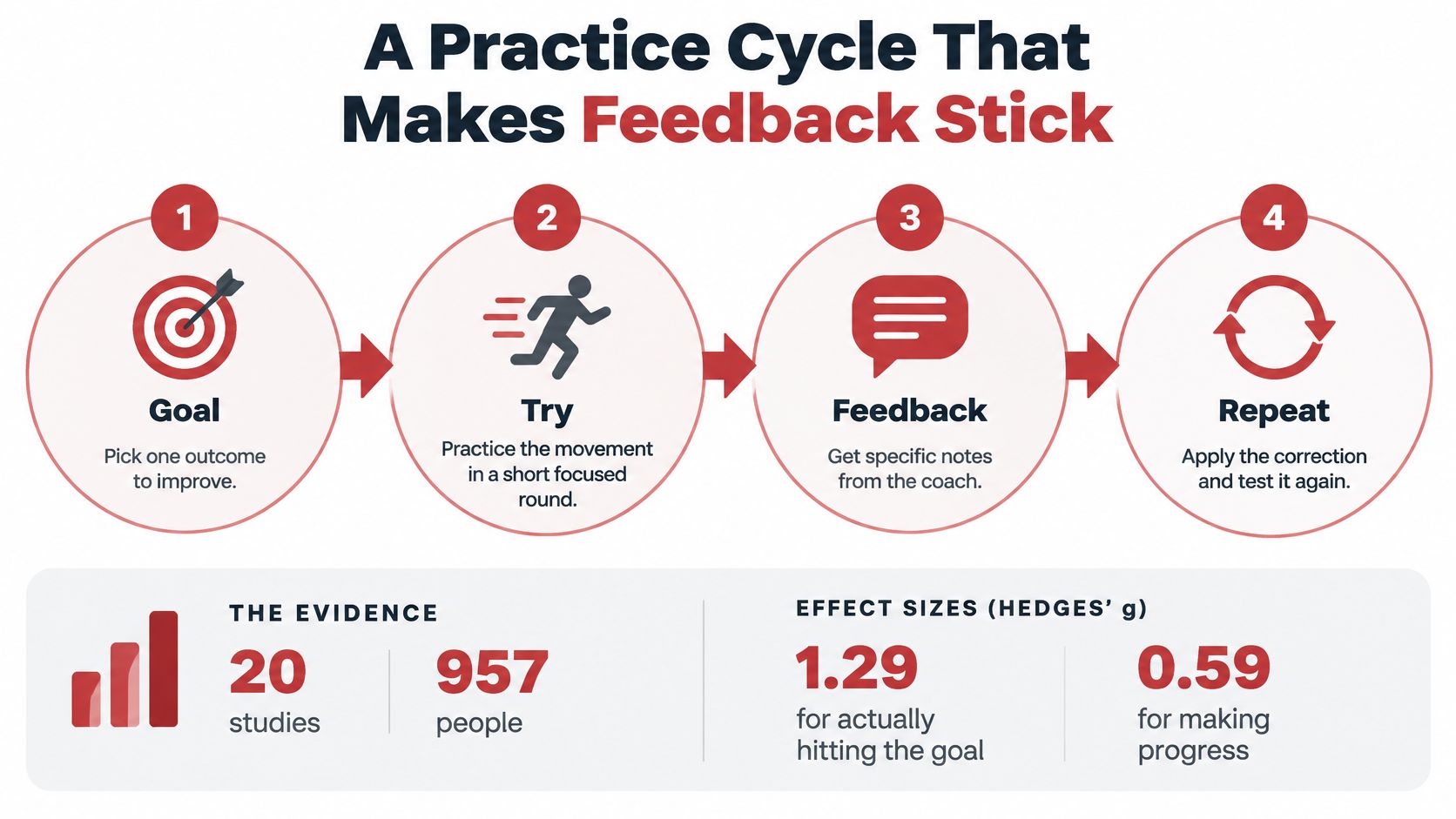
The goal-attainment synthesis reported g = 1.29 for reaching a specific goal and g = 0.59 for self-efficacy. A specific goal means completing a defined task, such as keeping a basic at tempo. Self-efficacy means believing you can do it. That belief is useful, but it is not the same as performing the task reliably.
The transfer and mental-practice findings address separate questions. Transfer asks whether a skill holds up when the task changes. Mental practice concerns rehearsing a movement in your mind between attempts; it can support physical practice, not replace it.
Make the outcome visible
A phone video can show whether you still rely on spoken counts. An instructor can check whether your frame stays consistent through a phrase. Your own sense of comfort matters too, but pair it with something observable.
Effect sizes are not percentages or lesson forecasts. They cannot tell you how much your timing will improve or how many appointments you will need. Set a clear target, then check whether the movement holds when the music or partner changes.
How a Coach Differs from a Group Class
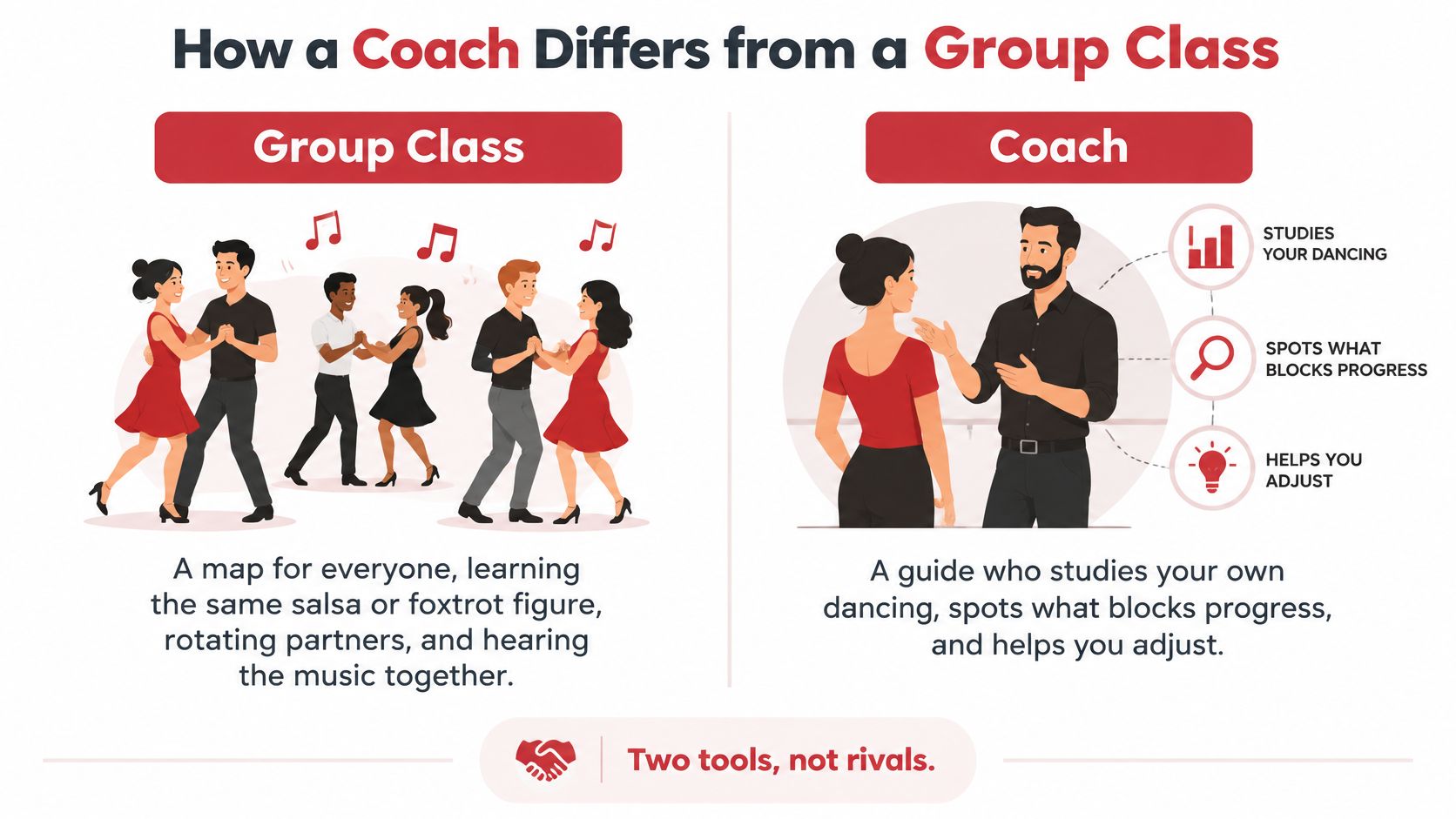
A group class is a map: dancers learn shared vocabulary, hear the music together, and try figures with other people. A private coach provides a diagnostic: attention to the particular movement that's blocking your progress.
They're tools for different jobs, not rivals. This comparison makes the distinction visible.
Private coaching compared with a group class
| Question | Private coaching | Group class |
|---|---|---|
| Who gets the teacher's eyes | Your frame, timing, and weight | The whole room, with occasional individual notes |
| Whose pace | Your goal and current tempo | The syllabus and the middle of the group |
| How errors are fixed | One variable, feedback after the pattern | A demonstration plus a general correction |
| Partner | Optional; coach or a chosen partner | Rotation is common; many studios need no partner |
| Best job | Stuck habit, wedding, competition, fear | Vocabulary, musical exposure, social repetitions |
| What proves it stuck | Same figure with new music or a new partner | Copying the figure during class shows immediate performance, not yet independent transfer |
Why feedback timing matters
A systematic review of motor-skill teaching trials, covering 15 randomized trials and 695 participants, found a large transfer-test effect for terminal feedback (SMD 0.94) and a smaller post-acquisition effect for mental practice (SMD 0.43). These weren't dance-specific results, but they provide a useful basis for testing end-of-sequence feedback in a studio.
Terminal feedback means feedback after the attempt. You dance the basic, finish, and then hear what to adjust. You're not trying to follow a stream of instructions while also listening, balancing, and responding to a partner.
For example, a coach might notice that you begin a turn before settling onto the supporting foot. You finish the pattern, hear a concise correction, picture the weight change, and try again. A group teacher can demonstrate that principle, but can't pause the whole room for every student's individual loop.
Choose for the job in front of you
A beginner may need a class to understand what a foxtrot figure looks like and private attention for the habit that makes it uncomfortable. An advanced couple may need choreography detail privately, then a practice party to cope with traffic and unfamiliar surroundings.
No partner is required for either format at our social dance studio, and significant others are welcome. Private instruction removes the wait for partner rotation; group participation offers a different social learning environment.
Use the distinction when considering private dance lessons: choose the format that fits your current goal. You don't have to become permanently a private-lesson person or a group-class person.
A Practice Cycle That Makes Feedback Stick
A salsa basic feels secure with one song, then unravels when the tempo changes. Coaching helps turn a correction into a skill by giving you a clear target, a way to practice it, and a test under different conditions.
The cycle is simple enough to repeat between lessons.
Run the cycle with a visible checkpoint
Name the outcome. Pick something you can see: a salsa basic at an agreed tempo, a frame held through a sequence, or a wedding phrase completed without verbal prompts. Write down what counts as success before you begin.
Record a baseline. Dance the task once without stopping to fix every mistake. A phone video can help if you're comfortable recording. Note the first breakdown, such as a late weight transfer, rather than listing every imperfection.
Ask for one usable correction. Complete the pattern, then ask what action to change. “Finish the weight change before starting the turn” gives you a clear task. “Improve your technique” does not.
Picture it, then rehearse it. Mentally follow the correction before trying the movement again. Do a few attentive repetitions, then check whether the intended change is still happening. Repeating a movement without checking can reinforce the old habit.
Change the conditions and retest. Try different music, a different lead, or an entrance without a count-in. Mark whether you met the written goal, not whether you are a “good” or “bad” dancer. If the test breaks down, note where.
Match the test to your purpose
A movement can work in a quiet practice and still disappear when the music changes. Test technique inside a real phrase to see whether you can keep the movement while listening. A calm observer can also help you check whether you complete the task without prompts.
For a competition figure, test whether it stays clear under observation. For a wedding dance, divide a 60- to 90-second song into phrases, practice each one, then join them without prompts. Keep the task manageable before adding difficulty.
At home, use the same goal, correction, and retest rather than practicing every step at once. These suggestions for practicing dancing at home can help you organize a focused rehearsal.
Leave with a written goal and a retest, not only a good feeling.
A respectful lesson gives you room to try imperfectly. Coaching supports learning and participation; it is not clinical care.
Wedding Night, Social Floor, and Competition
The right coaching choice depends on where you want to use the dancing. A wedding couple, a hesitant social dancer, and a competitive partnership don't need identical lessons.
Their settings may look different, but each needs a visible test.
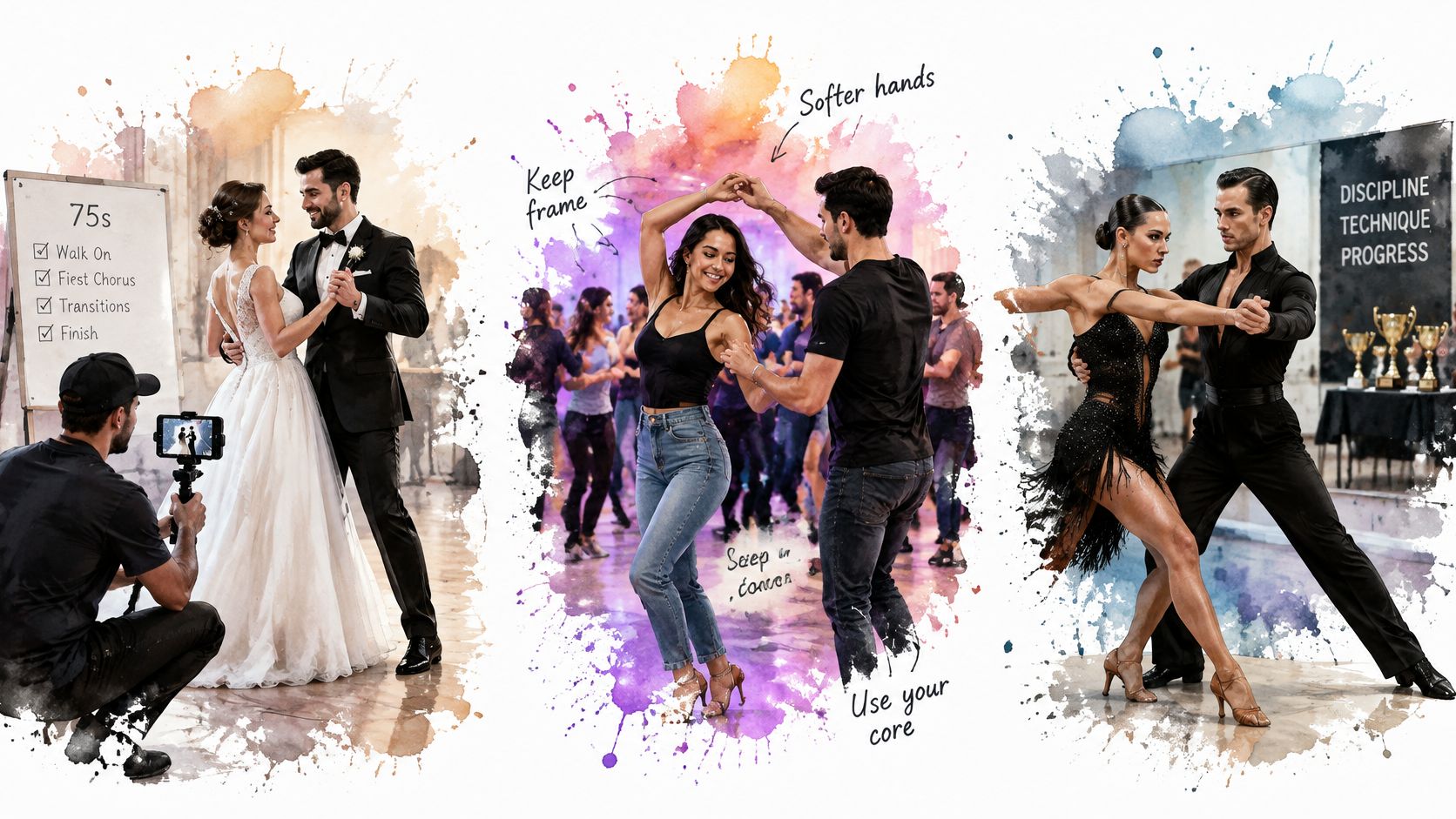
A first dance that feels manageable
Consider a hypothetical couple with eight weeks before their wedding and a 75-second song edit. They're nervous about the entrance and don't know how to finish when the DJ fades the music.
The coach's useful choice isn't to add a lift. It's to film the walk-on and first chorus, select simple waltz or foxtrot timing that fits the music, and give the ending a clear shape.
Their test is practical: dance the song without spoken counts, in the shoes they intend to wear, within a small marked floor area. They need a dance they can enjoy together, not an unexpected showcase.
A social song without hiding
Another dancer feels older than everyone else in the room and waits near the speakers rather than accepting an invitation. Their first goal isn't an elaborate salsa shine. It's staying with a comfortable basic and recovering when they lose the beat.
A 2025 systematic review of dance and physical self-perception covered 16 studies across seven dance forms, finding improvements in physical self-esteem and self-confidence alongside reductions in social physique anxiety and negative self-evaluation. That supports taking the emotional experience of participation seriously, without claiming that coaching itself produced those findings.
The coach can offer a slower entry, clear permission to restart, and nonjudgmental feedback. The visible test is finishing a song with a considerate partner, not impressing the room.
Watching partnered movement can also give a nervous beginner a less abstract starting point.
A competition phrase under scrutiny
Say a smooth couple receives criticism about uneven rise and fall but can't feel the difference. Their coach isolates a waltz phrase and compares video with the intended movement.
Instead of polishing the same comfortable attempt indefinitely, they try the phrase at a different tempo and under observation. The test asks whether they can maintain control when conditions no longer feel automatic.
Safety and encouragement matter in each case, particularly for the hesitant participant. None of these scenarios replaces medical or mental-health care, and physical-activity cost-effectiveness findings don't justify promising financial or clinical benefits from dance coaching. Promise a clearer dance, not a cheaper life.
Why Coached Gains Fade Without Practice
A 2025 study of 662 primary healthcare workers in England found that wellbeing and resilience improved after coaching, then declined by follow-up, although they remained above baseline. The outcomes weren't dance skills, but the pattern challenges the idea that completing coaching automatically secures lasting change.
A great teacher doesn't install a permanent habit. You still need opportunities to retrieve and use what you learned without that teacher beside you.
Replace supervision with practical supports
A wedding routine forgotten after the celebration doesn't automatically mean the instruction failed. Nor does a competition figure falling apart at a social prove you never learned it. You may have practiced it only with familiar cues and no plan for keeping it available.
Build a modest rehearsal structure instead:
- Keep the task narrow. Write the movement and its success condition where you'll see them before practice.
- Make rehearsal manageable. As a sample routine, use ten focused minutes rather than an open-ended session spent replaying everything.
- Include independent use. Try the figure in a class, practice party, or social situation where your coach isn't supplying cues.
- Arrange a re-check. Bring back the attempt that failed, not only the version you've already made comfortable.
A workable example is a coached variable, three short home rehearsals, and a public attempt. That's a suggested practice rhythm, not a scientifically established dose.
Coaching is important because it makes continued practice more accurate, not because a few sessions finish the job.
Watch checkpoints, not promised timelines
The first lesson can establish a written baseline and a retest. Home rehearsal then reveals whether you can reproduce the change without immediate help. A later check after a longer gap shows what remains available and what needs refreshing.
Avoid buying a long package with no clear way to assess progress. Constantly switching styles can also make it difficult to tell whether a particular correction has settled. A compliment is welcome, but it isn't evidence that a skill holds under changed conditions.
If you're considering a first lesson in Philadelphia or Exton, use that visit to look for this kind of follow-through. You're assessing whether the teacher can help you organize learning, not whether you can impress the teacher.
Choose a Coach and Book a First Lesson
Choose a teacher by how clearly they help you work, not by how complicated their demonstration looks. You need instruction you can understand while you're learning, not only admire from the edge of the floor.
Five checks for a useful teaching relationship
- A clear observation. The coach can watch your movement and describe the obstacle in plain language. Your weight stays between your feet is more useful than you need better coordination.
- A goal you could miss. The lesson ends with a checkable task, such as a basic at tempo, a chorus without cues, or a phrase recorded on video.
- A manageable pace. The teacher responds to your nerves without dismissing them. Encouragement refers to what changed, rather than becoming a speech about confidence.
- Relevant teaching experience. Look for experience teaching the style and level you need, whether that's salsa, cha-cha, rumba, swing, waltz, foxtrot, or tango. Performance ability alone doesn't tell you how someone explains movement.
- A route into broader dancing. You can eventually use the skill with other people, rather than needing the teacher's exact lead forever.
Try the fit without performing for approval
At Danza Academy of Social Dance, our Private Dance instruction offers one-on-one coaching customized to your goals and pace, while Professional Training serves competitive or advanced dancers seeking mastery. Our instructors bring decades of international experience in dance.
Our studios are in Center City Philadelphia and Exton, PA. No partner is required, and significant others are welcome. Alongside the styles above, the academy teaches samba, hustle, West Coast swing, quickstep, and country two-step.
You can also explore dance teacher qualifications when considering what matters in an instructor. The practical question remains whether you understand what the teacher wants you to try and why.
Use the first visit as a baseline, not an audition. Bring a song, explain the moment that makes you hesitate, or describe where a familiar figure falls apart. If you leave able to name your next practice task, you have something concrete to build on.
Danza Academy of Social Dance offers personalized instruction to help you turn a frustrating movement into a clear practice goal. Visit Danza Academy of Social Dance and book your free complimentary lesson in Philadelphia or Exton. Bring one goal, and use the lesson to work toward one correction and one meaningful retest.