
You put on the music, try the step you learned in class, and within a minute something feels off. Your living room suddenly seems too small, your timing slips, and without a teacher or partner in front of you, you're not sure whether you're improving or just repeating mistakes.
That's normal. Home practice often feels awkward at first, especially in Ballroom and Latin styles where connection, timing, and frame matter as much as the steps themselves.
The fix isn't “practice harder.” It's practice with structure. When you know what to work on, how long to work on it, and how to make solo practice translate to real partner dancing, your time at home starts paying off fast.
Your First Steps in Home Dance Practice
Most dancers don't struggle because they lack motivation. They struggle because the studio gives them structure, and home takes that structure away.
A beginner runs a Waltz box a few times, then switches to Tango walks, then tries a turn from memory, then quits because nothing feels clean. An engaged couple rehearses their first dance once after dinner, gets stuck on the same transition, and decides they “just need the next lesson.” A more advanced social dancer puts on Salsa music and dances full out, but never isolates the part that keeps breaking down.
None of those dancers are lazy. They're just practicing without a method.
Practical rule: Don't use home practice to “do everything.” Use it to make one or two things better.
That shift changes everything. Good home practice has a narrow target. Maybe today you clean up your frame. Maybe you drill a Cha-Cha chasse so it lands with better timing. Maybe you walk your wedding entrance and exit until they feel calm instead of rushed.
The dancers who improve at home aren't usually the ones doing the longest sessions. They're the ones who remove friction. They clear space, choose one focus, record a short video, and stop before fatigue turns clean repetition into sloppy repetition.
If you've been wondering how to practice dancing at home without feeling lost, start here: make your practice simple enough that you will do it, and specific enough that it changes the way you dance in your next lesson or social outing.
Creating Your At-Home Dance Sanctuary
The usual home setup goes wrong in a familiar way. You push the coffee table aside, start a Waltz box, then shorten every step because the lamp is too close. You try a Salsa basic, but the floor grabs your feet. If you are practicing for a wedding or a social floor, that kind of setup teaches your body to dance small, guarded, and disconnected.
Clear the floor first
Give yourself enough room to move with honest intention. A home practice guide from Synergy Dance recommends a clear 6×6-foot area on a smooth floor, which is a solid minimum for basic drills and short patterns in place. Hardwood is usually easiest. Carpet can work for walks, timing drills, and frame practice, but heavy turning on sticky carpet often teaches tension instead of control.
For partner-style training, test more than foot space. Check arm space too. Ballroom and Latin dancers practicing solo still need room to hold shape, rotate the torso, and place the free arm without clipping furniture. Wedding couples should also rehearse the size of the movement they want on the day, not a cramped version that falls apart in a larger venue.
Run this quick check before you start:
- Remove rugs that slide, cords, bags, pet toys, and low furniture corners.
- Take one side step with both arms out in dance position. If you hit something, reset the room.
- Try two slow turns. If the floor sticks or slips, change shoes or change the drill.
- Save dips, floor work, and repeated spins for a space that supports them.
If you have any history of ankle, knee, or back irritation, build your setup around safer surfaces and controlled repetition. Our guide to dance injury prevention for home practice will help you make smart choices before a small problem turns into missed practice time.
Set up feedback that helps partner dancing
A phone camera does more for home dancers than a mirror alone. Mirrors tempt you to watch the front of the body. Video lets you check posture, timing, foot placement, and whether your frame stays consistent from start to finish.
Set your camera where it can capture your full body from the front, then from the side. For Ballroom and Latin, I also recommend filming one round in your dance hold shape, even when you are alone. That is how you catch the habits that hurt partnering later. Raised shoulders, bent wrists, collapsing left side, drifting elbows, and a frame that changes every count.
Sound matters too. Social dancers need to hear timing cleanly, especially in Foxtrot, Swing, Salsa, and Cha-Cha. If you practice in a room with a lot of echo, music cues get muddy and your rhythm work gets less precise. A guide to acoustic treatment for home theater can give you practical ideas for making a dedicated practice room sound clearer.
A short visual walkthrough can also help you spot setup details people often miss:
Make the room easy to return to
Good practice spaces get used because they are easy to reset. Leave your speaker, phone stand, and dance shoes in one place. Mark your camera spot on the floor with tape if needed. If you are working on first-dance material, keep the song cued and the start position clear so you can rehearse without spending five minutes setting up every time.
I like simple tracking here. A notebook on the shelf. A calendar with check marks. One line after each session on what felt better and what still broke down. That habit is especially useful for solo practice aimed at partner dancing, because it helps you notice patterns such as losing frame on turns or rushing entrances into closed position.
The room does not need to look impressive. It needs to support repetition, honest feedback, and the kind of movement you want to bring into your next lesson, social dance, or wedding floor.
The Foundation of Every Practice Session
A strong session has shape. Without it, dancers tend to jump straight into choreography, repeat mistakes, get tired, and call it practice.
Research on home dance training shows that deliberate, purposeful practice drives faster learning, and a recommended structure is a 3-5 minute warm-up, 10-15 minutes of focused skill work, 5 minutes of creative application, and a 3-5 minute cool-down. The same guidance also notes that video self-analysis helps dancers catch technical problems that are easy to miss in the moment, as explained in this at-home dance practice resource.
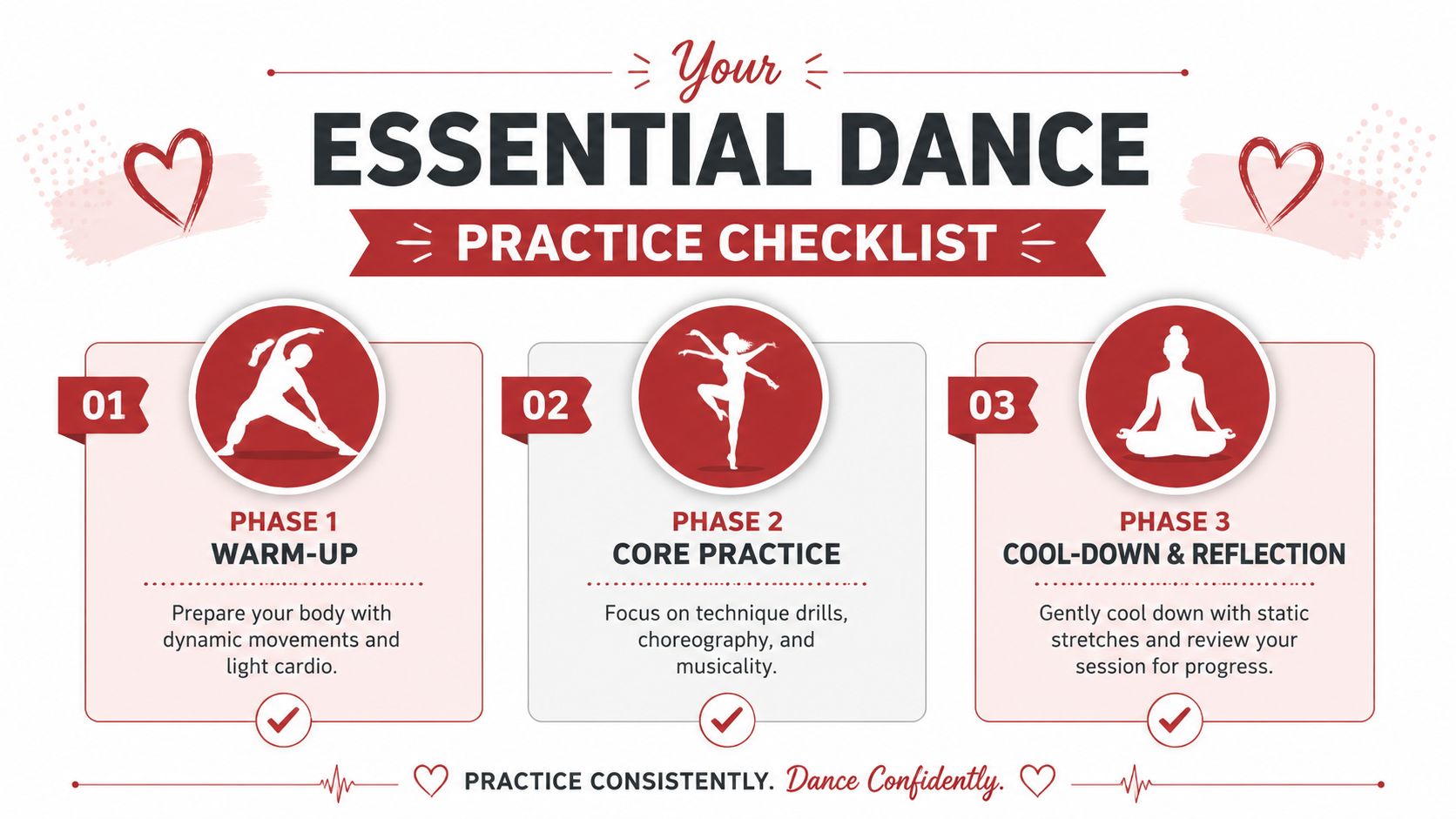
Warm up with purpose
Don't start cold by launching into spins, dips, or full choreography. Use the first few minutes to wake up joints, posture, and balance.
A useful warm-up for social dance includes:
- Head and shoulder isolations for mobility and posture awareness.
- Ribcage and hip movement to loosen the torso, especially for Latin action.
- Weight shifts and ankle rolls so your feet start responding quickly.
- Small marching or side steps to bring in rhythm before bigger movement.
Keep it dynamic. This isn't long stretching on the floor. You're preparing to move, not settling down.
If you're working through recurring soreness, pay attention to mechanics before adding volume. This guide on dance injury prevention is worth reading because dancers often blame “tightness” when the actual problem is alignment, overuse, or poor load management.
Use the middle of practice for one clear skill
Progress happens here. Pick one technical target and work it from a few angles instead of running your whole dance repeatedly.
Here are examples that work well at home:
- Posture drill: Stand in dance position and slowly shift weight without letting the ribcage collapse or shoulders creep up.
- Foot placement drill: Mark a basic pattern on the floor and step it slowly, making every transfer complete.
- Timing drill: Clap the rhythm first, then walk it, then dance it.
- Balance drill: Hold the end position of a turn or check step for a breath before resetting.
- Frame drill: Practice keeping elbows, back, and center organized while moving through basics.
For musical practice, some dancers like non-lyrical tracks because they make the beat easier to hear. If you're building a practice playlist, instrumental music for karaoke can spark ideas for cleaner rhythm work without vocal clutter.
Record short clips instead of relying on memory
Most dancers remember how a movement felt. Video shows how it looked.
Film one short clip, watch it immediately, and ask only a few questions:
| What to check | What you're looking for |
|---|---|
| Alignment | Is your head stacked over your spine, or are you leaning? |
| Footwork | Are you placing the foot clearly, or reaching and guessing? |
| Timing | Do your weight changes match the music, or are you late? |
| Transitions | Do you finish one action before starting the next? |
Your first video review shouldn't be emotional. It should be diagnostic.
That mindset matters. If you treat video as proof that you're “bad,” you'll avoid using it. If you treat it like a coach's eye, it becomes one of the fastest tools you have.
Cool down and reflect
A short cool-down helps you leave the session in better shape than you started. Ease the heart rate down, then stretch the areas that worked hardest. Calves, hip flexors, hamstrings, upper back, and feet often need attention after Ballroom and Latin practice.
Finish by writing one sentence: what improved, and what still needs work. If you don't reflect, the next session starts from scratch.
Dancing with a Ghost How to Practice Partnering Solo
Most advice about home dance practice assumes dancing is a solo activity. That's useful up to a point, but it leaves social dancers with a real problem.
Ballroom and Latin dancing depend on frame, lead-follow connection, and synchronized timing, and most home guides don't explain how to rehearse those partner dynamics alone. That gap is highlighted in this discussion of solo home practice for social dancers.

Shadow the partnership, not just the steps
If you only practice your own foot pattern, you miss the traffic of partner dancing. You need to know where the other body would be, how much space the figure needs, and where your center should move in relation to another person.
Use shadowing for that. Mark approximate partner positions on the floor with tape, sticky notes, or mental landmarks. Then dance your part while respecting that shared lane.
This helps with:
- Frame spacing: You stop overreaching with the arms.
- Floor craft: You learn where turns and side steps travel.
- Timing under structure: The movement starts feeling partnered, not free-form.
For wedding couples, shadowing is especially helpful when one person is traveling for work or practicing at a different time of day. You can still rehearse entrances, side-by-side moments, and transition points with partner awareness intact.
Train frame with a prop
A solo dancer often lets the elbows drop, chest tighten, or shoulders rise because there's no physical feedback. A light prop can fix that.
Try one of these:
- Pillow frame practice: Hold a pillow lightly in front of the torso to keep the arms organized without gripping.
- Resistance band connection: Hold a band between the hands to feel width across the back and steadiness through the arms.
- Doorway check: Stand in your dance posture near a doorway or wall edge to notice whether one side collapses.
None of these replaces a real partner. They provide your body with a reference.
If your solo frame only looks correct when you freeze, it isn't ready yet. A usable frame stays organized while you move.
Practice lead and follow through intention
Leaders and followers can both work on connection alone. The key is to rehearse the timing of intention.
Leaders should practice starting movement from the center instead of from the hands or shoulders. That means walking basics, direction changes, and rotational actions while imagining a partner receiving information from your body first.
Followers should practice staying responsive without becoming floppy. That means preserving your own axis, moving on time, and not “pre-guessing” the next figure.
A simple comparison helps:
| Solo habit that hurts partnering | Better solo practice habit |
|---|---|
| Throwing the arms into position | Moving from center and back muscles |
| Rushing into the next figure | Completing weight transfer before changing shape |
| Practicing only big choreography | Rehearsing starts, stops, checks, and transitions |
| Dancing full power every run | Alternating between slow control and musical speed |
Use visualization like a real rehearsal
Mental rehearsal isn't fluff. It's one of the best ways to clean up partnered dancing when your body needs a break or your partner isn't available.
Run the dance in your head with details. Where is the hand connection? When do you breathe before the turn? Where does your body settle after the promenade? Good visualization makes your next physical repetition cleaner because you're not solving everything on the fly.
This is how you turn solo work into partner-ready work. You're not dancing alone. You're rehearsing the relationship your body will need on the floor.
Building Your Personal Practice Plan
A useful plan is small enough to sustain and specific enough to measure. If you take classes, home practice should support the material you're learning, not compete with it.
Dance studios commonly recommend one to three hours of home practice for every hour of instruction, and for dancers with limited time, even a smaller commitment can still move the needle. One source notes that 30-45 minutes of focused home practice weekly can help dancers progress approximately 2-3 times faster than attending studio classes alone, and that this is especially helpful for couples preparing a wedding dance on a short timeline, according to this discussion of home practice and dance progress.
Choose a weekly rhythm you can keep
If your schedule is packed, don't build a heroic plan you'll abandon in a week. Build one you can repeat.
Some dancers like fixed days. Others do better attaching practice to an existing routine, such as after work on class days or on weekend mornings. If planning is hard for you, tools built for AI-powered workout planning can be helpful for thinking in repeatable training blocks, even if you adapt the structure for dance rather than gym work.
Here's a simple model you can personalize.
Sample weekly home practice schedules
| Day | Social Dancer (20-30 min) | Wedding Dance Prep (30-40 min) |
|---|---|---|
| Monday | Warm-up, basic timing drill, one footwork pattern | Warm-up, entrance and first phrase walkthrough |
| Tuesday | Frame and posture work, short video review | Frame practice, transition between key sections |
| Wednesday | Light musicality session, rhythm clapping, creative movement | Music listening, mental rehearsal, spacing check |
| Thursday | Technique focus from latest lesson | Full run of choreography, then isolate trouble spot |
| Friday | Rest or brief review of one pattern | Rest or gentle review without full-out repetition |
| Saturday | Longer session with basics, turns, and one recorded clip | Full dance with video, then corrections journal |
| Sunday | Easy reset, stretching, notes for next week | Walkthrough in wedding shoes or event footwear if appropriate |
Track the right things
Don't track everything. Track what changes behavior.
A simple practice journal can include:
- Focus of the day: One technique or one section of choreography.
- What improved: A short note after practice.
- What broke down: One issue to bring into your next lesson.
- Video check: Yes or no.
If memory is your biggest struggle, this article on how to remember dance choreography offers useful ways to organize movement in your head before it falls apart under pressure.
Keep your notes short enough that you'll actually write them. One honest sentence is better than a perfect log you never maintain.
What works and what doesn't
What works is repetition with attention. What doesn't work is blasting through the full dance every time and hoping confidence appears on its own.
What works is revisiting one correction until it sticks. What doesn't work is collecting five corrections and practicing none of them long enough to change your muscle memory.
If you're consistent, your class time becomes more valuable. You stop using lessons to remember what happened last week and start using them to refine details.
From Home Practice to Dance Floor Confidence
Home practice won't make you perfect. It will make you prepared.
That difference matters. Prepared dancers walk into lessons with better body awareness, cleaner recall, and more useful questions. Prepared wedding couples don't panic as easily when a section feels shaky because they've already spent time with the music, the timing, and the transitions. Prepared social dancers adapt faster because their basics are more reliable.
If dancing in front of others still makes you tense, that's common too. Confidence usually arrives after repetition, not before. This piece on how to overcome fear of dancing in public can help if your technique is improving but your nerves still get in the way.
The strongest result of learning how to practice dancing at home is simple: you stop guessing. You know how to warm up, what to drill, how to review yourself, and how to make solo work support real partner dancing.
The next step is getting expert eyes on what you've built.
If you're ready to turn home practice into faster progress, book a complimentary first lesson with Danza Academy of Social Dance. You'll get personalized feedback on your technique, timing, frame, or wedding choreography, and you can schedule it directly through the contact page.