
You hear a rumba song start and feel that pull to dance, but your feet hesitate. That's a common beginner moment. The music feels smooth and inviting, yet the movement seems harder to decode than it looks from the side of the floor.
The good news is that rumba becomes much more approachable when you stop treating it like a list of steps and start feeling its structure. Beginners usually don't need more patterns first. They need a clear sense of timing, steady posture, and the body action that makes simple footwork look like dancing.
That's what makes rumba dance steps for beginners worth learning the right way. A small amount of good technique goes a long way on the social floor.
Feel the Rhythm Your First Rumba Steps
Most beginners come to rumba with the same frustration. They can copy a few steps when watching someone else, but the moment music starts, everything feels late, rushed, or stiff. That doesn't mean you're uncoordinated. It usually means nobody has shown you what to listen for and how the movement should feel in your body.
Rumba has a calm, grounded quality. It isn't about racing through patterns. It asks for patience, balance, and a little confidence in stillness. That's why people often find it beautiful to watch and surprisingly challenging to begin.

What beginners usually feel first
On the dance floor, the first hurdle is rarely foot placement by itself. It's more often a mix of three things:
- Timing confusion: The music feels slower than expected, so beginners either freeze or step too early.
- Body tension: Shoulders tighten, elbows lock, and the hips stop moving naturally.
- Overthinking: Instead of hearing the music, dancers try to memorize a sequence under pressure.
That's normal. It happens in dance the way it happens in other hands-on skills. If you've ever learned by following simple visual instruction, like Direct AI's beginner origami picks, you already know that breaking a complex movement into a few reliable pieces makes it far less intimidating.
Rumba gets easier when you stop trying to “perform” it and start organizing what you hear, where your weight is, and how your body settles over each step.
What actually builds confidence
A beginner doesn't need flashy styling. You need a dependable base. That means learning to hear the pulse, staying upright without becoming rigid, and letting the hips respond to weight transfer instead of forcing them.
If music counting feels slippery right now, it helps to spend a little time on finding the beat in music before you worry about partner work. Once the beat becomes clear, rumba starts feeling less mysterious and much more danceable.
Mastering the Slow Quick Quick Count
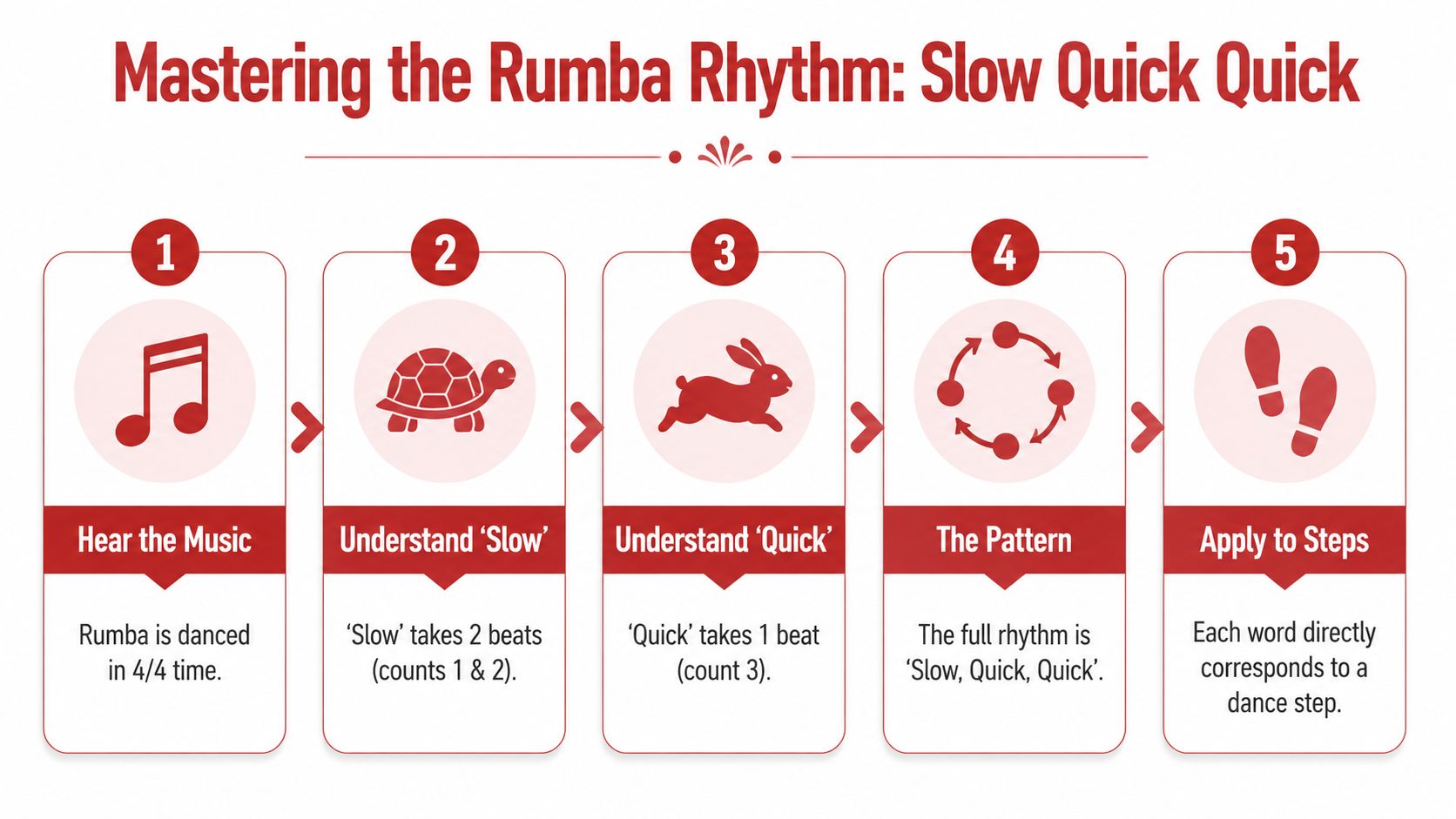
Rumba uses a 4/4 time signature and is commonly taught at 27 bars per minute or 105 beats per minute in standardized instruction, with the basic rhythm danced as slow, quick, quick where the slow takes two counts and each quick takes one count, as described in this rumba timing guide. That's the heartbeat of the dance.
Beginners often hear four even beats and assume the steps should feel evenly spaced. They don't. Rumba stretches one step across two beats, then places two shorter actions after it. That uneven spacing is exactly what gives the dance its suspended, romantic quality.
How the count works in your body
Think of the slow as a full breath. You don't want to cut it short. The two quicks are smaller and cleaner, but they're not frantic.
A practical way to count it is:
- Slow: take one step and stay with it for two beats
- Quick: take the next step on one beat
- Quick: take the next step on one beat
That uneven pattern creates a real coordination challenge. Dancing 4 Beginners notes that dancers who isolate the timing pattern in practice report 67% faster progression to intermediate levels. That tracks with what works on the floor. Students improve faster when they separate rhythm training from partner complexity.
What works and what doesn't
Here's the trade-off beginners run into right away. If you focus only on steps, your timing usually falls apart. If you focus only on the count without moving, you don't build usable coordination. The fix is to combine the two in small doses.
What helps:
- Count out loud: Say “slow, quick, quick” while stepping in place.
- Keep the slow honest: Let it take the full two beats.
- Practice without a partner first: Remove the pressure of leading or following.
What usually doesn't help:
- Rushing because the music feels empty: The pause inside the slow is part of the dance.
- Marching all steps the same size: Equal steps flatten the rhythm.
- Starting with fast combinations: More patterns hide bad timing instead of fixing it.
Practical rule: If your rumba feels hurried, the problem usually isn't your feet. It's that your slow step has become too short.
A simple rhythm drill
Try this for a few songs:
- Step to one side on slow
- Replace weight on quick
- Close feet on quick
Then reverse it. Keep the steps small. Your goal isn't travel. Your goal is consistency.
Once that pattern starts to feel predictable, your body has room to relax. That's when rumba begins to feel musical instead of mechanical.
Your First Rumba Steps The Basic Box Step
The first pattern most beginners learn is the rumba basic, often called the box step. Beginner instruction commonly builds around a set of 10 essential steps, including the rumba basic, cucaracha, side step, under arm turn, and New Yorker, and it starts from a closed position with the leader's right hand under the follower's shoulder blade, as shown in this beginner rumba lesson resource.
The box step matters because it teaches direction, rhythm, and weight transfer all at once. It also gives both partners a dependable home base. On a social floor, that matters more than people realize. If you lose track of what to do next, a calm basic can reset everything.
Closed position first
Before the feet move, the frame needs to make sense. In basic closed position, the partners connect through the hands and upper body without squeezing or leaning. The contact should feel present but not heavy.
For beginners, the goal is simple. Stand tall, keep the elbows comfortably alive, and avoid hanging on your partner for balance.
Rumba Box Step Breakdown
Here is a simple way to organize the pattern. The leader and follower mirror each other.
| Beat Count | Leader's Steps | Follower's Steps |
|---|---|---|
| Slow | Step forward with left foot | Step back with right foot |
| Quick | Step side with right foot | Step side with left foot |
| Quick | Close left foot to right foot | Close right foot to left foot |
| Slow | Step back with right foot | Step forward with left foot |
| Quick | Step side with left foot | Step side with right foot |
| Quick | Close right foot to left foot | Close left foot to right foot |
How to make the box step feel better
Most beginners can memorize that chart quickly. The harder part is making it feel grounded. Three details change everything:
- Finish your weight transfer: Don't place the foot and hover. Arrive on it.
- Keep steps modest: Oversized steps make balance harder and kill timing.
- Let the body move with the foot: If your upper body stays frozen while your feet travel, the dance looks disconnected.
A common mistake is to think the box is drawn with the feet only. It isn't. The box is also traced by the body shifting from leg to leg. If that shift is late or incomplete, the step looks uncertain even when the foot placement is correct.
The box step should feel like a smooth exchange of weight, not six separate foot taps.
Two beginner corrections that matter
The first correction is to stop stepping before the music asks you to. Anticipation is one of the biggest beginner habits in rumba. You hear the beat coming and jump ahead. Wait for it.
The second is to stop trying to make the box large to prove you know it. Social rumba works better when the movement is compact, clear, and balanced. Small steps with complete weight transfer beat large, unstable steps every time.
Once the box step feels natural, the other beginner patterns start making more sense because your rhythm and balance already have a home.
The Secret to Rumba Posture and Cuban Motion
The part of rumba that people notice first is often the hips. The part that creates that look is posture and weight transfer. Cuban motion isn't something you paste on top of the dance. It shows up when the body settles properly over each standing leg.

If you try to force the hips side to side, the movement usually looks busy and disconnected. If you use the floor well, keep the knees soft, and settle the weight completely, the hips begin to respond on their own.
Start with your standing leg
Here's the simplest beginner cue. When you place weight onto one leg, allow the body to arrive there fully. As that leg supports you, the hip on that side can settle and organize naturally.
Try this short drill:
- Stand with feet under you: Don't turn it into a wide lunge.
- Shift weight fully to one foot: Let the other leg release.
- Straighten the standing leg gradually: Feel the hip respond instead of pushing it manually.
That feeling is much closer to real rumba than exaggerated swaying.
For dancers who spend a lot of time at a desk, some basic exercises for better posture can also help free the chest and upper back. Better alignment makes Cuban motion easier because the hips don't have to fight a collapsed torso.
Posture that supports movement
Good rumba posture is upright but not stiff. The rib cage shouldn't flare. The shoulders shouldn't creep up. The neck stays easy. Your core is active enough to support you, but not clenched so hard that your movement becomes robotic.
That's why technical training matters. Classes that focus on body organization, such as dance technique training, help beginners understand why some movements feel easy and others feel blocked.
If the shoulders are tense, the hips usually stop telling the truth.
A visual breakdown can help once you've tried the feeling in your own body:
What beginners should avoid
The biggest errors are easy to spot:
- Forcing the hips first: This creates shape without substance.
- Locking the knees: That kills the settling action.
- Leaning forward or back: Once your axis moves off center, balance gets messy fast.
A clean rumba look comes from patience. Let the step finish. Let the weight arrive. Then the body action starts to make sense.
Putting It All Together A Beginner Routine
A beginner doesn't need a long routine. You need one combination that's simple enough to repeat and useful enough to take onto a social floor. That's how skill starts replacing guesswork.
Repetition matters here. Expert instruction often moves from the basic through several additional techniques, and achieving functional fluency across those patterns is described as roughly 100 to 120 hours of deliberate practice in this instructional reference. That shouldn't discourage you. It should take the pressure off. You're not supposed to feel polished after one class.
Three solo drills that pay off
Use these before partner practice:
- Rhythm walk: Step in place with slow, quick, quick. Keep your voice steady as you count.
- Weight-settle drill: Shift side to side slowly and let one hip release as the other leg supports you.
- Box step without arms: Remove styling and focus only on clean direction and complete transfer.
These drills work because they strip away distraction. If your solo timing is shaky, partner dancing will expose it immediately.
A simple partner sequence
Try this short combination:
- Dance one full box step
- Repeat the box step
- Open slightly for an under arm turn
- Return to basic closed position
- Dance the box step again
This works well for beginners because the basic acts like punctuation. You don't need to chain many patterns together. You just need one place to reset after a turn or opening action.
For anyone building comfort in social Latin styles, Latin ballroom dancing lessons can give structure to that practice by pairing timing work with partner connection.
What to expect from practice
At first, you'll count everything. Then you'll count only the moments that feel uncertain. Eventually, the music starts organizing the movement for you.
That shift doesn't come from cramming more steps into one session. It comes from repeating a few reliable actions until your body trusts them. In beginner rumba, less is often smarter.
Your Invitation to the Dance Floor
By this point, you've got the essentials that matter most at the start. You know the rhythm isn't evenly spaced. You know the box step depends on real weight transfer. You know Cuban motion comes from posture and settling, not from throwing the hips around.
That foundation is enough to begin. It's also enough to realize why in-person feedback changes things so quickly. A teacher can catch the tiny errors beginners almost never feel on their own, like a rushed slow, a late weight change, or shoulders that tense up right before a turn.
That's why the fastest path forward usually isn't learning more online patterns. It's getting a trained eye on the basics you already have. When a beginner gets clear correction on timing, frame, and body action, rumba starts feeling less like memorization and more like conversation.
If you've been waiting until you “feel ready,” this is the point where most dancers should stop waiting. Readiness often comes from starting, not from thinking about starting.
A complimentary first lesson at Danza Academy of Social Dance is a practical next step if you want help turning these basics into something you can use on the floor. You can book your free lesson through the contact page, get real-time feedback on your timing and posture, and start building confidence in a setting designed for beginners.