
92% of U.S. couples performed a first dance in The Knot's 2023 Real Weddings Study, based on 9,318 U.S. couples married in 2023. That makes the first dance a nearly universal reception moment, not a niche performance for trained dancers. You're preparing for two visible minutes in front of people who love you, and that preparation has a clearer shape than most couples expect. Decide how long you'll dance, and the lesson count, stamina, and choreography fall into place around it.
When to Start Wedding Dance Lessons
Start wedding dance lessons four to six months before the wedding, and plan on six to ten private sessions. That's the default for most couples who want a relaxed first dance. It gives you time to learn a basic step, settle it into your body between lessons, and still miss a week for a tasting or a fitting without panic.
Most couples who book wedding dance lessons are beginners, and Danza Academy welcomes beginners. One couple, Geena R. and her husband, took lessons for seven months before their wedding and credit their instructor Stephanie for a first dance their guests loved. You're learning one common reception skill, and nobody expects you to arrive knowing it.
Before you count sessions, make one decision: your song length. A 60 to 90 second edit is the sweet spot for a first dance. Long enough to feel romantic and give guests a moment to watch, short enough that two beginners can repeat it calmly without running out of choreography or stamina. Shorter than that and the dance ends before the emotion lands. Longer and you're paying for more lessons to fill time your feet don't need. Set the length first, because the session count, the stamina required, and the amount of choreography all follow from it.
Read the Timeline by the Months You Have Left
Pick the row that matches your calendar today, not the row you wish matched. Each window has a different honest goal, and the session count follows from that goal.
| Time left | Sessions to plan | What you can learn | Best for |
|---|---|---|---|
| 12 months or more | Weekly social class, then 6-8 private sessions | Social style plus a custom first dance | Couples who want to dance with guests all night |
| 6-8 months | 6-8 private lessons | A polished 60-90 second routine and a simple parent dance | Couples adding a parent dance |
| 4-6 months | 6-10 private lessons | A relaxed 60-90 second first dance | Most couples (default) |
| 3-4 months | 6-8 private lessons | Basic step, a turn, and one optional dip on a short edit | Busy couples using a short edit |
| 4-6 weeks | 3-4 crash lessons | Frame, basic step, entrance, and exit | Last-minute bookings |
| Wedding week | 1 walk-through | Pathway, cues, and confidence only | Couples skipping choreography |
With 12 months or more, you can do two jobs in sequence. Take weekly social classes first and learn to move with guests in waltz, foxtrot, salsa, or swing. Then switch to private sessions and build your custom routine on top of real comfort. Starting this early also means your 60 to 90 second edit feels generous, since the steps already live in your body before choreography begins.
At six to eight months, the standard path covers one short first dance plus a simple parent dance. You've got room to learn both without rushing either. Keep your dance at the full 60 to 90 seconds and let the parent dance run shorter, since your parent may have even less dance background than you do.
When Time Gets Short the Goal Shrinks
Three to four months still works well. Commit to the 60 to 90 second edit, keep lifts off the plan, and you can learn a basic step, one turn, and an ending that looks intentional. Resist the urge to trim the song under a minute to save lessons. A very short edit reads as abrupt rather than efficient, and a slightly longer, simpler dance looks more confident. Most guests won't know you started later. They'll see a couple who looks calm.
Four to six weeks is a crash course, and you should name it that way when you book. Three or four lessons can cover frame, basic step, the walk-on, and a clean stop. That's enough to avoid the middle-school sway, and it's a real result. It isn't enough for a routine with multiple turns and a dip sequence, so hold the song at the short end of your edit and let clean execution carry it.
A single session in the wedding week only walks the path. You'll practice getting from your table to the floor, hearing your cue, and knowing who starts. It builds confidence, not choreography, and that's fine if you know it going in.
Practical rule: Book the first session before you've locked the floor layout and the final song file, so your instructor can build around the real space and the real recording.
Slot the booking into your wider planning early, the same way you'd slot the photographer. A resource like a wedding countdown guide for engaged couples from Pretty Progress helps you see where lessons sit alongside fittings and vendor deadlines. Find your row in the table, pick your song length, book that first session, and let everything else build from a real date on the calendar.
Private Lessons or Group Classes
Choose the format from the job you need done, not from a package name. A private lesson and a group class solve different problems, and buying the wrong one wastes both money and the weeks you just counted out.
Private lessons put both partners on your exact recording, at your pace. Your instructor adds dips and turns only after both of you agree to them. That's the right buy when the goal is one first dance, a parent dance, or any short routine guests will sit and watch.
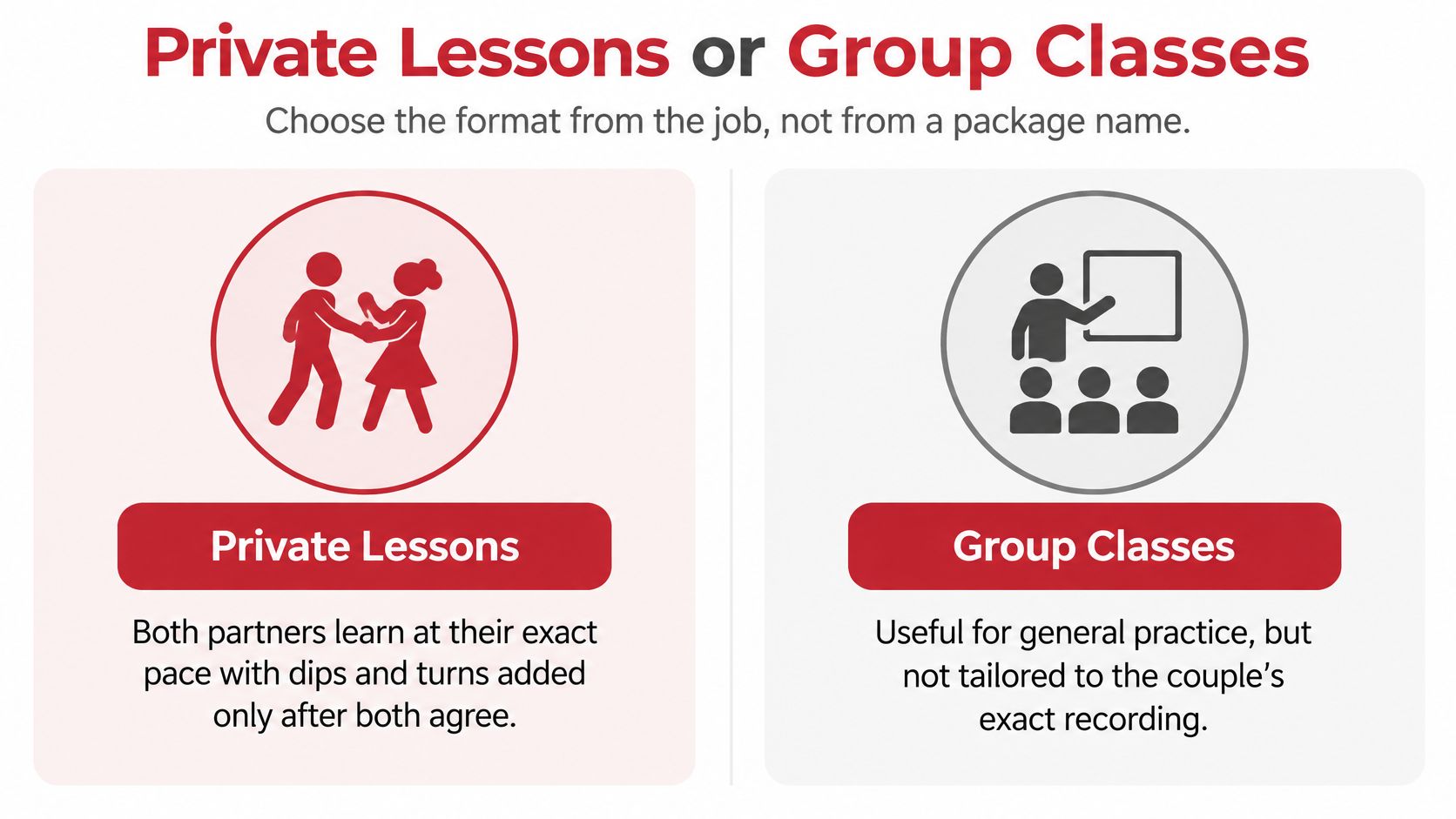
Group classes teach shared basics in styles like hustle, swing, salsa, or foxtrot, and you'll meet other dancers while you learn. What a group hour won't do is finish a custom edit of your song. The class moves at the group's pace, on the group's music.
| Format | Best when | What you practice | Partner needed | Pace |
|---|---|---|---|---|
| Private lesson | The first dance or a parent dance is the goal | Your song, frame, turns, and an agreed ending | Yes, once the routine starts | Set to the couple |
| Group class | You want to dance with guests later | Shared social basics in one style | No | Set by the class |
| Hybrid | You want a spotlight dance and social dancing | Group basics, then a private routine | Only for the private block | Split between class and couple |
The Hybrid Option and Who Has to Show Up
A hybrid plan works when you want both outcomes. Social classes build musicality and comfort on a crowded floor. Private sessions then set your entrance, your chorus, and your exit. If that mix appeals to you, look at our group dance classes for social styles alongside a private block.
No partner is needed to take lessons at Danza Academy, so one of you can start group classes alone. The other person should join once the routine itself begins, because partner connection is the aspect you're rehearsing. Either partner can lead, or you can switch the lead by phrase. Tell your instructor which arrangement you want in lesson one.
What to Compare Before You Pay
Private hours usually cost more than group classes, so compare packages on what's included. Four items change the price and the value:
- The song cut: Is editing your track to the chosen length part of the block?
- The parent dance: Does the price cover a second, simpler routine?
- The session count: How many private lessons are you really getting?
- The final rehearsal: Is one extra session close to the wedding date included?
Ask for the per-hour rate and the total for the block before you book. Confirm whether the complimentary first lesson counts toward that total. A hybrid plan usually costs more than one format alone, so price the spotlight dance first and add group classes only if you'll be dancing with guests.
The recommendation is simple. Book private if the spotlight dance is the point. Book group if dancing with guests is the point. Book both only if your timeline still has room after the private block is on the calendar.
How Long the First Dance Should Be
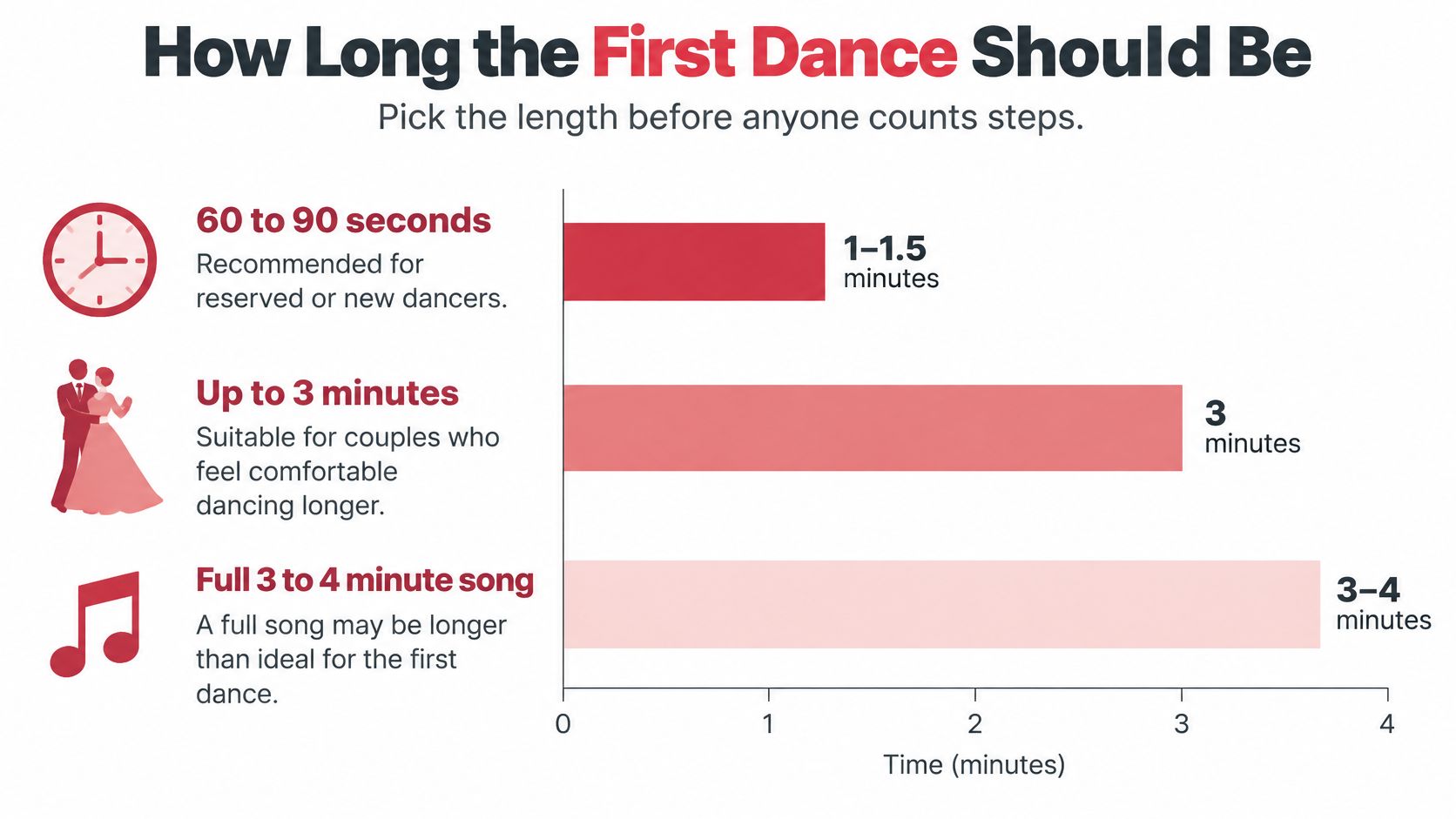
A shorter first dance isn't a lesser one. For beginners, a 60 to 90 second edit usually produces the most romantic result, because you finish relaxed, on time, and still smiling instead of counting down the last verse. Pick the length before anyone counts steps, because the length is what sets your stamina, your lesson count, and how much choreography you need to remember.
Wedding experts commonly recommend a 60-90-second first dance for reserved or inexperienced couples, while more confident couples may choose up to three minutes, according to The Knot's guidance on first dance timing. Other planning advice presents a full three to four minute song as normal, which is where couples get confused. A full recording is common on playlists. That doesn't make it a good default on a dance floor.
Think about what works against you in minute three. Nerves are highest at the start, but fatigue builds as you go. A heavy dress pulls on every turn, new shoes change your balance, and guest attention naturally fades after the first chorus. None of that means you failed. It means the song was longer than the moment needed.
| Length | Who it fits | Moves that fit | Watch-outs |
|---|---|---|---|
| 60 seconds | Nervous or first-time dancers | Basic step, sway, one turn | Can feel abrupt if the exit is not rehearsed |
| 90 seconds | Most couples | Verse, one chorus, optional shallow dip | Best default for beginners |
| 2 minutes | Couples already comfortable moving | Two sections and a traveling step | Needs open floor space |
| 3 minutes | Experienced or performance-minded couples | Fuller arrangement and more turns | Fatigue, dress limits, and guest chatter |
Match the Seconds to Your Stamina
At 60 seconds, keep it honest and simple. A basic step, a sway, and one simple turn fill the minute completely. Rehearse the exit so the ending reads as a choice, not an escape.
At 90 seconds, you can add the emotional chorus and, if both of you agree, one shallow dip. That's why this length suits most couples. You get the part of the song that matters and one picture moment, without a second verse to survive.
At two minutes, you need open floor and a traveling step, because dancing in one spot starts to look static. At three minutes, plan for water and a breath beforehand, and resist adding extra tricks to fill time. Length itself is the difficulty at that point.
Keep the Feeling Without Four Minutes of Dancing
Couples ask this constantly, so here's the edit that works. Start after the intro. Dance the verse that explains why you chose the song. Hit the chorus once. Exit on a cue your DJ or band has agreed to in advance. You've kept every line that means something and cut only the repetition.
Mark the edit for tempo changes and musical breaks before you rehearse it. A spin that lands in a silent gap looks like a mistake even when you timed it perfectly. Your instructor can flag those spots in the first listen.
Run the chosen edit twice in a row, in your wedding shoes, on a floor close to your reception size. If you're winded or the timing slips, cut 30 seconds instead of adding lessons.
That twice-through test is your decision tool. A dance you can repeat calmly is a dance you'll enjoy once, in front of everyone, when it counts.
How to Build the Wedding Dance
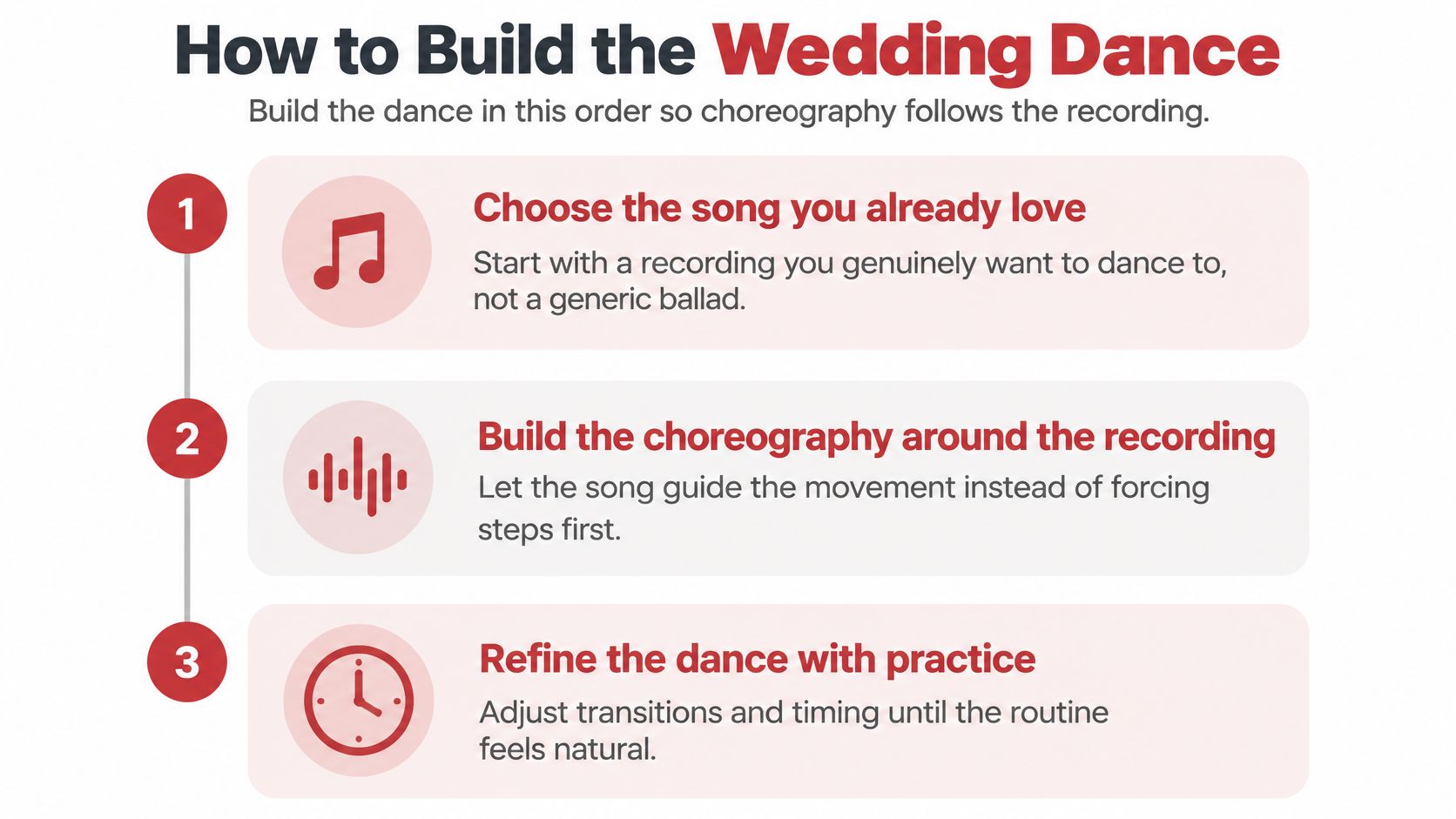
Build the dance in order, and let the recording lead. Couples get into trouble when they learn steps first and then try to force their song to fit them. The sequence below does the opposite, so every lesson adds one layer to something that already works.
The Six Steps in Order
Choose the song you already love. Don't default to a generic ballad because it seems safe. First dance taste is personal and generational. In The Black Tux survey of more than 900 married people, 10.9% of baby boomers selected "Unchained Melody", 7.3% of Generation X respondents chose Aerosmith's "I Don't Want to Miss a Thing", and "All of Me" by John Legend was the leading selection among millennials at 7.6%, according to reporting on The Black Tux survey of more than 900 married people. If you're still browsing, our list of the best wedding dance songs to start from can narrow the field, but the final pick should be a track you'd choose in the car, not just at a wedding.
Send your instructor the exact materials. That means the specific track file, not just a song title, because live and studio versions differ. Include your chosen edit length, whether that's 60, 90, 120, or 180 seconds. Say who's leading, or say you haven't decided. Both answers help.
Learn frame and one basic step that matches the tempo. A foxtrot walk suits a slow standard. A salsa basic suits a brighter, rhythmic track. Get comfortable holding each other and moving on the beat before any turns enter the picture. This step feels slow and does the most work.
Map the floor. Walk the actual pathway from your table to the dance space. Note columns, a slick surface, a floor smaller than the studio's, or a rug edge you'll cross in heels. A traveling step that works in a big studio can run out of room fast at a restaurant venue, and you want to learn that in week two, not at the reception.
Add only the picture moments you both want. One turn, one dip, one moment where you separate and come back together. That's usually plenty. Agree out loud before any dip, every time, until it's automatic. Choreographed routines are having a moment, but a short, repeatable dance reads better to a room than a trick-heavy one you have to think through. If you're adding a parent dance, give it its own simpler pattern rather than copying your routine with a different partner.
Rehearse in what you'll wear, then run the ending. Practice in the shoes, at the dress length, and in the jacket you'll have on. Fabric and heel height change your balance more than you'd expect. Finish by running the final seconds on the exact DJ or band cue, because a clean stop is what guests remember and photograph.
Knowing When You're Done
The finish line: Stop adding material when you can dance the whole edit cleanly twice in a row without talking through it.
That standard protects you from the most common beginner trap, which is one more move. Every addition needs rehearsal time, and rehearsal time near the wedding is the scarcest resource you have. A calm, finished 90 seconds beats an ambitious routine that's still wobbling in the final week. When the edit runs clean twice, you're not settling. You're ready.
Rehearsal Fixes and Access Needs
Treat problems in rehearsal as notes, not as proof you booked the wrong lessons. Almost every couple hits the same three or four snags, and each one has a plain fix.
Here's a look at how a typical session works through those fixes in the studio.
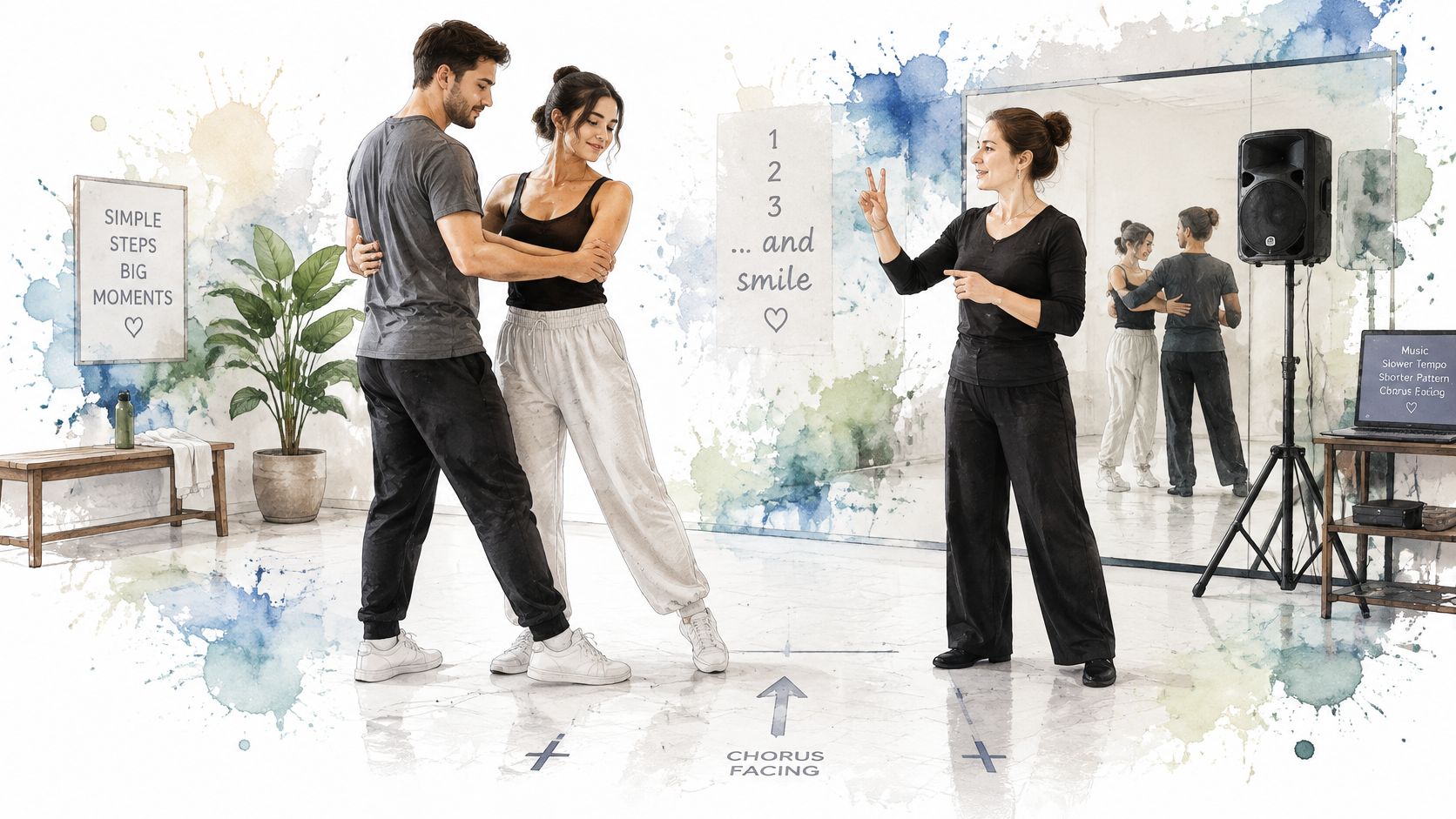
If you freeze when people watch, shrink the pattern back to the basic step and look at each other through the chorus. Eye contact with your partner gives your attention a job, and guests read it as romance, not retreat. If your steps start rushing, count the edit out loud once without music, then dance it to the track. Rushing usually means you're chasing the beat instead of sitting in it.
If a dip feels unsafe, cut it. A memorable first dance doesn't need lifts, deep dips, or fast turns, and nobody in the room is scoring difficulty. One student said the Foxtrot weekly sessions made them look like they knew what they were doing at their first dance, and that's the right target. Recognizable, calm movement is the whole job.
Say Your Access Needs Early
Tell your instructor in the first conversation about height or strength differences, pregnancy, balance concerns, chronic pain, sensory sensitivity, a wheelchair, or a medical device. Early notice turns adaptation into choreography instead of a last-minute workaround. Rehearse the actual pathway and the actual floor, including how you'll get onto it, rather than hoping the venue can adjust that week.
Same-sex couples, and any couple that doesn't want fixed gender roles, should say who leads, or agree on a hand signal to switch mid-dance. Your instructor shouldn't assume. Ask before any move that changes your partner's balance, and treat a no as final. For footwear that supports all of this safely, see our guidance on choosing dance shoes for your wedding before your final rehearsals.
Low-impact options carry a full dance on their own. A sway, a box step, and a slow turn in place give you movement, variety, and photographs without strain. Watch how simple patterns hold together at full speed in this example.
This connects to something bigger than choreography. 72% of couples identified making guests feel taken care of as their top priority in The Knot's 2025 study. A dance your guests can watch without worrying about you does exactly that.
Pack a backup plan and rehearse it once. If the floor is sticky, the dress binds, or a heel catches, drop to the basic step and keep your ending. A planned simple version isn't a failure mode. It's how you stay composed when the room surprises you.
Book a Complimentary First Lesson
You already know your window, your format, and your song length. The next step isn't another week of comparing studios. It's one trial lesson where you test the plan with your feet.
Wedding Dance lessons help couples create a first dance for their wedding day, and your first lesson at Danza Academy is complimentary and easy to book. You can book that complimentary first lesson here and use it as a working session, not a sales tour. Bring three things:
- Your timeline: The number of months until the wedding.
- Your song: The exact file you want to dance to.
- Your format lean: Private coaching, a group class, or both.
Use the trial to test your frame, confirm whether a 60 or 90 second edit suits you, and ask directly how many sessions your routine needs. Then check that answer against your calendar. Four to six months with six to ten private sessions is the default path, six to eight months also suits a parent dance, and a few weeks means a crash plan. If the numbers your instructor gives you fit the time you have, you've found your plan.
Couples who give it that room tend to remember the process fondly. As Geena R. put it, "My new husband and I took dance lessons for 7 months before our wedding. Our instructor Stephanie helped make our first dance AMAZING!"
If the trial feels calm and the plan fits, book the block before your preferred times fill. If you only have a few weeks, say so at booking, so your lessons stay a focused crash plan rather than a full choreography pitch. Either way, you'll leave the first session knowing your edit length, your session count, and your first basic step. That's a better place to plan from than any amount of browsing.
Danza Academy of Social Dance offers wedding dance lessons that help couples build a calm, repeatable first dance around their own song, timeline, and comfort level, starting with a complimentary first lesson for new students. Bring your song file and your wedding date, and we'll help you set the edit, the session count, and the first steps. Visit Danza Academy of Social Dance to book your complimentary lesson and start rehearsing while you still have time to enjoy it.