
The venue is booked. The playlist is half done. Your dress or suit is in progress. Then the first dance starts to feel real, and a surprisingly practical question shows up late in the planning process. What are you going to wear on your feet?
Most couples begin with looks. They picture the photos, the entrance, the silhouette. Then they get into a lesson, try a turn, and realize quickly that wedding shoes and dance shoes for wedding planning are not the same thing. A beautiful shoe that slips, pinches, wobbles, or sticks to the floor can make a simple routine feel much harder than it is.
The right pair does more than help you survive three minutes of choreography. It supports you through photos, standing, walking, greeting guests, and then dancing when all eyes are on you. Good wedding dance shoes protect confidence as much as feet.
Why Your Wedding Shoes Matter More Than You Think
A couple will often come in feeling calm about everything except the dance. They've handled contracts, seating charts, and family logistics. But when they practice their first turn in the shoes they planned to wear, the bride grips tighter, the groom shortens his steps, and both of them start apologizing for mistakes that aren't really theirs. The problem is usually not rhythm. It's footwear.
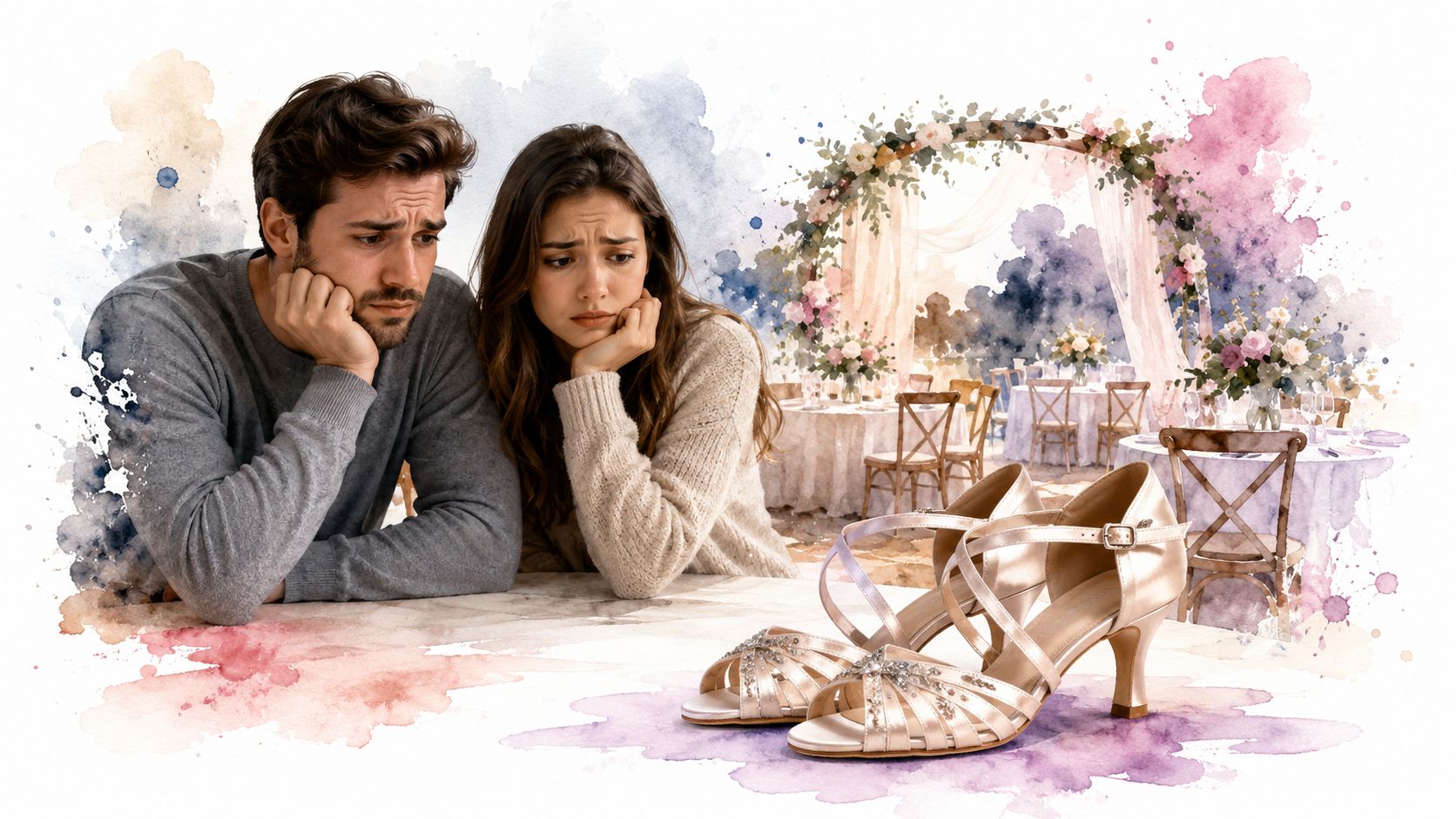
Standard fashion shoes are built to look polished in still moments. Wedding dancing asks for something else. You need a shoe that lets you shift weight cleanly, stay balanced during turns, and keep moving after the first dance ends. That difference matters from the first set of portraits to the last song of the reception.
The whole day changes the decision
A wedding shoe isn't only for the dance floor. It has to carry you through:
- Photos and standing time: Long periods of waiting put pressure on the same points of the foot.
- Transitions between spaces: Ceremony area, cocktail hour, reception room, outdoor walkway, stairs.
- Emotional moments: Nervous energy often makes people grip with their toes or tense their ankles.
- Late-night dancing: Fatigue exposes every flaw in fit and support.
Practical rule: If a shoe already feels questionable during a short try-on, it won't improve after hours of standing and dancing.
The best shoe choice often looks less dramatic on the shelf and much better in motion. That's the trade-off many couples don't expect. A slightly more practical pair almost always creates better posture, cleaner movement, and more relaxed expressions in photos.
What works and what usually doesn't
A few patterns repeat constantly. Shoes with unstable heels, slick bottoms, or overly stiff construction tend to create hesitation. Shoes with secure fit, balanced support, and movement-friendly soles usually calm people down almost immediately.
A wedding day moves fast. Your shoes should simplify that day, not become a separate problem to manage.
Match Your Shoes to Your First Dance Style
The first dance often sounds simple when couples describe it. Then we try the opening turn, a small directional change, or a dip, and the shoes immediately tell the truth. A pair that feels fine while standing in front of a mirror can feel completely different once you start moving through the actual song.
Start with the dance you plan to do, then choose the shoe that supports it. That choice affects more than the first ninety seconds on the floor. It also shapes how steady you feel during practice, how relaxed you look in photos before the reception, and whether you keep dancing comfortably after the spotlight moment ends.
Classic ballroom styles
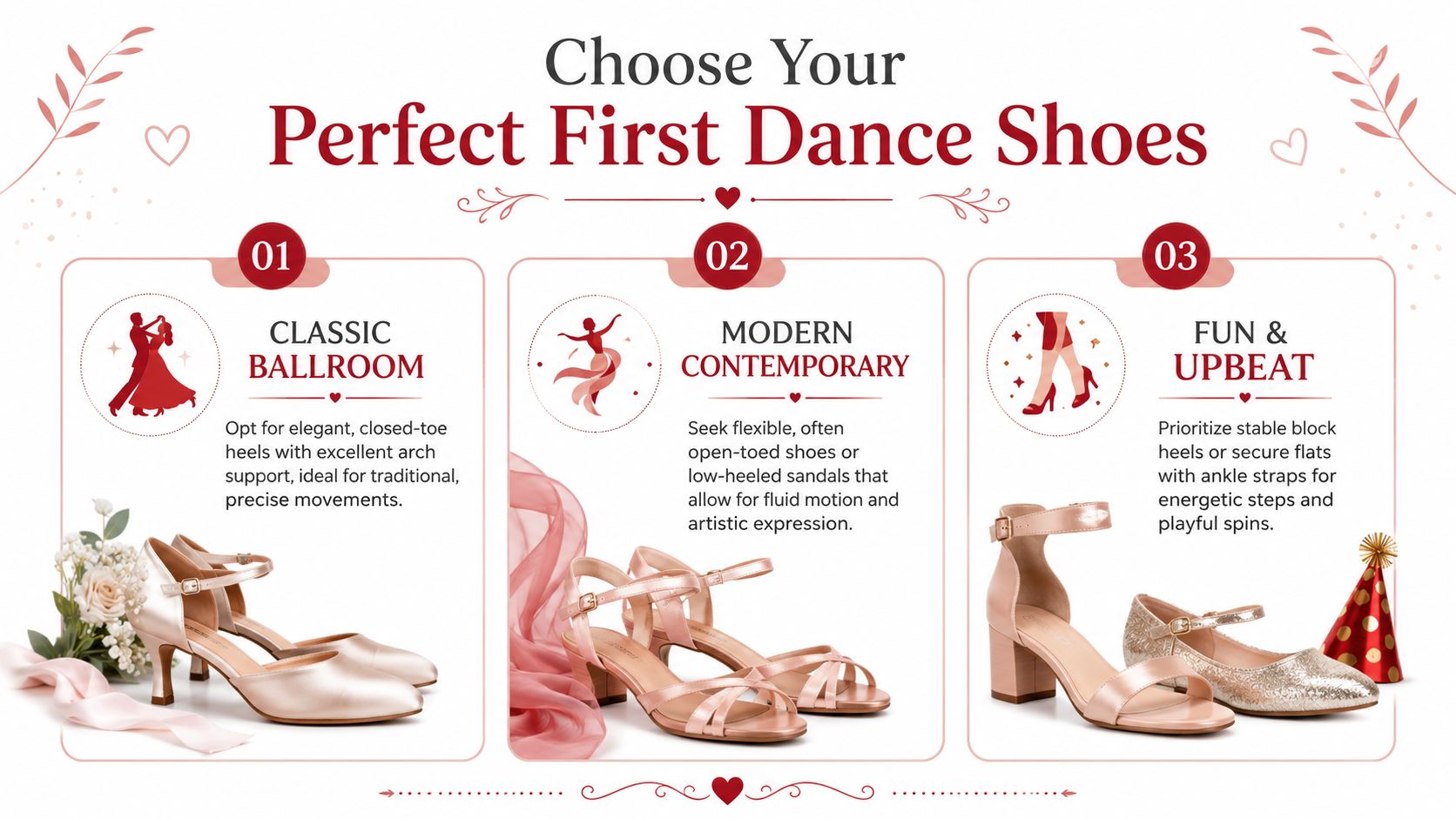
Waltz, Foxtrot, and Tango need clean weight changes and a steady base. If your choreography has gliding steps, turns in frame, or rise and fall, a closed-toe ballroom shoe usually gives better containment through the front of the foot. That extra hold helps many brides feel less wobbly, especially if nerves make them grip with their toes.
Guidance from professional ballroom instruction notes that traditional ballroom dances often suit a closed-toe heel in roughly the 2 to 2.5-inch range, while Latin dances often suit a higher heel closer to 3 inches because the movement demands are different, as explained in wearing the right shoes for your wedding dance.
For the partner leading, flexibility matters just as much as polish. A ballroom-style men's shoe, or a dress shoe with some forefoot flex, usually works better than a stiff formal oxford that fights every step. If the sole will not roll through the foot, the dance starts to look heavy.
Latin and rhythm styles
Cha-Cha and Rumba ask the shoe to do something different. You need easier foot articulation, clearer leg lines, and enough freedom through the front of the shoe to point and place the foot with intention. That is why open-toe Latin shoes often suit these dances better than a more structured ballroom style.
There is a trade-off, though.
Open-toe shoes can look beautiful in motion, but they also expose fit problems faster. If the front straps are too loose, the foot slides forward. If they are too tight, you start protecting your feet instead of dancing. Brides who choose Latin styling for the look alone sometimes regret it by the end of the night unless the routine exactly matches that shoe.
Let the movement set the standard. The shoe should support the dance you are actually doing.
If you are still choosing music, compare songs and shoe options together. A smooth classic track usually pairs better with ballroom structure, while a playful rhythm track may call for more freedom through the foot. These wedding dance song ideas for first dances can help you match the mood of the song to the kind of movement you want to practice and wear all day.
Here's a practical comparison:
| First dance style | Best shoe direction | Why it works |
|---|---|---|
| Waltz, Tango, Foxtrot | Closed-toe ballroom heel | More foot containment, steadier posture, cleaner gliding steps |
| Cha-Cha, Rumba | Open-toe Latin heel | Better foot articulation, sharper leg line, more expressive action |
| Modern mix or simple sway | Secure low heel, stable sandal, or elegant flat | Easier to wear for photos, transitions, and relaxed social dancing after the first dance |
Modern and freestyle routines
A lot of couples fall into this category. They want a few polished moments, maybe a turn or dip, but they do not want to dance like competitors. In that case, buy for control first. A secure low heel, a stable sandal, or even a refined flat can be the smartest option if it lets you rehearse properly and enjoy the rest of the reception.
Look for these qualities:
- Secure attachment: An ankle strap or well-fitted upper helps if your routine includes turns or quick changes of direction.
- Moderate flexibility: The shoe should bend with the foot enough to let you move naturally.
- Stable base: A dramatic fashion heel often looks better in photos than it feels halfway through a rehearsal.
- Day-long wearability: If you plan to keep the same pair on from portraits through open dancing, comfort has to stay part of the decision.
If you are unsure which category your dance falls into, ask your instructor before you buy. I do this with couples all the time. A quick look at the song, the floor surface, and the choreography plan usually makes the right shoe choice much clearer.
Finding Your Ideal Heel Height and Material
You feel shoe problems long before the first dance. They show up during photos, the walk between spaces, the cocktail hour, and that moment late in the reception when tired feet make every turn feel harder. Heel height should serve the whole day, not just the 90 seconds of choreography.
Heel shape changes stability as much as heel height. A moderate heel with a wider base often feels calmer and more predictable than a lower, narrower heel. According to this overview of dance shoes for weddings, well-made dance shoes are priced for construction that supports movement, ballroom styles often use a flare heel for a broader base, and men's versions are usually lighter and more flexible than standard dress shoes.
That wider base matters. A flare heel still gives a polished line, but it forgives small balance errors better than a fashion stiletto, especially if nerves make you place your weight a little late or a little too far back.
| Heel option | Usually works well for | Main trade-off |
|---|---|---|
| Flare heel | First dances, receptions, longer wear | Slightly more technical look up close |
| Slim fashion heel | Photos, standing, minimal dancing | Less stable for turns and directional changes |
| Low block or stable low heel | Freestyle, outdoor transitions, all-night wear | Less classic ballroom line |
If you are between heights, choose the one you can rehearse in consistently. The best-looking shoe on paper is the wrong choice if you shorten your practice because your feet are done after twenty minutes. Couples who want help making that call can ask an instructor early, especially if they are deciding between two heel heights or planning a dip, rotation, or direction changes. Good dance injury prevention habits start with footwear that lets you stand and move without fighting for balance.
Satin, leather, and the real-world choice
Material affects more than appearance. It affects how the shoe breaks in, how it handles venue changes, and whether you still like it after a full day on your feet.
Satin suits formal bridal styling and photographs beautifully. It is a strong choice for indoor ceremonies and ballrooms where the shoe stays relatively clean and dry. It is also the material I tell brides to reconsider if the day includes sidewalks, lawn photos, gravel paths, or unpredictable weather.
Leather handles real use better. It softens with wear, usually lasts longer, and often makes more sense for grooms, brides who want to rewear the pair, or anyone moving through several locations. If your wedding day involves outdoor transitions, leather usually causes fewer regrets.
Choose the material for the schedule and surfaces, not only for the dress code.
When to spend more
Spend more for fit, support, and a heel shape that matches your dance plan. Decorative details change the look. They do not improve control.
A simple, well-built pair often outperforms a prettier shoe with weak support. If you can only stretch the budget in one direction, put the money into comfort you can trust from portraits through the last open-dance song.
Ensuring a Perfect Fit and All-Night Comfort
A dance shoe should not fit like a casual shoe. That's where many wedding shoe mistakes begin. People shop for a roomy, forgiving feel because that sounds comfortable, but extra movement inside the shoe causes rubbing, toe gripping, and instability.
The better goal is a snug, secure fit. Not cramped. Not pinching. Just secure enough that your foot doesn't slide when you turn or change direction.
How to test fit the right way
Use a more deliberate fitting process than a quick mirror check.
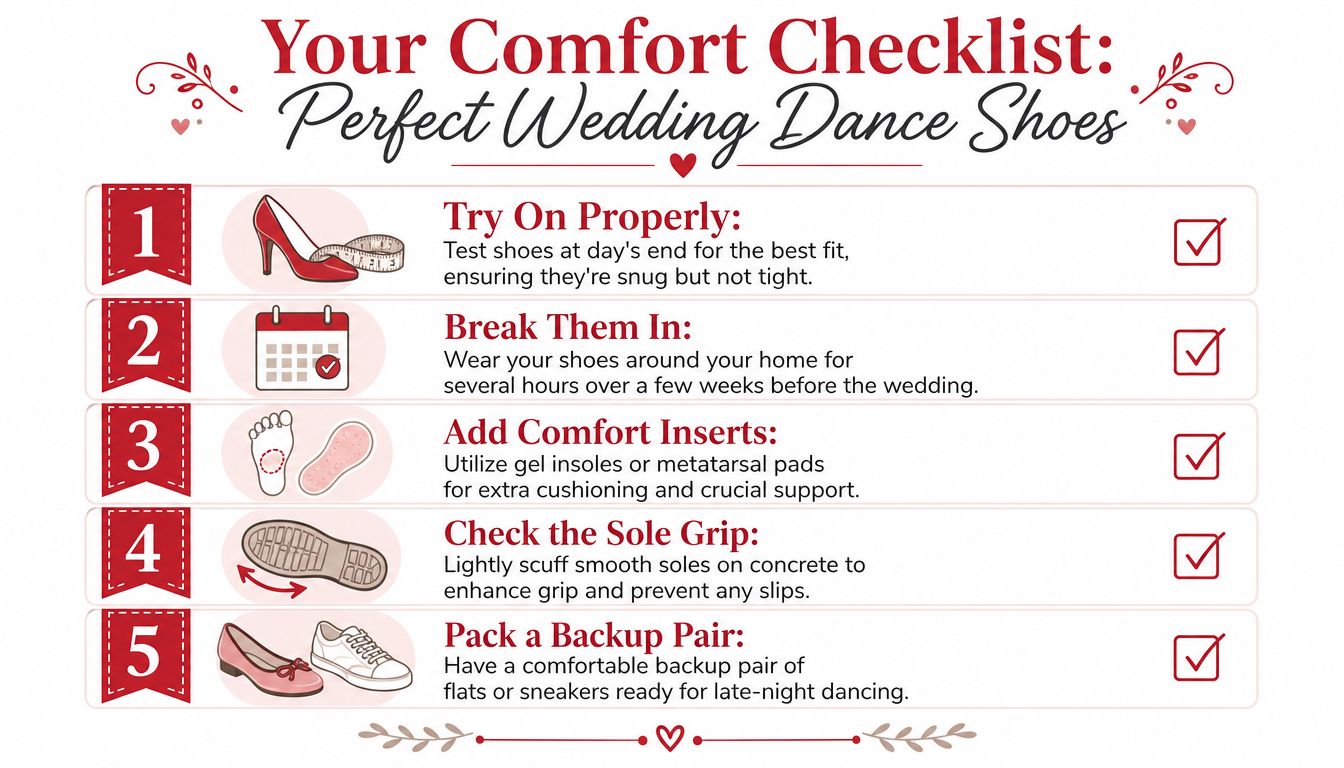
- Try shoes later in the day: Feet are usually a bit fuller then, which gives you a more honest fit.
- Test both stillness and motion: Stand, walk, rise onto the balls of your feet, and make a few quarter turns.
- Notice toe behavior: If your toes claw downward to keep the shoe on, the fit or strap placement is wrong.
- Check heel hold: Your heel shouldn't bounce out or shift side to side.
One more thing matters here. The same heel height you practice in should be the heel height you wear on the day. Consistently wearing the same heel height in lessons builds muscle memory and confidence because your body learns the exact mechanics it will use in the first dance. That's a foundational principle noted earlier in the ballroom shoe guidance.
Break them in without ruining them
Breaking in doesn't mean forcing yourself through pain. It means teaching the shoe and the foot to work together gradually.
Start at home
Wear the shoes indoors for short periods. Stand in them. Walk in them. Practice weight changes while holding a counter or chair.Move into dance practice
Use them during rehearsals once they feel stable. That way, pressure points show up early enough to fix.Adjust support if needed
If you use gel pads or inserts, add them before your later practices, not for the first time on the wedding day.Stop if the problem is structural
A little stiffness can improve. A shoe that twists your ankle line, dumps weight into your toes, or slips badly is the wrong shoe.
For couples working on dips, rotations, or anything with repeated directional change, comfort is also tied to safety. It helps to review sensible movement habits before the big day. This guide to dance injury prevention is useful for spotting common issues before they become painful.
A well-fitted dance shoe should feel more secure as you practice, not more frightening.
Build a backup plan
Even excellent shoes can feel different after a long day. Smart couples prepare for that.
Keep a second pair nearby if your reception will run late. That backup doesn't need to be glamorous. It just needs to be clean, comfortable, and stable enough to let you enjoy the final stretch of the party.
Styling Your Shoes and Prepping for the Big Day
Once the fit and function are handled, styling becomes much easier. The best-looking wedding shoe is the one that belongs naturally with the outfit and still lets you move like yourself.
Make the shoe serve the outfit
If your gown is full length, the shoe will appear in flashes. In that case, silhouette and finish matter more than ornate detail. Satin dance shoes often work beautifully because they read as formal immediately. If your hem is shorter or your dress has a vintage shape, the shoe becomes a bigger visual feature, so shape and proportion deserve more attention.
For brides planning around architectural or period-inspired spaces, dress shape can influence the best shoe style too. A fuller historic silhouette may pair better with a stable, elegant pump than a very minimal sandal. If you're still refining the overall look, this guide to bridal gowns for historic wedding venues is a helpful styling reference.
Buy versus rent
For dance footwear, buying is usually the better path. Rental shoes solve cost for one night, but they rarely solve fit. A wedding first dance asks for familiarity. You want your foot to know the shoe, and you want the shoe to respond predictably.
Owning the pair gives you time to practice, soften materials naturally, and learn what adjustments you need. That preparation is worth more than temporary convenience.
Here's a simple decision view:
| Choice | Better for | Limitation |
|---|---|---|
| Buy | Practicing, fit customization, long receptions | Higher upfront spend |
| Rent | Costume look for a brief use | No real break-in or personalized fit |
Care details most couples miss
Good shoes need a little attention before the day.
- Protect the pair during transport: Keep them in a dust bag or box, not loose in a tote.
- Check the sole before the wedding: A sole that's too slick or too sticky can affect movement.
- Pack simple foot-care items: Cushions, blister protection, and a small cloth go a long way.
- Assign shoe responsibility: One person should know where the dance shoes are at all times.
Suede soles also deserve a quick brush when needed so they keep the right amount of glide on the floor. Too much debris can change how the shoe moves.
When expert advice saves time
The best moment to ask for help is not the night before the wedding. It's when you already have a shortlist of shoes and a rough idea of your dance.
Bring the shoes into a lesson or fitting session if you can. An experienced instructor can tell within minutes whether the pair supports your choreography, catches awkwardly on the floor, throws off balance in turns, or needs a simpler routine built around it.
That outside eye matters most when:
- The bride loves a very high heel
- The groom plans to dance in stiff formal shoes
- The couple wants dips, spins, or faster footwork
- The venue floor is unusual
- There's still uncertainty between two shoe options
What works on carpet in a bedroom mirror can fail on a polished reception floor. Testing the actual footwear during rehearsal is the cleanest way to avoid surprises.
Step Confidently into Your First Dance
A calm first dance rarely happens by accident. It comes from a series of smart choices that remove friction before the wedding day arrives. Shoes are one of the biggest of those choices because they affect posture, balance, stamina, and confidence all at once.
If you choose dance shoes for wedding planning based on your routine, venue, and full-day comfort, you'll feel the difference immediately. Steps get clearer. Turns feel less risky. Your attention goes back where it belongs, on your partner and the moment.
Confidence comes from testing, not guessing
There's a reason easy booking matters when couples are preparing for something unfamiliar. Dance studios that offer online trial class booking around the clock and keep forms to the essentials can increase trial bookings substantially, with one case study showing a 3.2x improvement from 12 to 38 bookings per month, according to this report on dance studio trial booking performance. Convenience removes hesitation. That's especially important when couples are juggling wedding planning and trying to make decisions quickly.

If you're still unsure whether your shoes are right, don't leave that question hanging. A lesson gives you a practical answer. You can test movement, see how the footwear behaves with real choreography, and get direct guidance from experienced wedding dance teachers.
The best wedding shoe is the one you stop thinking about once the music starts.
That's the goal. Not just a pretty pair. A dependable pair. One that lets you enjoy the entire day, move naturally, and step into your first dance with real confidence instead of crossed fingers.
Book a free complimentary lesson with Danza Academy of Social Dance and bring your wedding shoes with you. You'll get expert feedback on whether they fit your dance style, your comfort needs, and your choreography, all before the big day. It's an easy next step if you want less guesswork and more confidence. You can schedule your complimentary lesson directly through the contact page.