
Comparing hourly rates is the usual advice for booking private dance lessons in Philadelphia. It's also an easy way to buy the wrong package. A low starting price tells you little about the cost of learning to dance comfortably at a reception, finishing a first-dance routine, or improving your competitive technique.
Start with the result you want, then price the instruction, practice support, and travel needed to reach it. The best booking isn't necessarily the cheapest lesson or the most impressive studio photograph. It's a teacher who helps you improve at a pace you can manage, in a room you'll reach each week.
What Private Dance Lessons Cost in Philadelphia
The lowest advertised hour isn't necessarily the lowest total bill. The Thumbtack dance-lesson marketplace provides a national instructor price signal of $30–$50 per lesson, while Philadelphia wedding listings show starting prices of $59–$250 and a reported typical couple spend of about $1,150. Those figures describe different purchases, not interchangeable hours.
Lesson length, instructor level, travel, choreography, and practice support can change the final amount. A starting price may cover instruction without music editing or extra rehearsals. Before comparing offers, get a written description of what you're buying.
Outcome Budgets for Private Dance Lessons
These are planning scenarios, not guaranteed completion schedules or Danza Academy prices. Use them to request a complete quote rather than multiplying an attractive starting rate by an assumed number of visits.
| Goal | Sessions to budget | Price signals | Confirm before you pay |
|---|---|---|---|
| Simple first dance | 4 weekly lessons as an initial planning block | Listings often start at $59–$250 | Minutes per lesson, included floor time, music edit, one run-through, missed-week rule, practice video |
| Social confidence block | 6 weekly lessons as a proposed starting plan | National listings often show $30–$50; request a local studio quote rather than treating that as a ceiling | Lesson length, floor access, practice notes, homework, and what a missed week costs |
| Fuller wedding performance | A written lesson count based on the song, choreography, and rehearsal needs | Reported couple spending is near $1,150; per-lesson starts are $59–$250 | Extra rehearsals, floor time, choreography scope, music editing, cancellation terms, practice support |
| Competitive or advanced coaching | Ongoing 4-week planning blocks | A coach-specific quote based on level and scope | Minutes per session, video feedback, solo practice plan, floor rental, missed-session terms |
A simple first dance should have a deliberately narrow target: start together, move comfortably, include a manageable change, and finish without confusion. Don't spend the opening block collecting decorative figures if you still need help hearing the beat. Ask the teacher what would count as a successful result and what would trigger additional lessons.
For social confidence, define the setting. Dancing a basic with an instructor is different from starting with an unfamiliar partner while other couples move nearby. Your proposed block should include starting, stopping, recovering after a mistake, and keeping a comfortable connection, not just learning more steps.
Ask for the Total Before Buying
A fuller wedding performance needs a scope agreement. Specify the song version, entrance, ending, turns, and whether the teacher will adapt the choreography to clothing or floor restrictions. The same marketplace's Philadelphia wedding context estimates $27,500–$33,611 for 150–200 guests. Dance instruction may be a small part of that budget, but it still deserves a total rather than an open-ended commitment.
Advanced students should request a technical objective for each coaching block and an explanation of additional practice costs. Our guide to how much private dance lessons cost can help you organize the questions before comparing packages.
A cheap lesson becomes expensive when you repeatedly pay to relearn material because nobody explained how to practice it. Good value means useful instruction and a realistic route to your goal.
Budget the outcome, not the teaser rate. Treat four weeks as a minimum planning block for measuring change, not a promise that every beginner will be reception-ready.
How to Choose and Book a Private Instructor
A hypothetical 60-minute private lesson might include a short warm-up, a constrained movement pattern, slow drilling, a retest, and a written home-practice note. The teacher should correct something you can act on, such as finishing a weight transfer, rather than listing every technical fault at once.
You can ask about any lesson format before committing, including a trial, a single session, or a block of four. Confirm the actual duration and what's included, especially when booking an introductory appointment.
Use this visual checklist to prepare your first inquiry.
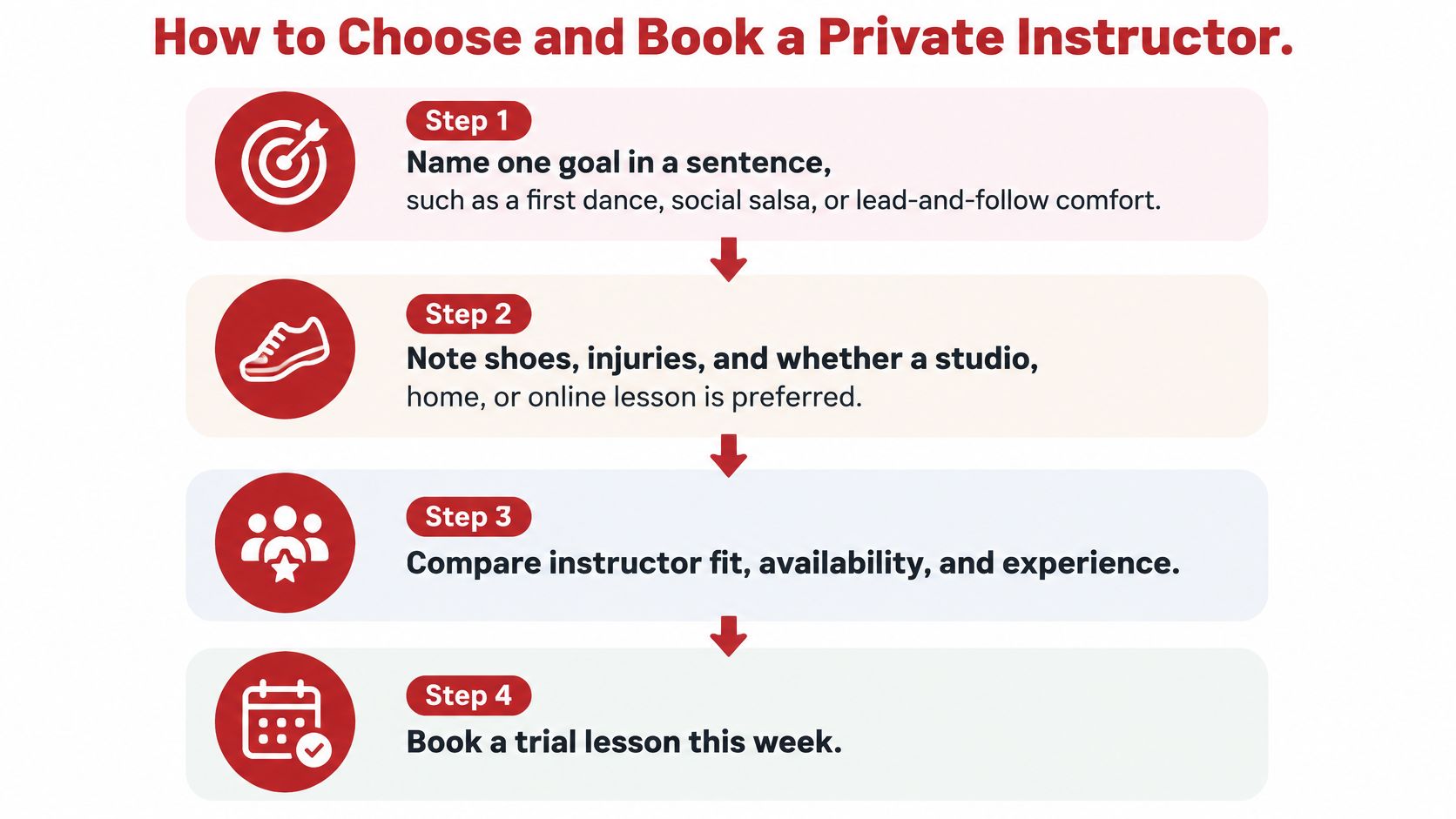
Make These Decisions This Week
Name your goal in a sentence. Try “I want to dance salsa socially without freezing when I lose the count” or “We want a comfortable first dance to our song.” Include your deadline, shoes, injuries, preferred lesson setting, and whether a partner will attend.
Shortlist teachers who teach your style to adult learners. At Danza Academy, we welcome beginners, and no partner is needed. We've operated since 1976, but longevity alone doesn't tell you whether an individual teacher fits your pace. Use our explanation of dance teacher qualifications to distinguish performance credentials from teaching ability.
Request a trial before a substantial package. Tell the teacher what you'd like to test: rhythm, comfortable connection, or a wedding phrase. Notice whether the explanation becomes clearer when you're confused, rather than louder or faster.
Check what you can do independently. Can you repeat the pattern without watching a full demonstration? Does the teacher reduce the tempo when your balance becomes uncertain? Do you leave knowing what to practice and when to stop?
Reserve a repeatable appointment. Choose a weeknight you can realistically protect for a proposed four-week block. Put the cancellation, rescheduling, and package-expiration terms in the confirmation instead of relying on a conversation you may remember differently later.
Reassess before extending. At the fourth lesson, compare your current movement with your starting goal. Continue because you can identify progress and the next useful task, not because you feel awkward declining a larger purchase.
Bring What Helps the Teacher Help You
Bring indoor dance shoes or clean, secure hard-soled shoes if you have them, and confirm suitability before dancing. Wedding couples should bring their chosen recording, not just the song title, because introductions and endings can differ. Keep your calendar available so scheduling doesn't become another unfinished task.
Event planners helping couples coordinate a reception may also benefit from Fiore's floral training options for event planners. That's a separate planning skill, but the same principle applies: choose instruction around an actual task rather than a vague promise of expertise.
You can also preview the academy through this video before arranging your visit.
Build the Lesson Sequence and Practice Safely
Learning a routine and learning to dance aren't quite the same thing. You might remember which foot moves next while still depending on your teacher to supply the timing, direction, and balance. A useful lesson makes those dependencies visible and gradually reduces them.
Begin with a baseline that matches your actual purpose. A wedding couple might attempt a short phrase to their music; a social dancer might try maintaining a basic through a song; a competitive student might demonstrate a figure family. The teacher needs to see what happens before offering corrections.
The following cycle keeps instruction focused without making every lesson feel identical.
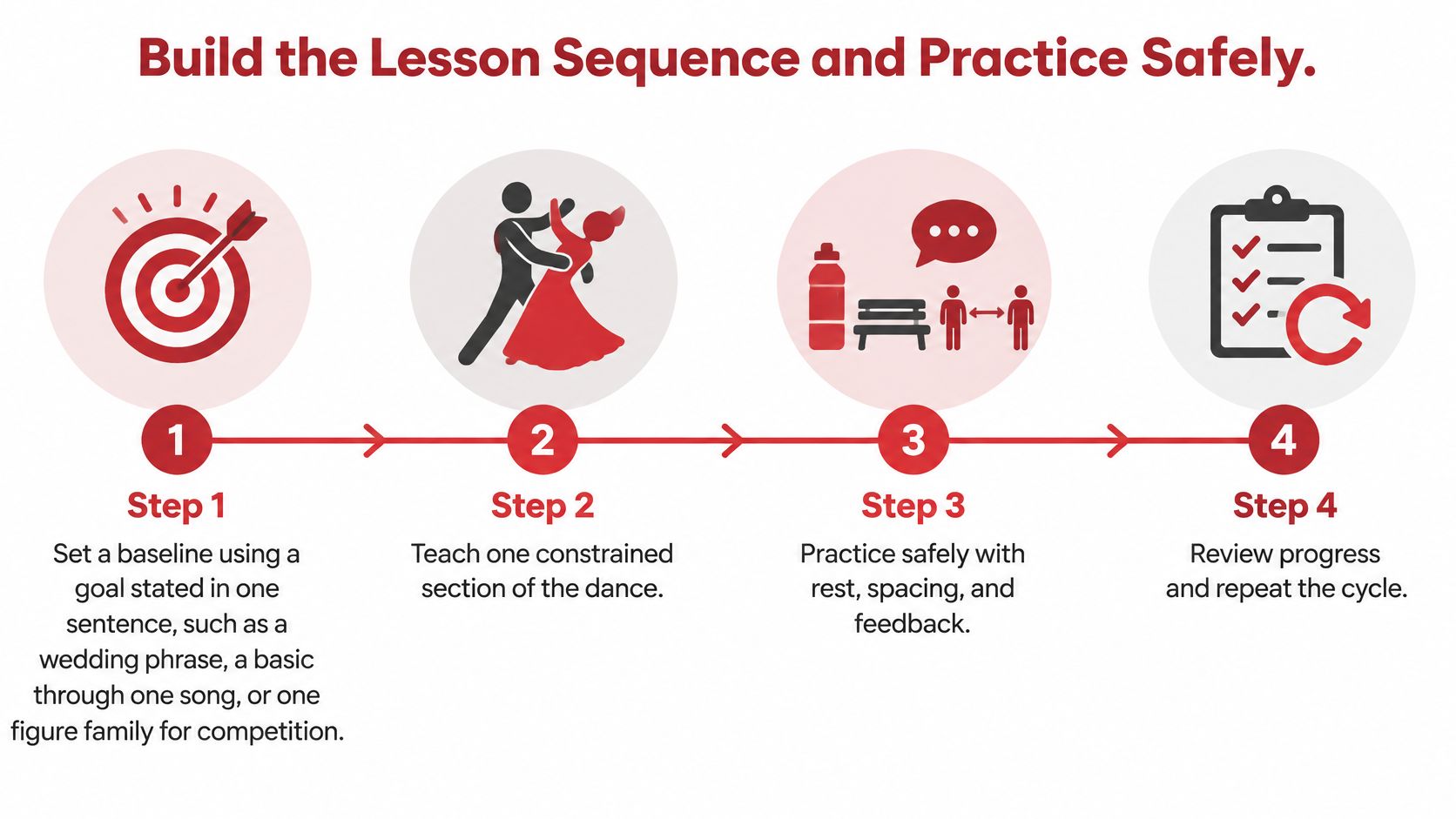
Teach Less at Once, Then Test More Honestly
Choose a constrained pattern with a clear beginning and ending. In a basic partner exercise, that could mean transferring weight, closing the free foot without leaning, and stopping in balance. Keep the task simple enough that the student can notice the correction.
Practice slowly with external feedback. The instructor might demonstrate where the standing leg supports the body, give a short verbal cue, or use a mirror to show a leaning torso. Feedback should answer a practical question: what should feel or look different on the next attempt?
Add musical timing, partner connection, and changes of direction only after the weight transfer is reliable. Faster music shouldn't be used to disguise an unfinished movement. If you can't stop comfortably, adding rotation usually makes the task harder rather than more educational.
Then ask the student to perform without a demonstration. Change the starting direction or use a different tempo so the exercise tests understanding rather than imitation. An unsuccessful attempt is useful information about what still needs support.
An umbrella review of dance interventions found benefits across physical and psychological outcomes, with the strongest health evidence generally associated with participation lasting at least four weeks. That supports sustained participation, but it doesn't establish a universal private-lesson success rate or prove that a particular package will deliver a specific result.
Use the following weekly measures as teaching tools:
- Independent repetitions: Note whether you can complete the pattern without a prompt or demonstration.
- Musical continuity: Check whether you maintain the pulse across a song, including after a mistake.
- Turn control: Watch whether you finish over a supporting foot rather than stepping out to catch yourself.
- Recovery: Practice stopping, resetting, and restarting without an apology or a hurried scramble.
A Wedding Couple With Time to Build
Say a couple has seven months before the reception. Start with posture, a comfortable frame, and a sway that doesn't pull either partner off balance. Their first useful achievement is moving together without bracing or staring continuously at their feet.
Once weight transfer holds, add an entrance and a manageable turn. Rehearse the approach to the floor as well as the dance itself, because finding the starting position under attention is a separate task. Keep an uncomplicated fallback available if either partner forgets the choreography.
Later rehearsals should include the chosen recording and the space the couple expects to use. If the dress limits stride length, shorten the movement rather than forcing a studio-sized step. A dependable ending is more useful than a dramatic figure the couple can't recover from.
The lesson shouldn't become a weekly test of who practiced more. Give each partner an individual responsibility, such as maintaining their own balance or making the direction clear, so corrections don't turn into blame.
A Social Dancer Learning to Adapt
A social dancer needs more than a polished basic performed beside a teacher. Retest it to music at a tempo appropriate for the intended social setting, then practice using less space. Keep the movement controlled rather than rushing to imitate a crowded floor.
Introduce interruption deliberately. Stop the pattern, reset the connection, and begin again without reconstructing the entire sequence. That teaches a practical response to distractions, nearby dancers, or a partner interpreting the movement differently.
Don't treat every error as a request for another figure. Sometimes the useful lesson is recognizing the beat after losing it, or keeping the arms comfortable while the feet simplify. Those skills make a small repertoire usable.
Competitive Coaching With a Narrow Target
For a competitive student, a proposed four-week coaching block can focus on a figure family rather than a broad promise to improve everything. Select a technical priority, such as coordinated rotation, consistent timing, or a more stable standing leg. Record the baseline before changing it.
Video review should compare the same task under similar conditions. A side view can reveal whether the torso moves ahead of the supporting foot; another angle may be needed to inspect alignment. Ask permission before filming anyone else in the room.
Expect occasional retrieval failures when the teacher stops prompting. A student who can explain a correction may still lose it when music or partner pressure changes. Return to a manageable version, then rebuild the difficulty without treating the lapse as a personal failure.
Make Home Practice Safe and Repeatable
Before practicing, check for pain, previous-injury restrictions, footwear problems, and balance concerns. Clear the floor of rugs, cables, pets, and furniture corners. Warm up with several minutes of gentle rhythmic walking or marching before rehearsing weight shifts and controlled movement.
For a beginner, a suggested home-practice cap is ten minutes of the basic, not repeated full-speed choreography. Use secure dance shoes appropriate to the surface. Socks are suitable only if they won't slide unexpectedly; don't use them for turns on a slippery floor.
Film a song from the side when you can do so safely, then inspect posture and controlled stops rather than criticizing appearance. Finish with gentler movement, and stop before fatigue makes the movement sloppy.
A 2024 systematic review of dance and fall prevention found very low-certainty evidence for dance as an alternative to dedicated strength-and-balance training. Dance can support physical activity and wellbeing, but a teacher shouldn't promise fall prevention or substitute technique coaching for medical care.
Safety rule: Sharp pain, joint swelling, dizziness, or repeated loss of balance means stop or modify the activity and seek advice from a qualified health professional. More repetitions aren't the answer to an unresolved warning sign.
Center City or Exton for Your Weekly Lesson
Choose the studio you can reach on an ordinary, tiring weeknight. A beautiful room won't help if getting there requires a journey you repeatedly postpone. For private dance lessons in Philadelphia and the surrounding area, location is a weekly-life decision, not just an address comparison.
We teach from a flagship studio in Center City and a spacious, modern studio serving Chester County in Exton. Neither is automatically the better choice for every student. Start with where you'll be immediately before the lesson and where you need to go afterward.
Center City and Exton Studio Snapshot
| Studio | Address | Phone | Fits best when |
|---|---|---|---|
| Center City Philadelphia | 2103 Sansom Street, Philadelphia, PA 19103 | (215) 561-0323 | You're already downtown and can protect a weeknight |
| Exton | 430 Walkertown Road, Exton, PA 19341 | (610) 363-3090 | You live in Chester County and want a modern suburban studio |
Center City suits a downtown routine. If you already work nearby, an appointment after work may require less effort than returning home and leaving again. Transit or a manageable walk can make the lesson part of a normal evening rather than a separate expedition.
Don't judge that trip from an unusually quiet weekend visit. Consider your actual departure point, what you'll carry, and whether you need time to change shoes. If driving is necessary, investigate parking before choosing an appointment.
Exton suits a Chester County routine. Our Exton dance studio offers a spacious, modern setting without requiring a trip into Center City. That can be the practical choice for someone whose work, home, and evening responsibilities are already in the suburbs.
Test the Journey You'll Actually Make
Try comparing both trips against your least convenient normal weekday, not your ideal schedule. Include the time needed to finish work, travel, change, and return home. An appointment that requires everything to go perfectly is harder to maintain.
Consistency beats the prettier commute on paper. Choose the trip you can repeat for four straight weeks.
Wedding couples should consider where they can meet reliably, especially if they work in different places. The closer studio to their shared practice location may reduce friction more than the closer studio to either person's office. Agree on the journey together before committing.
Competitive students may prioritize a consistent coach and usable floor over the shortest drive. Call the studio you intend to attend, confirm private-lesson availability, and ask about shoes and clothing before your first visit. Don't assume a preferred appointment at one location is available at the other.
Book a Complimentary Lesson and Test the Fit
You don't need to settle every question before stepping onto a dance floor. You need a visit that gives you enough information to make the next decision. Your first lesson at Danza Academy is complimentary, so you can test the fit before committing to ongoing instruction.
Book through our complimentary lesson scheduling page. Include your goal, preferred weeknight, intended location, and whether a partner is coming. If you have a deadline or a movement limitation, mention it when arranging the appointment.
Use the Visit to Make a Real Decision
Bring a specific task rather than a request to learn everything. A wedding couple might want to feel comfortable beginning their song; a returning dancer might want to find out why turns feel rushed. Give the teacher something concrete to assess.
We offer private, group, wedding, and social dance options. Wedding lessons help couples shape a first dance for their wedding day, rather than requiring them to fit a generic routine. The appropriate next step should follow your purpose and comfort level.
A longer runway can be worthwhile when the coaching matches the couple. Geena R. describes her experience this way:
“My new husband and I took dance lessons for 7 months before our wedding. Our instructor Stephanie helped make our first dance AMAZING!”
That's an individual testimonial, not a required preparation schedule. Your plan should reflect your starting point, song, ambitions, and willingness to practice. A simple, comfortable dance and a fuller performance are different projects.
Decide From What You Experience
After the visit, ask yourself whether the teacher made the task clearer. Could you repeat something independently? Did you feel comfortable asking for a slower explanation, and did the journey fit your evening?
- Continue when the fit is clear: You understand the correction, can attempt the movement yourself, and have a realistic next goal.
- Clarify before paying: Get the lesson duration, package total, scheduling terms, and practice expectations in writing.
- Keep looking when necessary: If the pace, communication, or commute doesn't work, the complimentary visit has still helped you avoid a poor commitment.
Prefer scheduling by phone? Center City readers can call (215) 561-0323, and Exton readers can call (610) 363-3090. Tell us what you want to dance, when you can attend, and whether you'll be coming alone or together.
Danza Academy of Social Dance offers personalized private instruction, wedding preparation, and group and social dancing in Center City and Exton. Book your free complimentary first lesson through the scheduling page above, and test the teacher, the movement, and the commute before comparing more hourly ads.