
You and your partner are at the kitchen table, phones out, arguing over Spotify. One of you wants Sinatra; the other wants something with a groove. The useful question isn't which song wins. It's whether West Coast Swing fits your song, your reception floor, and the way you want to feel together in front of your guests. Treat the decision as a fit-and-risk check first, then build a routine around what works.
Why Couples Choose West Coast Swing for Their First Dance
A polished first dance does not require lifts or aerials. West Coast Swing can suit couples who want a contemporary feel and enjoy moving to R&B or pop, while keeping its recognizable swing roots. It developed from Lindy Hop and related forms in the western United States during the 1930s and 1940s. The name became established as a synonym for “Western Swing” in a 1961 dance book (West Coast Swing's history)). That mix of history and modern musicality is appealing, but the style still has to fit your song, space, and comfort level.

Be candid about the risks before paying for choreography. West Coast Swing can be the wrong choice for a first dance. Its traveling movement and syncopated footwork call for space, a clear musical pulse, and a partner connection that feels comfortable. A crowded, narrow, or irregular floor can make those demands stressful. A very slow romantic ballad may also fight the dance's groove. If that describes your song, Waltz, Rumba, or Foxtrot may suit it better.
Before booking lessons, check three practical details:
- The song: West Coast Swing music commonly ranges from roughly 80 to 130 BPM. A clear backbeat matters as much as speed. Clap along and check whether you can hear the pulse without effort. If not, choose another track or ask an instructor to assess it before planning steps.
- The floor: Check the actual reception layout for a usable lane about four feet wide, rather than relying on the venue's advertised floor size. If tables, guests, or a tight stage leave little room to travel, keep the dance contained or choose a different style.
- The clothes: Make sure the bride's dress allows comfortable steps and turns. Both partners should be able to hold a relaxed connection without catching fabric or fighting sleeves.
A song at a moderate tempo can give beginners more time to hear the rhythm and shape their movement. Faster music calls for simpler choreography unless you can confidently improvise. If the track is too slow or lacks a clear groove, do not force triple steps into it.
If you love the song but the full style feels risky, choose a simplified WCS-inspired routine. It can borrow West Coast Swing's look and partner connection without requiring full dance mechanics. Or build a hybrid first dance: begin in a romantic close embrace, then add a few swing patterns when the music opens up. That is sensible planning, not a compromise.
The Mechanics You Need Before Choreographing Anything
Before you build choreography, decide whether both of you can manage the style's mechanics comfortably. West Coast Swing depends on a clear travel path, steady timing, and a responsive hand connection. If either partner feels pulled, rushed, or unsure where to move, simplify the dance before adding patterns.
The slot is a straight, narrow lane. The follower travels forward and backward along it while the leader generally stays near one end, turning to make room. Use the slot as a practical guide when checking the reception floor, and keep the travel path clear (slot and floor-space overview).
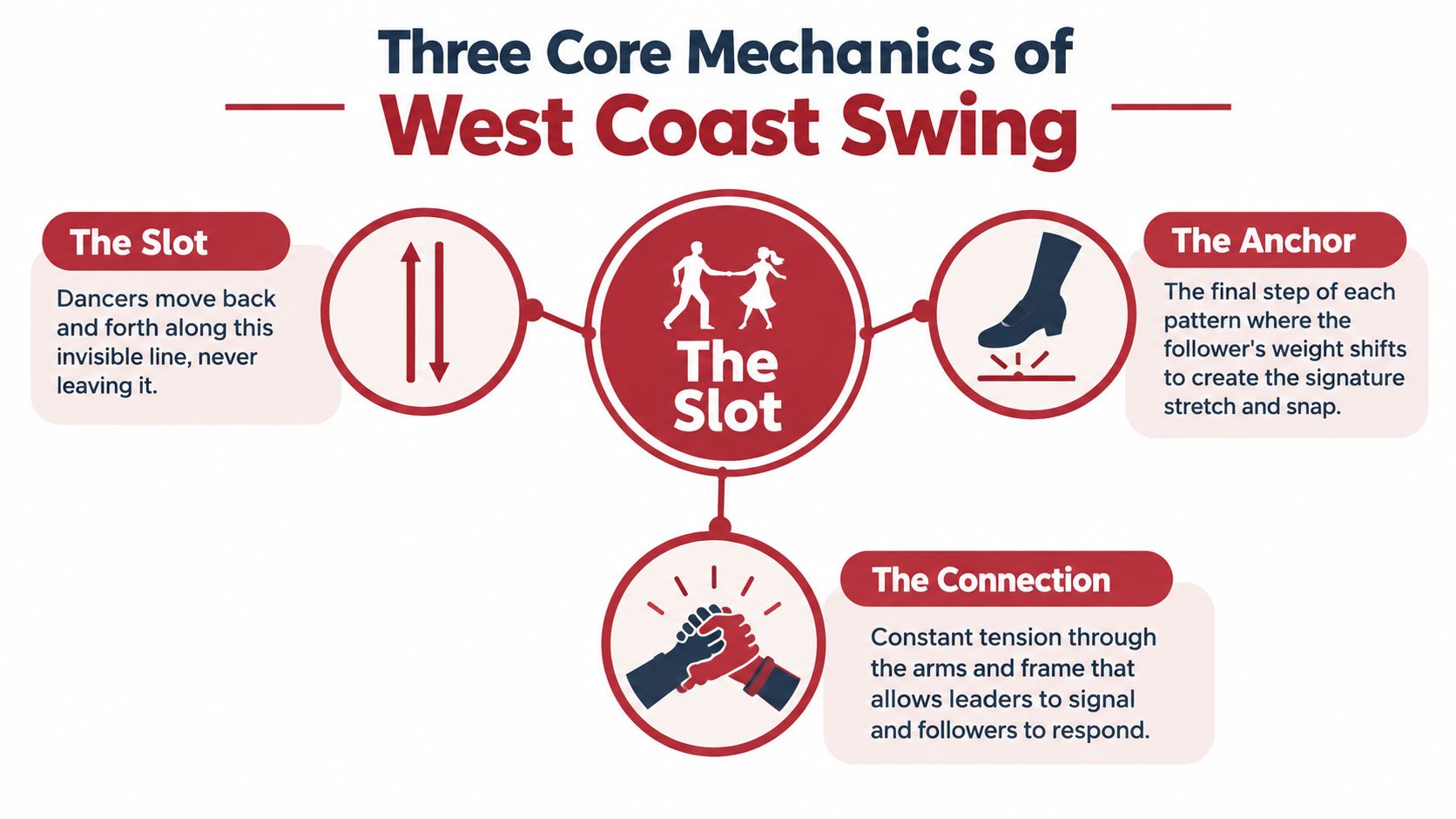
The basic six-count rhythm is walk-walk, triple-step, triple-step, also spoken as “step-step-triple-step-triple-step.” In 4/4 music, six beats fit eight steps. Leaders generally start on the left foot on count one; followers start on the right (six-count rhythm details). Rehearse the opening weight transfer until you can begin without staring at your feet, especially if the music starts as you enter the floor.
The third mechanic is elastic connection. A leader signals through gentle changes in stretch or compression through one or two hands. Keep the arms responsive, not forceful. The follower should be able to travel with momentum while the leader keeps the movement controlled.
Practical rule: If your arms are doing the work, ease the pressure and return to the rhythm.
A coach can help you develop comfortable timing, connection, and movement with West Coast Swing technique instruction. Watch the demonstration below to notice the slot, rhythm, and connection. Don't copy steps blindly; first check whether the movement feels comfortable for both of you.
A Simple Three-Pattern First-Dance Routine
Test the song before you commit to choreography. Clap through its opening phrase together and choose a clear place to begin. A tempo near 108 BPM is a useful middle-ground reference drawn from historical competition rules), not a requirement. The song's phrasing and your comfort matter more than matching a target.
Build the routine around three patterns you can repeat cleanly. Start with a sugar push: the follower travels toward the leader, then returns along the slot while the leader stays near one end. Practice the hand change slowly. If it feels awkward, make the connection clear before adding decoration.
Add a left-side pass next. The follower travels down the slot as the leader rotates slightly to open a path. Practice that small rotation together. Without it, the pair can crowd each other or turn the pass into a tug.
Use an underarm turn to finish the phrase. The follower travels down the slot beneath a raised hand, with the free arm relaxed. Keep the styling simple until the timing is reliable. A clean turn reads better than a flourish that arrives late.
| Pattern | Counts | Slot direction |
|---|---|---|
| Sugar push | Six-count | Follower travels in, then back along the slot |
| Left-side pass | Six-count | Follower travels down the slot |
| Underarm turn | Six-count | Follower travels down the slot beneath the raised hand |
Practice in a set order: settle the weight transfers, add the triple steps, connect the patterns through the anchor, then add styling. Keep styling minimal at first; add musical accents only after the sequence feels steady. That progression follows standard social-dance instruction: weight transfers first, then timing, then connection.
Choosing Your Preparation Track
Choose lessons according to the result you want, not a generic promise that a few sessions will be enough. The tracks below use two, five, and eight hours of instruction as planning options. Your starting window is a practical recommendation, not a guarantee: confidence, song difficulty, and how often you practice all affect what you can accomplish.
| Preparation track | Time | A realistic wedding-day outcome | Suggested start |
|---|---|---|---|
| Quick Start | Two hours | A comfortable opening, a basic pattern, and a simple turn. You won't have a fully choreographed routine or a reliable plan for every musical change. | Start several weeks ahead if possible. |
| Standard | Five hours | A polished sequence of patterns, a clear beginning and ending, and practice with the chosen song. You won't be preparing a showpiece with detailed styling throughout. | Begin around two months ahead. |
| Showcase | Eight hours | A more fully choreographed piece with transitions, selected styling, and a rehearsed final pose. This gives you more to practice, not permission to skip practice. | Start earlier than the Standard track so you have time to refine it. |
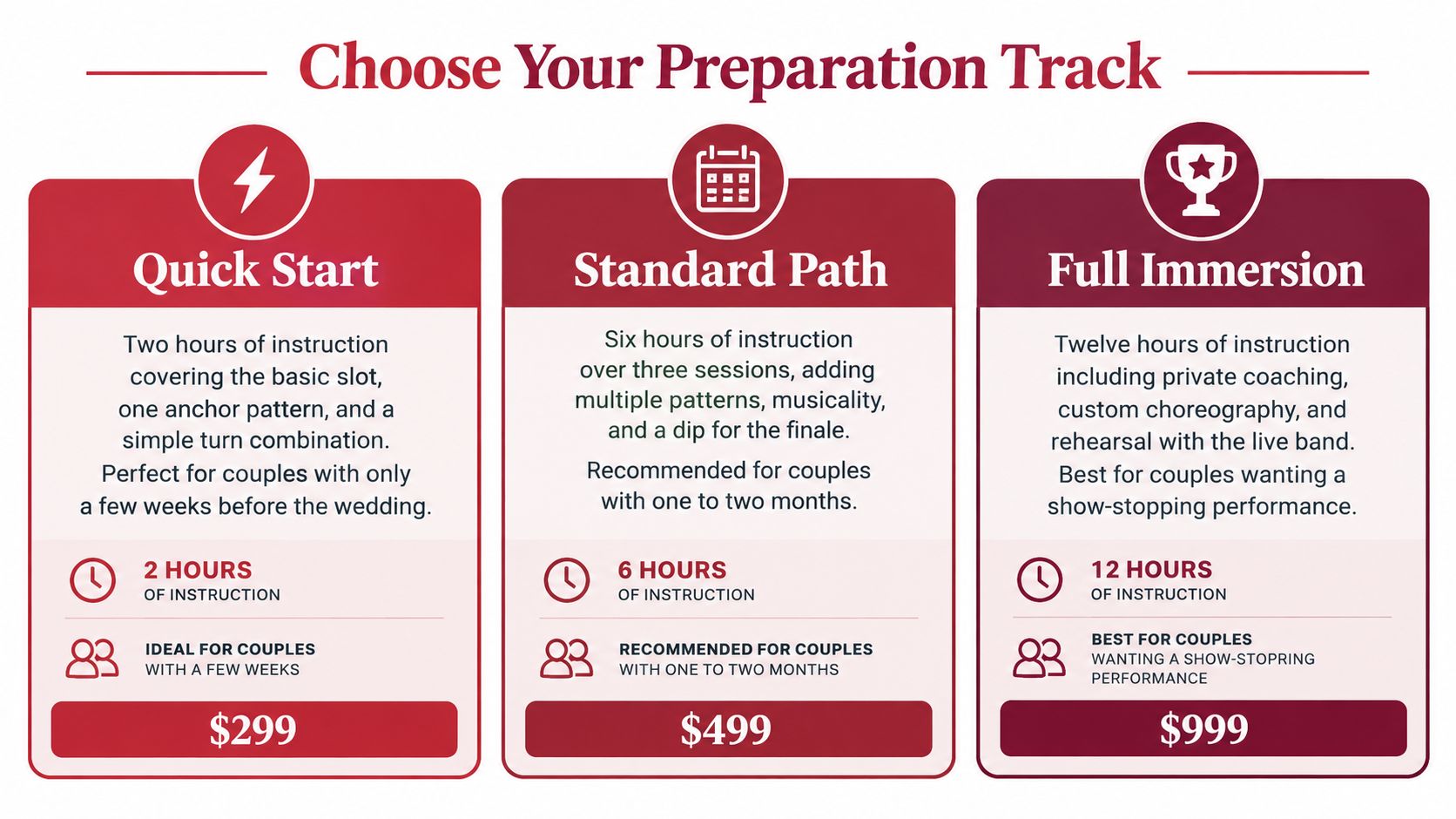
Don't mistake the infographic's package labels for a promise about lesson hours. Pick the track by the amount of instruction you can commit to, then agree with your instructor on exactly what that time includes. A couple who already moves comfortably together may make a simple routine look relaxed with less choreography. Beginners who want a clean sequence should prioritize consistency over extra patterns.
Faster music may call for choreography or confident improvisation. Slower tempos give dancers more time to shape musical interpretation, but they still need a pulse that suits the style. Before committing, compare your song and goals with this West Coast Swing music guidance. The best track is the one that leaves you feeling prepared, not overloaded.
Your Eight-Week Practice Schedule
Use a focused practice session instead of running the whole routine over and over. Dance-learning guidance emphasizes perception, execution, feedback, and repetition; a novice motor-skill study also found better error reduction with reduced feedback focused on key anatomical features than with full or absent feedback (motor-learning guidance for dance). In plain terms, notice what you're doing, try one target, get useful feedback, and repeat after a short rest.
| Week | Practice focus |
|---|---|
| One | Watch a demonstration and verbally mark the opening phrase. Practice weight transfers without adding patterns. |
| Two | Add triple-step timing. Clap the song, then dance slowly enough to keep the pulse clear. |
| Three | Connect patterns through the anchor step. Ask a coach or record a short video for feedback. |
| Four | Rehearse the transitions between patterns. Correct one high-impact issue per run, not every small detail. |
| Five | Practice to the chosen song at its actual tempo. Stop if timing or connection falls apart, then isolate the troublesome phrase. |
| Six | Run larger portions of the dance and test the opening against the song's real start point. Rest between attempts. |
| Seven | Dance the full song, then review one attempt. Choose one adjustment to make on the next run. |
| Eight | Rehearse in wedding footwear and, if possible, in clothing that behaves like the wedding outfit. Keep the final practice calm and clean. |
Don't practice mistakes on repeat without feedback. Don't train only at a slow speed, because the song will feel different. And don't add styling before your rhythm and connection are stable.
Your readiness benchmark is straightforward: complete three consecutive full-song runs without stopping, keep the music timing, and preserve safe slot spacing. Treat that as an operational studio benchmark, not a universal guarantee. If you can't do it comfortably, simplify the routine instead of adding more moves.
Wedding-Day Recovery Moves When Something Goes Wrong
The first dance is live, and the room may not cooperate with your choreography. Decide in advance how you'll handle a missed cue, an unexpected song start, a freeze, or a crowded floor. A clear fallback keeps you together and gives the audience a composed moment.
- The leader misses a pattern cue: Return to a basic sugar push. Keep the connection gentle, then rejoin the routine at the next phrase. Don't force the missed pattern.
- The DJ starts at the wrong spot: Walk together until you hear a phrase you recognize, then begin with a familiar movement. A calm restart reads as intentional. Chasing a missing introduction usually looks uncertain.
- One partner freezes: Keep a comfortable two-hand connection, breathe, and shift weight together. Resume when both partners are ready. Reconnecting matters more than hiding the pause.
- Guests crowd the slot: Reduce travel and finish with a rehearsed close-hold pose. The slot is a narrow pathway, so don't send the follower into a packed area.
Walk through the venue and rehearse in your wedding footwear. Check where you'll stand, how much floor is usable, and whether shoes or a long hem restrict movement. Coordinate the dance with the reception schedule to reduce avoidable timing surprises. Texas Old Town's stress-free wedding timeline guide can help you fit the dance into the day.
Agree on a recovery signal before the wedding. Either partner can learn to lead, follow, or do both, and you don't need to follow fixed gender roles. Choose whichever roles feel comfortable and useful, then settle on a simple cue, such as a gentle hand squeeze, that means “return to the basic.” Practice that reset until it feels familiar.
Working With a Dance Instructor and Your Next Step
A useful first lesson is a fit-and-style consultation, not a sales pitch for elaborate choreography. The instructor should listen to the song, assess the venue's usable floor, teach a short pattern that suits the couple's natural roles, and leave you with a realistic practice plan. If the song or space doesn't suit West Coast Swing, a good coach should say so and suggest a simpler or more suitable alternative.
Ask how the instructor handles role flexibility. They should be willing to teach either partner as lead or follow, and help you decide whether you want to learn one role or both. If you're comparing coaches, Danza Academy's wedding dance teachers page describes instructors who work with couples preparing for a first dance.
Return to that kitchen table and the two phones fighting over Spotify. You don't have to guess whether Sinatra, a contemporary R&B track, or a different song will work with your dress, venue, and comfort level. A professional can give you a clear read and a practical plan, whether you choose true West Coast Swing, a simplified version, or another style.
Book the free complimentary lesson to check your song, floor, and dance plan before you commit to choreography.
Danza Academy of Social Dance offers private wedding-dance coaching and West Coast Swing instruction suited to your song, floor, and comfort level. Book the free complimentary lesson at Danza Academy of Social Dance and leave with a practical next step for your first dance.