
You can know the basic West Coast Swing patterns and still feel lost the second the music starts. Your feet are moving, your count is right, and yet the dance feels stiff, disconnected, or strangely heavy. That's usually not a pattern problem. It's a west coast swing technique problem, which means the fix lives in slot discipline, body-based connection, timing, and how you finish each action before you start the next one.
Great West Coast Swing looks easy because the mechanics are doing real work underneath the surface. The dance's identity is built around the slot, a narrow linear pathway that keeps movement readable and gives partners a shared lane to work in, while historical technique settled around repeatable actions like the Sugar Push, the anchor step, and later codified timing choices (West Coast Swing history, West Coast Swing overview). Once those mechanics are clear, the dance stops feeling like a memorized pattern list and starts feeling like a conversation that has shape, tone, and rhythm.
If you want a parallel for how partner dances become musical instead of mechanical, mastering funk drum patterns is a useful outside perspective because groove depends on placement, tension, and release, not just hitting notes on time. For a quick contrast with another swing style, you can also compare this with the studio's guide to the difference between East Coast and West Coast Swing.
From Awkward Steps to Effortless Swing
The fastest way out of the beginner trap is to treat West Coast Swing as a chain of connected body actions, not a list of foot placements. If you are only counting steps, the dance can feel disconnected, heavy, or hard to trust. Once the body actions line up, the movement starts to make sense from the inside out.
That matters because West Coast Swing is built to stay adaptable. The same pattern has to work with different songs, different partners, and different amounts of energy on the floor, so the technique has to carry more weight than the footwork alone. A clean lead, a clear follow, and a settled finish give the dance room to breathe, and that is what makes it feel musical instead of mechanical. For a quick contrast with another swing style, the studio's guide to the difference between East Coast and West Coast Swing helps show why the mechanics feel so different.
Practical rule: if the dance feels rushed, the issue is often not speed. It is incomplete weight transfer and a weak finish to the previous action.
That is why solid technique feels so steady on the social floor. A partner does not need perfection, but they do need clarity. When your movement stays centered, your anchor is clean, and your timing is easy to read, both people can relax and respond with more confidence.
The key shift happens when you stop asking, “What comes next?” and start asking, “What did I just finish?” The answer shapes everything that follows. A clean connection, a stable frame, and a body that arrives fully before moving again give West Coast Swing its calm, responsive feel. The groove matters too, because good social dancing has to sit inside the music, just as mastering funk drum patterns depends on placement, tension, and release rather than only hitting notes on time.
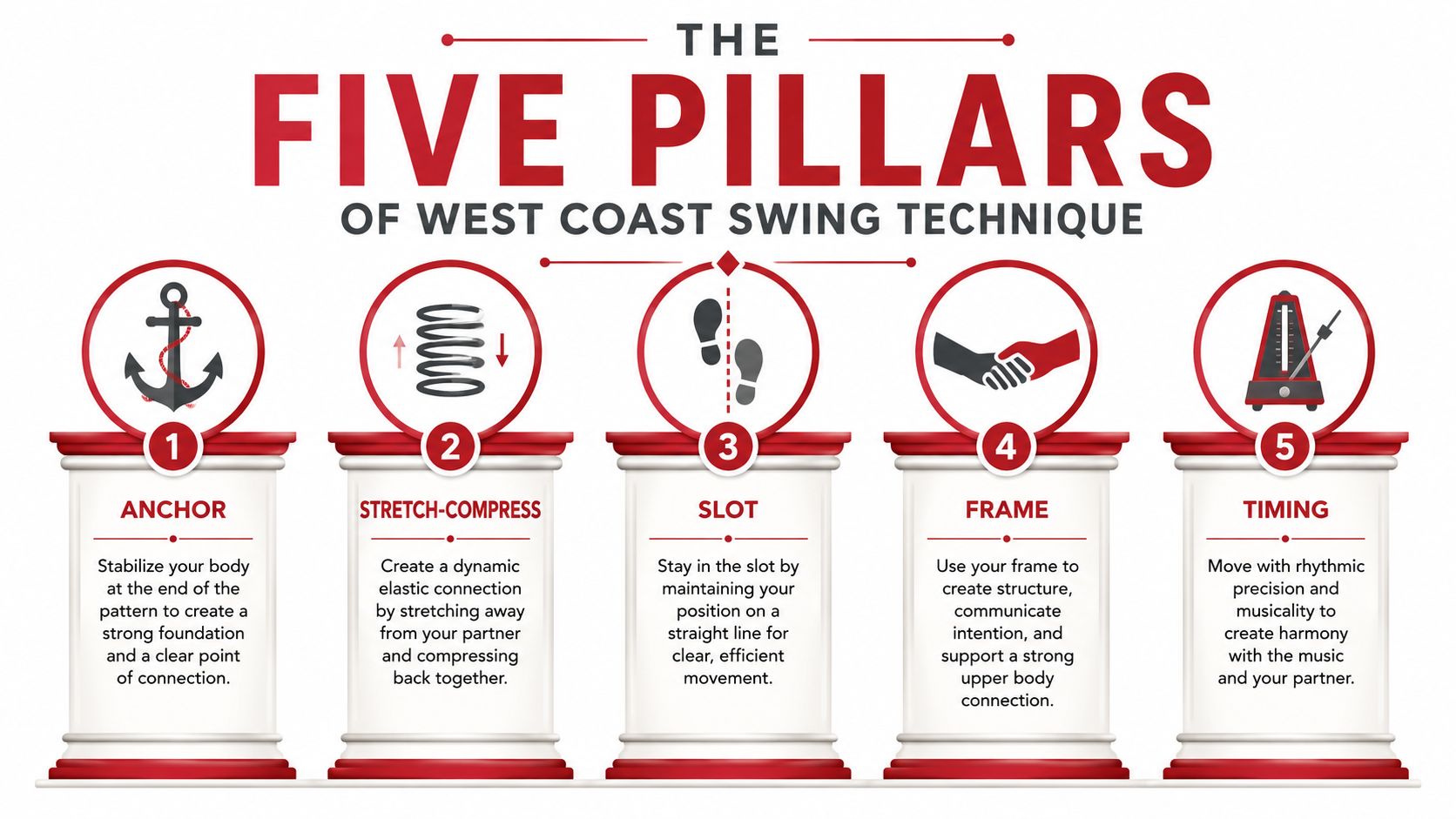
The Five Pillars of West Coast Swing Technique
The Slot
A strong West Coast Swing dance starts with a clear lane. The slot gives each partner a shared pathway, so the follower can travel with direction while the leader stays centered enough to keep the space open. That shape keeps the dance readable, even before any styling or variation comes in.
You can hear and feel the difference on a crowded social floor. When both partners honor the same lane, the dance has less drift, fewer collisions, and far less second-guessing. The form of the dance developed around that idea, and its social identity is tied closely to the slot, as described in the West Coast Swing overview.
Frame and Connection
Frame gives the partnership structure. A useful frame stays alive through the body, with tone supported by the center, lats, and hands, so the lead and follow travel through contact instead of through arm force (West Coast Swing technique).
Good connection has a clear feel. It moves between compression and tension, and the job is to keep that exchange elastic enough for communication while still organized enough to be easy to read. Too little tone makes the partnership vague, while too much pressure makes the movement hard to absorb. The best balance gives both dancers room to respond without losing clarity.
The Anchor
The anchor finishes the idea that came before it. It tells the partnership that the phrase is complete and that the next lead can begin from a settled place. That matters because a dance that never fully finishes its actions starts to feel hurried, even if the tempo is unchanged.
A clean anchor feels balanced and calm. It does not need to look big to work well. If the ending arrives late or gets pulled through, the next action has less room to breathe. The modern social shape of the dance also grew with this kind of ending, replacing older habits with a finish that supports a more responsive conversation between partners, as noted in the West Coast Swing overview.
Footwork
West Coast Swing footwork changes with the pattern, the music, and the amount of travel in the move. Teachers often describe the basic timing as walk-walk-triple-step-triple-step, and the whip extends that rhythm by adding walking action into a longer shape (West Coast Swing basics video). A key skill involves not repeating a pattern by memory, but keeping the weight transfer clean enough that the feet support the body instead of distracting from it.
A lot of dancers improve once they stop stomping through the floor and start letting the weight roll. Triple steps often feel ball-flat, which helps the movement stay grounded without becoming heavy (West Coast Swing footwork guidance). If you want a clear reference for the basic rhythm and how it shows up in social dancing, the studio's West Coast Swing basic moves guide is a useful place to compare the common shapes with the way they feel in motion.
Timing
Timing keeps the dance musical. A solid basic uses a six-count structure, and the rhythm sits in a walk-walk-triple-step-triple-step feel rather than an even march (West Coast Swing basics video). The counts only help when they support the body action. If the numbers lead but the movement is late, the dance loses its groove.
That musical relationship is part of why the style feels so responsive. The anchor-based approach shaped the modern timing dancers use now, and older swing structures helped set that direction over time (West Coast Swing overview). Once the timing lives in the body, accents in the music stop feeling random and start landing with intention.
Essential Drills for Confident Leaders
A leader who feels rushed usually sends mixed signals through the body before the pattern even starts. Clear leading comes from organized posture, steady weight transfer, and a slot that stays readable enough for a follower to answer without guessing. The purpose of these drills is to make the lead feel calm, specific, and easy to interpret on the social floor. For a quick reminder of how those pieces fit together in basic movement, the studio's West Coast Swing basic moves guide is a practical reference.
Frame Hold and Release
Stand in dance posture with your elbows soft and your hands alive, not locked. Engage the lats lightly so the upper body feels connected, then release that tone and rebuild it without changing your posture or leaning back.
This drill separates tone from stiffness. When the arms do all the work, the frame gets noisy. When the center organizes the shape, the partnership has something cleaner to read.
Slot Walking Drill
Mark a straight path on the floor and walk it slowly with small, deliberate steps. Keep your torso centered while your feet stay inside the lane, and resist the urge to turn your body to face an imaginary partner at every moment. The goal is to feel how a leader protects the slot instead of drifting through it.
That habit matters because the slot keeps the follower's path clear. A leader who wanders makes the dance harder to read, even with an easy pattern. A useful practice is to compare your walking shape with the common social-dance basics in the studio's West Coast Swing basic moves guide, then return to the drill and notice where your body loses the line.
Weight Transfer with Purpose
Take a slow walk and pause each time your weight fully arrives over one foot. Feel the floor accept you, then send you into the next step. That pause matters because partial weight transfer creates a lead that feels vague.
Practical rule: a leader who never fully arrives never gives a clear message. The body has to land before it can send.
Near the end of solo practice, watch how the connection stays organized through motion in the embedded class demo.
One-Track Walks and Direction
Practice forward walks so each foot lands on one clean track instead of crossing out of line. That alignment keeps the partnership predictable, especially when the follower is moving toward the leader's center line. It also matches the technique that asks for one-track forward walks and body-driven action-reaction, so the lead stays easy to feel rather than forced.
Follower Technique for an Effortless Response

A strong follower does not wait passively for motion to happen. The follower helps shape the dance by keeping balance, staying centered over the feet, and answering the lead without loading the next step too early. That is why the best follow looks calm and ready, not delayed.
Footwork questions come up here constantly because dancers want one rule they can memorize. Real technique depends on context. Forward steps can use heel or ball leads depending on the moment, triple steps often feel ball-flat, and continuous weight transfer keeps the movement from looking heavy or plodding.
Balance Before Motion
Stand tall, soften the knees, and shift weight from foot to foot without letting the upper body collapse forward. Keep the center over the standing leg long enough to feel where your balance lives. That feeling matters because the follower who knows where her own weight is becomes much easier to lead.
The goal is to stay available to the lead. If the body is already falling forward or reaching early, the connection gets muddy before the pattern even starts. A stable center gives the lead something clear to work with.
Slot Travel with Control
Mark a straight line on the floor and walk it with small, precise steps. Keep the hips and shoulders organized so the movement travels down the lane instead of swaying across it. The follower's path should feel deliberate, not decorative.
Self-management matters here. When the follower controls momentum, the lead can communicate direction more clearly. It also leaves room for styling without stealing timing from the partnership.
Responsive Foot Placement
Place each foot under your body instead of throwing it out to the side. Keep the weight transfer continuous, and let the floor tell you when the step is complete. This helps most when the music gets faster or the leader changes direction.
A useful cue is simple. Step where the lead sends you, finish the transfer, then wait in balance for the next invitation. That keeps the connection alive without making the follow feel pushy or detached.
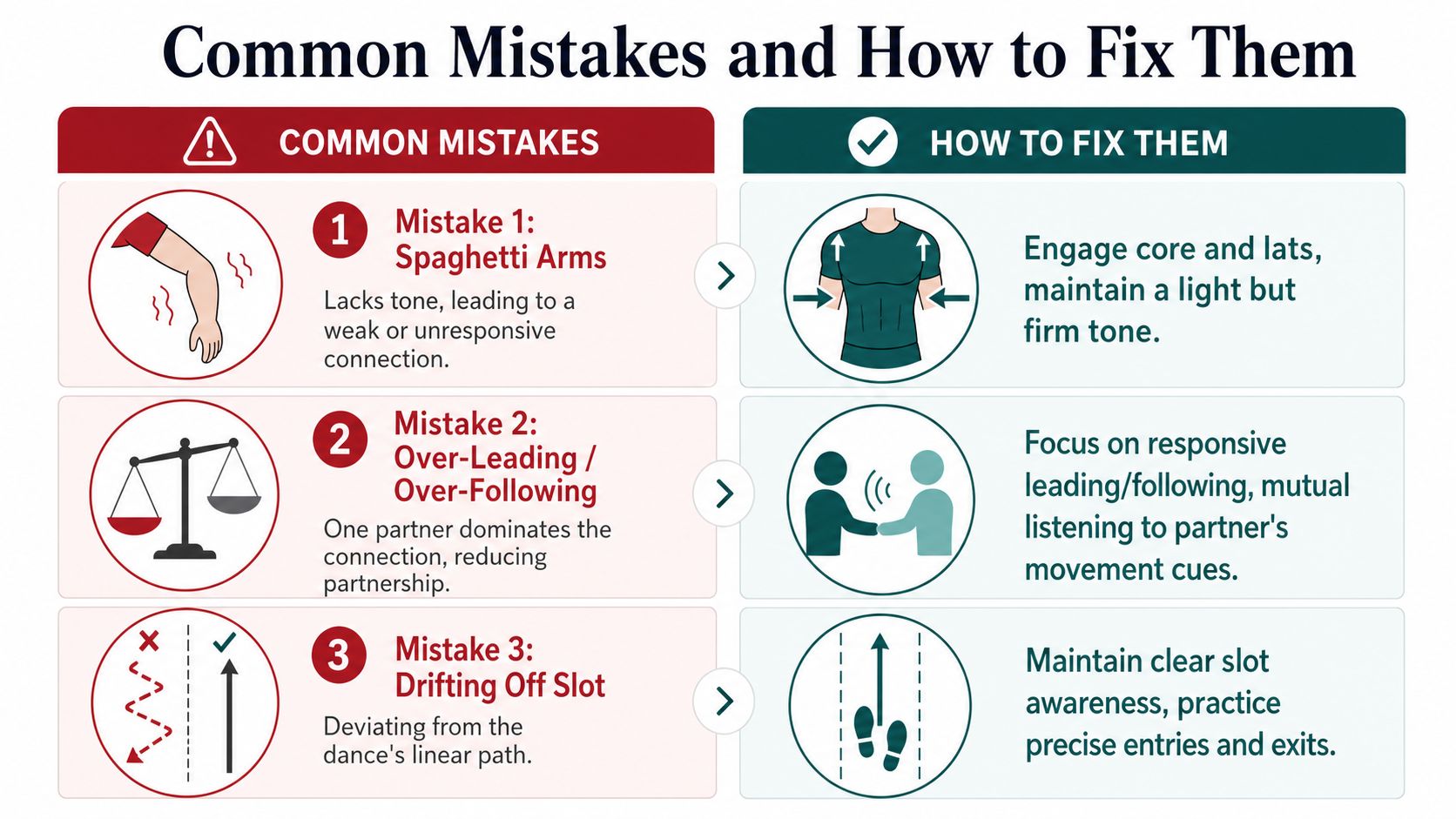
Common Mistakes and How to Fix Them
The most frustrating West Coast Swing problems usually look small from the outside and huge from the inside. A broken connection can feel like you're dancing alone. A drifting slot can feel like both partners are always half a beat late.
A common blind spot is focusing on patterns while under-explaining stretch and compression. West Coast Swing is an extension-compression dance with action-reaction partnering, so technique lives in timing, center, and connection, not just foot placement (West Coast Swing connection guidance).
Spaghetti Arms
This usually feels lifeless to the leader and vague to the follower. The connection doesn't disappear, it just loses tone, so every lead has to be rebuilt from scratch. The root cause is usually collapsed posture or trying to lead from the hands alone.
Fix it by engaging the core and lats, then letting the hands stay alive without gripping. The goal is a light but firm tone, not a death hold and not a noodle. When the frame stays organized, the body can communicate much more cleanly.
Over-Leading and Over-Following
This feels stressful to both people because one partner starts doing the job for both of them. The dance loses its give-and-take, and the partnership starts to feel like a tug-of-war. This often happens when dancers don't trust their own balance or timing.
The correction is mutual listening. Leaders should create shape and wait, while followers should answer without jumping ahead. That sounds simple, but it changes the whole experience because action-reaction only works when each person leaves room for the other.
Drifting Off Slot
When the slot breaks, the dance starts feeling zig-zagged and crowded. Leaders lose clarity, followers lose direction, and the floor starts to feel smaller than it is. The root cause is usually over-rotation, traveling too wide, or not respecting the linear lane.
Keep the line simple before you make it stylish.
A good fix is to rehearse entries and exits with a straight line on the floor. Step in, travel cleanly, and return to the same lane before you add extra flavor. That kind of discipline makes the dance look cleaner immediately.
Your Practice Plan and Next Steps at Danza Academy
In West Coast Swing, clean technique comes from repetition with a purpose. A practical weekly plan works better than random drilling, especially if you divide the work between solo mechanics and partnered application. The solo work builds body awareness, and the partner work checks whether the connection communicates.
Start with two solo sessions focused on slot walking, frame tone, and weight transfer. Add one session where you practice footwork in front of music and listen for the moment your body finishes each step. Then use one partnered session to test whether your anchor feels settled and whether your lead or follow stays clear when the music changes.
For dancers who want guided structure, a teacher can catch the small habits that are hard to feel from the inside. A studio like Danza Academy of Social Dance offers technique-focused instruction, including social dance classes that help dancers work on timing, connection, and floorcraft in a real classroom setting, and its technique dance classes are a natural place to sharpen those fundamentals. That matters because West Coast Swing has been codified for decades, and the dance's formal recognition in 1988 as the official state dance of California only underscores how much technique and tradition sit behind the social experience (West Coast Swing history).
If you want the fastest path from “I know the steps” to “I feel the dance,” ask for feedback, then apply it in the next song instead of waiting to practice it alone later. The right corrections make everything else easier.
Danza Academy of Social Dance offers welcoming West Coast Swing instruction that focuses on technique, musicality, and partner connection, so you can stop guessing and start dancing with more confidence. If you're ready for clear feedback and a smoother social floor experience, visit Danza Academy of Social Dance and book your free complimentary lesson on the contact page today.