You've typed adult salsa lessons near me because you want a real answer, not a glossy studio listing. You're probably deciding between three or four tabs right now, trying to figure out which place will welcome a beginner, won't waste your time, and won't make you feel like the only person in the room who doesn't already know the steps.
That's the right instinct. The best local salsa class isn't the one with the prettiest website, it's the one that teaches fundamentals clearly, manages partner work safely, and makes it easy to keep showing up. Salsa has a serious history, a real fitness value, and a social side that can feel intimidating at first, so the details matter more than the logo on the page.
What Most Adults Actually Want from Salsa Lessons
Most adults don't start by asking, “Which studio has the most advanced turn patterns?” They ask, “Will I be able to keep up, will I look ridiculous, and can I fit this into my week without hating my life?” That's the honest starting point, and any guide that skips it is useless.
A good local salsa search usually comes down to four things: schedule fit, level structure, instructor quality, and whether the room feels human. If a studio only looks good on paper but has vague class descriptions, you're buying uncertainty. If it has a clear beginner path, posted calendars, and a tone that sounds calm instead of performative, you're closer to the right place.
What adults really worry about
People rarely say this out loud, but they're often worried about fitness readiness, partner anxiety, and the fear of looking inexperienced in front of strangers. Those concerns are normal. Salsa classes attract adults with zero dance background, adults returning after years away, and adults who just want something social that doesn't feel like a gym.
My rule: if a studio makes beginners feel like a problem to be managed, walk away.
Salsa also carries a real cultural lineage. It grew out of Afro-Caribbean roots and New York's Latin music communities, with musical foundations in Cuban son, mambo, rumba, guaracha, bolero, plena, bomba, and jazz, and with movement shaped by African-derived rhythm plus European partner-dance structure, so a serious school should respect that lineage while still keeping class approachable.
If you're comparing options, you'll also want a practical framework for studio selection. A useful starting point is how to choose a dance studio, because the dance world is full of places that look friendly until you ask how they teach.
How to Find and Screen Local Studios
Start with search results, but don't stop there. Google Maps gives you the obvious names, but the better clues come from community boards, social dance calendars, and word-of-mouth from people who already dance. If a studio is active, you'll usually see signs of it beyond one polished landing page.
The website itself should do real work for you. Look for posted instructor bios, transparent pricing, class calendars with more than one time slot, and level descriptions that separate beginner fundamentals from choreography-heavy classes. If a studio hides basics behind a contact form, that's a mild warning sign. If it explains what happens in class before you pay, that's a good sign.
The five questions worth asking before you book
Ask these before you hand over money, and pay attention to how direct the answers are.
| Question to Ask | What a Good Answer Sounds Like | Red Flag to Walk Away |
|---|---|---|
| How are levels defined? | Clear beginner, intermediate, and higher-level placement criteria | “Just come in and we'll see” with no structure |
| Is partner rotation standard? | Yes, with an explanation of how it works and how to opt out | Rotation is handled awkwardly or not explained |
| What's the cancellation policy? | Written policy you can read before booking | Vague answers, no policy, or pressure to commit |
| Do you offer drop-ins? | Yes, with a clear way to try a class first | Only packages, no trial path |
| How are instructors trained? | They teach fundamentals, timing, and safety, not just choreography | Lots of performance talk, no teaching method |
A serious studio looks like an instructional environment. A casual social club can still be fun, but it's a different thing. You want the place where someone can explain timing, partner connection, and body mechanics without acting like those details are optional.
If you're mapping studios and want a reality check on nearby health service access while you're out and about, Telomyx clinic locations can be useful as a general local reference point. It's not about dance, it's about thinking like an adult who plans ahead.
Also, don't ignore the scheduling pattern. A studio with one beginner slot and no follow-up options can leave you stuck. A better studio offers enough calendar depth to help you progress instead of restarting every week.
Group Classes, Private Lessons, or Both
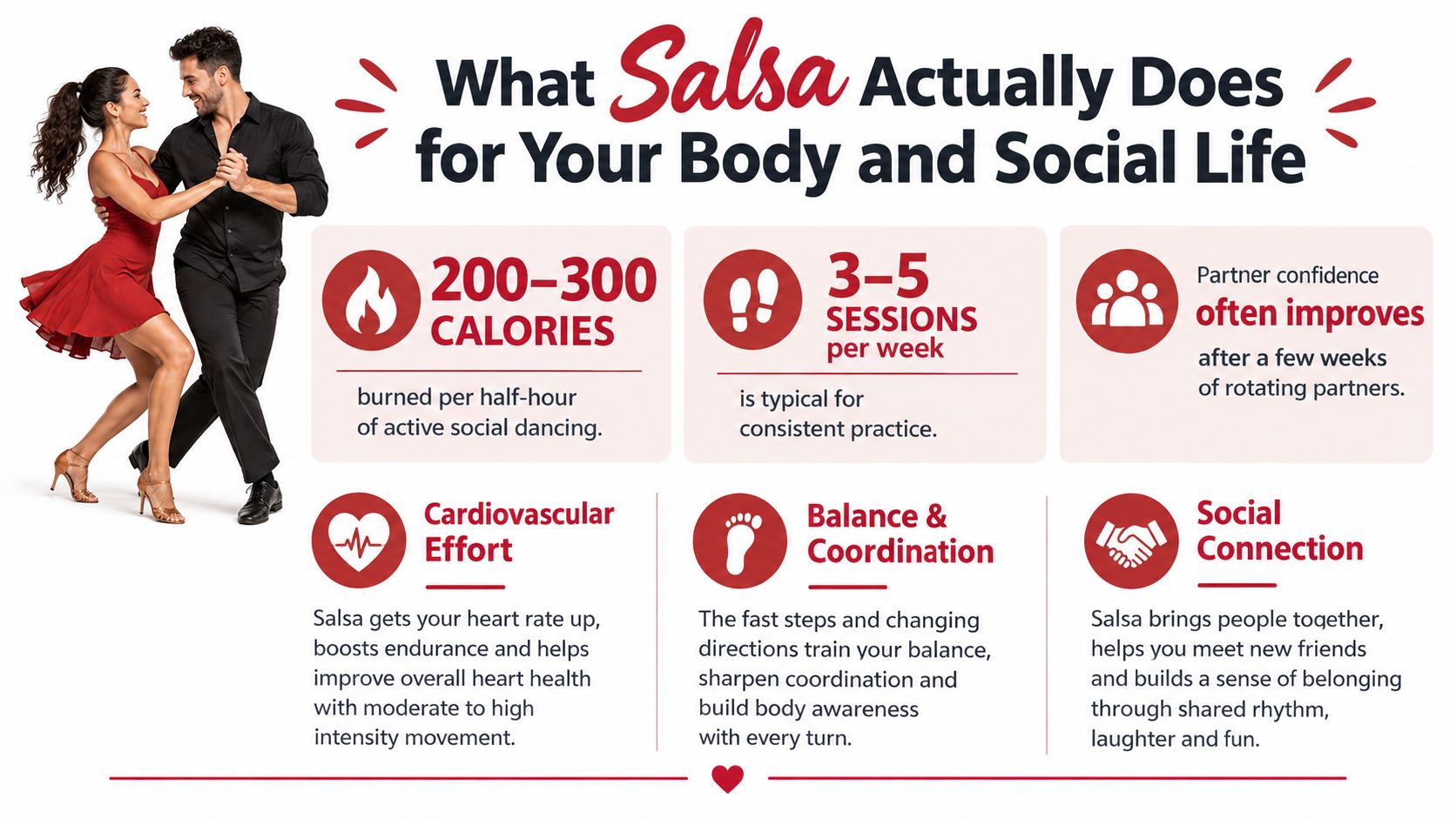
Group classes are the social engine of salsa. You get rotating partners, a steady pace, and a built-in chance to learn how your lead or follow changes from one person to the next. That's the point of social dance, not a side benefit.
Private lessons solve a different problem. They're better when you need correction, confidence, or a faster path through bad habits. If your timing is off, your frame collapses, or you feel lost the moment the music starts, a private lesson can clean up the mess before group work makes it stick.
Which format fits which adult
- Complete beginners: start with a few privates if you're nervous, then move into group class once basic timing and weight transfer feel less foreign.
- Returning dancers: jump back into a level-appropriate group if you already know how to hear the count and connect with a partner.
- Busy adults: a hybrid path usually wins, one group class for social practice, one private every so often for correction.
- Shy learners: private first, then group once you can relax enough to learn in public.
That hybrid model is why many adults do best when they mix both formats. Group class gives you the pressure test. Private lesson gives you the repair work.
If you want a place that offers one-on-one attention, private adult dance lessons are the cleaner option when you know you need individual correction before you're comfortable in a room full of strangers. Danza Academy of Social Dance is one studio that works this way, offering adult salsa and Latin instruction in group and private formats.
Practical rule: if you freeze when other people are watching, don't force yourself into a big group on day one. Build the floor under your feet first.
What Salsa Actually Does for Your Body and Social Life
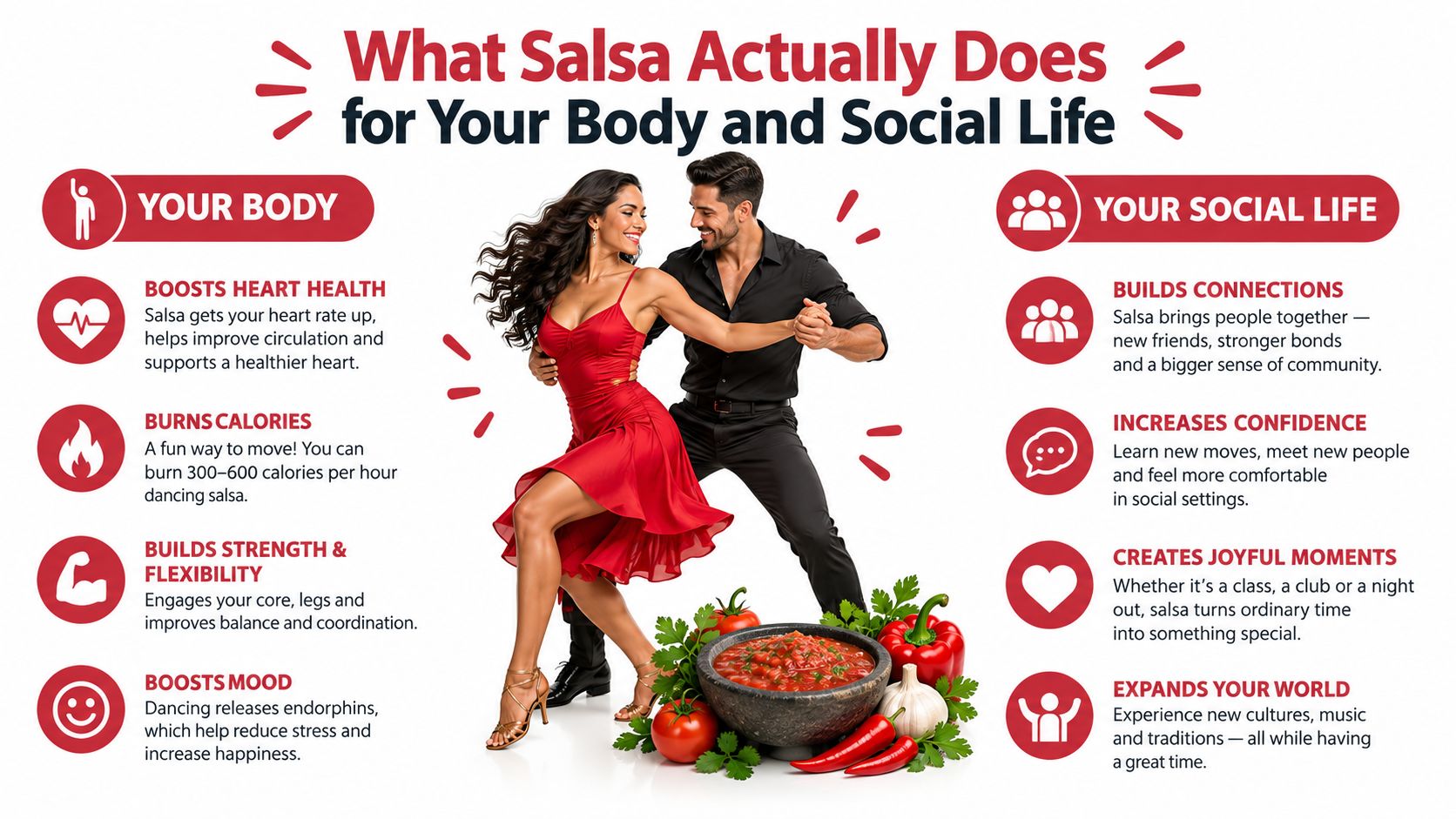
Salsa is not just a nightlife activity. The U.S. National Endowment for the Arts summarizes federal guidance as at least 2.5 hours of moderate-intensity physical activity per week for adults, and the CDC recommends 150 minutes of moderate-intensity aerobic activity weekly, or 75 minutes of vigorous activity, plus muscle-strengthening work on at least two days each week. Dancing can count as moderate-intensity activity for an average-fit adult, and recurring salsa lessons can contribute to that weekly target when practiced consistently CDC adult activity guidance.
The physical value is not magic, and it isn't identical from one class to the next. Intensity depends on class length, breaks, choreography, and how much effort you put in. But adult salsa lessons can absolutely support cardiovascular work, coordination, rhythm, balance, and social engagement when the class is well structured NEA on free-form dance benefits.
What the research says, in plain English
Adult dance programs have been linked with improvements in balance, postural control, motor skills, and quality of life, and they often keep people engaged better than conventional exercise alternatives. That matters because the hardest part of fitness is often sticking with it. Dance gives many adults a reason to return.
Socially, salsa works because people learn in relation to one another. Rotation, shared timing, and repeated practice with different partners build comfort over time, and synchronized movement has been associated with positive affect and stronger feelings of connection in dance settings. You can't force friendship, but you can create the conditions for belonging.
For adults worried about stability or returning to movement after a long break, it helps to strengthen the basics first. A practical set of strengthen stability with these exercises can make turning, balancing, and weight transfer feel less shaky before class starts.
If you've had prior ankle, knee, hip, or back issues, get clearance when appropriate. Salsa is adaptable, but pain-free control comes first. The right class should make it easier to move, not tougher to recover from.
Your First Class Without the Anxiety

Wear comfortable clothes and supportive shoes with smooth soles. Bring water, show up 10 to 15 minutes early, and give yourself time to sign in instead of arriving breathless and flustered. You do not need a performance outfit. You need to be able to move and stay upright.
The first few minutes usually feel ordinary, which is good. You'll see the room, hear how the instructor talks, and get a sense of whether people seem relaxed or guarded. Then the warm-up starts, usually with simple movement to get your body online before the footwork begins.
What usually happens in the room
First comes rhythm and weight transfer. Then the basic step. Then the instructor layers in partner connection, which is where adults either relax or panic, depending on how clearly the class is taught.
Most good instructors cue beginners with counts, demonstrations, and repetition. They'll break steps down instead of rushing everyone into choreography. If they skip the explanation and just keep saying “again” while half the room looks confused, that's not instruction.
No one in that room was born knowing how to salsa. Some people just got there earlier.
Your job isn't to be impressive. It's to notice whether the class makes sense. Did the instructor explain timing? Did partner rotation feel respectful? Did you feel physically safe and socially comfortable? Those answers matter more than whether you remembered every step on the way home.
If you're someone who gets tense in unfamiliar social spaces, it can help to think about how support systems reduce stress in other parts of life too. For some adults, find family counselling support is the kind of resource that reminds you healthy environments are built, not assumed, and dance classes should work the same way.
After class, don't judge yourself by how polished you looked. Judge the studio by whether it taught clearly, managed the room well, and left you wanting to return.
Showing Up Solo and Belonging Anyway
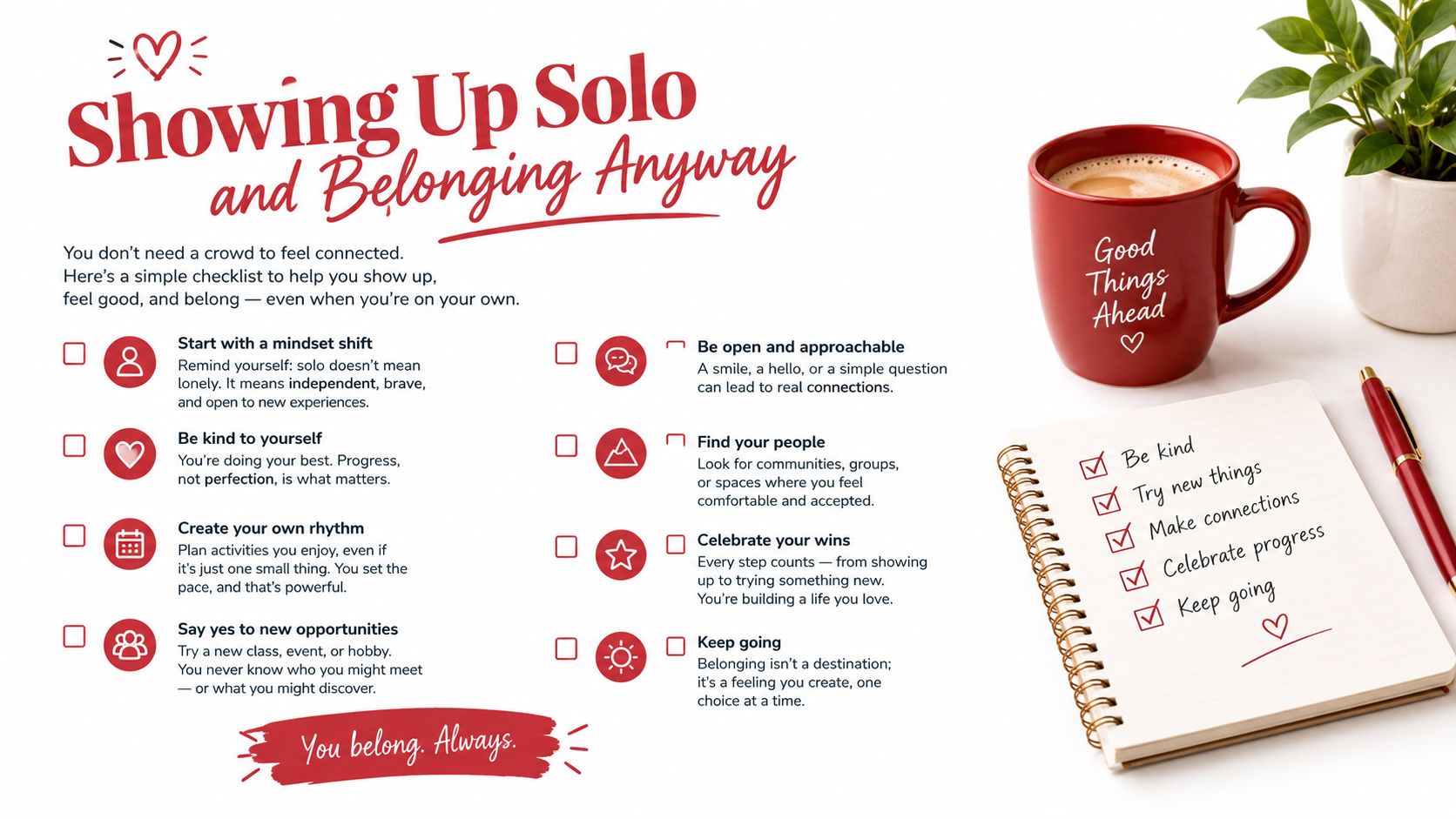
You do not need a partner to start salsa. Most adult classes are built for people who arrive alone, because that's how social dance works. The class teaches you how to connect with different people, not how to cling to one familiar partner forever.
Rotation should be explained clearly. A respectful studio tells you when partners change, lets you opt out if needed, and makes space for people who want same-gender rotation, a non-rotating option, or a quick observation cycle before joining in. Inclusivity is specific, not vague. If the staff can't explain how beginners, shy adults, and culturally different newcomers are accommodated, the room may feel friendly but not welcoming.
The social payoff usually comes from repetition, not instant chemistry. Recent evidence on dance and group movement points to cohesion, belonging, and reduced embarrassment in shared settings, especially when movement is synchronized. That doesn't guarantee a friendship circle by week one, but it does mean the environment can soften the fear of being the least experienced person in the room.
What to ask before you commit
- Rotation policy: Do you rotate partners, and can I opt out if I need to?
- Accessibility: Can you modify turns, standing time, or intensity for my body?
- Comfort level: Is it normal to come alone and still feel included?
- Observation option: Can I watch a cycle before jumping in?
- Culture and boundaries: How do you make sure the room stays respectful?
A good class makes solo attendance feel ordinary. A bad one makes it feel like you're interrupting someone else's hobby. Choose the place where showing up alone is treated as normal, because that's the kind of studio that understands adult beginners.
Booking Your Complimentary First Lesson
Danza Academy of Social Dance offers adult salsa and Latin instruction in Center City Philadelphia and Exton, PA, with beginner pathways built around fundamentals instead of throwing newcomers straight into choreography. That matters if you want a studio that teaches timing, partner connection, and social-dance basics the right way from the start. Their beginner resources include beginner Latin dance classes near me, which is exactly the kind of entry point adults should look for.
Use your first visit the way a serious student would. Watch how the instructor explains levels, ask about credentials, and notice whether the room feels organized, respectful, and beginner-friendly. If those pieces are solid, you're in the right place.
The smartest move is simple. Book the complimentary first lesson, check the fit before you commit to a package, and use that one session to decide whether the studio matches your goals, pace, and comfort level. A good first lesson should answer more questions than it creates.
Danza Academy of Social Dance teaches adults how to start salsa without the usual intimidation, with group classes, private lessons, and a welcoming environment built for real beginners. If you want to see whether it's the right fit for you, visit Danza Academy of Social Dance and book your first complimentary lesson.