You might be here because of a very ordinary moment. A wedding invitation arrives. A friend asks you to go salsa dancing. Music starts at a party, and you feel that familiar split second of wanting to join in and wanting to disappear at the same time.
That feeling is more common than most adults realize.
Many people don't avoid dancing because they dislike music or movement. They avoid it because they don't want to feel exposed, clumsy, or judged. They worry they'll slow everyone down. They assume everyone else somehow learned this years ago.
They didn't. A lot of adults start later than you think, and they start for the same reasons you might be considering it now: confidence, connection, fitness, fun, or one meaningful event they want to enjoy instead of dread.
Why Consider Private Dance Lessons as an Adult
A student once told me, "I don't want to perform. I just want to stop freezing when someone asks me to dance." That's a very adult goal, and it's a good one.
Private adult dance lessons work well for adults because they remove the biggest barrier first. Pressure. You don't have to walk into a room full of strangers and keep up. You don't have to pretend you know the steps. You begin with one instructor, one pace, and one clear goal.
Adults start for real-life reasons
Most adults don't begin dance lessons because they woke up wanting a new hobby out of nowhere. They start because life creates a reason.
- Social confidence: You want to feel comfortable at parties, weddings, or nights out.
- Connection: You'd like an activity you can share with a partner or spouse.
- Personal growth: You want to do something that's challenging in a healthy, rewarding way.
- Joy: You miss moving to music without overthinking every second.
If confidence is the hard part, it can help to support that work outside the studio too. Some adults pair dance with small mindset habits or tools for support for self-confidence, especially when nerves show up before trying something new.
Private lessons aren't for people who are already confident. They're often how people become confident.
Dance also isn't some tiny niche activity for a select few. One industry source cites 10,908 dance-studio businesses in the United States and says the industry grew at a 1.6% CAGR from 2019 to 2024 in a broad look at adult dance participation and studio availability, which points to a mature market with lots of room for adult learners and different teaching formats (adult dance market overview).
A private lesson can be the gentlest starting point
Adults often tell themselves they should "just be brave" and join a big class. Sometimes that's fine. But if fear is the thing stopping you, a private lesson is often the easier first step because it reduces the emotional noise.
You can ask basic questions. You can laugh at mistakes. You can repeat one pattern ten times if that's what helps. If dancing in front of others feels intimidating, this guide on how to overcome fear of dancing in public can help you put words to what you're feeling.
For many adults, the first win isn't a perfect turn. It's walking into the studio and realizing, "Oh. I can do this."
What Exactly Are Private Adult Dance Lessons
A private adult dance lesson is one-on-one instruction with a teacher, or one instructor working with you and your partner together. That's the simplest definition.
The better definition is this: it's dance coaching built around your body, your learning pace, and your reason for being there.
How private lessons differ from group classes
A group class teaches a room. A private lesson teaches a person.
That's why the experience feels so different. In a group setting, the instructor has to keep everyone moving together. In a private setting, the instructor can stop the moment something feels off and help you fix it before it becomes a habit.
It's the difference between using a workout app and working with a personal trainer. The app can show you what a squat looks like. A trainer can tell you why your knees are drifting, why your balance is off, and what to change right now.
Private dance lessons work the same way.
- In group classes, you learn shared material with limited individual correction.
- With videos, you can copy steps, but no one tells you whether your timing, posture, or connection is correct.
- In private lessons, you get immediate feedback that matches your exact needs.
Why the feedback loop matters
Private adult dance lessons are especially efficient because the instructor can give continuous, real-time corrections on technique, which helps reduce bad habits before they settle in. That immediate feedback is one reason studios position private lessons as ideal for specific goals such as social confidence, wedding choreography, or technique improvement (real-time correction in private lessons).
Here are a few examples of what gets corrected quickly in a private lesson:
- Timing: Are you hearing the beat but stepping late?
- Posture and frame: Are your shoulders tight, or is your upper body collapsing?
- Weight transfer: Are you fully arriving on one foot before moving to the next?
- Connection: If you're dancing with a partner, are you pushing, pulling, or communicating?
Practical rule: The sooner you correct a movement pattern, the easier it is to keep improving.
That doesn't mean private lessons are stiff or overly technical. Good teaching makes corrections feel clear and useful, not critical. You leave understanding what changed and why it helped.
Who private lessons are for
They aren't only for advanced dancers. In fact, they're often a strong match for adults who feel hesitant, self-conscious, busy, or very goal-driven.
A private lesson fits if you want:
- A calmer first experience
- Fast, specific feedback
- Flexible scheduling
- Instruction for one clear outcome
If your main worry is "What if I'm awkward?", private is often the format that gives you room to be awkward for five minutes and comfortable for the rest of the hour.
Tailoring Lessons to Your Personal Dance Goals
Not every adult walks in wanting the same thing. That's why private lessons work best when the goal is clear, even if it's simple.
Some people want to dance comfortably at social events. Some want to reconnect with a partner. Some need a polished first dance for a wedding. The lesson format can hold all of those goals because the teaching changes with the student.
One format, different priorities
The one-to-one structure allows an instructor to shape the lesson around what matters most to you. A beginner may spend time on posture, balance, and rhythm, while a more experienced dancer may focus on styling, turn preparation, or cleaner mechanics in a familiar pattern (individualized lesson design).
That means two people can both take private adult dance lessons and have completely different experiences.
One lesson might look like this:
- learning how to hear the beat
- practicing a basic partner hold
- walking through a simple social pattern
Another might look like:
- refining rise and fall in Waltz
- smoothing out a lead on a turn
- preparing choreography for a performance or event
Private lesson formats compared
| Format | Best For | Typical Goal |
|---|---|---|
| Individual private lessons | Adults learning on their own | Build confidence, improve technique, feel comfortable dancing socially |
| Couples private lessons | Partners who want to learn together | Create connection, communicate better in partner dancing, enjoy a shared activity |
| Wedding dance private lessons | Engaged couples | Prepare a first dance, choose music, learn choreography that feels natural |
How to choose the right path
If you're unsure which category fits you, start by asking one question: What do I want to feel able to do?
If your answer is "I want to stop feeling nervous at parties," individual lessons make sense.
If your answer is "We want something fun to do together," couples lessons are often the best starting place.
If your answer is "We want to feel prepared for our wedding dance," then your lessons will naturally center on song choice, comfort level, entrances, exits, and choreography that suits your personalities.
The right goal doesn't have to sound impressive. "I want to enjoy dancing without panicking" is a strong goal.
Your goal can change as you improve
This is one of my favorite parts of teaching adults. The goal you start with is rarely the only one you keep.
A student may begin wanting to survive one wedding, then discover they love Swing. A couple may come in for wedding choreography, then continue with ballroom because they enjoy learning together. A nervous beginner may start with simple rhythm work and later decide they want more polish and musicality.
Private lessons leave room for that evolution. You're not locked into a fixed curriculum. You're building a skill that can grow with your confidence.
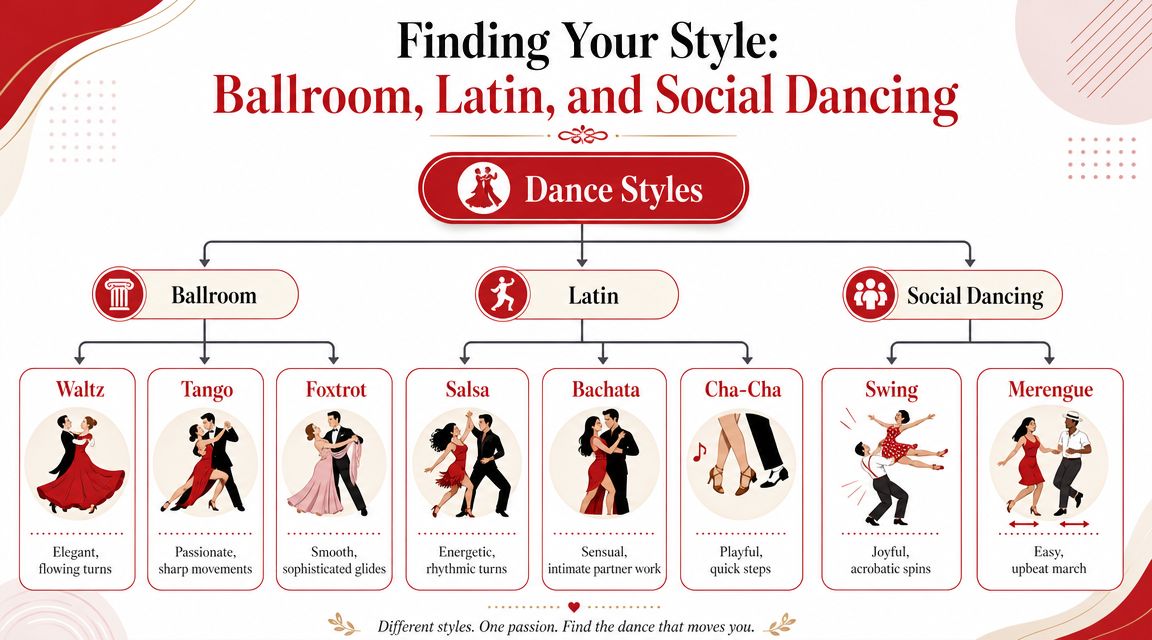
Finding Your Style Ballroom Latin and Social Dancing
Most beginners don't need a giant catalog of dance names. They need a simple way to tell which style feels like them.
A good first step is to think in terms of personality and energy. Some dances feel smooth and elegant. Some feel rhythmic and playful. Some feel casual and social right away.
Ballroom feels graceful and classic
Ballroom styles often appeal to adults who like structure, poise, and a smoother look across the floor.
A few examples:
- Waltz has flowing turns and a soft, romantic quality.
- Foxtrot feels polished and gliding.
- Tango has sharper contrast and a more dramatic mood.
If you like the idea of moving with control and elegance, ballroom may be your lane.
Latin brings rhythm and expressive energy
Latin dances tend to feel more grounded, rhythmic, and playful. Many adults are drawn to them because the music is energizing and the movement feels lively.
Common examples include:
- Salsa, which is quick, social, and full of turning action
- Rumba, which is slower and more expressive
- Cha-Cha, which adds a crisp, cheeky rhythm
For a closer look at style options, lesson formats, and what different partner dances can feel like in practice, you can browse Latin and ballroom dancing lessons.
A short video can also help you connect names to movement:
Social dancing keeps things practical and fun
Social dances are often where adults start if their goal is confidence in real-world settings. These styles can feel approachable because they connect quickly to parties, mixers, live music, and relaxed dance floors.
You might explore:
- Swing if you like upbeat music and energetic movement
- Hustle if you want something versatile and fun
- Merengue if you want a simple, steady rhythm that's easy to begin with
You don't need to pick the perfect style before lesson one. You just need a starting point.
In private adult dance lessons, many students try a few basics first and then settle into the style that feels most natural. That's normal. Your first choice isn't a contract. It's a doorway.
Understanding Pricing and Dance Lesson Packages
Cost matters, especially if you're an adult beginner who already feels a little unsure. Clear pricing lowers pressure. It helps you make a calm decision instead of wondering whether you're signing up for more than you expected.
General pricing guides place private dance lessons in the range of $50 to $100 per hour, with many 60 minute sessions falling around $50 to $85 (dance lesson pricing ranges). That gives you a starting point, not a promise. Actual rates change based on your area, the teacher, and how the studio structures lessons.
Private lessons work a lot like hiring a tutor instead of joining a large class. You're paying for focused attention, a pace built around you, and feedback shaped to your goals. For many adults, that also means something less visible but just as valuable. More privacy, less self-consciousness, and more room to learn without feeling watched.
Why prices vary
Two studios can offer the same lesson length and still price differently. The difference often comes from what is included in the experience and how much individual support you receive.
A lesson fee may reflect:
- Lesson length, such as 30, 45, or 60 minutes
- Teacher experience
- How personalized the lesson plan is
- Local market rates, especially in large metro areas
- Package discounts for booking several lessons at once
That wide range can feel confusing at first. Ask questions early. A good studio should be able to explain its pricing in plain language.
What beginners should ask before buying a package
The hourly rate is only one part of the decision. A better question is whether the package matches the way you learn.
For example, one adult may do well with a weekly lesson and a little practice at home. Another may want a few lessons close together to get comfortable before a wedding or social event. Same dance. Different plan.
Before you commit, ask about:
- How often lessons are usually scheduled
- Whether packages expire
- What happens if you need to cancel or reschedule
- Whether practice sessions or group classes are included
- What extra costs might come later, such as dance shoes
If you want more context for how structured pricing is built in service-based settings, this look at how organizations determine optimal event pricing gives a useful outside perspective.
One lesson helps you test comfort. A package supports steady progress.
A low-pressure way to test the fit
If you're nervous about spending money before you know whether dance feels right, start small. One introductory lesson can tell you a lot. You can notice whether the teacher explains clearly, whether you feel relaxed enough to ask questions, and whether the pace feels supportive instead of rushed.
Danza Academy of Social Dance offers a free complimentary lesson for adults who want to try private instruction before choosing a package. That kind of first visit can be helpful because it answers the questions beginners often carry. Will I feel awkward? Will I be behind? Will the teacher meet me where I am?
You do not need to solve every pricing question on day one. You just need enough clarity to make a comfortable first step. If you'd like a practical checklist before booking, this guide on how to prepare for your first private dance class can help you know what to ask and what to expect.
Preparing for Your First Private Dance Lesson
The biggest fear most adults bring into lesson one isn't physical. It's emotional. They worry they'll look silly, miss the beat, or somehow disappoint the instructor.
That fear matters. A lot. Adults stay with dance when the environment feels safe enough to learn imperfectly. Providers who focus on adult beginners often emphasize that concern directly, noting that fear of judgment or awkwardness can hold adults back and that a psychologically safe setting supports confidence and retention, especially for people who feel self-conscious or out of practice (beginner confidence and psychological safety).
What to wear and bring
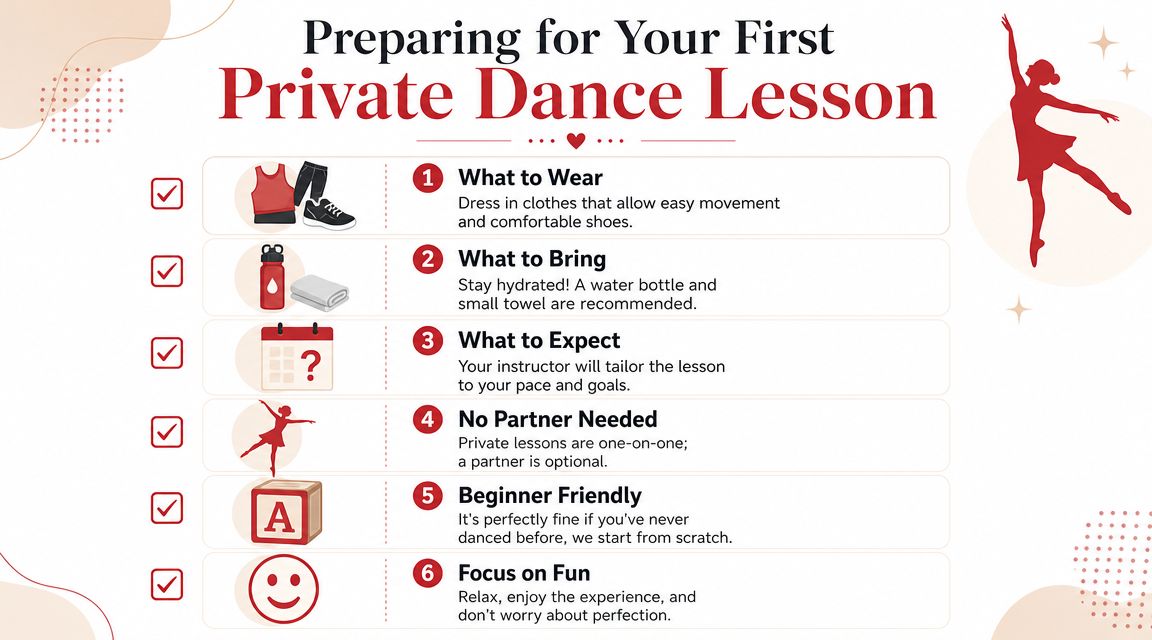
Keep this simple. You don't need a dance costume. You don't need to look experienced. You need to be able to move comfortably.
A practical first-lesson checklist:
- Wear comfortable clothes: Choose something you can move in without tugging or adjusting every minute.
- Pick easy shoes: Supportive shoes that let you move comfortably are usually enough for a first visit.
- Bring water: Dancing is physical, even at a beginner pace.
- Bring your questions: If you're nervous, unsure, or curious, say so. That helps your instructor teach you better.
If you'd like a little more detail before your visit, this guide on how to prepare for your first private dance class can help you feel more settled.
What the first lesson usually feels like
Most private adult dance lessons don't begin with nonstop dancing. They begin with a conversation.
Your instructor will usually want to know:
- why you're there
- whether you've danced before
- whether you're coming alone or with a partner
- what kind of music or style interests you
- whether you have a specific event or goal
Then you start moving. Usually quite basically.
A first lesson may include:
- standing posture and balance
- how to hear the beat
- basic steps in one style
- how to hold a frame or connect with a partner
- a short combination you can remember
Mistakes in the first lesson aren't evidence that you're bad at dancing. They're the material the lesson is built from.
What nervous adults are often relieved to discover
The first surprise is that you don't need a partner to begin. The second is that instructors expect beginners to be beginners.
You are not behind. You are not the only one who feels awkward. You are not supposed to "pick it up instantly."
Many adults also assume dance teachers want polished students. Good teachers want engaged students. If you're willing to try, ask, repeat, and laugh a little, that's enough.
Here are the things I most want a first-time adult student to know:
- You can start from zero: No background is required.
- You can go slowly: Fast progress is nice. Clear progress matters more.
- You can be honest: Say, "I'm nervous," or "I don't know what I'm doing." That's helpful information.
- You can enjoy this before you're good at it: Fun doesn't have to wait for mastery.
If lesson one helps you feel a little less guarded and a little more curious, it's doing exactly what it should.
Your Frequently Asked Questions About Dance Lessons
Do I need a partner?
No. Many adults start on their own. In private lessons, your instructor can work with you directly, and if you do have a partner, they can join you.
What if I have two left feet?
That phrase usually means you haven't been taught yet. Dance is learned. It isn't reserved for naturally coordinated people.
How long until I feel comfortable?
That depends on your goal, your consistency, and how much pressure you're putting on yourself. Most adults notice progress when they focus on small wins, such as hearing the beat more clearly, moving with less tension, or getting through a basic pattern without freezing.
Are private lessons only for weddings or advanced dancers?
Not at all. Adults take private lessons for social confidence, better technique, date-night skills, event preparation, and the simple pleasure of learning something new in a supportive setting.
Will I be judged if I'm out of shape or haven't danced in years?
You shouldn't be. A good studio meets you where you are today. Adults come in with different bodies, histories, schedules, and confidence levels. That's normal.
Is one lesson enough?
One lesson can tell you whether the environment feels right and whether you enjoy the process. Real comfort usually grows through repetition, because dancing is physical learning, not just information.
What's the best style for beginners?
The best style is the one you'll want to practice. Some people connect with smooth ballroom, some with rhythmic Latin, and some with practical social dancing. Your first lesson can help narrow that down.
Private adult dance lessons are often less about becoming a "dancer" overnight and more about becoming more at ease in your own body, with music, and with other people. That's a meaningful shift, and it's available to beginners.
If you've been waiting to feel less awkward before you start, start first. Confidence usually follows action.
If you're ready to try your first steps in a supportive setting, Danza Academy of Social Dance offers a free complimentary lesson you can book through the contact page. It's a simple way to see how private instruction feels, ask questions, and begin at your own pace without pressure.