
You see West Coast Swing for the first time and it doesn't look like a beginner dance. The music feels modern. The dancers look relaxed. One partner glides down a narrow track, the other redirects with what seems like almost no effort. It looks smooth, playful, and just a little mysterious.
That mix of curiosity and hesitation is normal. A lot of adults who ask about West Coast Swing lessons are interested for the same reason. They want a dance that feels social, current, and expressive, but they also want to know what they're getting into before they walk into class.
The good news is that West Coast Swing is learnable. You don't need a dance background, a perfect sense of rhythm, or a partner to start. You do need a clear path, realistic expectations, and instruction that helps the dance make sense from the ground up.
Your First Step onto the Dance Floor
A new student usually arrives with one of two stories.
The first is, “I saw it online and loved how it looked.” The second is, “I watched people dancing at an event and thought, I want to do that, but I have no idea where to begin.” Both students often share the same worry. They assume everyone else already knows the rules.
They don't.
Individuals who start West Coast Swing lessons are not trying to become performers overnight. They want to feel comfortable in class, stop overthinking their feet, and eventually enjoy a social dance without freezing when the music starts. That's a sensible goal, and it's a very achievable one.
You don't need to understand the whole dance before your first lesson. You only need enough confidence to start.
What helps most is knowing that progress in West Coast Swing follows a logical path. First you learn how the dance moves. Then you learn how the partnership works. After that, the dance starts to feel less like memorizing and more like responding.
That's when students begin to relax. And once they relax, they improve much faster.
What Exactly Is West Coast Swing
West Coast Swing is a partner dance, but it doesn't feel stiff or formal. It feels more like a conversation. One person suggests direction, timing, or shape. The other responds. Then both partners adjust to each other in real time.
That's a big reason people fall in love with it.
West Coast Swing is also unusually flexible in how it fits music. Dancers use it with blues, jazz, pop, R&B, acoustic songs, and a lot of contemporary tracks. If you like the idea of learning one dance that can work across different moods and playlists, this style makes a lot of sense.
The character of the dance
West Coast Swing is defined by a few traits that make it feel different from other partner dances:
- Slotted movement means the dance travels along a narrow lane instead of circling all over the floor.
- Elastic connection means partners do more than move beside each other. They create stretch and redirection through timing and body control.
- Improvisation matters. Even beginners start learning how to adapt instead of only copying fixed choreography.
- Lead and follow functions like a conversation, not a tug-of-war.
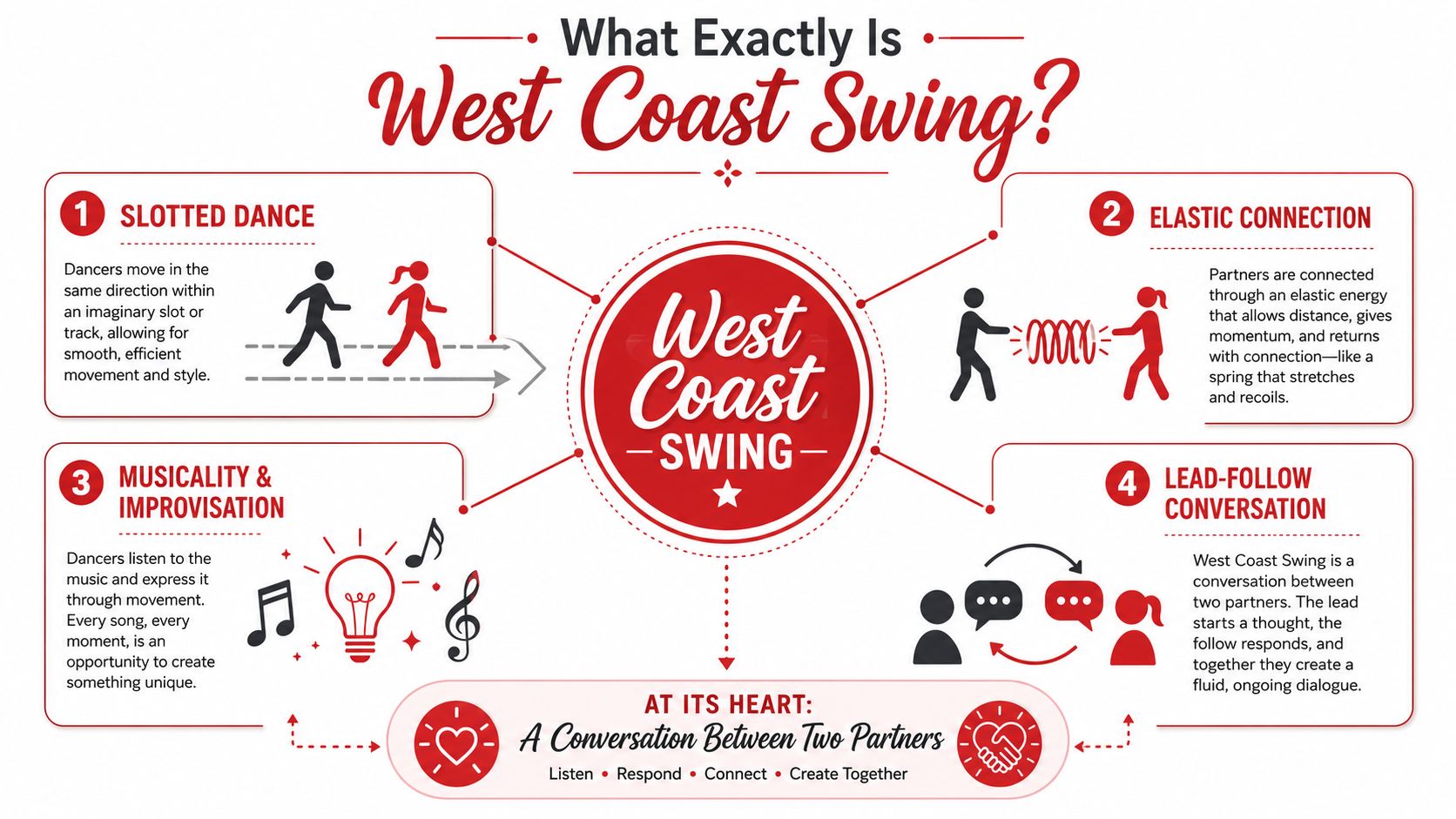
That conversational quality is what makes the dance so satisfying. You're not just doing steps at each other. You're listening through movement.
Why lessons focus on a small set of basics
Modern West Coast Swing teaching stays grounded in the dance's history. The Library of Dance description of West Coast Swing notes that it evolved from Lindy Hop in the 1950s and that instruction is built around foundational 6-count and 8-count patterns, including the Sugar Push, Left Side Pass, Right Side Pass, Tuck Turn, and Whip. It also notes that virtually all other moves grow out of those basics.
That matters because it explains why good beginner lessons don't throw everything at you at once.
A strong teacher usually starts with a compact vocabulary. You learn a few patterns, repeat them often, and use them to understand timing, direction, and connection. Students sometimes worry that this feels too simple at first. It isn't. It's how the dance becomes usable.
If you're also comparing swing styles, this guide to the difference between East Coast and West Coast Swing can help clarify why West Coast Swing feels smoother, more linear, and more improvisational.
Practical rule: If a basic pattern feels boring, you probably haven't reached the interesting part of it yet. In West Coast Swing, depth comes from how you dance the pattern, not just from collecting more of them.
The West Coast Swing Learning Journey
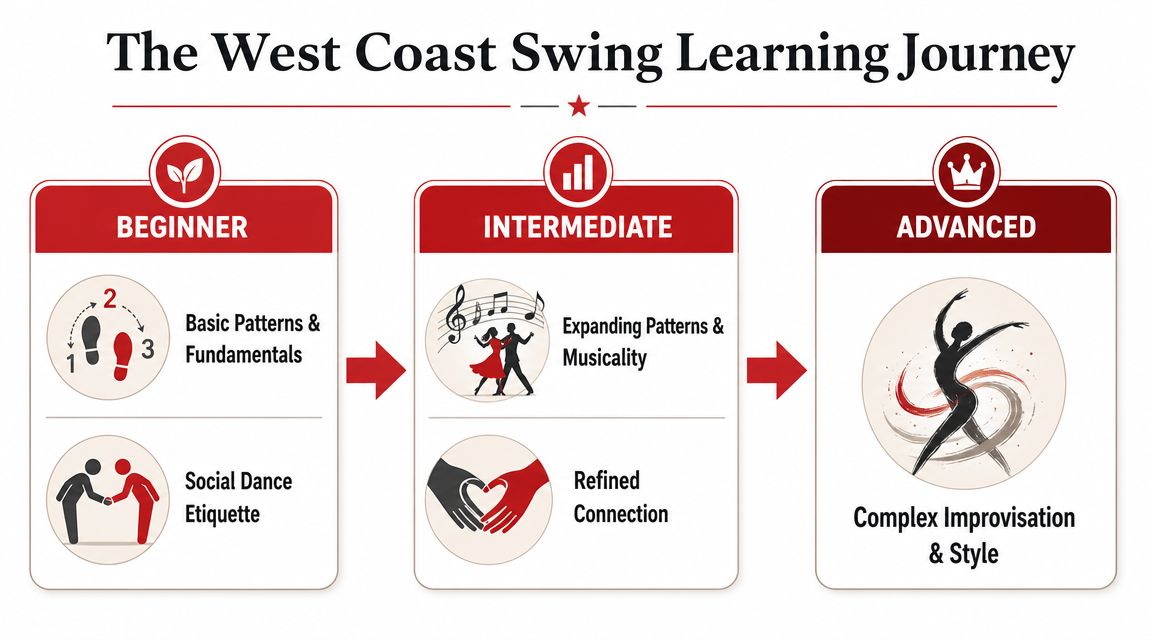
Most students do better when they stop asking, “How long until I'm good?” and start asking, “What should I be working on right now?” West Coast Swing lessons become much less overwhelming when you break the process into stages.
A simple roadmap helps. Here's what that journey often looks like.
Beginner stage
At the beginning, students need structure more than variety. Consequently, lessons focus on the fundamentals that make partner dancing work at all.
The first big ideas are usually:
- Slot discipline: You learn where the dance travels and how not to block your partner.
- Anchor timing: You finish a pattern in balance so the next action has clarity.
- Weight transfer: You stop faking steps and start arriving on each foot.
- Basic figures: A small group of core patterns becomes your working vocabulary.
An instructional breakdown of beginner mechanics shows why this matters. Effective West Coast Swing lessons prioritize slot discipline and a strong anchor-step framework because that's what allows clear partner communication and future improvisation in the dance, as shown in this beginner West Coast Swing technique lesson.
A lot of students want more moves right away. I understand that impulse. But if the slot is messy and the anchor is rushed, more patterns usually create more confusion.
Here's a short visual example to make that progression feel more real:
Intermediate stage
Once the basics start to hold, students begin to combine patterns more fluidly. The dance then opens up.
You start noticing things like:
- how to keep your connection consistent with different partners
- how to recognize musical accents
- when a side pass can be shaped differently without losing the structure
- how small changes in timing can change the feel of the same pattern
Intermediate dancers often think they've plateaued because they're no longer getting obvious “firsts” every week. In reality, they're learning refinement. That part is quieter, but it's where social dancing becomes comfortable.
A student at this stage might know the pattern already, yet still be learning how to make it feel cleaner, calmer, and more responsive.
Advanced stage
Advanced training doesn't just mean harder sequences. It means better control.
One advanced teaching example emphasizes drills for partial weight transfers, foot-pressure changes, and managing rotation. Another advanced curriculum includes elements such as hitches, rock-and-go's, ducks, pro-level footwork, rolling count, one-foot spins, dips, and tricks in this advanced West Coast Swing training example. The main shift is that dancers stop relying on memorized shapes and start training musicality, compression and extension control, and micro-timing.
That sounds technical, but the idea is simple. Advanced dancers care about exactly when the movement lands, how the body organizes that movement, and whether the connection feels effortless.
At higher levels, the dance gets smaller before it gets bigger. Precision comes first. Flash comes later.
If you're just starting, that should feel encouraging, not intimidating. It means there is real depth ahead, but you only need to master the piece that belongs to your current stage.
Inside Your First WCS Lesson
A first class usually feels better once you know what's coming. Most beginners don't struggle because the dance is impossible. They struggle because uncertainty makes them tense before they even begin.
A typical lesson starts. You check in, meet the instructor, and spend a few minutes loosening up your posture and footwork. Nobody expects polished movement. The point is to wake up your timing and get you paying attention to weight shifts.
What you'll probably do in class
Then the instructor introduces one idea at a time. Often that means a basic pattern, how each role moves, and where students tend to get mixed up.
In many West Coast Swing lessons, rhythm is taught with clear counting. A beginner teaching source explains that figures are usually organized into 6-count and 8-count categories, and gives a Sugar Push count as “one, two, three and four, five and six” in this West Coast Swing timing tutorial. That kind of counting gives students something solid to hold onto when the movement still feels new.
You might hear the same concept taught several ways in one class:
- Traditional counts for timing
- Walk and triple language for foot rhythm
- Step-by-step cues for people who need movement broken down more precisely
That mix helps because not everyone learns rhythm the same way.
If you want a preview of the kinds of figures teachers often use in beginner classes, these West Coast Swing basic moves give you a useful head start.
What beginners usually find hard
Most new students don't get confused by the count itself. They get confused by doing the count while staying connected to another person.
That's normal.
Common first-lesson moments include stepping too big, turning too soon, or forgetting which foot is free. None of that means you're bad at dancing. It means your brain is juggling timing, direction, and partnership at the same time for the first time.
If your first lesson feels mentally busy, that's a sign you're learning. The dance gets simpler as your body starts recognizing the pattern.
By the end of class, most students won't feel “finished.” They'll feel introduced. That's exactly right.
Group Classes vs Private Lessons Making the Right Choice
This is one of the most important decisions for beginners, and it's one that many studio pages don't really help with. Public class listings often tell you when lessons happen, but not which format fits your goals.
A practical note from El Motivo's West Coast Swing page highlights this gap clearly. Many new dancers are unsure how to choose between private lessons for targeted feedback and group classes for social practice, even though that decision shapes the learning experience from the start.
When group classes make sense
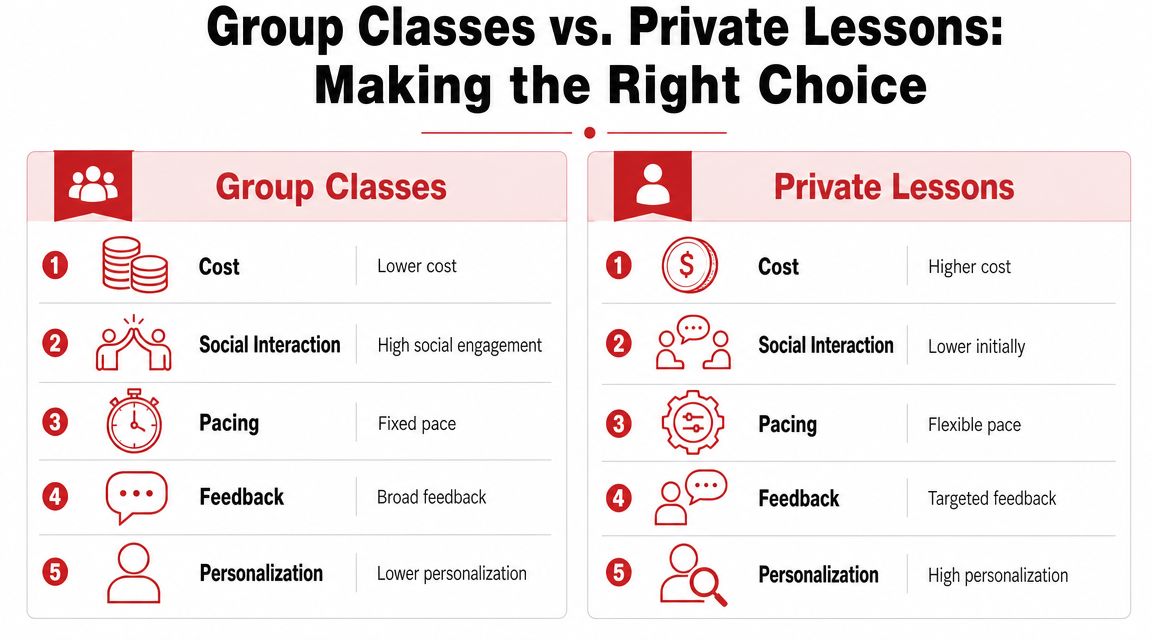
Group classes are a great fit if you want energy, repetition, and exposure to different partners. They also help you get used to the social side of West Coast Swing early.
They tend to work well for students who:
- Enjoy a shared learning environment: Seeing others make the same mistakes can be reassuring.
- Want social practice built in: Rotating partners teaches adaptability from the beginning.
- Like external structure: The class schedule keeps you moving forward.
- Are still exploring the dance: You can sample the style before committing to a more focused plan.
The tradeoff is that group classes move at a shared pace. If one concept clicks slowly for you, there may not be time to stay with it very long.
When private lessons are the better fit
Private instruction is useful when you want direct answers to your specific habits. If your timing rushes, your anchor collapses, or you're not sure what your arms should feel like, private coaching gives you immediate correction.
Private lessons are often the better choice if you:
- Prefer individualized feedback: The teacher can adjust everything to your body and learning style.
- Want faster cleanup of mistakes: You won't repeat the same issue for weeks without noticing.
- Have a specific goal: Social confidence, technique improvement, wedding prep, or role training all benefit from targeted work.
- Feel nervous in groups: Some adults learn better before stepping into a room full of people.
One practical option is a hybrid plan. Many dancers use private lessons to build technique and group classes to test that technique with a variety of partners. Danza Academy of Social Dance offers both formats, which can be useful if you want one place where you can mix personalized instruction with social class experience.
A quick comparison
| Learning format | Best for | Main strength | Possible drawback |
|---|---|---|---|
| Group classes | New dancers who want community and partner rotation | Social practice and shared momentum | Less individualized correction |
| Private lessons | Students who want tailored coaching | Specific feedback and flexible pacing | Less built-in social variety at first |
| Hybrid approach | Adults who want both technique and floor comfort | Balanced development | Requires planning and consistency |
If you're torn, ask yourself one question first. Do you mostly need confidence, or do you mostly need correction? Your answer usually points you in the right direction.
Tips for Faster Progress and More Fun
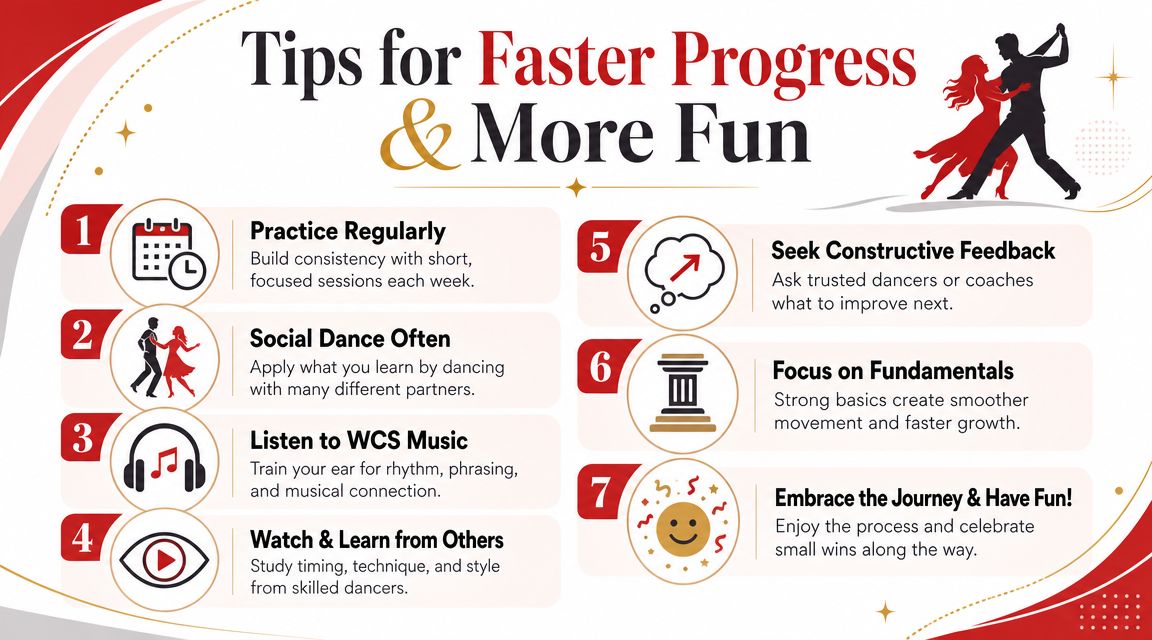
Students improve faster when they make learning part of their week, not just part of one class. You don't need an elaborate training plan. You need a few habits you can keep.
Small habits that pay off
- Ask one real question each class: Not “Was that okay?” Ask, “Am I finishing my weight before the anchor?” or “Did I step out of the slot there?” Specific questions get useful answers.
- Practice without a partner: You can work on rhythm, anchors, posture, and foot placement in a hallway, kitchen, or living room.
- Record short clips of yourself: A quick video often reveals what your body is doing versus what you think it's doing.
- Go social dancing before you feel fully ready: Social floors teach adaptability, floorcraft, and calmness in a way class alone can't.
- Listen to the music outside class: If the groove becomes familiar, timing gets easier during lessons.
- Wear shoes that let you move cleanly: You don't need anything fancy on day one, but sticky footwear can make turns and redirections harder.
What to focus on first
Many dancers slow their own progress by trying to “look advanced” too early. Styling can wait. Clean basics can't.
Keep your attention on:
- Timing before decoration
- Weight transfer before speed
- Connection before bigger patterns
Better dancing usually comes from simpler practice, done with more attention.
One more thing matters a lot. Be patient with the awkward phase. Every good social dancer you admire has gone through the stage where nothing felt natural. The students who keep improving aren't the ones who never get frustrated. They're the ones who keep showing up anyway.
West Coast Swing Lessons FAQ
Do I need to bring a partner
Usually, no. Many adults start alone, and that's often a good thing because learning with different partners builds adaptability. If you do have a partner, that can be fun too, but it isn't a requirement for getting started.
What should I wear
Wear clothes you can move in comfortably. You don't need performance outfits. For a first lesson, think neat, breathable, and easy to bend and turn in.
Shoes matter more than people expect. You want something stable and comfortable that allows movement without gripping the floor too aggressively. Very sticky soles can make pivots and redirections feel harder.
How long until I feel comfortable social dancing
That depends on how often you practice, how regularly you attend lessons, and how soon you start using what you've learned in real partner dancing. Most beginners feel some uncertainty at first, especially with timing and connection.
A better benchmark is this: you're ready to start social dancing when you can stay calm, keep basic timing, and recover if something goes off. You do not need to be polished before you begin.
Is West Coast Swing hard to learn
It's layered, not impossible.
The first challenge is that you're learning both steps and communication at the same time. That can feel mentally busy. Once the basic rhythm and slot start making sense, the dance becomes much more enjoyable.
What if I can't tell whether my connection is right
This is a common frustration. Many lesson materials explain the figure but not always the feeling behind it. Beginners often need help understanding body angle, connection to the core, and whether they're staying responsive without becoming tense.
Useful self-check questions include:
- Can I keep my frame without stiffening my shoulders
- Am I moving because I was led, or because I guessed
- Do I finish balanced, or do I fall into the next step
- Am I rotating clearly, or am I over-rotating and pulling off the slot
Those are excellent questions to bring into class or private coaching.
Start Your Dance Journey Today
West Coast Swing gives adults something rare. It's structured enough to learn step by step, but open enough to stay interesting for years. You can begin with a few basics, grow into confident social dancing, and keep developing musicality, style, and connection over time.
If you've been thinking about trying West Coast Swing lessons, the best next step isn't more overthinking. It's getting on the floor with a teacher who can meet you where you are.
If you want to explore local options, you can start by looking at West Coast Swing classes near you. Then make it easy on yourself and take the next action while your interest is still fresh.
A first lesson gives you something videos and articles can't. Real feedback. Real movement. A real sense of whether this dance fits you.
And for many, that first lesson is the moment West Coast Swing stops feeling intimidating and starts feeling possible.
Book your free complimentary lesson with Danza Academy of Social Dance through the contact page and take your first step toward confident, enjoyable West Coast Swing. If you've been waiting for the right moment to start, this is it.