
What makes a song right for West Coast Swing, its popularity, its speed, or what you can hear in the groove? The best west coast swing music depends on your dancing goal, not on whether a track is famous or fast. A beginner needs room to find timing and connection. A performer may need vocal phrasing, breaks, or emotional contrast. A couple preparing a wedding dance needs music that supports both confidence and choreography.
The eight tracks below move from slow connection and foundational timing to faster musicality, expressive performance, social dancing, and wedding choreography. Their BPM ranges are useful guideposts, not rigid rules. A song at a comfortable tempo can still feel difficult if its accents are unclear, while a faster track may feel manageable when the groove is steady.
Start by identifying the tempo. Then listen for clear phrasing, breaks, backbeats, and changes in energy. Choose patterns and styling that support what you hear instead of forcing the same vocabulary onto every song.
Musicality begins with choosing a track you can hear and respond to.
For more swing inspiration, find Bennygoodman here.
1. Smooth Operator by Sade
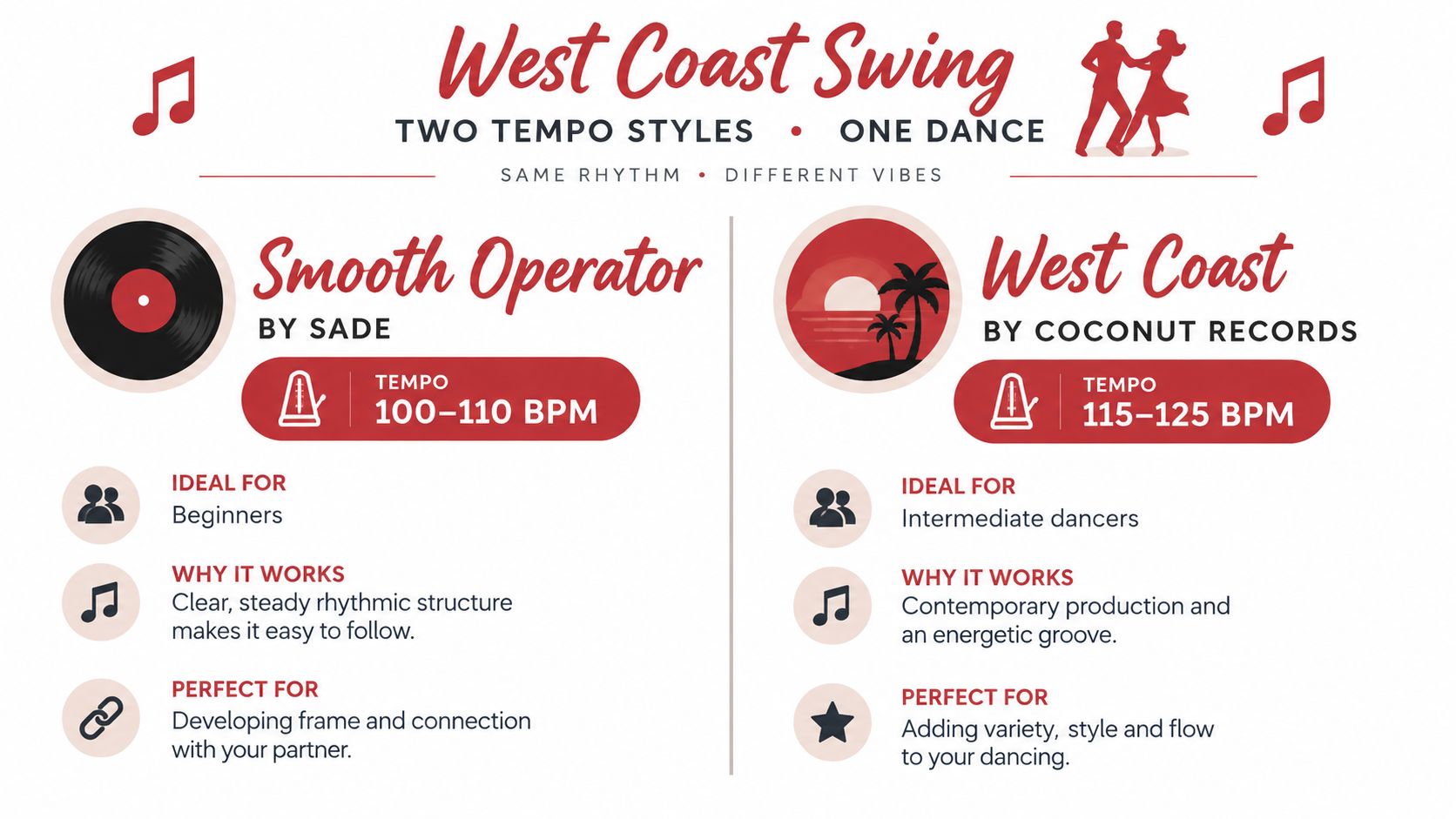
“Smooth Operator” gives newer dancers space to work on the quality of West Coast Swing rather than chasing complicated patterns. Its relaxed character sits around 100 to 110 BPM, a range that suits foundational practice and deliberate connection work. Historical guidance places traditional social West Coast Swing around 26 to 32 measures per minute, approximately 104 to 128 BPM in 4/4 time (historical West Coast Swing music guidance).
Listen for the song's calm pulse and breathing spaces. Keep your frame elastic rather than rigid, and let your weight changes travel smoothly through the slot. The goal isn't to fill every sound with a flourish. It's to maintain a clear conversation with your partner while the music gives you room to settle into the rhythm.
Use this track for:
- Connection exercises: Practice compressing and stretching the connection without pulling or collapsing.
- Footwork quality: Keep the steps compact, smooth, and sliding rather than vertical or hurried.
- Break awareness: Try an underarm turn or spin when the music creates a noticeable opening.
- Styling control: Add a small arm, body, or hip accent only after your basic timing remains stable.
If you're still building your vocabulary, review these West Coast Swing basic moves and apply them without overloading the song. A simple sugar push, left-side pass, or underarm turn can sound musical when your timing and connection match the track.
Use “Smooth Operator” when you want to hear whether your partnership is genuinely connected. It may feel too restrained for a high-energy showcase, and that's useful. The limitation encourages you to refine the details that faster music can hide.
The track also suits wedding choreography because its smooth atmosphere supports a couple who wants elegance without excessive speed. For a first dance, select it when the dancers value comfort, intimacy, and clear movement over a dramatic finale.
2. West Coast by Coconut Records
“West Coast” by Coconut Records raises the energy without abandoning the relaxed, contemporary feel that makes West Coast Swing approachable. At approximately 115 to 125 BPM, it works as a bridge between slower technical practice and more active social dancing. A broad social programming range is often described as about 80 to 130 BPM, with suitable tracks spanning blues, R&B, pop, country, funk, acoustic covers, neo-soul, and light EDM when the groove and phrasing remain clear (social West Coast Swing tempo guidance).
This is a strong choice when a beginner has learned the basic patterns but hasn't yet learned to manage speed. Keep the steps precise and let the beat organize your movement. The faster pulse should make you smaller and more efficient, not tense.
Use the track to build confidence
Begin with patterns you already know. Try a sugar push, starter step, underarm turn, and whip before adding variations. Once those figures feel secure, combine them into short sequences and listen for whether your transitions stay aligned with the music.
The track solves a common intermediate problem: dancers often add personality by abandoning structure. Instead, keep the timing dependable while changing the styling. A relaxed shoulder action, a clearer body line, or a well-placed pause can express character without disrupting the partnership.
Choose “West Coast” for a practice session when your goal is progression rather than maximum challenge. It may not provide the deep blues phrasing that invites rolling timing, and dancers seeking a highly dramatic competition track may want more pronounced breaks. Its strength is its accessible groove and steady push toward contemporary west coast swing music.
For structured practice, explore West Coast Swing classes near you and bring this track into a class or private lesson. Ask your instructor to identify where your timing changes as the tempo rises. That feedback can turn a comfortable song into a useful diagnostic tool.
3. Night and Day by Ella Fitzgerald and Louis Armstrong
“Night and Day” reveals the lyrical and refined side of West Coast Swing. Its jazz character sits approximately around 120 to 130 BPM, with vocal interplay and orchestration that reward dancers who listen beyond the main beat. West Coast Swing developed from the Lindy Hop lineage in California during the late 1930s and early 1940s, and its musical identity later expanded beyond its early swing and blues associations (West Coast Swing historical background).
The main dancing problem here is interpretation. A dancer can complete every pattern correctly and still miss the song's personality. Study the vocal phrasing, then let your movement echo the musical conversation. A sustained vocal line may invite a longer extension, while a crisp response may support a sharper change of direction.
Use the arrangement as a map:
- Vocal lines: Shape your body movement around the rise and fall of the melody.
- Instrumental breaks: Reserve a turn, change of level, or styling detail for a moment that deserves attention.
- Orchestral texture: Keep your frame elegant and avoid adding movement because you can.
- Partner exchange: Let one dancer initiate an idea and the other answer through timing or styling.
This track is best for an advanced showcase, a heritage-focused event, or a partnership session where dancers want to develop polish. It can expose rushed footwork and unfocused arms because the music contains so many layers. If your basic timing isn't settled, simplify the patterns and concentrate on matching the vocal line.
Select “Night and Day” when sophistication is the decision. Choose another track when you need a strong pop backbeat, a casual social groove, or an uncomplicated teaching song. The music is rich, but richness requires restraint.
4. Uptight Everything's Alright by Stevie Wonder
“Uptight (Everything's Alright)” brings a driving Motown groove to West Coast Swing and solves a different problem: controlled quickness. Its energetic feel is commonly placed around 130 to 140 BPM for this selection, which pushes beyond the broad social range often cited for West Coast Swing. That makes it a demanding practice choice, not a default beginner track.
The song's strong beat makes rhythmic accuracy easy to hear, but the pace leaves less time for large movements. Master slower patterns before using it. At this speed, dancers need smaller steps, cleaner weight transfers, and more disciplined preparation.
Turn speed into control
Practice one figure at a time. Start with a basic pattern, then repeat it while keeping the upper body quiet and the feet underneath you. Add quick-quick-slow variations only when you can complete them without rushing the anchor or compressing your partner.
The track is useful for:
- Pattern acceleration: Reduce unnecessary travel and prepare earlier.
- Beat clarity: Place your movement directly into the groove instead of reacting late.
- Personality: Use facial expression and playful styling without allowing them to interrupt technique.
- Energy management: Keep the body energized but not tense.

“Uptight” can be excellent for a fun showcase or an advanced group class, but its limitation is obvious. A dancer who is still learning foundational timing may substitute rushing for musicality. Use it when the decision is deliberate, and lower the intensity if your partner can't maintain a comfortable connection.
West Coast Swing is now performed to contemporary genres including pop, funk, hip-hop, R&B, country western, and jazz, so a Motown track fits the dance's broader adaptive tradition (overview of West Coast Swing's musical development)). The song works because its groove gives dancers something clear to organize around, not because genre alone makes a track suitable.
5. Unforgettable by Nat King Cole
“Unforgettable” slows the room down and puts the quality of partnership under a spotlight. At roughly 90 to 100 BPM for this selection, the ballad leaves generous space for frame, alignment, and refined styling. It's an effective wedding choice when the couple wants a romantic first dance with controlled movement rather than a routine packed with tricks.
A slow song can reveal more than a fast one. If the lead changes direction abruptly, the follower may feel the interruption. If the frame collapses during a sustained phrase, the couple loses the sense of shared movement. Use the track to practice a soft, elastic connection that remains responsive from the beginning of a pattern to the anchor.
Connection focus: Slow music doesn't mean empty music. It gives you time to make each weight change, extension, and pause intentional.
Keep the choreography spacious. A simple pass can become expressive when the dancers maintain body alignment and allow the music to breathe. Subtle body rolls, gentle hip movement, and restrained styling can work, but they should support the romantic tone rather than turn into separate performances.
This track solves the problem of over-choreographing a wedding dance. Couples often want a memorable moment, but too many complicated figures increase pressure during rehearsal and on the wedding floor. Choose “Unforgettable” when the couple's strongest asset is warmth and connection.
Its limitation is that it won't train fast reactions or high-energy musicality. Pair it with a different practice track if you need to develop speed. For a first dance or a private lesson, however, the slower tempo helps an instructor address posture, frame, balance, and confidence in detail. It's also a natural song to explore during a complimentary first lesson at Danza Academy.
6. Sir Duke by Stevie Wonder
“Sir Duke” is a celebratory choice for dancers who need rhythm accuracy without losing joy. Its approximate range of 110 to 120 BPM makes it accessible to intermediate dancers while giving advanced performers enough musical detail to explore. The upbeat Motown arrangement encourages movement that feels open, bright, and socially inviting.
Start with a reliable pattern and listen for the rhythmic structure. Practice quick-quick-slow variations with confidence, but don't force accents onto every prominent sound. The song gives you permission to smile, expand your styling, and share energy with your partner. Technique still decides whether that energy feels connected or chaotic.
Make musicality social
Use “Sir Duke” in a group setting when you want dancers to practice expression alongside timing. Have one couple repeat a simple pattern while changing only the styling. One version might stay compact and smooth. Another might respond to the horns with a sharper arm line or a more buoyant body action.
That exercise teaches an important distinction. Musicality isn't a collection of decorative moves. It's the dancer's choice about how to use timing, emphasis, energy, and space in response to the track. A clear explanation of this idea appears in Danza Academy's guide to what musicality in dance means.
Choose this track for:
- Social confidence: Practice inviting, comfortable movement that leaves room for a partner.
- Pattern variation: Keep the rhythm stable while changing the shape of familiar figures.
- Community energy: Use shared joy and clear timing to make group practice feel connected.
- Performance preparation: Develop an expressive presence without relying on difficulty.
“Sir Duke” may not suit a quiet, intimate routine or a minimalist emotional performance. Its best use is a social floor, community showcase, or intermediate class where dancers need to combine accuracy with personality.
7. The Very Thought of You by Billie Holiday
“The Very Thought of You” asks dancers to solve an emotional problem. The track's haunting jazz-ballad character sits around 95 to 105 BPM for this selection, but its impact comes less from speed than from Billie Holiday's expressive vocal delivery. The music invites restraint, sensitivity, and a willingness to leave space between actions.
Begin with technical security. If you're still thinking about where to place your feet, you won't have enough attention for emotional interpretation. Once the foundation feels automatic, study the vocal phrasing and notice where the melody lingers, softens, or changes direction.
Minimal movement can carry considerable weight here. A delayed extension, a quiet pause, or a gradual change in body orientation may communicate more than a fast sequence of turns. Keep the connection honest and avoid copying the song's sadness with exaggerated facial expressions. Emotional authenticity starts with listening, not acting.
Use the song for:
- Artistic showcases: Build a performance around mood and musical storytelling.
- Vocal interpretation: Let the singer's phrasing influence the length and quality of movement.
- Connection depth: Make the partnership visible through timing and responsiveness.
- Performance discipline: Remove unnecessary patterns so the important moments stand out.
The limitation is its demand for maturity. A technically strong dancer can still look disconnected if the choreography treats the ballad as background music. Conversely, a simpler routine can feel compelling when every choice supports the emotional tone.
Select “The Very Thought of You” when the goal is advanced performance musicality. For a beginner social lesson, choose a track with a clearer, more forgiving groove. For a professional-style showcase, this song offers space to develop a distinctive interpretation rather than just display more figures.
8. Just the Two of Us by Grover Washington Jr. and Bill Withers
“Just the Two of Us” bridges smooth R&B, partnership work, and wedding choreography. Its warm, understated character sits around 105 to 115 BPM for this selection, giving dancers enough time to maintain a connected frame while responding to subtle instrumentation. West Coast Swing commonly uses a clear 4/4 pulse, prominent backbeats, and phrasing that supports elastic timing. The most useful test is whether the music encourages West Coast Swing more than another dance style (guidance on identifying WCS-compatible music).
This track solves the problem of dancing to intimacy without becoming motionless. Keep the connection soft and responsive. Let the vocals guide the relationship between partners, while the melodic details shape small changes in direction, body rhythm, or styling.
Build a wedding plan around the phrasing
For a couple preparing a first dance, use the intro to establish a calm starting position. Begin with simple connected movement, then introduce a turn or change of shape when the phrasing gives you a natural opportunity. Save any larger highlight for a musical lift that both dancers can recognize.
The track supports:
- Partner listening: Respond to changes in tone rather than executing a memorized sequence mechanically.
- Smooth frame: Maintain a gentle connection through transitions and turns.
- Modern choreography: Blend recognizable West Coast Swing patterns with personal styling.
- Emotional clarity: Let the warmth of the song guide the size and speed of movement.
Its limitation is subtlety. Dancers who need strong, obvious breaks may find fewer cues than they get from funk or highly arranged pop. That makes it a valuable choice for refining musical awareness, but a less suitable option for a routine built around repeated dramatic hits.
Use “Just the Two of Us” when the couple wants a contemporary romantic track that still allows practical partner dancing. You can also explore it in a complimentary lesson at Danza Academy, where an instructor can help translate the song's phrasing into a comfortable plan.

8 West Coast Swing Songs: Style & Feel Comparison
| Song | Tempo & Style | Implementation Complexity | Resource Requirements | Expected Outcomes | Ideal Use Cases | Key Advantages |
|---|---|---|---|---|---|---|
| Smooth Operator, Sade | 100–110 BPM; relaxed, smooth groove | Low; beginner-friendly patterns and connection work | Basic WCS technique, frame, posture, and weight transfer | Improved connection, body mechanics, and musical timing | Beginners, wedding choreography, foundational classes | Clear rhythm, accessible tempo, elegant musical phrasing |
| West Coast, Coconut Records | 115–125 BPM; modern, upbeat swing | Moderate; requires accurate timing and pattern control | Intermediate technique, rhythmic precision, and stylistic confidence | Greater confidence, personality, and variation skills | Intermediate classes, social events, contemporary choreography | Engaging modern sound, energetic groove, broad student appeal |
| Night and Day, Ella Fitzgerald & Louis Armstrong | 120–130 BPM; sophisticated jazz | High; complex phrasing and musical interpretation | Strong musicality, styling, and advanced partnership skills | Enhanced interpretation, elegance, and performance quality | Advanced choreography, competitions, showcases | Rich arrangement, vocal nuance, strong connection to swing heritage |
| Uptight (Everything's Alright), Stevie Wonder | 130–140 BPM; energetic Motown funk | High; fast patterns require controlled technique | Solid fundamentals, speed control, and rhythmic accuracy | Improved quickness, timing, and performance energy | Intermediate-advanced classes, social events, energetic showcases | Driving beat, playful energy, excellent for quick variations |
| Unforgettable, Nat King Cole | 90–100 BPM; slow romantic ballad | Moderate; simple patterns require refined connection | Strong frame, alignment, partner communication, and styling | Greater elegance, connection, and emotional expression | Weddings, romantic performances, connection training | Timeless appeal, spacious phrasing, ideal for refined movement |
| Sir Duke, Stevie Wonder | 110–120 BPM; celebratory Motown groove | Moderate; accessible patterns with room for variation | Intermediate timing, rhythm control, and expressive styling | Improved confidence, accuracy, and joyful performance | Group classes, community events, social dancing | Uplifting energy, clear beat, broad audience appeal |
| The Very Thought of You, Billie Holiday | 95–105 BPM; intimate jazz ballad | High; demands emotional maturity and subtle interpretation | Advanced musicality, expressive control, and artistic coaching | Deeper emotional expression and artistic performance | Advanced showcases, artistic choreography, performance training | Emotional depth, nuanced phrasing, strong interpretive potential |
| Just the Two of Us, Grover Washington Jr. & Bill Withers | 105–115 BPM; smooth R&B groove | Moderate to high; requires controlled connection and phrasing | Intermediate-advanced technique, frame control, and musical responsiveness | Stronger partnership, musicality, and expressive confidence | Weddings, partnership training, contemporary performances | Modern appeal, balanced accessibility, warm and sophisticated groove |
Turn a Good Song Into Better Dancing
The right west coast swing music depends on what you need to practice today. “Smooth Operator” and “Unforgettable” give you time to improve frame, alignment, connection, and controlled styling. Their slower character makes small issues easier to notice, especially when a lead or follow interrupts the elasticity of the partnership.
For timing and social confidence, start with “West Coast,” “Sir Duke,” or “Just the Two of Us.” These mid-tempo choices support clear rhythm while leaving room for personality. They also reflect the broader musical life of West Coast Swing. The dance began in a swing and blues lineage, but it now works across many genres when the pulse, backbeat, and phrasing support the dance (West Coast Swing music overview).
Use “Uptight (Everything's Alright)” when your foundation is ready for controlled energy. Faster music demands earlier preparation, smaller steps, and cleaner decisions. It shouldn't make you rush. It should show you where your technique still depends on extra time.
For expressive performance musicality, choose “Night and Day” or “The Very Thought of You.” One offers layered jazz phrasing and vocal interplay. The other rewards emotional restraint and detailed listening. These tracks ask you to interpret the music rather than complete patterns.
A repeatable selection process keeps your playlist practical:
- Match tempo to ability. Begin with a range where you can maintain balance, connection, and clear timing. A commonly cited West Coast Swing range is 80 to 130 BPM, while traditional social guidance is sometimes narrower, around 104 to 128 BPM (West Coast Swing tempo reference). Treat those figures as orientation, not a substitute for listening.
- Identify the groove. Find the pulse, notice the backbeat, and decide whether the song feels smooth, funky, lyrical, or driving.
- Mark the phrasing. Listen for vocal shifts, melodic pauses, builds, and releases. Decide where a pattern change, styling choice, or pause could fit.
- Choose one technical focus. Work on frame, anchor timing, smaller steps, body control, partner responsiveness, or expressive styling. One clear goal produces better feedback than trying to fix everything.
- Test the setting. A song that suits a showcase may not suit a crowded social floor. A romantic wedding track may need choreography that feels natural under pressure. Reassess the track based on the people, space, and purpose.
- Keep the connection first. West Coast Swing uses both 6-count and 8-count rhythmic families. Common instructional timings include 1, 2, 3&4, 5&6 for six-count patterns and 1, 2, 3&4, 5, 6, 7&8 for eight-count patterns (West Coast Swing timing explanation). Choose patterns that let you stay with the music and your partner.
A favorite song becomes a useful dance track when you can hear its structure and make a clear decision in response. You don't need the most complicated pattern or the most dramatic styling. You need movement that fits the groove, supports the partnership, and suits the moment.
If you're preparing for a wedding, building social confidence, or developing performance musicality, book Danza Academy's free complimentary lesson through the Danza Academy contact page. A private lesson can help you select music that matches your ability, identify the best phrases in your chosen track, and turn a favorite song into a confident dance plan.
Danza Academy of Social Dance offers private lessons, group classes, workshops, and West Coast Swing instruction for dancers at different experience levels, including customized wedding dance preparation. Visit Danza Academy of Social Dance to explore suitable classes and start turning the west coast swing music you love into comfortable, connected dancing.