
You've watched a few West Coast Swing videos, learned a basic pattern, and then stepped onto a social floor only to discover that remembering the counts isn't the same as dancing. Your feet may know what comes next, but the music changes, your partner moves differently, and suddenly the slot disappears.
Learning how to dance West Coast Swing means moving beyond memorized sequences. You need to understand the lane you share, communicate through elastic connection, hear the timing, and practice adapting when the dance doesn't unfold exactly as it did in class. Once those skills become familiar, the patterns stop feeling like separate puzzles and start becoming tools for conversation.
Understanding the Roots and Rhythm of the Dance
West Coast Swing grew in California during the 1930s and 1940s, when dancers adapted Lindy Hop and Jitterbug movement for Hollywood's straight-line camera framing and crowded nightclub floors. Those conditions encouraged a dance that could travel along a narrow path rather than sweeping through a large circle. The result was smooth, controlled, and practical for busy social spaces.
That history gives you a useful answer when you're wondering why West Coast Swing feels different from other swing styles. The dance depends on a slot pattern, a clear partner connection, and the ability to adapt movement without losing balance. If you're comparing styles before choosing a class, this guide to the difference between East Coast and West Coast Swing can help clarify the contrast.
The dance's identity became even more established on October 1, 1988, when the California Legislature designated West Coast Swing the Official State Social Dance of California. That recognition helped cement its place in American social dance history, but the style has never been frozen in the past. West Coast Swing continued absorbing ideas from Hustle, country-western styling, disco, and contemporary music, which is why it can feel comfortable on a modern social floor as well as in a traditional swing setting. (California history and mechanics)
Why the dance looks smooth
A beginner often expects swing dancing to involve large kicks, circular turns, or constant bouncing. West Coast Swing asks for something more restrained. Your body travels efficiently, your steps stay relatively small, and your weight shifts create much of the visual movement.
By 1978, the Greater San Diego Dance Teachers Association had documented “some 200 or more patterns and variations” for West Coast Swing. (Historical vocabulary of West Coast Swing) You don't need to learn all of them to begin social dancing. The large vocabulary makes fundamentals more important, because a reliable anchor, balanced posture, and responsive connection let you use familiar material in many different ways.
Think of the dance as a conversation. The pattern provides a sentence structure, but connection and musicality determine how that sentence sounds. Your first goal isn't to collect moves. It's to make each movement understandable to your partner.
Your first mindset shift
When you enter a class, don't judge progress by how many combinations you can recite. Ask whether you can maintain a shared path, transfer weight without rushing, and finish in a position that allows the next idea to happen.
Instructor's principle: A small, balanced step that your partner can understand is more useful than a large step that looks impressive but breaks the connection.
Mastering the Slot and Elastic Connection
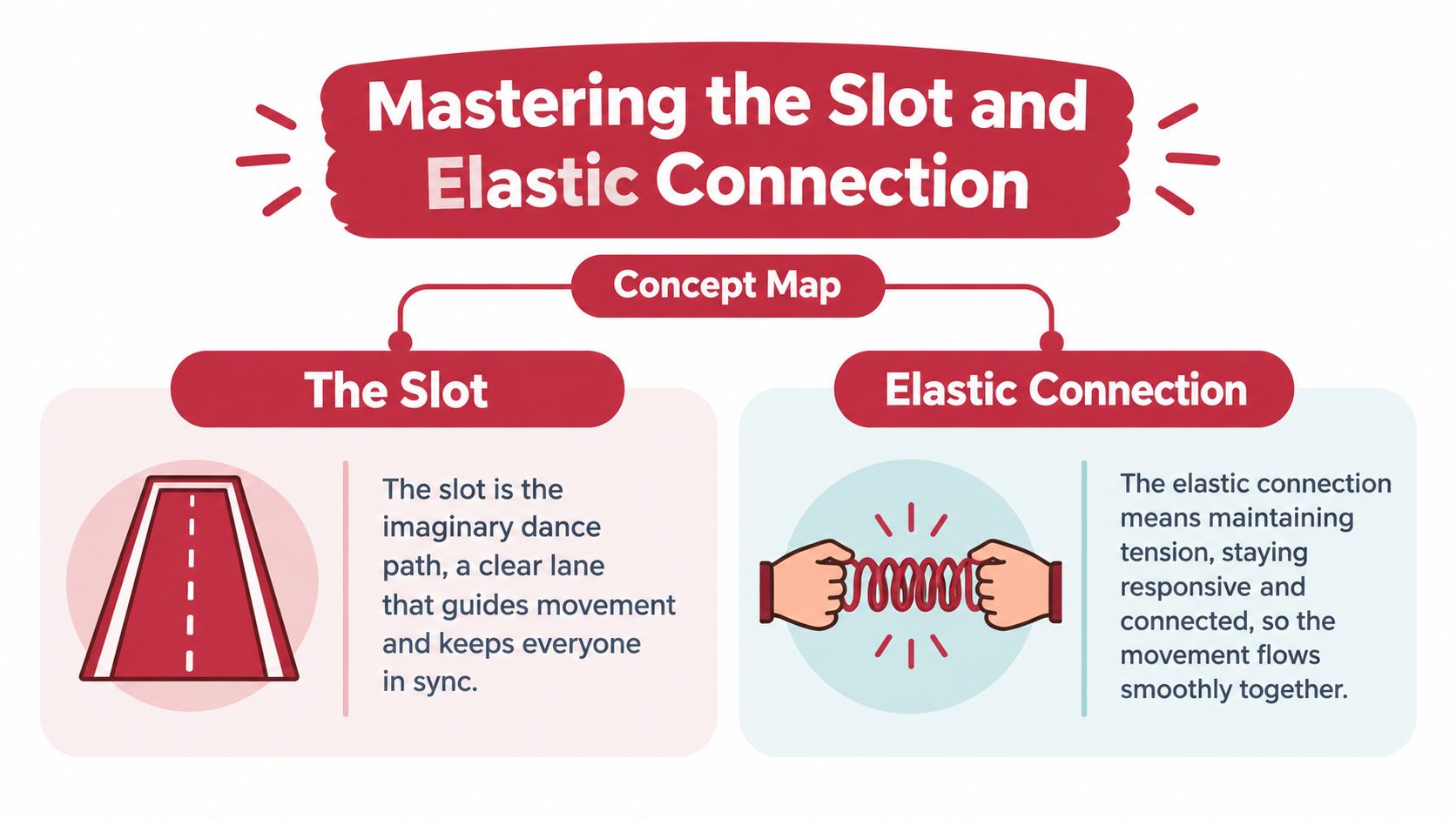
The slot is an imaginary long, narrow lane, often understood as a rectangular path on the floor. The follower generally travels back and forth through that lane, while the leader moves minimally to the side to keep the pathway open. At a very slow tempo, one reference describes the slot as roughly eight to nine feet long, becoming shorter as the music gets faster. (Slot dimensions and floor use)
Establish the lane before you move
Start without a partner. Choose a straight line on the floor and treat it as the slot. Walk forward and backward along that line, keeping your steps underneath your body instead of reaching toward the ends. Your shoulders should remain relaxed, and your torso should stay available for balance rather than twisting to chase your feet.
Then make the lane smaller. West Coast Swing doesn't require you to fill the entire available space on every pattern. The follower may travel farther when the music is slow, but faster music usually rewards compact movement. A shorter slot also helps you avoid collisions and makes your direction easier for a partner to read.
The leader's role isn't to stand rigidly at the end of the lane. Step slightly aside when needed, maintain your own balance, and avoid blocking the follower's path. The follower shouldn't drift diagonally because the leader has moved. Both partners share responsibility for keeping the track clear.
Replace arm-leading with elastic connection
West Coast Swing uses extension and compression, sometimes called pushing and pulling, to communicate direction. Extension occurs when partners move away from one another while maintaining a comfortable connection. Compression occurs when they move toward one another with controlled support. The feeling is elastic, not rigid.
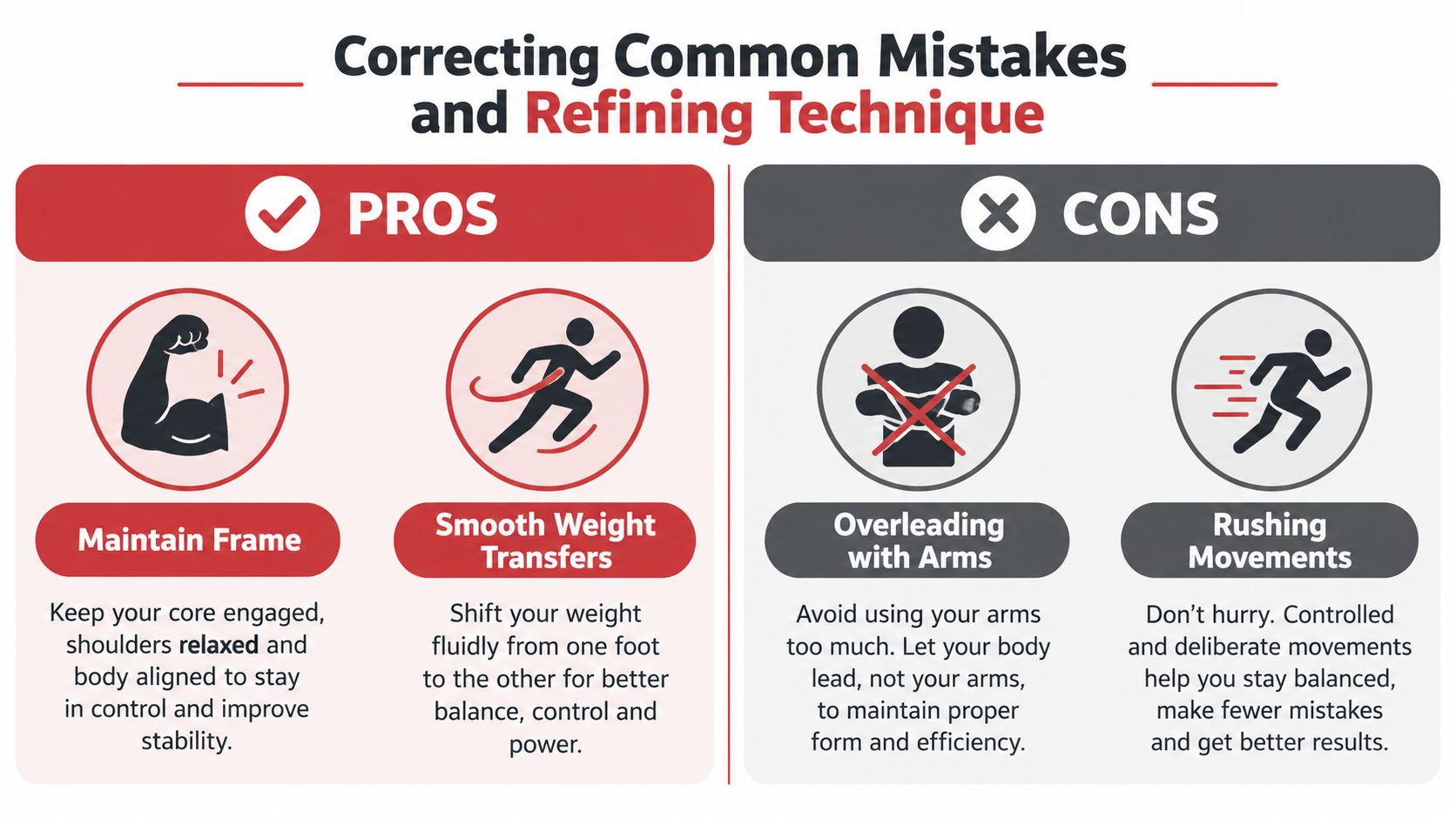
Your arms don't create the entire lead. Your center, weight, and body direction communicate first, while your arms maintain a responsive frame. Pulling with the hands can make a partner feel yanked. Pushing through locked elbows creates resistance rather than information.
Practice this with a partner by standing at a comfortable distance and gently shifting your weight away, then toward, without bending the elbows or changing the shoulder line. The objective isn't to create dramatic force. It's to let your partner sense where your balance is going.
Practical rule: Connection should feel like information moving through the body, not like one person dragging another person through a shape.
At the end of a figure, preserve the elastic quality instead of collapsing the arms. That stretch gives both dancers time to settle and prepares the next lead. If the connection disappears, the dance feels like a collection of unrelated steps.
Building Your Foundation with Core Patterns
A new dancer often learns best by following one imaginary social dance rather than memorizing a disconnected list. Start with a basic pattern, notice where the follower travels, and finish with a clear anchor before trying the next idea. The West Coast Swing basic moves provide useful vocabulary, but each pattern becomes practical only when you keep the slot and connection intact.

Begin with the Sugar Push
The Sugar Push introduces the essential idea of sending the follower away and receiving them back into connection. The follower moves backward along the slot, then returns toward the leader before settling into the anchor. The leader provides a clear pathway and keeps the movement compact.
Keep your feet underneath your center. Beginners often step too far backward because they think the pattern needs a large travel distance. That reach pulls the body out of balance and makes the return feel hurried. A smaller step allows you to redirect smoothly.
The pattern typically uses six counts. Concentrate on the quality of the weight transfer rather than speed. Each foot should arrive with your body over it, and the final settling action should leave a clear stretch between partners.
Add the Left Side Pass
A standard Left Side Pass is a six-count pattern, commonly counted 1 2, 3&4, 5&6, in which the follower passes to the other end of the slot on the leader's left side. (Basic pattern explanation)
The leader creates the route without pushing the follower across it. The follower moves through the center of the slot and continues toward the opposite end, keeping the steps small enough to remain balanced. Both dancers should finish facing one another with the connection available for the next pattern.
Introduce turns and whips carefully
An Underarm Turn adds rotation while preserving the slot. The leader offers space and a clear pathway for the follower to turn underneath the raised arm. The arm should guide the shape without forcing the rotation, and the follower should keep traveling rather than spinning in place.
A Whip combines rotation, redirection, and a return through the slot. It can feel complex because the partners change direction while maintaining a shared connection. Break it into parts: travel, redirect, return, and anchor. If one part feels unstable, slow the exercise down rather than adding more patterns.
Finish every phrase with an anchor
West Coast Swing patterns commonly end with an anchor step, described as a two-beat or two-count settling action that resets the connection for what follows. (Anchor-step function) The anchor isn't a decorative ending. It gives both partners a balanced place to finish and creates usable stretch for the next lead.
Use the sequence pattern, settle, listen, respond. If you rush straight from one move into another, your partner loses the moment where the next communication begins. A controlled anchor makes the dance feel continuous even when you're using only a few familiar patterns.
Finding the Beat and Adapting to Modern Music
West Coast Swing is generally danced in 4/4 time at 26-32 measures per minute. Many basic figures take six counts, while some span eight, so your body must manage delayed weight transfer instead of placing a large step on every beat. (Timing and tempo guidance)
The count 1,2,3&,4,5&,6 can confuse beginners because the quick step and the preceding quick share one beat of music, splitting that beat into two equal halves. The “&” isn't an extra beat. It's a subdivision inside the beat.
Hear the phrase before choosing a pattern
Before you dance, tap the steady pulse. Then listen for the larger musical phrase, such as a vocal line or repeating musical idea. You don't need advanced musical training. You need enough awareness to avoid starting a six-count pattern at random and feeling lost when the music continues beyond your final anchor.
A helpful method is to walk the slow counts and mark the quicks without changing direction. Keep the motion continuous. Triples shouldn't sound or feel like three separate stomps. They're a smooth distribution of weight within the phrase.
For more practice identifying pulse and phrasing, use this guide on how to find the beat in music. Apply the same listening skill while watching your partner, because social dancing requires you to respond to both the music and the connection.
Choose music that supports learning
West Coast Swing isn't limited to 1950s big-band recordings. On many modern social floors, contemporary R&B is dominant, while country-inflected crossover tracks are growing in WCS settings. Beginner-friendly songs often sit around 85-110 BPM and have a clear structure. (Modern West Coast Swing song guidance)
The right song makes timing easier because the pulse is easy to locate and the phrases are predictable enough for practice. A song can be technically danceable but still challenging if the rhythm is crowded or the phrasing is difficult to hear. Start with clear music, then gradually explore songs with more texture.
Listening exercise: Dance a familiar pattern without adding styling. Use your attention to notice the bass, vocal phrasing, and spaces in the music. Musicality begins with hearing what you can already express.
Correcting Common Mistakes and Refining Technique
Many beginners assume that bigger movement shows stronger dancing. West Coast Swing technical standards point in the opposite direction. The dance “moves very little” overall, while the center of balance shifts and settles over the rear foot at the end of the phrase. (Technical standards for West Coast Swing)
That principle gives you a useful diagnostic test. If your feet are traveling far outside your body line, your movement may look busy while your connection becomes harder to follow.
When you drift off the slot
Place a strip of tape on the floor or use a line between floorboards. Practice walking the slot without a partner, then repeat a basic action while keeping your torso aligned with the lane. If you drift, don't force your feet back into place with a sudden correction. Reduce the step size and restart with a calmer weight transfer.
Leaders should check whether they're stepping into the follower's route. Followers should check whether they're angling across the lane instead of traveling straight. Both partners can improve the result by looking ahead and leaving room for the other person's movement.
When you overstep
Overstepping usually begins with a mistaken idea that the foot must reach the destination before the body. Place the foot under your center first, then let the body travel naturally. Your knees can stay soft, but don't turn the movement into a deep squat or a bounce.
The correction is simple to describe and demanding to feel: make the step smaller, keep the weight centered, and let the torso lead the transfer. Practice without music until you can move from foot to foot without leaning or reaching.
When the anchor collapses
A weak anchor leaves the partners standing too close, too far apart, or disconnected. Instead of settling into the rear foot, beginners often keep moving forward or let the arms fold inward. That removes the stretch needed to communicate the next pattern.
Pause briefly at the end of a basic. Feel the weight settle, maintain a comfortable frame, and allow the connection to extend without locking the elbows. The pause doesn't need to interrupt the music. It shows your body that the anchor has a job.
A useful question: Can your partner tell where your balance is, even when you aren't adding a turn or styling?
Record a short practice clip from the side. Look for diagonal travel, reaching feet, raised shoulders, and an anchor that ends with no visible settling. Correct one issue at a time. Refinement works better when your attention has a clear target.
Structuring Your Practice and Taking the Next Step
The gap between a classroom pattern and a comfortable social dance closes through repeated context, not through endless memorization. You need instruction to understand the mechanics, social dancing to experience real variation, and solo practice to build balance and spatial awareness between partner sessions.
A practical routine can combine one class, one social, and short solo practice sessions, an approach highlighted in a recent practice guide for returning to West Coast Swing. (Structured West Coast Swing practice) The exact schedule can vary, but the principle remains useful: practice alone to clarify your body, practice with others to develop responsiveness, and review instruction to correct habits before they settle.
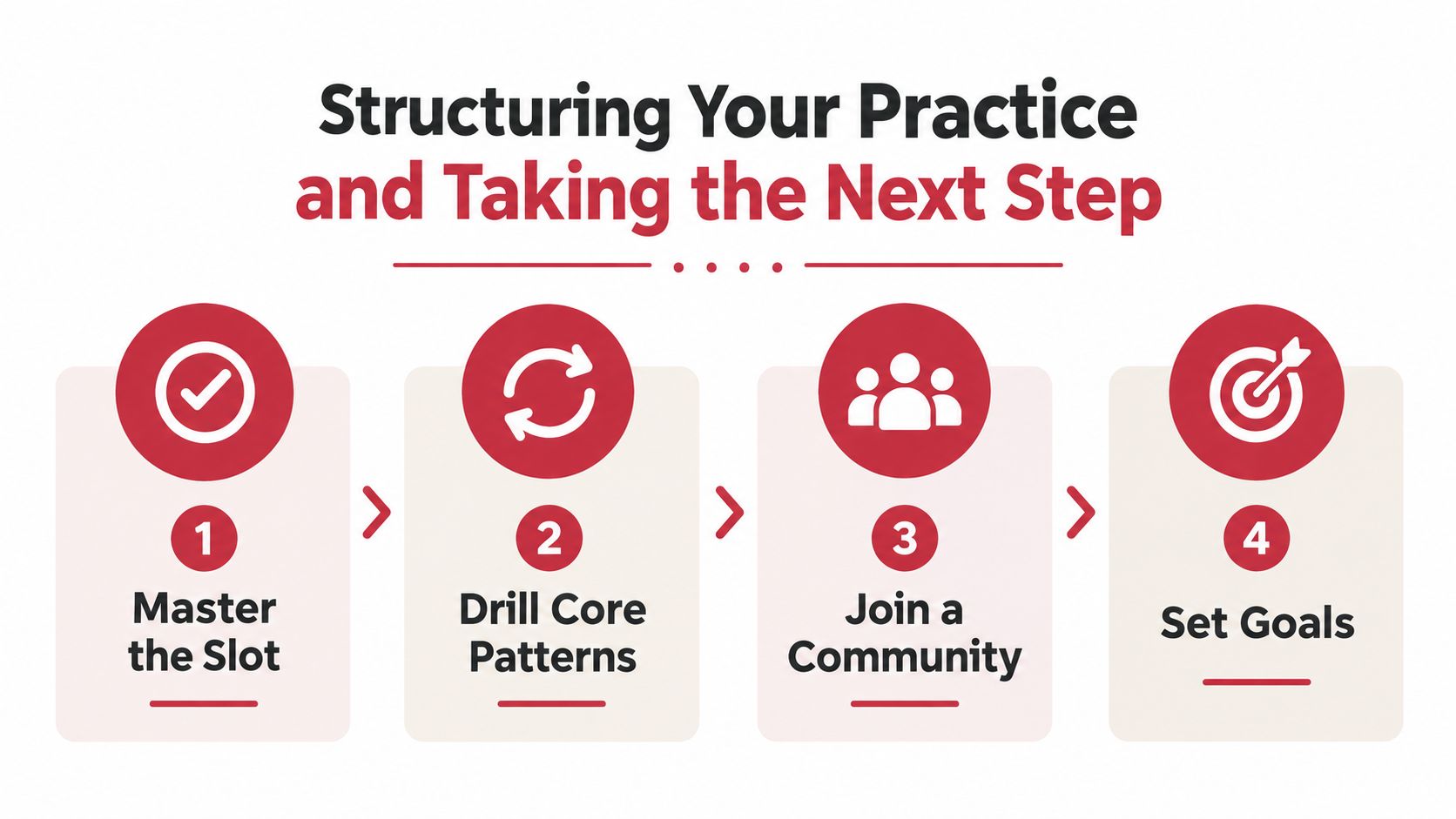
Use a simple weekly progression
-
Master the slot. Walk forward and backward along a straight lane. Keep your steps under your body and notice whether your shoulders remain relaxed.
-
Drill core patterns. Practice the Sugar Push, Left Side Pass, Underarm Turn, and Whip separately. Finish each with a deliberate anchor before combining them.
-
Join a community. Attend a social where you can dance with different partners. Treat each dance as listening practice, not an examination of whether you can perform a routine perfectly.
-
Set goals. Choose a specific focus, such as keeping the slot straight, hearing the “&” count, or maintaining connection through the anchor. A narrow goal gives your practice a clear direction.
Danza Academy of Social Dance offers West Coast Swing classes, workshops, and private instruction in Philadelphia and Exton, with beginner-friendly options and no partner required. Its instructors focus on technique, musicality, and practical social dancing, so you can receive feedback while building confidence in a welcoming setting.
Don't wait until you can recite every pattern. Book a complimentary lesson, bring your questions, and let an instructor help you turn isolated steps into a dance that responds to music and partnership.
Visit Danza Academy of Social Dance to book your free complimentary lesson and practice West Coast Swing with guidance for your goals. You'll work on the slot, elastic connection, timing, and social-floor confidence in a welcoming lesson where no partner is required.