
You sit down with your phone, type senior dance near me, and hope the results will tell you something useful. Maybe you want gentle movement after a stretch of being too sedentary. Maybe your parent needs a social outlet that doesn't feel clinical. Maybe you miss music, people, and having somewhere to go each week that feels light instead of heavy.
That search usually starts as a fitness question, but it rarely stays there. The right class can add rhythm to the week, familiar faces to look forward to, and a sense of progress that feels good at any age. The wrong class can feel confusing, rushed, or not built for your body.
A good decision comes from looking past the schedule page. You want to know whether a class is welcoming, how it handles balance concerns, whether beginners can join without embarrassment, and whether it's the kind of place where people come back.
Why a Search for Senior Dance is More Than Just Exercise
A lot of older adults start looking for dance after a life change. Retirement creates open space in the calendar. A move means fewer familiar people nearby. An injury or health scare makes exercise feel important, but a gym still sounds unappealing. Dance appeals because it doesn't feel like punishment. It feels social, musical, and human.

That social side matters more than many families realize. The U.S. Surgeon General warned in 2023 that loneliness and social isolation carry health risks comparable to smoking up to 15 cigarettes a day, and dance is increasingly discussed as a way to combine movement with belonging and confidence-building in older adults, as noted in this overview of senior dance and social connection.
What people are often really looking for
When someone searches for local senior dance, they're often asking a bundle of questions at once:
- Will I feel out of place
- Can I do this with my knees, back, or balance issues
- Do I need a partner
- Will anyone talk to me
- Is this an actual class or just a room rental with music
Those questions deserve real answers. Generic class listings usually don't give them.
Practical rule: The best senior dance option is not the class with the fanciest description. It's the one that fits your body, your comfort level, and your weekly routine.
Some adults want gentle line dancing and a steady social circle. Others want ballroom, Latin, or simple beginner partner dancing because learning something new feels energizing. Both are valid. What matters is choosing a setting that supports consistency and enjoyment.
If you want a fuller look at how movement classes can support comfort, confidence, and connection, Danza's guide to dance for seniors and gentle movement with big benefits is a useful next read.
Your Guide to Finding Local Senior Dance Groups
The fastest search result isn't always the best result. Local dance options for older adults often live in places that don't market aggressively, so a smart search is wider than Google alone.
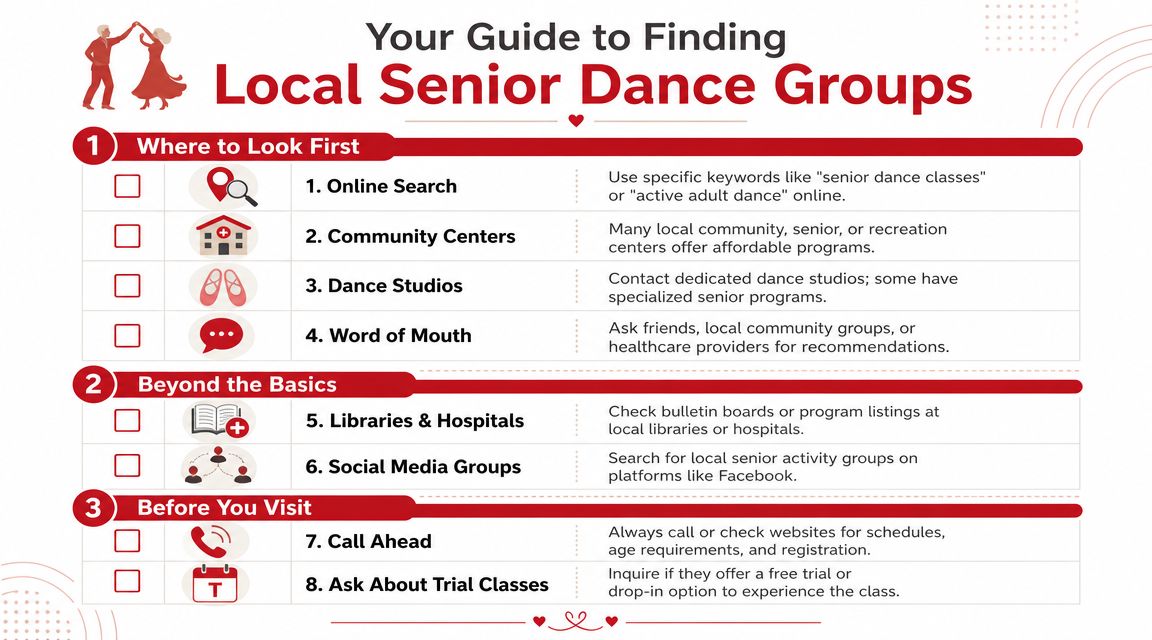
Where to look first
Start with places that already serve older adults in your area:
YMCAs and community centers
These are often the easiest entry point. They usually offer lower-cost programs, simpler registration, and a less intimidating atmosphere than a performance-focused studio.Senior centers and parks departments
These programs often lean social first, fitness second. That can be a plus if you want a relaxed pace and familiar community faces.Dedicated dance studios
Studios are worth checking if you want more instruction, clearer progression, or access to styles like ballroom, swing, salsa, or social partner dance.Libraries, hospitals, and local bulletin boards
These places often list community programs that don't rank well online.
After you build a short list, check whether the class is recurring or occasional. Many senior dance programs are built around regular weekly attendance. One example from Indianapolis requires participants to be 55 or older, meets every Monday and Wednesday from 11:30 a.m. to 1:30 p.m., and teaches a new dance each week, which adds up to about 16 hours per month of organized activity in a recurring format, according to this local report on the Young at Heart Senior Line Dancers.
A quick visual checklist can make the search easier before you call around.
What to ask before visiting
Don't settle for “We have a class on Tuesdays.” Ask a few direct questions:
Who is the class built for
Ask whether it's intended for older beginners or open to all ages.How often does it meet
A recurring schedule is usually easier to build into your life than random workshops.Do I need to register ahead of time
Some programs require advance signup, and that's good to know before you drive over.Can I come alone
This answer tells you a lot about the social culture of the program.
A good local program makes the next step obvious. You should know the time, the level, the format, and what to expect before you walk in.
Evaluating Dance Styles and Instructors for Active Adults
Not every class will feel right, even if it's nearby. Some people thrive in a partner format. Others prefer solo movement with no pressure to match anyone else. The style matters, but the teacher matters just as much.
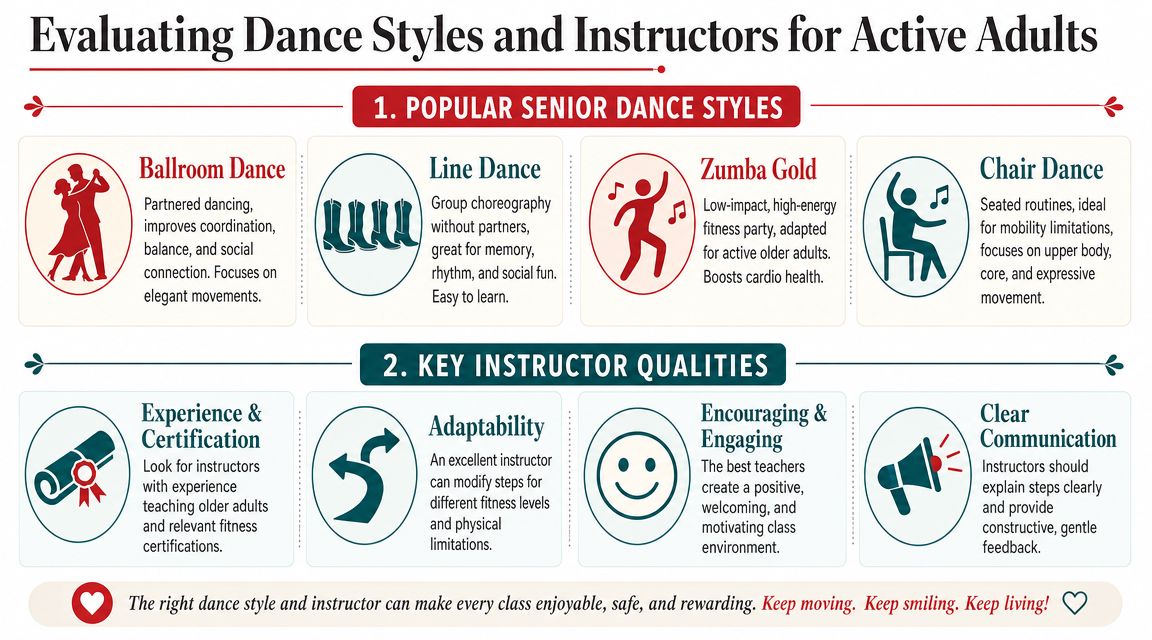
Comparing common class types
Senior-friendly programs usually fall into a few broad categories. Here's how they differ in practice:
| Dance style | Social format | Typical feel | Best for |
|---|---|---|---|
| Ballroom | Partnered, though some studios rotate or adapt | Structured, skill-based, elegant | Adults who want technique, connection, and clear progress |
| Line dance | Solo in a group | Repetitive patterns, easy to follow over time | People who don't want a partner and enjoy shared group rhythm |
| Zumba Gold | Group fitness format | Low-impact, upbeat, music-driven | Adults who want cardio energy with simplified movement |
| Chair-based dance or adaptive movement | Solo, seated or partly seated | Gentle, accessible, modification-friendly | Adults with limited mobility or who need lower loading |
Community programs often describe senior fitness dance classes as low-impact and designed for beginners, with movement that can support balance, flexibility, and cardiovascular strength while introducing steps from salsa, merengue, cha cha, mambo, cumbia, calypso, and rock and roll. Some community options are also priced at $3 for Y members and $5 for community members, as shown in the YMCA senior dance listing and related senior fitness descriptions.
What a good instructor does differently
A strong instructor for older adults doesn't just know steps. They know how to pace a room.
Look for someone who can do these things well:
Demonstrate without rushing
Fast cues lose beginners immediately.Offer options without making anyone feel singled out
Modifications should sound normal, not apologetic.Watch the room closely
The teacher should notice fatigue, confusion, and spacing issues before they become problems.Keep the atmosphere light
Adults learn better when they're not bracing to be corrected every minute.
One practical way to judge a studio is to read how they talk about beginners. If the language sounds welcoming, specific, and realistic, that's usually a good sign. If every description feels vague or performance-oriented, keep looking. Danza's article on how to choose a dance studio lays out that difference well.
Matching style to personality
If you're social but hesitant, line dance can be easier than partner work because no one has to “lead” or “follow.” If you love learning patterns and want a little elegance, ballroom often feels satisfying. If you want movement that feels more like exercise than instruction, a low-impact dance fitness class may fit better.
The right dance style is the one you'll return to next week. Enjoyment is not a bonus. It's part of whether the class works.
Asking the Right Questions About Safety and Accessibility
Safety questions aren't negative. They're smart. Most older adults don't need a class that treats them like they're fragile, but they do need one that respects real physical limits and plans for them.
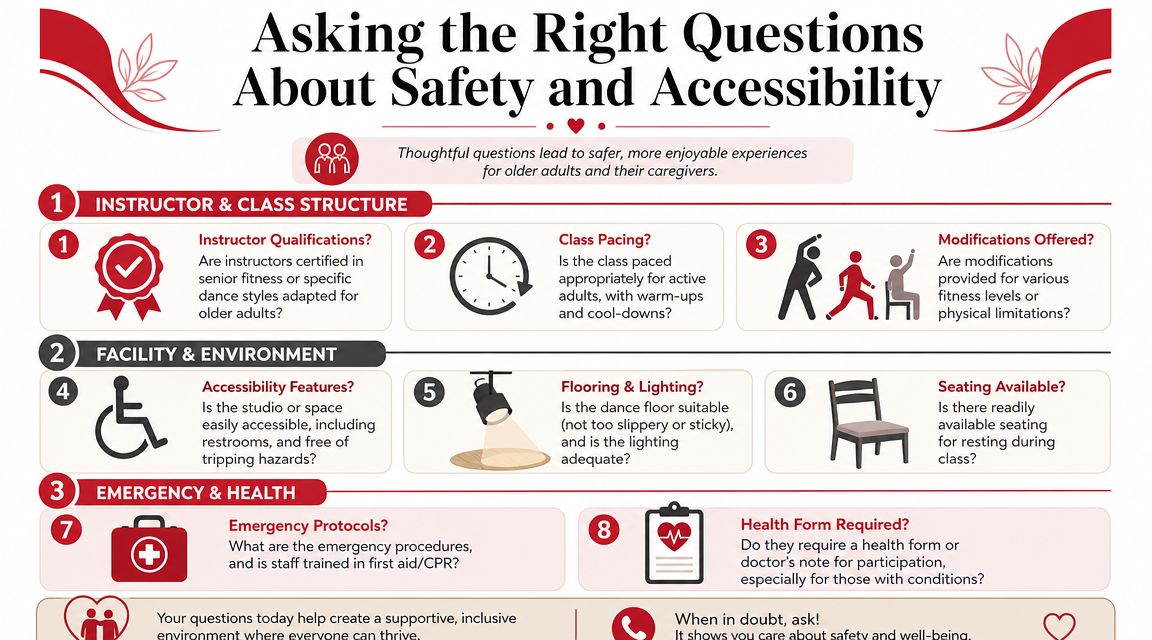
The reason this matters is simple. The WHO estimates 1 in 3 adults aged 65+ fall each year, and while dance can support balance, the main question is whether a specific class is medically sensible for your body and skill level, as discussed in this review of senior dance safety concerns and fall risk.
Questions worth asking on the phone
A quick call can tell you more than a glossy class page. Ask:
- How do you handle arthritis, balance concerns, or limited mobility
- Are there seated or lower-impact options if I need them
- What kind of warm-up and cool-down do you use
- Is there seating available during class
- What is the flooring like
- Are there stairs, handrails, easy parking, and nearby restrooms
- What happens if someone feels dizzy, tired, or unsteady
Notice not just the answer, but how the answer is given. A thoughtful provider will respond clearly and comfortably. If the person seems irritated or dismissive, that tells you plenty.
What accessibility looks like in practice
Accessibility is not just wheelchair access at the front door. It includes the whole experience:
| Area | What to look for |
|---|---|
| Entry and parking | Short walking distance, low-stress arrival, clear entrance |
| Inside the room | Enough space between dancers, visible teacher, easy seating access |
| Class design | Steady pacing, repetition, permission to rest, modifications offered openly |
| Culture | No embarrassment around sitting out, asking questions, or moving more slowly |
For families wanting a clinical perspective on movement and adaptation, Sheree Dibiase's dance therapy expertise offers helpful context on how dance and physical therapy principles can intersect.
If you're screening a class carefully, it also helps to understand common movement risks and how instructors reduce them. Danza's resource on dance injury prevention covers the basics in a practical way.
If a class can't explain how it adjusts for common limitations, it hasn't thought hard enough about senior participation.
Your First Day on the Dance Floor What to Expect
The first class is usually easier than people fear. The hardest part is showing up.
Wear clothes you can move in comfortably. You don't need anything fancy. Choose shoes that feel secure and won't make you worry about slipping or catching. Bring water, arrive a little early, and give yourself time to settle instead of rushing in flustered.
How a good first class usually feels
A solid beginner class starts gently. You should see a simple warm-up, clear introductions to the steps, repeated practice, and permission to pause if you need a break. The room shouldn't feel like a test.
You may feel awkward for the first few minutes. That's normal. Older beginners often think everyone else is watching them, but fellow dancers are focused on remembering their own feet.
Some of the most successful students start with one goal only. Keep moving, stay curious, and come back next week.
What helps people stick with it
Long-term attendance often drops when participation gets complicated. A large review reported that dance is physically safe for older adults, but attendance declines as programs get longer, with programs lasting more than 6 months averaging 67.3% attendance, and the practical lesson is to choose classes with accessible times, low-friction formats, and clear progression, based on this PLOS One review of dance participation and outcomes in older adults.
That lines up with what instructors see in real life. People stay with dance when the process feels manageable. Good parking matters. Class times matter. So does knowing where to stand, what to wear, and whether you'll be greeted when you walk in.
A healthy mindset for week one
Don't judge the whole experience by your coordination on day one. Judge it by these questions instead:
- Did I feel safe
- Was the teacher clear
- Could I imagine returning next week
- Did the room feel welcoming
- Did I leave in a better mood than I arrived
Those answers matter more than whether you nailed every step.
Start Your Dance Journey With Danza Academy
A common moment happens after all the research is done. You find a class that looks promising, then pause and wonder whether the room, the pace, and the teaching will work for you or for your parent. That final step matters because a good fit is not just about location. It is about feeling safe enough to return.
Research on dance programs for older adults has found better results with classes that meet regularly over several weeks and give people enough time to practice in each session, as reported in this systematic review on dance dosage for older adults. In practice, that usually means a structured class will serve a beginner better than a one-off drop-in, especially if balance, confidence, or learning speed are part of the decision.
For readers in the Philadelphia area, Danza Academy of Social Dance is one local option with studios in Center City Philadelphia and Exton, PA. The school offers ballroom, Latin, and social dance instruction, which can be a good match for adults who want clear teaching, steady progression, and a setting where questions are welcome.
Why a complimentary lesson helps
A first visit gives you information that a class description cannot. You can see how the instructor corrects students, whether the room feels rushed or calm, and whether the social tone feels friendly without being pushy.
That matters.
Before committing, look for a few practical signs:
- Instruction that is clear and paced for beginners
- A space that feels comfortable to enter and easy to move through
- Teachers who welcome questions and offer simple corrections
- A class format that feels manageable for your energy, schedule, and goals
A complimentary lesson can help you answer those questions without pressure. It turns a search into a real test of fit, which is often the missing step for adults who want to make a careful, informed choice.
Frequently Asked Questions About Senior Dance Classes
Do I need a partner
No. Many classes welcome solo students, and some formats like line dance don't require a partner at all. In partner-based settings, ask whether the class rotates or offers another way to participate comfortably.
What if I have no experience
That's common. Beginner classes are built for people who haven't danced before. What matters is clear instruction and a pace that lets you learn without feeling rushed.
I'm worried I have no rhythm. Should I still try
Yes. Rhythm improves with exposure, repetition, and listening. Most adults who say they “have no rhythm” really mean they haven't been taught in a patient environment.
Are senior dance classes expensive
They vary. Community programs can be very affordable, while studio instruction may offer more individualized teaching and progression. Compare value, not just price.
What if I have arthritis or balance issues
Ask specific questions before attending. A good program should be able to explain pacing, modifications, rest options, and how it adapts movement for different bodies.
If you're looking for a warm place to begin, Danza Academy of Social Dance offers a practical next step. You can book a free complimentary lesson on the contact page and see whether the teaching style, pace, and environment feel right for you. It's a simple way to move from searching for “senior dance near me” to trying a class with support.