
You're at a party. The music gets louder, a few people head to the dance floor, and your brain immediately starts running worst-case scenarios.
What do I do with my hands? What if I'm off beat? What if everyone notices I can't dance?
That spiral is far more common than is commonly acknowledged. The good news is that learning how to dance at a party usually has less to do with talent than with reducing pressure. You don't need a routine. You don't need perfect rhythm. You need a small set of reliable habits that help you look comfortable, stay on beat, and stop freezing.
I teach social dance, and I've seen the same pattern again and again. The people who improve fastest are not the boldest or the most naturally gifted. They're the ones who stop trying to “perform” and start treating dancing like a normal social skill. That shift changes everything.
The Real Reason You're Afraid to Dance at Parties
People often don't avoid dancing because their body can't do it. They avoid dancing because they feel exposed.
That feeling has a name. Public-health evidence shows social anxiety affects about 4% of people globally, and dance-related anxiety research points to self-consciousness as a central barrier to participation, not a lack of talent, as noted in this dance anxiety guidance. If you freeze at the edge of the floor, that doesn't mean you're bad at dancing. It means you're aware of being seen.
That's why move-based advice often fails beginners. If someone is tense, giving them five new steps makes the problem worse. Their attention goes inward. They monitor every arm, foot, and facial expression. Then they stiffen up and feel even more awkward.
Fear shrinks when your job is simple
The fastest way to calm dance anxiety is to reduce the number of decisions you're making.
Practical rule: Pick one repeatable movement, do it clearly, smile, and let the music hold your attention.
That sounds almost too basic, but it works because it gives your brain one task instead of ten. You're no longer trying to be impressive. You're trying to be steady.
Use this mental reset before you step onto the floor:
- Choose one base action. A side-to-side step, a gentle bounce, or a step-touch is enough.
- Make it decisive. Small is fine. Hesitant is what reads as uncomfortable.
- Look outward. Listen to the song, notice the room, or make brief eye contact with friends.
- Let your face help you. A relaxed smile softens your whole presence.
If fear is what stops you most, this deeper guide on overcoming fear of dancing in public can help you work on the mental side before the next party.
You are not auditioning
At a party, people aren't grading your technique the way judges would in a competition class. They're mostly focused on themselves, their friends, and the music. That shift matters.
Dancing at a party is a social activity first. Once you stop treating it like a performance test, simple movement starts to feel natural instead of risky.
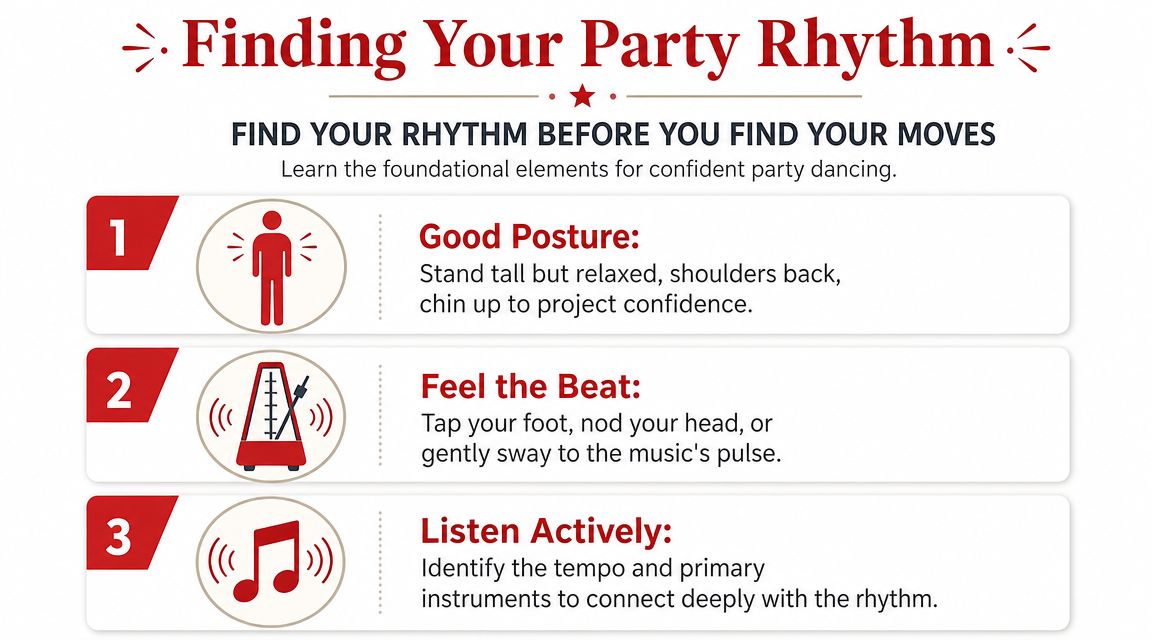
Find Your Rhythm Before You Find Your Moves
Rhythm makes even basic movement look intentional. Without it, fancy steps still look disconnected.
A good first goal is not “learn a move.” It's “find the pulse of the song and stay with it.” A sound approach is to identify the beat and mark it with a minimal bounce or step-touch, match movement size to the tempo, and reset to the base step whenever you feel lost, as described in MIT's guidance on scaffolding and musical pattern-building.
Start with your stance
You don't need a “dancer pose.” You need a body position that can move easily.
Try this:
- Stand tall, but don't puff up your chest.
- Let your knees stay soft, not locked.
- Keep your weight centered so you can shift side to side.
- Relax your shoulders and jaw.
That posture solves a common beginner problem. Many people try to look confident by standing rigidly. On a dance floor, rigid usually looks nervous. A soft stance makes timing easier and helps your movement flow.
Find the beat with one body part
Think of the beat like a heartbeat in the song. It's the steady pulse under everything else.
If you struggle to hear it, don't start with your feet. Start smaller:
- Nod your head to the strongest pulse.
- Tap one finger against your leg.
- Shift your weight left and right without traveling.
- Notice the drums or bass because they often outline the beat clearly.
If you can gently bounce in time, you're already dancing.
For extra practice, use songs with a steady, moderate pulse. A curated set like LesFM's 105 BPM song collection can make beat-finding easier because the tempo is manageable for beginners.
If rhythm has always felt mysterious, this guide on how to find the beat in music breaks it down in a very beginner-friendly way.
Match your movement to the song
A lot of beginners use the same size movement for every track. That's why they feel out of sync even when they're technically on beat.
A simple adjustment helps:
| Song feel | What to do |
|---|---|
| Faster song | Keep steps small and compact |
| Mid-tempo song | Use an easy step-touch with light bounce |
| Slower song | Let the weight shift be a little fuller |
Your first win at a party is not variety. It's consistency. If you can hold one easy groove through a full phrase of music, you'll look more comfortable than someone trying three complicated ideas badly.
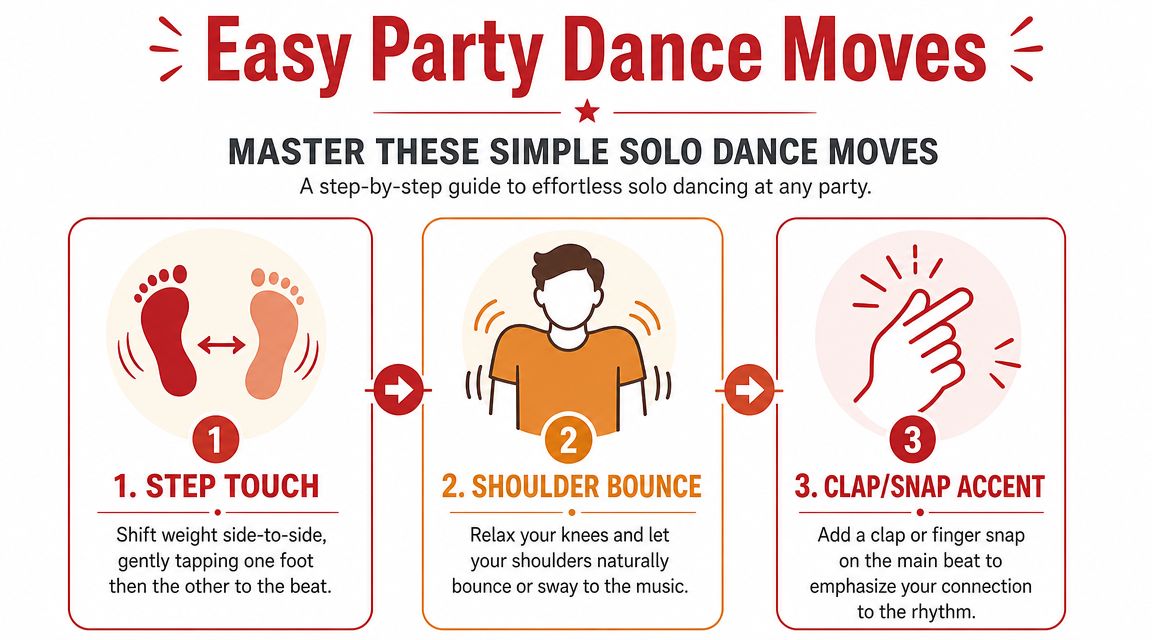
Master These Simple Solo Dance Moves
You don't need a library of moves. You need three dependable options that work almost anywhere.
Research suggests a reliable method is to establish a stable pulse with a side-to-side weight shift or two-step, add one upper-body accent like a shoulder pulse, keep footwork minimal at first, and only increase complexity once you can sustain the pattern without losing rhythm, based on findings in this dance training research review.
The step-touch
This is the safest social dance move you can learn.
Here's how:
- Step one foot to the side.
- Bring the other foot in and lightly touch beside it.
- Repeat the other way.
- Keep the steps small enough that you could do them in a crowded room.
The mistake people make is overcommitting. They travel too far, then scramble to recover. Keep it compact. The goal is groove, not mileage.
The shoulder bounce
Once your feet are steady, add one upper-body layer.
Try this while doing the step-touch:
- Let your knees bend slightly on the beat.
- Allow that bend to create a natural shoulder pulse.
- Don't lift your shoulders toward your ears.
- Keep the motion relaxed and subtle.
This move helps because it makes your dancing look connected to the music without adding hard coordination. It's especially useful if you don't know what to do with your torso.
Here's a visual walkthrough if you want to see simple social movement in action:
The clap or snap accent
You don't need constant styling. One accent every so often is enough.
Use it like this:
- Keep your base step going.
- On a strong beat or chorus moment, clap once or snap.
- Return to your regular groove right away.
Keep this in mind: accents should decorate your rhythm, not replace it.
That's why this move works. It adds personality without knocking you off balance.
A simple combo that works almost anywhere
If you want one no-fail pattern, use this:
| Count idea | Movement |
|---|---|
| First few beats | Step-touch side to side |
| Next few beats | Add shoulder bounce |
| Chorus accent | Clap or snap once, then reset |
That's enough for a whole song. Seriously.
People often think confident dancers are doing more. Usually, they're just repeating simple patterns with better timing and less hesitation.
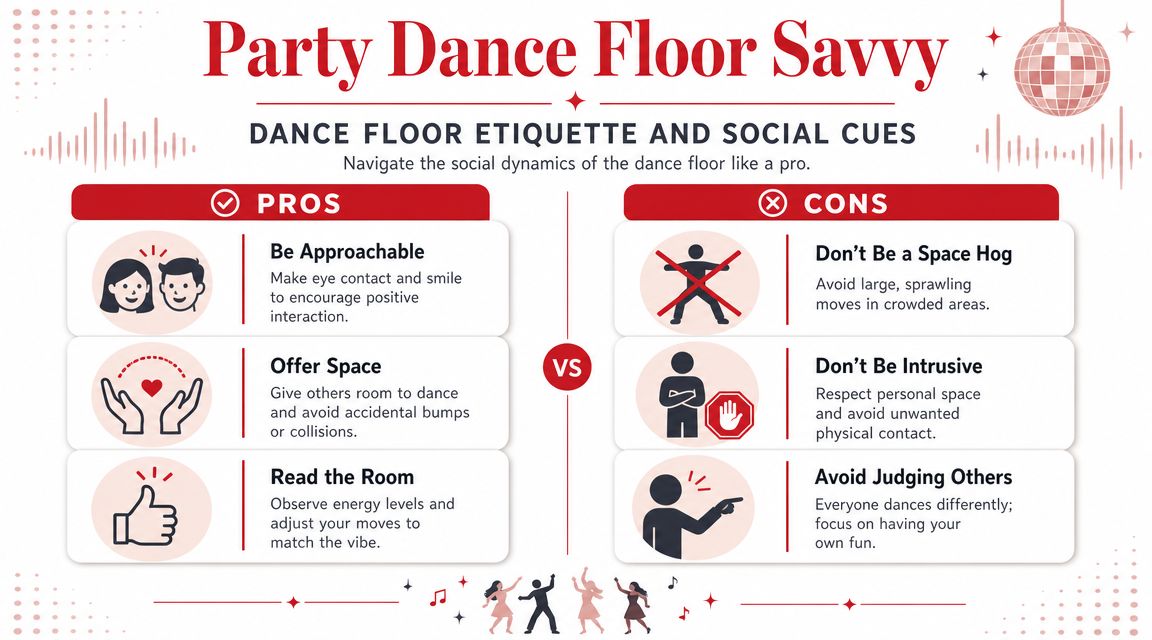
Dance Floor Etiquette and Social Cues
A party dance floor runs on social awareness. Good dancers aren't just moving well. They're easy to be around.
That matters because dancing is mainstream behavior, not some rare high-pressure activity. In the United States, 26% of consumers participated in dancing as a sport activity from Q1 2023 to Q1 2024, according to Statista's dancing participation forecast. For a beginner, that helps reframe the moment. Joining the floor is normal social behavior.
How to join without feeling awkward
A common beginner worry is, “How do I enter the dance floor without making it weird?”
Use the side-door approach. Don't march into the center and suddenly perform. Stand near the edge, find the beat, start your base step, and drift in naturally if the moment feels right.
A simple real-life version looks like this:
- You're with two friends near the floor.
- You start nodding to the beat and doing a small step-touch.
- One friend mirrors you.
- The group shifts a little closer to the music.
- Within seconds, you're dancing without a dramatic entrance.
That's how most social dancing starts. Subtly.
Respect space and energy
The fastest way to look inexperienced is to use giant movements in a crowded area. Big arm swings, sudden turns, and wide foot patterns create stress for everyone around you.
Use this quick guide:
- In a tight crowd, keep elbows in and footwork under your body.
- Near drinks or tables, reduce travel even more.
- During a high-energy chorus, add bounce or expression, not extra sprawl.
- When the song relaxes, settle your movement instead of forcing excitement.
Social awareness matters at events beyond clubs too. If you're dancing at a reception, the mood of the room affects what feels appropriate. A planning resource like fun wedding games for couples can also help hosts think about guest energy, transitions, and how people engage socially during celebrations.
Watch the people around you for ten seconds before expanding your movement. The room will tell you what fits.
Easy signs you're doing fine
You don't need applause to know you're blending in well.
Look for these signs:
| Social cue | What it usually means |
|---|---|
| People smile back | You look approachable |
| No one keeps backing away | Your spacing is good |
| Friends naturally join you | Your movement feels easy to follow |
Etiquette isn't about being stiff or overcareful. It's about making the floor feel comfortable for everyone, including you.
Easy Partner Dancing for Any Party
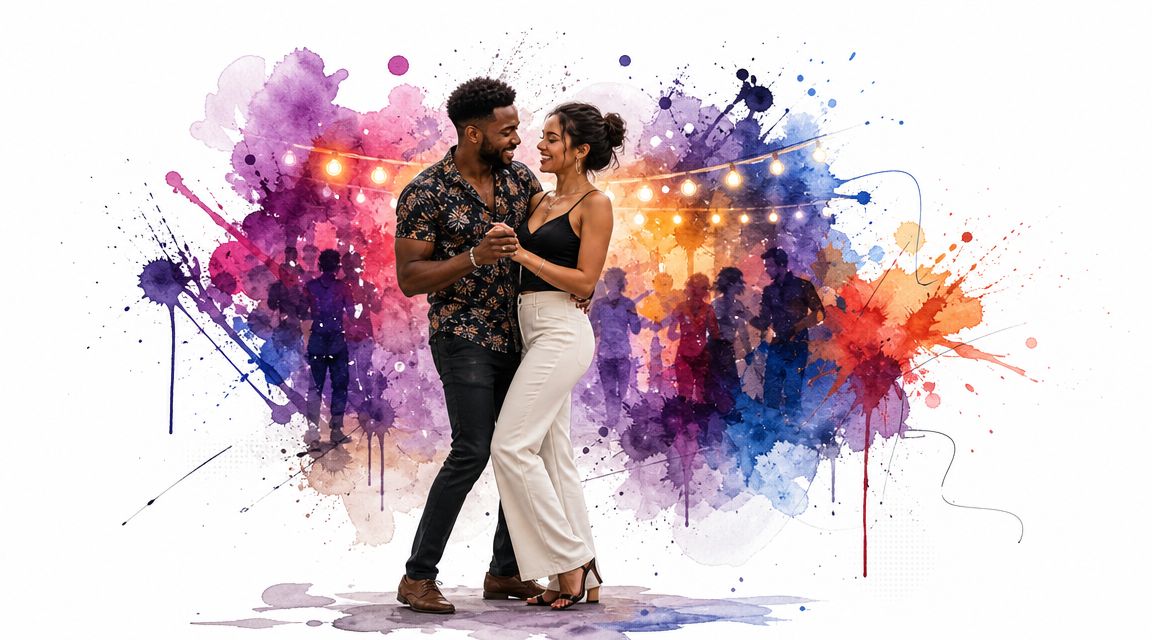
Partner dancing at a party doesn't have to mean spins, dips, or formal technique. In casual settings, it's often just two people sharing the beat.
That's a huge relief once you realize it. Your job isn't to impress someone with choreography. Your job is to create a clear, comfortable connection.
Start with the invitation
At a party, the invitation should feel light and easy.
That can be as simple as:
- making eye contact
- smiling
- offering a hand
- stepping toward open space near the music
If the other person says yes, great. If not, no problem. Social dancing works best when there's no pressure attached to it.
Use one-hand connection
For beginners, a one-hand hold is plenty. It keeps things simple and gives both people room to move naturally.
Try this basic setup:
- Hold one hand lightly, not tightly.
- Stand far enough apart that neither of you feels crowded.
- Keep your free arm relaxed.
- Let the shared rhythm do most of the work.
Now add the simplest possible pattern: a gentle rock step or side-to-side weight shift. If both people can feel the same beat, the dance already works.
Think conversation, not control
Many beginners find this confusing. Leading is not yanking. Following is not guessing.
A better way to think about it is conversation:
| Role | Helpful mindset |
|---|---|
| Leading | Suggest the timing and direction clearly |
| Following | Stay responsive and keep your balance under you |
If you want formal guidance on connection, rhythm, and beginner-friendly social partner work, couples dance lessons can help translate party dancing into something much less intimidating.
A very basic underarm turn can come later if the space allows and both people feel comfortable. But most party partner dancing looks better when it stays simple. A shared groove with good timing beats a forced trick every time.
Build Lasting Confidence on the Dance Floor
Confidence doesn't come from waiting until you feel fearless. It comes from repeating simple actions until they feel familiar.
Research shows a clear link between dance frequency and perceived benefits. In one peer-reviewed study, 95% of participants agreed that dance helped improve their affect, and dancing more often was significantly correlated with physical benefits. The study also found that people who danced at least once a week were more likely than occasional dancers to report improved physical fitness, as detailed in this peer-reviewed study on dance participation and benefits.
That matters for one reason above all. Regular, low-stakes practice works better than waiting for one magical night when you suddenly become confident.
A five-minute home practice plan
You don't need a mirror-heavy hour. Try this short routine:
One minute on the beat
Stand still and mark the pulse with a bounce or weight shift.Two minutes of your base step
Use step-touch or a two-step without adding anything else.One minute of upper-body groove
Add the shoulder bounce while keeping your feet easy.One minute of recovery practice
Purposely stop, then restart smoothly on the beat.
That last drill is important. At parties, what scares people most isn't making a mistake. It's not knowing how to recover. Recovery is a skill, and it can be practiced.
What to do when panic hits in the moment
Even with practice, you may have a moment where your body goes tight and your mind goes blank.
Use this reset:
Breathe out, shrink the movement, find the beat again, and return to your base step.
That one sequence solves a surprising number of problems. It stops the spiral before it grows.
If you're preparing for a party-heavy event, it also helps to think beyond dancing alone. Hosts often use other activities to loosen people up before the floor fills. For weddings and celebrations, resources on an alternative to photobooths can spark ideas for interactive moments that make guests feel more relaxed and social before dancing starts.
Keep your goal realistic
Your goal for the next party doesn't need to be “be amazing.” Try one of these instead:
| Better goal | Why it works |
|---|---|
| Stay on the floor for one full song | Builds tolerance and confidence |
| Use one base step all night | Removes decision overload |
| Recover calmly after getting lost | Teaches resilience |
One practical option for guided practice is Danza Academy of Social Dance, which offers social dance instruction for beginners and more experienced dancers. A structured lesson can give you a safer place to practice rhythm, posture, partner connection, and recovery before using those skills at a real event.
If you want help turning these ideas into real confidence, book a free complimentary lesson with Danza Academy of Social Dance. It's a simple, low-pressure way to practice with an instructor who can spot what's holding you back, help you find your rhythm, and show you how to look comfortable on the dance floor without relying on complicated moves.