You're standing at the edge of a room where thirty people just stepped, kicked and turned in unison, and you're doing quiet math about whether you can join without a partner, without boots and without knowing a single count. That pause is the barrier in Philly line dance, not the choreography. The steps are learnable inside an hour. What stops most adults is not knowing whether they can show up alone, how the lesson runs, and where they're supposed to stand once it starts.
The form itself is friendly to solo newcomers. Dancers arrange themselves in rows facing the same direction and repeat a set sequence together, so nobody needs a partner and nobody gets left without someone to follow. The rest is vocabulary, a handful of counts, and a room that runs on the same rhythm you're already hearing in the music.
What Philly Line Dance Is and How Its Counts Work
Philly line dance is a group form, and that single fact settles most first-timer worries. You take an open spot in a row, face the same way as everyone else, and repeat a choreographed sequence with the room. No partner required, no prior dance background required.
A Group Form With Deep Local Roots
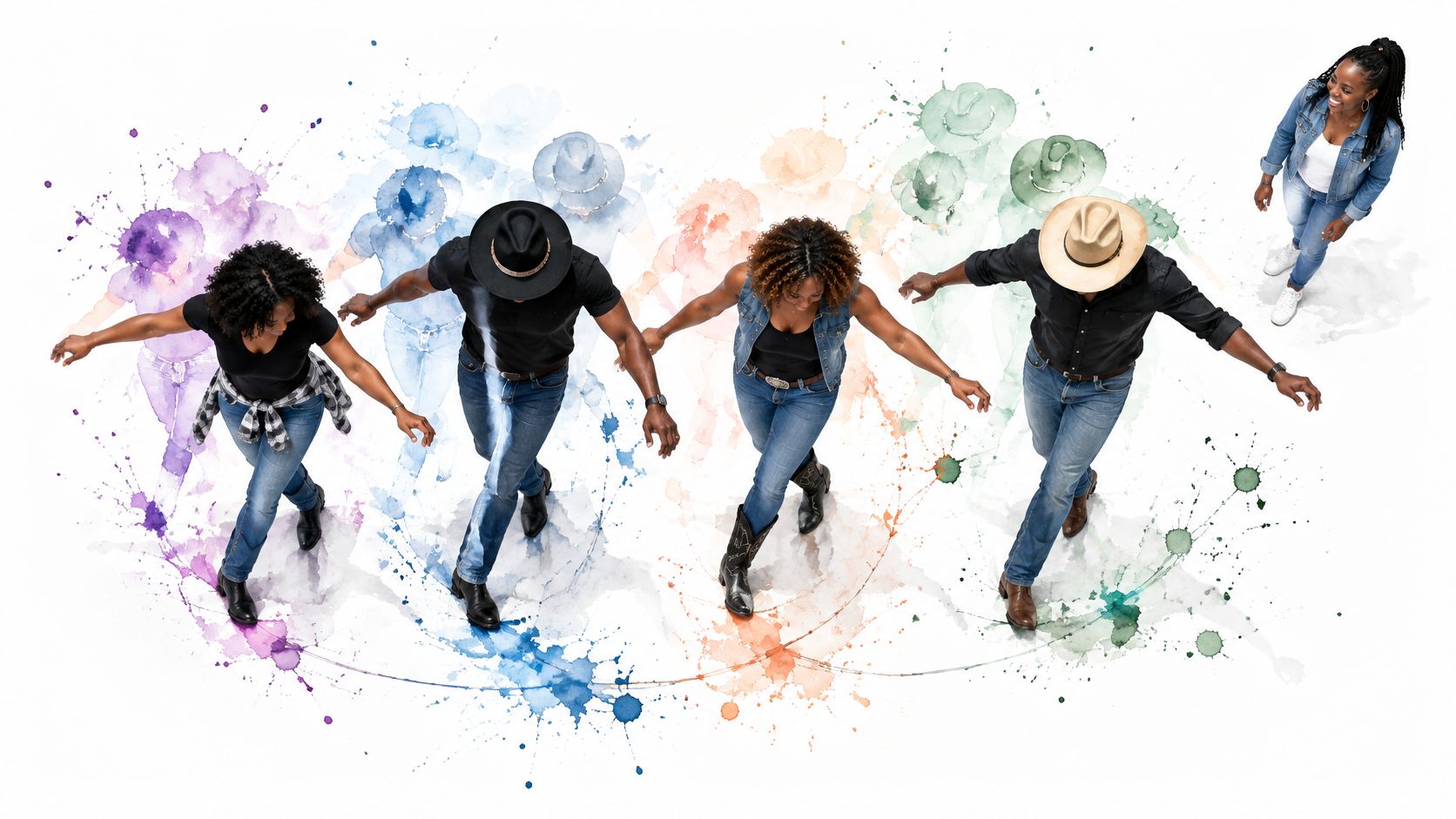
Philadelphia's modern soul line-dance tradition is generally traced to the 1990s, when R&B and soul line dancing grew in dance clubs across the Philadelphia, New Jersey and Delaware tri-state area, as the Library of Congress Community on the Line project documents. The repertoire draws on African American expressive culture and on music from The Temptations, Marvin Gaye, Barry White, Stevie Wonder and Prince. One milestone in that history is "Running Man," created in 1995 by Dave Bush, whom the Library of Congress project calls the "Godfather of Line Dancing" in the Philadelphia region.
That history isn't trivia. It tells you the music is half the lesson, and that familiarity with a song's structure helps you predict when a pattern restarts. The scene is large enough to have been archived: CBS News Philadelphia's reporting on the project notes interviews with more than 300 dancers, choreographers, DJs and other participants from the Philadelphia, New Jersey and Delaware soul-line-dance community.
The Counts Underneath the Steps
Routines follow musical counts and phrasing, not improvisation. A dance repeats a fixed pattern several times, then may add a tag, a short extra section, or a shortened ending so the choreography lines up with the song before the pattern restarts.
| Movement | Counts | How It Works |
|---|---|---|
| Ball change | 1 count | Step onto the ball of one foot and shift weight to the other |
| Cha-cha | 3 steps over 2 beats | Three steps fitted into two beats |
| Charleston | 4 counts | Step forward, kick, step back, touch |
| Tag | A short extra section | Added so the choreography matches the song's phrasing |
Count out loud through a phrase before you add music. Counting keeps a whole row together, and it gives you something to hold onto when the tempo climbs. If the idea of staying on the beat is new to you, this explanation of rhythm and timing in dance covers the pulse before the steps.
The format also has measurable physical value. A 2025 scoping review that synthesized 16 articles from 15 studies found evidence of improvements in balance, coordination and cardiovascular fitness, along with reductions in symptoms of depression and anxiety, according to the review indexed in PubMed.
Where to Find Philly Line Dance Classes and Events
Philly line dance runs in four main formats, and a beginner can start in any of them. The format, not the event name, decides how quickly you progress.
| Format | What It Looks Like | Best For | Reported Cost |
|---|---|---|---|
| Recurring weekly class | Same group, steps build week to week | Beginners who want steady progress | Ask the organizer; most listings leave cost blank |
| One-off workshop | Single session on a set date | Trying the style before committing | Ask the organizer; often priced per session |
| Monthly luncheon | Beginner and intermediate line dance | Low-cost social dancing | $12 (2025 listing) |
| Lesson then social night | One-hour lesson followed by dance numbers | First-timers who want to dance the same night | Ask the organizer; entry is usually at the door |
A recurring weekly class is the strongest choice if you want to get good, because the instructor builds on last week's phrase instead of restarting from zero. A one-off workshop suits the curious: you get a taste without a season-long commitment. The monthly beginner and intermediate luncheon is the cheapest entry point on the calendar, listed at $12 in a 2025 Pennsylvania schedule from the World Line Dance Newsletter.
Practical rule: Judge a class by what happens in the first fifteen minutes. If the instructor marks the beat before teaching steps, the room is built for beginners.
Pick One Room and Return Three Times
Your first session is mostly about learning where you stand, who calls the counts, and how the room resets between songs. That's not enough information to judge whether a class fits you. Go three times before you decide. By the third visit you'll know the warm-up, recognize two or three regulars, and stop watching the front row for every turn.
Two habits make the search easier. Confirm each listing is still active before you travel, because event pages go stale and a format described in older reporting may have changed. And ask the organizer for the current price directly, since many listings publish a date and a venue but leave cost blank. The same footwork patterns you learn in a line-dance room show up again in country western dancing lessons if you later want a partner format.
Choosing a Welcoming Class or Event for Your Level
The best first event has three markers: a lesson before the social dancing, a beginner label, and an address you can reach on a weeknight. Everything else is secondary.
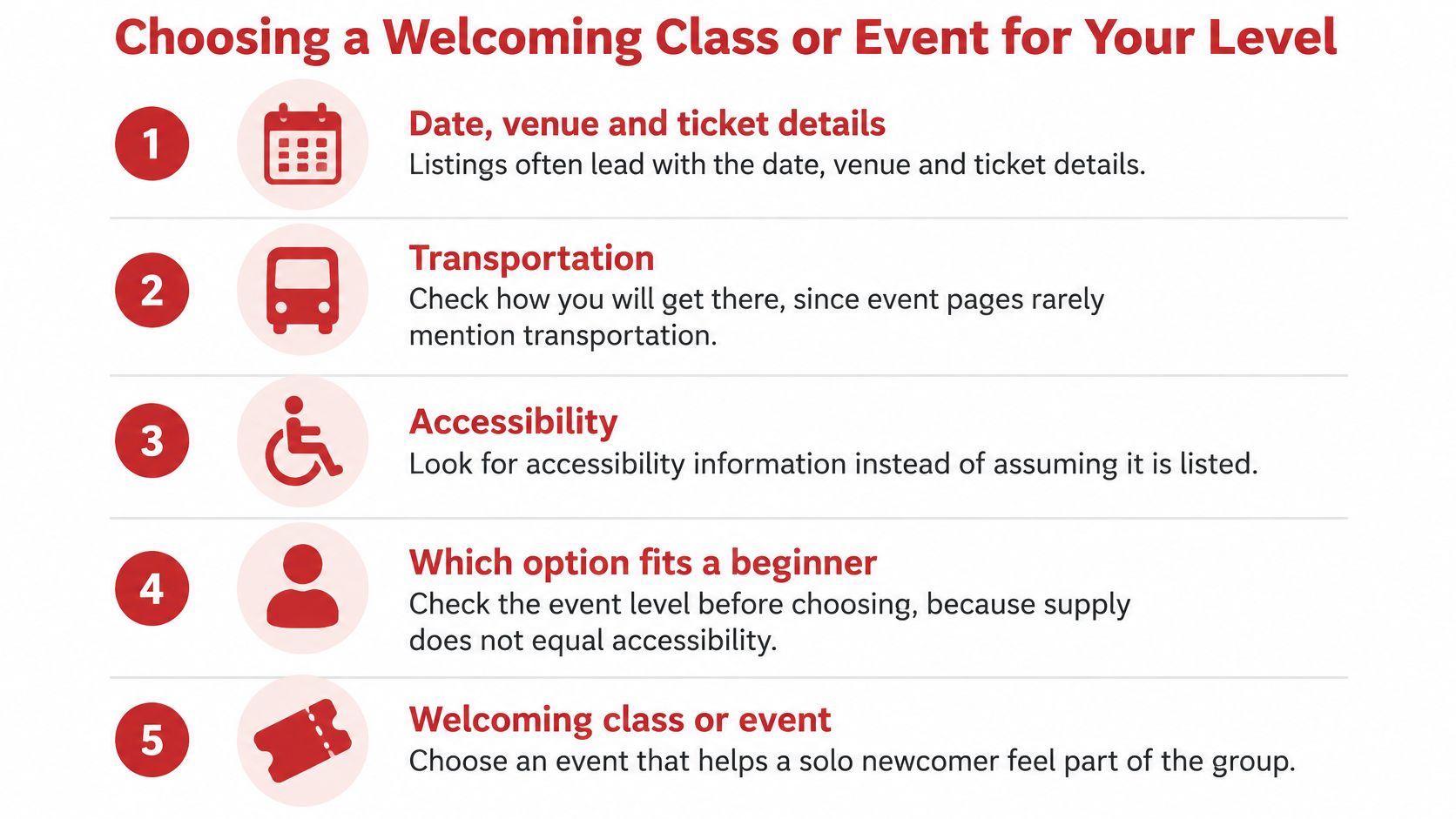
Plenty of events exist. Access is the separate problem. Eventbrite's Philadelphia line dancing listings show a fragmented calendar spread across Center City, North Philadelphia, Fishtown, Upper Chichester, Delaware County, South Jersey and Wilmington, mixing recurring weekly events with one-off workshops. Those pages lead with date, venue and ticket details, and they rarely answer the questions that decide whether an anxious adult walks in: transportation, accessibility, footwear, whether a partner is required, what the crowd is like, and how you move from a first lesson into social dancing.
Run this screen in two minutes:
- Lesson included: Is there a taught hour before the social dancing starts?
- Level label: Does the listing say beginner, or does it mix levels in one room?
- Solo friendly: Can you arrive alone without a partner?
- Recurring or one-off: Will the same class run next week so you can build?
- Cost stated: Is the price published, or do you have to ask?
- Reachable: Can you get there by transit from your neighborhood?
- Crowd described: Does the organizer say who the room is for?
If most answers are yes, it's a strong first step. If several are unknown, email the organizer before you go. Etiquette guidance for line-dance floors also recommends that beginners take the middle row, where you can see the front and follow the room without being the person everyone watches.
If a studio's level labels confuse you, this breakdown of dance class levels explains what beginner, intermediate and advanced usually mean on a schedule.
Save the two or three events that pass the screen, then try one this month. A welcoming room usually says so in the listing, and you can expect a mix of ages and experience levels once you're inside.
What Happens at a First Philly Line Dance Class
Giddy Up Philly's Friday night shows the standard shape. The event began in 2013 and runs at Voyeur Nightclub in Center City as a two-part night: a lesson from 7:00 to 8:00 p.m., followed by a series of dance numbers, as 34th Street Magazine reported. You learn the steps in a dedicated hour, then use them socially in repeated dances. Confirm current dates before you plan around any single event.
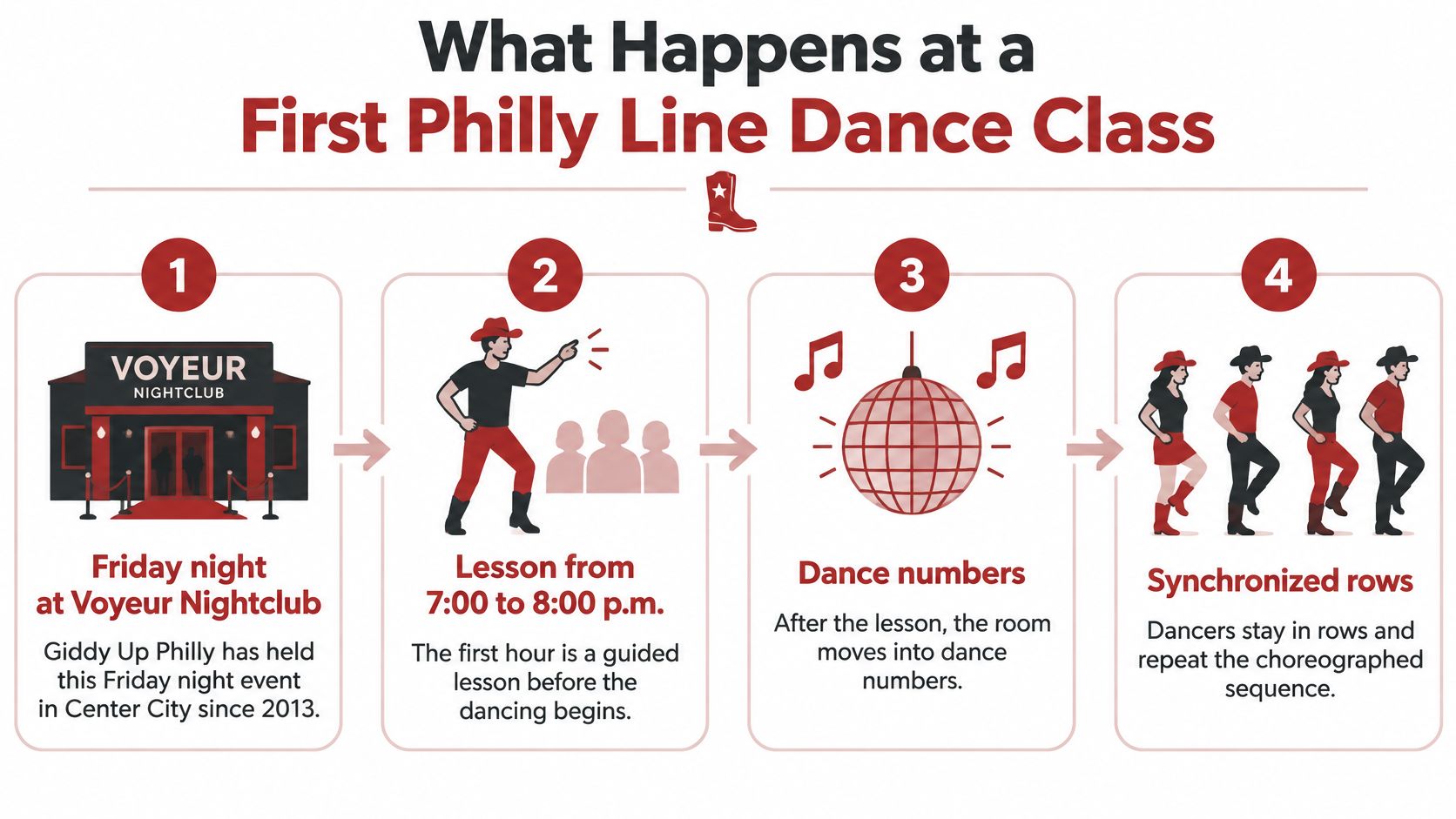
Here's the order of events, with the reason behind each one.
- Arrive 10 to 15 minutes early. Check that the session includes a beginner lesson. A mixed-level room moves fast, and knowing the plan up front stops the first ten minutes from feeling like an ambush.
- Take a middle-row spot. You can see the front line and copy the room, and you're not blocking anyone behind you while you find the counts.
- Wear smooth-soled shoes. You need to pivot without your soles grabbing the floor. Bring water, since an hour of repeated phrases is more work than it looks.
- Mark the beat during the warm-up. Weight shifts or claps put the timing in your body before the steps arrive, which is why instructors do it first.
- Learn one short phrase. Four or eight counts, taught with call-outs and repeated slowly. Resist adding styling until the sequence is automatic.
- Add the music. The same phrase at tempo feels different. Expect a small stumble here; it's normal.
- If you lose a step, keep moving. Rejoin at the next phrase or tag. Stopping dead breaks the row behind you, and nobody in the room is grading you.
What to expect after the lesson: the room shifts into dance numbers, the same routines repeated across several songs, so the phrase you just learned comes back often enough to stick.
Rooms that welcome beginners tend to say so. Danza Academy welcomes beginners, and our group classes are built so a first-timer can follow from the first count.
Learning Faster and Fixing Common Beginner Slips
Line dance is an auditory-motor skill: you hear a beat, hold a movement pattern in memory, anticipate the next count and move your limbs in time. Neuroscience research on rhythm learning ties improvement in auditory-to-motor reproduction to interactions among frontal, temporal and cerebellar beta-band networks, which is why repeated beat-linked demonstration beats verbal explanation, according to the published research on rhythm learning.
Progress won't be even, and that's expected. Pre-existing rhythm-discrimination ability predicts how much motor improvement a learner gains from music-based training, so two people in the same class with the same choreography will not move at the same speed.
Three Benchmarks to Check Yourself Against
Pulse accuracy is whether you can find the beat at all. Sequence memory is whether you recall what comes next. Spatial orientation is whether you turn and travel the right way. Most beginners are strong on one and weak on another, and the weakness tells you what to practice.
| Symptom | Likely Cause | Fix |
|---|---|---|
| Keeps the steps but loses the beat | Pulse not yet locked in | Mark the beat with weight shifts or claps before adding steps |
| Remembers the sequence but turns the wrong way | Spatial orientation not yet trained | Add direction changes one at a time after the phrase is set |
| Accurate at slow speed, falls apart at tempo | Working memory overloaded | Return to reduced tempo and raise speed in small increments |
| Misses a step mid-routine | Lost the count inside the phrase | Keep moving on the next count and rejoin at the next phrase or tag |
Two habits at home do most of the work. Repeat the phrase at reduced tempo, then raise speed in small increments so working memory isn't swamped. And listen for call-outs early enough to anticipate the next move, watching where the instructor puts their weight on the count where the direction changes.
If you like to learn a routine by following the words, a lyric print guide for music lovers helps you map where a verse ends and a chorus begins, which is often exactly where a tag falls.
Book Your Free First Lesson at Danza Academy
The fastest way to test any of this is a complimentary first lesson, because reading about counts and hearing them called are different experiences. You'll see how an instructor-led session runs, meet the teacher, and judge whether the room matches your level without spending anything.
Danza Academy of Social Dance has been operating since 1976 and has taught Philadelphians to dance for two generations. The flagship studio is at 2103 Sansom Street, Philadelphia, PA 19103, in Center City, easy to reach from most of the neighborhoods where line dancing happens.
Come the way the walkthrough suggests: smooth-soled shoes, a water bottle, and a middle-row spot once the lesson starts. Use the hour to check three things: whether the call-outs land early enough for you to anticipate, whether the tempo is raised in steps you can follow, and whether you leave knowing one phrase well enough to repeat it at home.
Book your complimentary lesson on our contact page and get the first session on the calendar while your interest is fresh.
Danza Academy of Social Dance teaches group classes, private lessons and social dance styles including Country Two Step, Hustle, Swing and West Coast Swing, all in a room where nobody needs to bring a partner. If the rows and counts in Philly line dance made sense here, the next step is feeling them with a teacher calling them out for you. Visit Danza Academy of Social Dance to book your complimentary first lesson and find out how quickly a first-timer can move with the room.