
You're probably here because you've had one of these moments. The music starts, other people seem relaxed, and somehow your feet feel late, early, or disconnected from what you're hearing. You may know the steps in your head and still feel off once the song begins.
That feeling is common. It doesn't mean you “have no rhythm.” It usually means no one has shown you rhythm and timing in dance in a way that your body can use.
I teach this skill the same way I'd teach balance, posture, or turning. It's trainable. You can improve it. And once it clicks, dancing stops feeling like guessing and starts feeling like conversation. The music gives you a pulse, and your body learns how to answer.
Why Rhythm Is the Heartbeat of Every Dance
A lot of dancers think rhythm is a gift some people are born with. In the studio, I see the opposite. I see people who felt clumsy at first become steady, musical, and confident because they practiced the right things in the right order.
Rhythm works a lot like a heartbeat. Your heart gives your body a steady pulse. Music does the same thing for movement. If that pulse feels unclear, everything else gets harder. You rush turns, hesitate on weight changes, and lose confidence with a partner. When the pulse becomes clear, even simple steps start to look better.
That's why rhythm and timing in dance matter so much. They aren't decoration. They're the structure under every step, every lead, every accent, and every pause.
Most timing problems aren't step problems. They're pulse problems.
Many adults come into dance believing they're behind because they didn't grow up training. Then they discover that rhythm is closer to learning a language than passing a talent test. At first, you hear separate sounds. Then you start hearing patterns. After that, your body begins to predict what comes next.
What confidence on the dance floor actually looks like
Confidence isn't doing fancy choreography. It's being able to stay with the music, recover when you make a mistake, and keep moving without panic.
A confident dancer can:
- Find the pulse quickly and settle into it
- Start phrases with intention instead of guessing
- Keep a steady weight transfer even in basic patterns
- Dance with another person without fighting the beat
If you've ever thought, “I can count, but I still don't feel musical,” that's not failure. It's just the point where your body needs training, not more self-criticism.
Understanding the Language of Music
Before your feet can match the song, your ears need a simple map. Most confusion comes from mixing up a few basic terms. Once those become clear, the music stops sounding random.
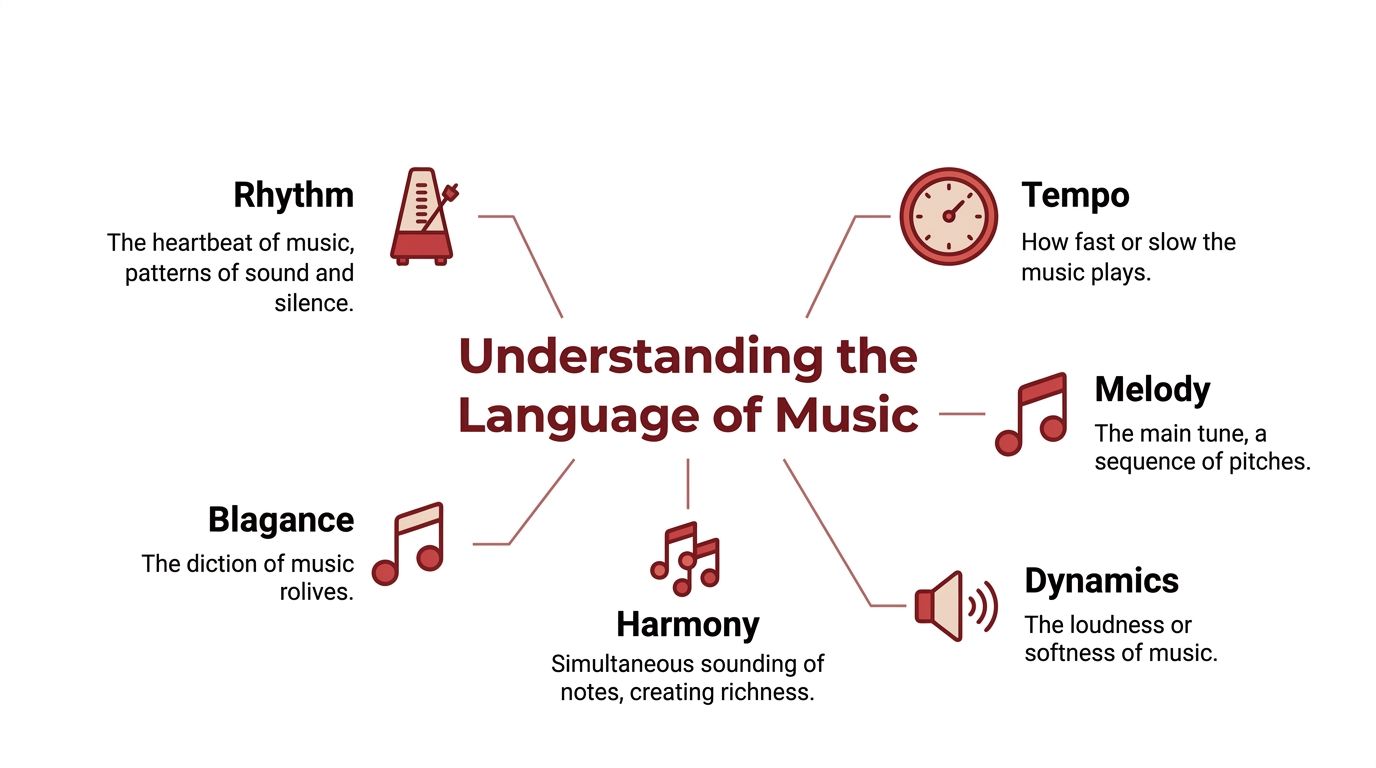
Pulse, beat, meter, and subdivisions
Think of pulse as the song's heartbeat. It's the steady underlying throb you can clap to. In dance, that pulse becomes the timing reference for your steps.
The beat is each count you feel inside that pulse. If you clap “1, 2, 3, 4,” you're marking beats. The meter is how those beats are grouped. Many social dances use 4/4 time, which means the music is commonly organized in groups of four beats. In dance teaching, rhythm is built from patterns synchronized to the beat, and the smallest measurable increment is often a 2-beat pattern in 4/4 time, which helps build muscle memory and troubleshoot timing problems, as explained by Dance House Productions' rhythm glossary.
Then come subdivisions. These are the smaller spaces between the main beats, often counted as “and.” So instead of only hearing “1, 2, 3, 4,” you begin to hear “1 and 2 and 3 and 4 and.” This matters when steps land between beats instead of directly on them.
The boom-tick feel dancers rely on
Professional dance instruction emphasizes that ballroom, Latin, and social dance music uses an even number of beats paired in a downbeat-accented odd count and upbeat-unaccented even count structure, often described as the “boom-tick” sound. In plain terms, counts 1, 3, 5, 7 tend to feel heavier, while 2, 4, 6, 8 feel lighter. Leaders should begin new patterns on the downbeat to keep proper timing, as described in this breakdown of dance timing from Naked Basics.
That's why some starts feel solid and others feel awkward. If you begin a pattern on the wrong part of the musical sentence, your body feels like it's stepping against the grain.
Practical rule: If the music feels like “boom-tick, boom-tick,” begin the main action on the “boom,” not the “tick.”
A plain-language way to listen like a dancer
Try this listening sequence the next time a song comes on:
- Find the heartbeat: Tap your hand until the pulse feels steady.
- Count the beats: Say “1, 2, 3, 4” out loud without speeding up.
- Notice the grouping: Hear how beat 1 often feels like the start of a fresh thought.
- Add the spaces: Whisper the “ands” between beats.
- Move one body part: Shift weight or nod your head to test whether your count matches the music.
Music has layers. Melody may float above the beat, and accents may tempt you to rush. Your job as a dancer is to hear the structure under the decoration.
Decoding Rhythms for Popular Dance Styles
Once you can hear pulse and grouping, different dances stop blending together. They begin to feel like different ways of organizing time. One dance glides. Another snaps. Another settles into a grounded break step.
The table below gives you a practical reference for a few common social styles. It's not meant to replace instruction. It gives you a clean starting map.
Timing patterns of popular social dances
| Dance Style | Time Signature | Tempo (MPM/BPM) | Basic Rhythm Pattern |
|---|---|---|---|
| Waltz | 3/4 | 24–28 MPM | Count 1-2-3 with the phrase anchored to beat 1 |
| Foxtrot | 4/4 | 118–128 BPM | Slow-Quick-Quick |
| Tango | 2/4 | 58–62 BPM | Slow-Quick-Quick with a sharp first accent |
| Salsa on 1 | 4/4 | 150–200 BPM | Break step on 1 and 5 |
How each style feels in the body
In Waltz, the rhythm sits in 3/4 time with a tempo of 24–28 measures per minute, and the timing must align with the first beat of each measure. That strong first beat gives Waltz its rise-and-fall shape and sweeping quality. If you're working on that style, this guide on how to dance the Waltz can help connect the count to movement.
In Foxtrot, the pattern is Slow-Quick-Quick in 4/4 time at 118–128 BPM. The key detail is that the slow step occupies two beats, while each quick takes one beat. That ratio is what gives Foxtrot its smooth travel instead of a hurried walk.
Tango uses 2/4 time at 58–62 BPM with a Slow-Quick-Quick structure, but it doesn't feel like Foxtrot. The first slow carries a sharper, more staccato accent, while the quicks move through more fluidly. Same broad pattern name, different body character.
For Salsa on 1, the timing is governed by 4/4 time at 150–200 BPM, and the dancer executes the break step on beat 1 forward and beat 5 backward to follow the on-1 rule, as noted in this Salsa timing reference. That's why Salsa can feel fast even when the basic step is simple. The speed leaves less room for late weight changes.
Different dances don't just use different steps. They organize energy differently across the same musical idea of counting.
Where beginners usually get mixed up
A few patterns cause trouble again and again:
- Hearing tempo instead of rhythm: Fast music makes people shorten steps that should stay calm.
- Using one count system for every dance: Waltz can't be danced with a Foxtrot feel.
- Ignoring the accent: Two dances may share a count pattern but still feel completely different.
If a dance style feels wrong, don't assume you lack ability. Often, you're applying the right effort to the wrong rhythmic shape.
Exercises to Build Your Internal Clock
Rhythm becomes reliable when your body repeats clear timing patterns often enough to trust them. That trust is what dancers mean when they talk about an internal clock. It's not mystical. It's trained coordination.
A 10-week dancesport intervention study found that college students in structured ballroom and Latin dance training improved rhythm perception accuracy and enhanced their internal clock mechanisms, outperforming a control group, according to the NIH study on dancesport rhythm training. That matters because it confirms what teachers see every week. Practice changes timing.
Start with sound before footwork
Don't begin with turns or patterns. Begin with accuracy.
Clap the main beat
Put on a song and clap only the strongest steady pulse. Stay there for one full phrase. If your claps drift, stop and reset.Count out loud while clapping
Add “1, 2, 3, 4” to the same exercise. Speaking and clapping at once reveals whether you know where the beat is.March in place
Replace clapping with walking feet. Let each step land exactly on one beat. Keep your shoulders relaxed so you don't tense up and speed up.
If finding the beat is still fuzzy, practice with this short guide on how to find the beat in music.
Add weight transfer and subdivisions
The next layer is where rhythm starts becoming physical instead of mental.
- Shift right and left: No travel yet. Just move weight cleanly from foot to foot on each beat.
- Pause without freezing: Step on counts 1, 2, 3, then hold 4 while keeping the pulse alive in your body.
- Use the “and” counts: Try stepping on “1 and 2 and 3 and 4 and” so your feet learn to hit subdivisions.
These drills work well because they train precision without giving you too much to think about at once. That same kind of layered learning is one reason many musicians develop sharp time awareness, and the broader advantages of music education can support dancers who want stronger listening skills.
For a visual practice session, use this simple follow-along clip after you've done the drills above.
A short home practice plan
You don't need a huge routine. You need consistency.
| Drill | Focus | What to notice |
|---|---|---|
| Clap and count | Beat clarity | Are you landing steadily or drifting? |
| March in place | Full-body timing | Do your feet hit the count cleanly? |
| Weight shifts | Balance with rhythm | Can you transfer fully without rushing? |
| “And” counts | Subdivision control | Can you stay relaxed between beats? |
If you want guided feedback, one option is Danza Academy of Social Dance, which offers instruction in ballroom, Latin, and social styles with attention to technique and musicality. But even if you're practicing at home, these drills will move you forward if you repeat them patiently.
Moving Beyond Counting to Truly Feel the Music
There comes a point when counting stops being the whole answer. You can be on the correct number and still look stiff. That's the plateau many dancers hit. They're accurate, but they aren't expressive.
A more useful idea now comes into focus: rhythm is not only something you hear. It's also something your body produces.
Rhythm as kinesthetic output
Emerging research defines rhythm not just as a reaction to sound, but as the “periodicity or relative duration of movement qualities” perceived through kinesthetic awareness. That means a dancer can express the energetic shape of a phrase through movement quality, not only by matching counts, as discussed in this NIH article on kinesthetic rhythm perception.
That changes how you practice. Instead of asking only, “Am I on count?” you also ask:
- How does this beat land in my body?
- Does this step press, float, suspend, or snap?
- Where does the movement breathe?
A dancer with strong kinesthetic timing doesn't merely chase the beat. They organize movement so the body speaks rhythm back into the room.
Counting is a ladder. You use it to climb, not to live on.
How to shift from numbers to feeling
Start by counting during the learning stage. Then gradually reduce how much you rely on spoken numbers.
Try this progression:
- Count out loud while learning the basic pattern.
- Count internally once the feet know where to go.
- Replace numbers with qualities such as “ground,” “quick,” “hold,” or “stretch.”
- Dance one phrase without counting and focus on breath, weight, and accent.
This is also where musicality becomes more than correctness. If you want a deeper look at expression and phrasing, this article on what musicality in dance means connects timing to interpretation.
Why some advanced dancers use elastic timing
Strict timing matters, but mature dancing also includes nuance. Some dancers use rubato, an elastic handling of phrasing where certain beats are stretched and others compacted for expression, as described in Barbara's Dance blog on rhythm basics and rubato. The key is that they don't lose the pulse underneath.
That's an advanced skill. Beginners don't need to force it. First build steadiness. Then add interpretation.
How to Fix Common Rhythm and Timing Mistakes
You are midway through a song, your feet know the pattern, and then something slips. You rush a step, hesitate, or lose your place with a partner. That moment feels bigger than it is. In most cases, the problem is not that you "have no rhythm." Your body has stopped producing a clear pulse for a few counts.
That idea matters. Rhythm in dance is a kinesthetic output. Your body sends timing into the floor through weight changes, steps, breath, and accents. Once you treat timing as something you create, mistakes become easier to fix.
Three common problems and what helps
You rush the beat
This often happens when your body gets ahead of the song's pulse, like a heartbeat speeding up under stress. Strip the movement down to walking or marching for a few counts. Let each footfall match the beat, then add the dance step back in without increasing effort.You drag or hesitate
This is often a weight-transfer issue, not a hearing issue. If you never fully arrive on one leg, the next step has no clean launch point. Practice slow side-to-side transfers and stay long enough on each leg to feel, "I am here now." That clear arrival helps your timing come out of the body instead of trailing behind it.You lose your place in a pattern
Do not try to rescue every count at once. Listen for the next musical phrase and re-enter on a strong point, such as the start of the next measure or the next obvious accent. Dancers who recover well are not guessing faster. They are hearing the larger sentence in the music and stepping back in where it makes sense.
If a pattern keeps falling apart, give your body one clear job. Find the next solid weight change and place it on the pulse.
Partner timing problems
With a partner, timing often breaks down because attention gets scattered. You start monitoring the hands, the turn, the footwork, and the fear of being wrong. The shared pulse disappears.
Use this reset:
- Feel the beat in your own body first.
- Make one clear, grounded weight change your partner can read.
- Rejoin at the next phrase instead of forcing the old pattern back into place.
A calm recovery works better than a heroic one.
If partner timing keeps slipping, simplify the goal for a full song. Forget fancy figures. Aim for clear pulse, clean transfers, and obvious starts. That gives both dancers something reliable to build on, and reliability is what timing grows from.
Your Next Steps to Becoming a Confident Dancer
Good timing doesn't appear all at once. It builds in layers. First you hear the pulse. Then you count it. Then you move with it. Finally, your body starts producing rhythm with enough confidence that the music feels less like an external command and more like a partner.
That marks a significant shift in rhythm and timing in dance. You stop treating rhythm as something outside you and begin carrying it inside your movement. That makes social dancing feel easier, partner work feel steadier, and performance feel more expressive.
If you've been stuck in the cycle of “I can't find the beat” or “I count but still feel robotic,” guided feedback can speed up the process. A trained instructor can spot whether the issue is listening, weight transfer, phrasing, or simple overthinking.

One lesson can make a surprising difference because timing problems often feel bigger from the inside than they look from the outside. Once someone shows you what to hear and what to do with your body, the whole picture gets simpler.
If you're ready to feel more relaxed, musical, and connected on the dance floor, the most practical next move is to get personalized help and start building these skills in real time.
If you want hands-on guidance, book a free complimentary lesson with Danza Academy of Social Dance. It's a simple way to get clear feedback on your rhythm, timing, and movement so you can stop guessing and start dancing with confidence.