A useful dance-class system has four levels: Beginner, Beginner-Intermediate, Intermediate, and Advanced, each defined by skills a student can demonstrate. For context, 22% of U.S. adults reported social or artistic dancing in the year before the National Endowment for the Arts' 2022 survey, while 12% had taken arts classes or lessons during that period and 55% had taken them at some point in their lives.
What does “intermediate” mean if a dancer can handle Salsa patterns but has never learned a Waltz? A level label alone can't answer that. Dance readiness is a bundle of separate skills: timing, balance, pattern recall, partner communication, musicality, and the ability to move safely at a particular tempo. You might be ready to advance in one area and still need practice in another.
Dance Class Levels at a Glance
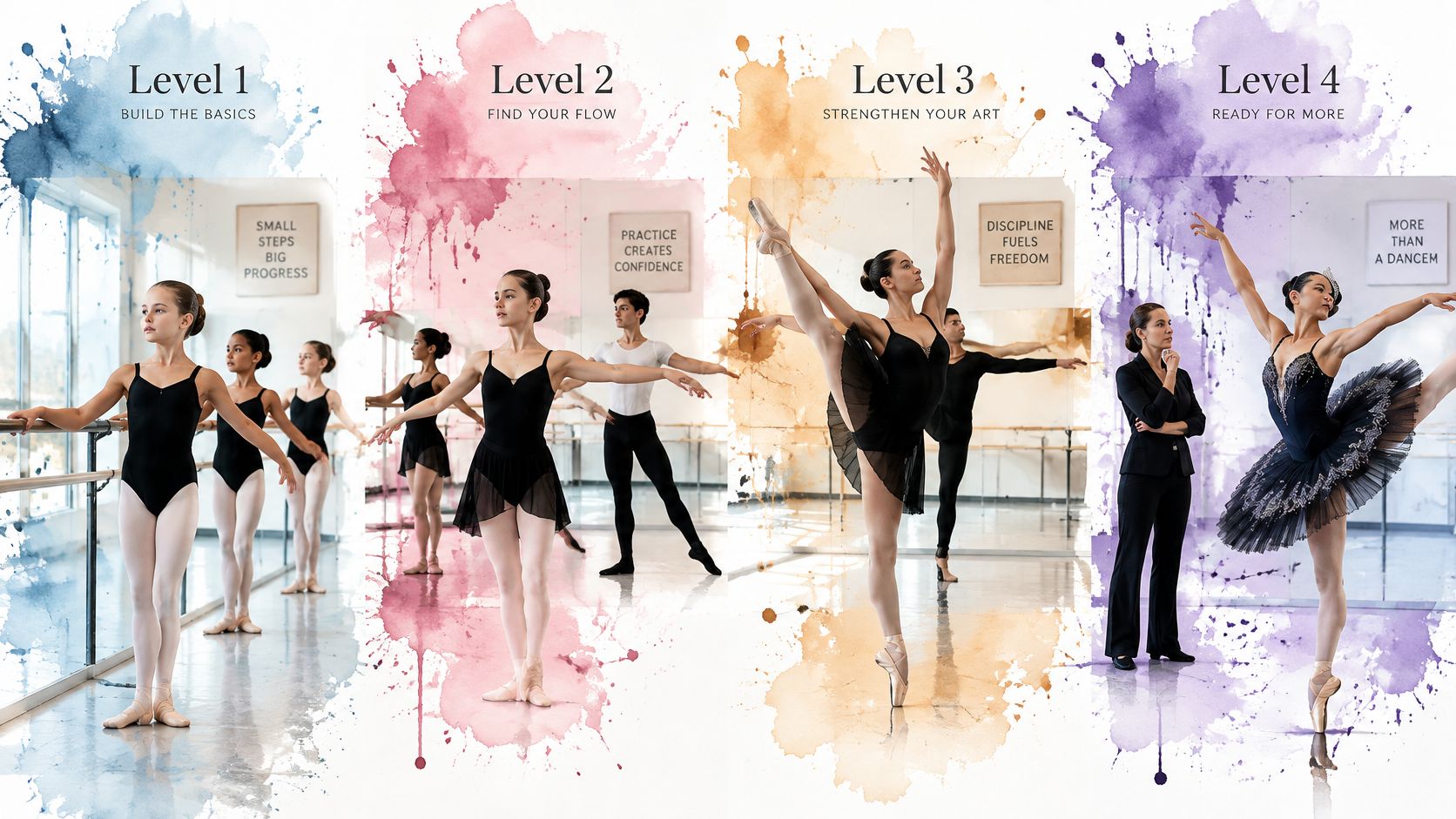
| Level | Who It Suits | Core Skills | Typical Practice | Move Up When |
|---|---|---|---|---|
| Beginner | New to dance or returning after years away | Posture, basic footwork, counting, stable frame | 1 to 2 classes a week | Basic step and timing are clean across 3 consecutive classes |
| Beginner-Intermediate | Finished a beginner sequence or dances socially | Turns, lead and follow cues, changing partners, basic styling | 1 to 2 classes a week plus home practice | Turns and partner changes hold at slow tempo |
| Intermediate | Six months or more of steady practice | Musicality, extended patterns at tempo, floorcraft | 2 classes a week plus weekly practice | Patterns hold at full tempo with a new partner |
| Advanced | Competitive, performance or teaching goals | Styling, repertoire, consistency under pressure, interpretation | 2 to 3 classes a week plus coaching | Ready for competition or teaching standards |
These are studio-typical ranges, not official standards. A level is a description of demonstrated skills, not a count of months enrolled. Someone might recognize many patterns but still need help with timing or connection, while another dancer may have a smaller repertoire and be highly reliable with a partner.
A Beginner learns how to move with control before adding complexity. Instructors build posture, basic footwork, counting, and a stable frame so students can focus on what their bodies are doing rather than trying to memorize a long sequence.
Beginner-Intermediate is the bridge between practicing a basic pattern and using it with other people. Students work on turns, simple lead-and-follow cues, and changing partners without losing the beat or their place in the sequence.
At Intermediate, dancers combine patterns with musical choices and adapt to different partners and changing floor conditions. Advanced classes develop a more polished, consistent performance, with deeper styling and repertoire for dancers pursuing competition, performance, or teaching.
It can help to compare dance classes with another activity that has a progression from recreational participation to elite training. For a useful parallel, see how soccer pathways range from recreational play to elite academies. The details differ, but both activities benefit from clear steps that match the learner's current abilities.
Why Dance Studios Use Four Levels
People come to dance from different starting points. Some want to feel comfortable at a social event; others want regular instruction, focused training, or a performance goal. A class structure with several entry points gives students a place to start and a path to follow without treating every new arrival as if they had the same background.
The National Endowment for the Arts' 2022 survey found that 22% of U.S. adults participated in social or artistic dancing during the preceding 12 months. In the same period, 12% of adults had taken arts classes or lessons, while 55% had done so at some point in their lives. The figures describe different kinds of participation, but together they show why studios need accessible ways to move from informal dancing into structured instruction. The NEA's survey places dance participation within a broader continuum, from occasional social activity to advanced or formal training.
That continuum can be thought of as four stages: occasional social participation, introductory instruction, sustained recreational study, and advanced or formal training. A person may already dance at parties or social events but still be new to the technique taught in a class. A beginner class helps that dancer develop timing, movement control, partner communication, and confidence. It doesn't assume that the student has never moved to music.
The same level names can be used in group classes, private lessons, and wedding preparation, but they describe readiness in a particular style and for a particular goal. Intermediate in Salsa doesn't automatically mean intermediate in Waltz. A student may carry over balance, coordination, or comfort with partnering, but the timing, footwork, and style-specific techniques still need to be learned. Pacing matters too: class frequency and practice habits influence how quickly a student can demonstrate the skills required for the next level.
Beginner Classes and What to Expect
What does a beginner practice in the first six weeks? The answer is a small bundle of separate skills, not one single rank. Timing, balance, frame, and partner communication each improve at a different speed, which is why progress feels uneven at first.
A beginner course often uses a Waltz or Foxtrot basic and builds it in stages:
- Weeks 1 and 2: Practice upright posture, balance on one foot, slow-quick-quick counting, and walking to the beat. These exercises show where weight sits and when to shift it.
- Week 3: Learn the basic box step, moving forward and back. A clear transfer of weight lets one step finish before the next begins.
- Week 4: Add a simple partner frame. Hold contact and signal direction without gripping or pushing.
- Week 5: Practice side and rock steps, then combine them into an eight-count pattern. Linking movements teaches continuous flow instead of stop-and-reset dancing.
- Week 6: Dance a short routine at slow tempo without stopping. The goal is to notice where timing or frame breaks down under mild pressure.
Beginners often rush. Memory and music compete for attention, so steps get ahead of the beat. Many dancers also squeeze the arms to feel connected, which blocks clear signals. Instructors usually slow the tempo and simplify the pattern until weight transfer feels steady.
A simple self-check
A usable foundation shows in three small tests. Stand tall for two minutes without locking knees. Step a box on the beat. Hold frame through a slow turn without leaning. No audition here. Each check points to the skill that needs the next round of practice.
No partner, prior experience, or specific fitness level is required to begin. If you're curious about how a first lesson in another movement-based class is structured, this guide to what to expect at your first class offers a helpful comparison. The same principle applies: a first class should introduce the basics and give you room to learn at your own pace.
A useful first-class expectation: You do not need to remember everything. Find your weight, listen for the beat, and ask for the movement to be shown again when the sequence slips.
Beginner-Intermediate Classes and the Bridge Skills
Beginner classes teach the basic steps; Beginner-Intermediate classes ask you to use them with more variation and less predictability. You'll work on controlled turns, clear lead-and-follow cues, partner changes, longer sequences, and basic styling that stays composed while you move.
For example, a six-week bridge course could unfold like this:
- Week 1: Review the basic step and frame at a slow tempo. A steady basic gives you something reliable to return to.
- Week 2: Add closed turns while keeping the frame steady. Focus on completing the turn with balance rather than forcing extra rotation.
- Week 3: Practice lead-and-follow cues, including a clear signal before a turn. A partner needs to be able to understand the cue, not guess what's coming.
- Week 4: Link two basic patterns into a sixteen-count combination. This gives you practice transitioning between figures instead of treating every step as a separate unit.
- Week 5: Try the same combination at a tempo that's ten percent faster. Keep the steps small enough to retain control.
- Week 6: Test the sequence with a rotating partner. The change helps reveal whether you're following the rhythm and cues or relying on one familiar partner's habits.
What to watch for
The readiness signal isn't just knowing more figures. At a slow tempo, you should be able to keep your frame through turns and change partners without losing the pattern. If you can manage the sequence only when you already know exactly how your usual partner moves, keep practicing the underlying cues.
A change in style can mean starting this bridge again. A Salsa beginner pattern doesn't automatically transfer to Ballroom timing; a dancer may be comfortable with partners and music but still need to learn the new style's basic movement. Tempo and turns are common sticking points at this level. If you feel behind, make the movement smaller and return to a slower tempo until you can keep your balance and communicate clearly.
Students who want more structured practice can look at technique-focused dance classes as part of their learning path. The goal is to connect the mechanics of each step with the way it feels to dance it, rather than collecting combinations without control.
Intermediate Classes and Partner Consistency
At the Intermediate level, dancers start moving beyond counting every step and begin responding to the music. That doesn't mean counts stop mattering. It means you can maintain the pattern while also hearing a phrase, noticing an accent, or changing the quality of a movement.
Musicality includes phrasing, which helps you sense how a sequence fits into a piece of music, and accents, which bring attention to particular beats or movements. In a Waltz, you might work on rise and fall while keeping the movement smooth. In a Latin dance, you might connect weight changes and body action to the music without losing the basic rhythm.
How an intermediate practice block can work
An eight-week plan might use a single pattern as a thread through the work:
- Weeks 1 and 2: Practice phrasing with one pattern. Notice where the phrase begins and ends instead of hurrying through the sequence.
- Weeks 3 and 4: Add accents and rise and fall to the same pattern. The focus is movement quality, not just where the feet go.
- Weeks 5 and 6: Run the pattern at full tempo, changing partners every two minutes. This gives dancers a chance to adjust their communication and balance.
- Weeks 7 and 8: Put together a three-minute floor routine, including a deliberate recovery after a missed step. The goal is to keep dancing rather than stop and apologize to the music.
A common plateau appears when a dancer knows the pattern but loses its quality as soon as the music speeds up or the partner changes. The answer usually isn't to add more figures. It's to practice the pattern with the right timing, maintain a comfortable frame, and recover calmly when something goes wrong.
Practice test: Can you keep your frame at full tempo, recover from a missed step within two counts, lead or follow a clear turn with a new partner, and adjust your path on a crowded floor?
That last skill is floorcraft: noticing where other couples are and changing direction or the size of a step to avoid collisions. It matters because social dancing isn't performed in an empty studio. An intermediate dancer needs to keep their movement controlled while making room for everyone else.
Intermediate status is still style-specific. A dancer may have reliable timing and partner communication in one style but be a beginner in another. Keep the style in view when choosing a class: a strong Salsa background can help with comfort on the floor, but it doesn't replace learning Waltz patterns, timing, and movement.
Advanced Classes and Competition Standards
A formal grading framework can show how an advanced class differs from one that teaches more choreography. The Imperial Society of Teachers of Dancing's Latin American practical grades run from Grade 1 through Grade 6, with Grade 6 the highest in that sequence. Each dance is scored out of 100 and requires at least 65% for an overall successful examination. Candidates must also meet a minimum in each assessed section, so strength in one area can't hide a significant weakness in another. The ISTD Latin American examination framework includes posture, technique, movement range within the dancer's abilities, and understanding the character of different styles.
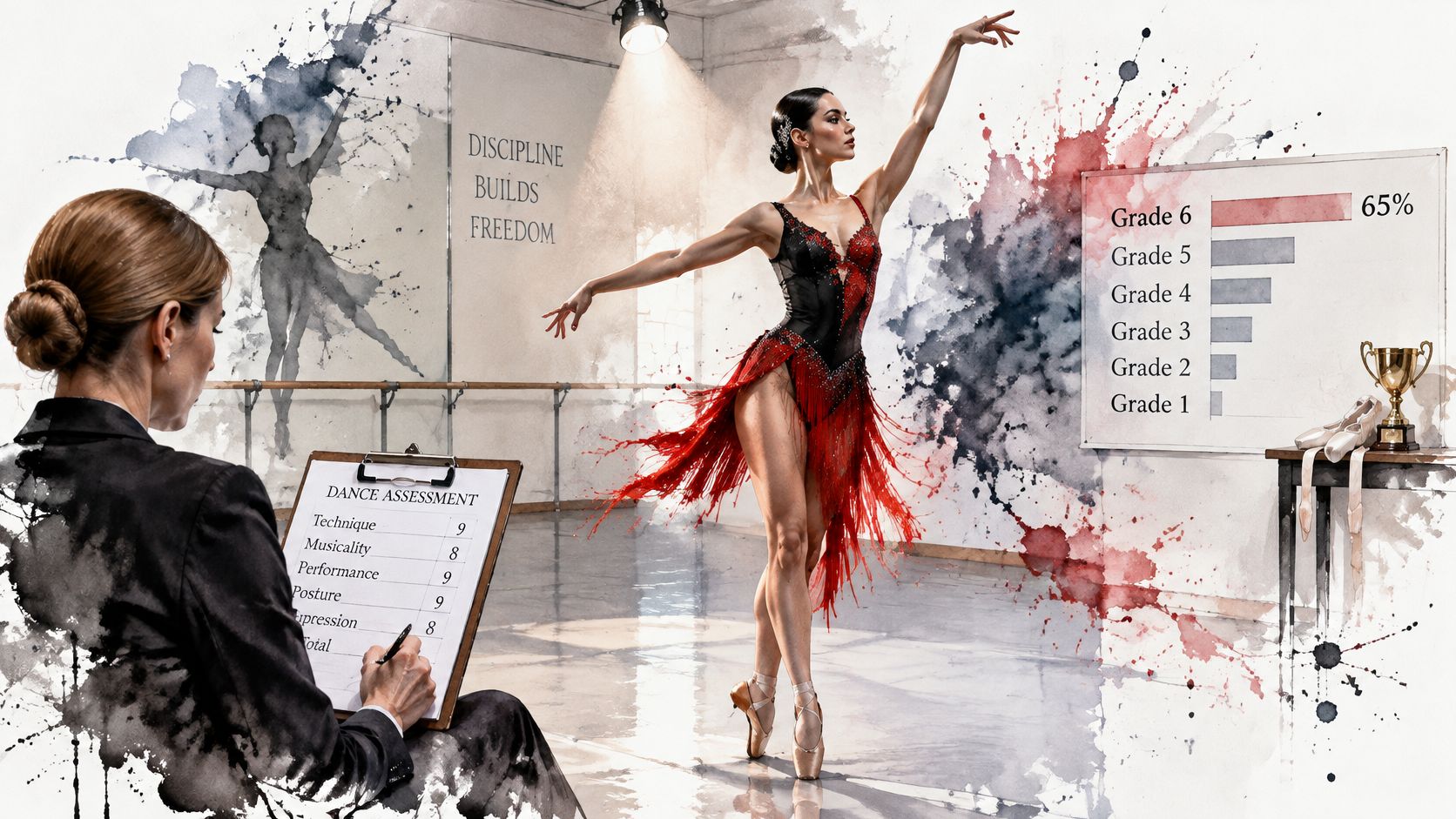
An advanced class can translate those expectations into alignment and body action, timing and musicality, movement quality, stylistic character, partnering, and consistency under performance conditions. Those domains give a teacher more to assess than the number of patterns a student remembers. A dancer may know an extensive repertoire, but if the technique changes whenever the tempo rises, the work isn't yet consistent.
A sample ten-week course could begin with a technical assessment and end with a public or studio presentation:
- Weeks 1 and 2: Review alignment, body action, and the execution of core figures.
- Weeks 3 and 4: Work on stylistic character and musical interpretation across a full routine.
- Weeks 5 and 6: Practice partner changes and adapt the choreography to musical variations.
- Weeks 7 and 8: Run the material under performance conditions and identify where movement quality drops.
- Week 9: Hold a mock examination with separate checks for each assessed domain.
- Week 10: Present a showcase or competition routine and review what held up under pressure.
For a dancer pursuing teaching, advanced study may also include practice explaining a step, giving a clear cue, and helping someone troubleshoot a movement. That requires understanding the mechanics well enough to communicate them, not just to perform them.
Advanced is always specific to a style and goal. An advanced Latin dancer may still be intermediate in Ballroom, while a strong performer may need additional training before teaching or entering a particular competition. Formal examination structures also include stages below the main graded sequence: the ISTD offers Pre-Primary and Primary stages before Grade 1 in some disciplines. For a competitive path or a structured performance goal, competitive Ballroom training can help connect classwork to the standards you're aiming to meet.
How Often to Move Up and What Promotion Requires
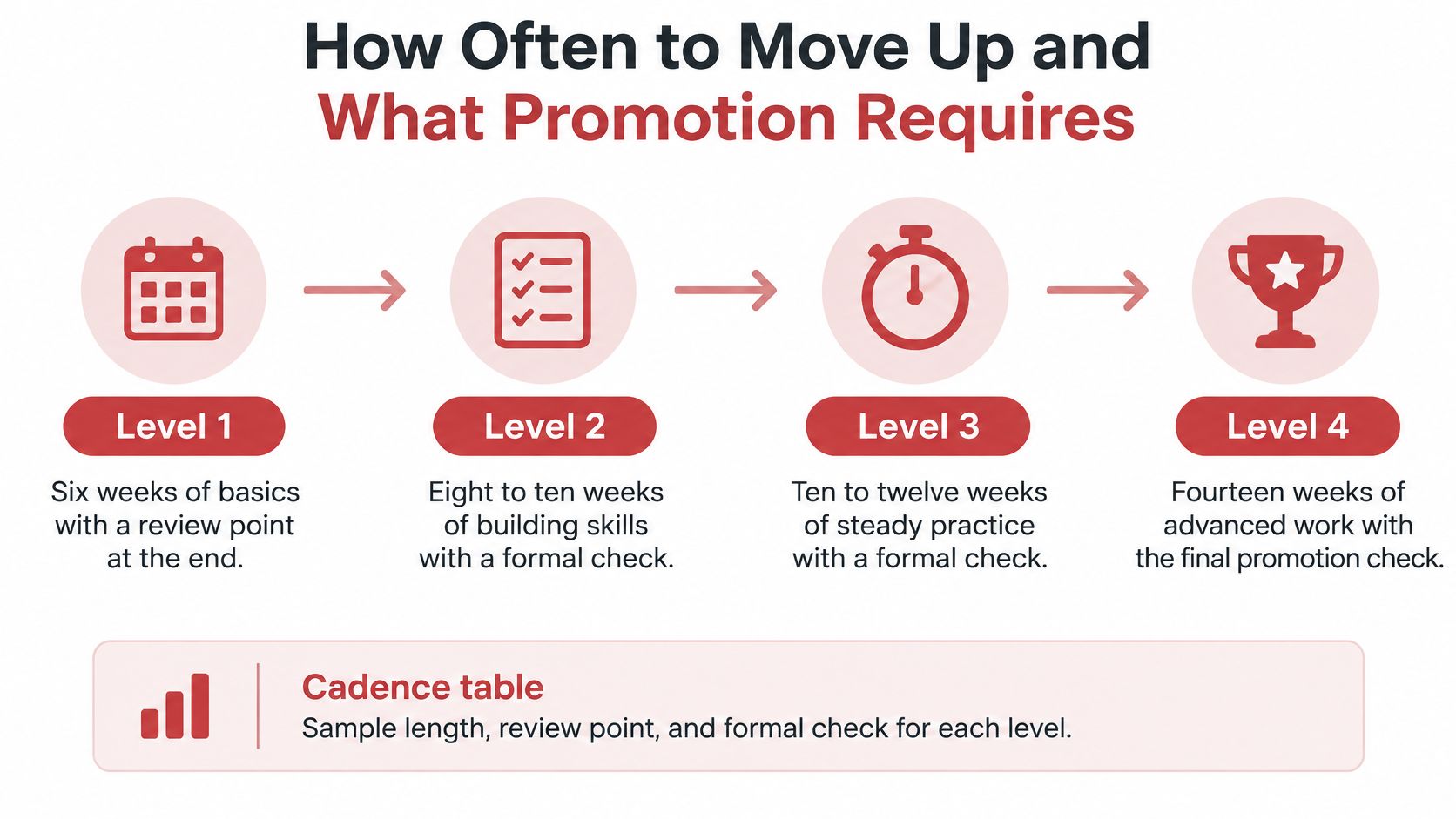
Use the course length as a planning guide, not a promise that every student will be ready on the same date. A dancer attending regularly and practicing at home may develop a skill sooner than someone attending a single class each week. Either way, the important question is whether the movement is reliable enough to carry into the next level.
| Level | Typical Time at Level | Review Point | Formal Check |
|---|---|---|---|
| Beginner | 6 weeks | Every 4 to 6 weeks | Basic step and timing clean across 3 consecutive classes |
| Beginner-Intermediate | 6 weeks | Every 4 to 6 weeks | Turns and partner changes hold at slow tempo |
| Intermediate | 8 weeks | Every 4 to 6 weeks | Patterns hold at full tempo with a new partner |
| Advanced | 10 weeks plus showcase | Every 4 to 6 weeks | Mock examination passed on every assessed domain; annual reassessment |
The National Dance Education Organization recommends that dance progression be sequential and outcome-based, with stated expectations for what students know and can do. Its standards support curriculum planning and assessment, rather than defining advancement only by attendance time or the number of figures learned. For a social-dance class, that means a teacher can check posture, weight transfer, timing, safe movement, partner communication, pattern recall, and musical interpretation as observable skills. The NDEO's Dance Education Standards describe outcomes across movement technique, choreography, observation, analysis, and cultural or historical understanding.
Promotion should reflect a dancer's overall readiness, not a single strength. Someone may have learned a lot of vocabulary and still need more practice with partnering or musicality. A teacher can assess several dimensions, then set a clear next step instead of treating the student's current class level as a fixed identity.
When to repeat a level
If you miss the same benchmark at two reviews, repeat the level with a changed focus. For example, if turns fall apart when you change partners, spend class time on balance, the preparation for the turn, and the cue that communicates it. Repeating a level can be productive when it targets a specific skill rather than replaying the same lessons without a plan.
Review at four-to-six-week intervals, formally check the required skills at the end of each level, and reassess advanced dancers annually. If you're trying to estimate how your practice schedule may affect your progress, this guide to how long it takes to learn Ballroom dancing can help you think about the role of consistency without treating a timeline as a guarantee.
Choosing Your Level and Booking a Free Lesson
Choose a class by looking at three separate things: your skill in the particular style, your current physical readiness, and the goal you have for taking lessons. A class that suits your technique might still be a poor fit if you need a lower-impact option or want to prepare a focused wedding routine rather than follow a general course.
Start with three questions:
- Can you hold a frame and keep timing through a basic pattern?
- Can you change partners without losing the pattern?
- Can you recover within two counts after a missed step?
If the first answer is no, a beginner class gives you room to build a foundation. If you can maintain the basic but need practice with turns or partner changes, Beginner-Intermediate may fit better. If you can hold the pattern at tempo with a new partner, try an Intermediate class. These are practical checks, not a substitute for an instructor observing you dance.
The same test applies when your background changes. A Salsa dancer should expect to learn the timing and patterns of Ballroom Waltz rather than assume an intermediate label transfers. Prior dance, fitness, or partner-dance experience may help with coordination and body awareness, but it doesn't automatically demonstrate readiness for every style. A recent systematic review found eight eligible dance injury-prevention studies from 2,209 records, with inconsistent methods and insufficient evidence to determine how effective prevention strategies are. A separate survey of 424 adult dancers found that injury history was associated with more years of dance experience, ballet participation, and beginning dance before age 12. The 2025 review and survey findings are a reminder that experience alone doesn't guarantee readiness for faster tempos or extended practice.
Match the class to your circumstances
A dancer returning after a decade away should begin one level below their former class and test the fit over two classes. The skills may return quickly, but the body still needs time to adjust.
If you're recovering from an injury, tell the instructor about pain, balance concerns, or medical limits before class. Choose lower-impact options and raise the tempo gradually. Don't push through pain to keep up with a level label. A returner or foundation-focused class can be a sensible temporary choice while you rebuild comfort and control.
For a couple with six weeks before a wedding, a focused track may serve the goal better than progressing through a full general-level sequence. And whenever you change styles, be willing to repeat or step down until the timing and basic patterns feel secure. Levels describe what you can do now, not what you did years ago.
If you're unsure where to start, book a complimentary first lesson at Danza Academy. We welcome beginners, you don't need a partner, and an instructor can help place you by observing your movement and asking about your goals. Book your complimentary lesson.
If you're ready to build confidence in a particular style, prepare for a wedding, or work toward performance goals, Danza Academy of Social Dance offers instruction across Ballroom, Latin, and social dance. Book your complimentary first lesson and get a class recommendation based on the skills you want to develop.