
You might be here because you've watched a ballroom competition and thought two things at once. First, “That looks amazing.” Second, “I have no idea how anyone gets from a beginner lesson to that floor.”
That reaction is normal.
Competitive ballroom dancing can look like a closed world of polished couples, sharp costumes, and judges with serious expressions. From the outside, it seems like everyone already knows the rules. From the inside, though, it's a skill system you can learn step by step, just like learning to drive, play tennis, or speak a new language. You don't start with mastery. You start with one dance, one lesson, one correction, and one brave decision to try.
From the Sidelines to the Spotlight
A lot of new dancers begin the same way. They see a waltz glide across a floor or a quick Latin routine snap perfectly with the music, and they assume the dancers were just born confident. Then they take a first lesson and discover something surprising. Confidence usually comes after the process starts, not before.
Competitive ballroom dancing is full of those quiet transformations. Someone walks in worried about posture, timing, or having “two left feet.” A few months later, that same person is learning how to enter the floor, hold frame under pressure, and keep going even after a mistake. The sparkle is real, but it sits on top of repetition, coaching, and steady practice.
If fear is the thing stopping you, that's common too. Many beginners aren't afraid of dancing itself. They're afraid of being seen while learning. That hurdle gets smaller once you understand how to work with it, and this guide on overcoming fear of dancing in public can help if that's where you're stuck.
Practical rule: You do not need to feel “ready” before you begin. Readiness often grows from action.
The exciting part is that competitive ballroom isn't one single path. There are different styles, divisions, age categories, and ways to participate. Some dancers love the classic elegance of closed-hold ballroom. Others feel more alive in rhythm-based styles. Some want local events first. Others want a long-term training goal. All of those paths are valid.
What matters most at the start is understanding the map. Once the world of competition stops feeling mysterious, it gets much easier to picture yourself in it.
What Makes Ballroom Dancing Competitive
A competition floor can look glamorous from the audience. Up close, it feels more like a timed skill test set to music. You are still dancing with a partner, still listening and responding, but now every choice is being measured against clear standards.
That is the core difference.
Social ballroom is built around connection, enjoyment, and sharing the dance. Competitive ballroom keeps those goals, then adds a second layer: technique you can repeat, movement you can control under pressure, and performance quality that holds up while judges compare you to other couples on the floor at the same time.
DanceSport adds rules, levels, and comparison
In the United States, competitive ballroom is often called DanceSport. The term means ballroom organized as a judged sport. Dancers enter divisions, compete within set categories, and progress through levels as their skills improve.
A useful comparison is pickup basketball versus league play. Both involve the same ball, court, and basic skills. League play adds officials, structure, and direct comparison. Ballroom works the same way. The dancing stays artistic, but competition asks for precision as well as expression.
That structure matters for beginners in Philadelphia and anywhere else in the country because it gives you a map. You are not guessing what “better” means. You are working toward visible markers such as cleaner footwork, steadier timing, stronger posture, and better partnership.
Competition is wider and more welcoming than many beginners expect
A lot of new students assume ballroom competition is only for children, retired professionals, or people who started very young. The actual age range is much broader. According to Champions Dance Sport Club's overview of competitive ballroom dancing, competitors span from young children to senior age categories well into later adulthood.
That changes the picture right away.
An adult beginner in Philadelphia is not arriving after the door has closed. A college student, a working parent, and a retiree can all enter the same larger world of competition, just in different age groups and skill levels. Ballroom is one of the few judged performance sports that still gives late starters a real path to improve, compete, and enjoy the process for years.
The competitive part is not just harder steps
Beginners often assume competition is about learning flashier choreography. Choreography matters, but judges usually notice the basics first. They can see whether your frame stays organized, whether your weight arrives cleanly, whether your timing matches the music, and whether you and your partner look connected instead of operating as two separate dancers.
That is why competition changes how you practice.
Instead of asking only, “Do I remember the routine?” you start asking better questions:
- Can I keep my posture when I get nervous?
- Can I stay balanced through each step, not just survive the pattern?
- Can my partner and I start and finish movement together?
- Can I dance the same quality in every round, not only once in rehearsal?
Those questions point toward what judges reward. They are not searching for perfection in the way beginners often fear. They are looking for couples who show control, clarity, musical timing, and partnership more consistently than the dancers around them.
For a new competitor, that is good news. Winning does not begin with “looking advanced.” It begins with doing simple things well, on purpose, and often enough that they hold together under pressure.
Understanding the Ballroom Styles and Divisions
A new competitor in Philadelphia usually asks some version of the same question after watching a comp for the first time: “How do I know which kind of ballroom I'm even looking at?”
That confusion is normal. Competitive ballroom in the U.S. is organized into four main style families: International Ballroom, International Latin, American Smooth, and American Rhythm. Those names sound technical at first, but the differences become much easier to follow once you know what each family asks the body and partnership to do.
The fastest way to sort them out is to watch for three things: hold, movement, and music feel. Are the dancers staying in a classic closed frame or opening apart? Are they traveling across the floor or working more in place? Does the dance feel floating, sharp, earthy, or theatrical? Those clues tell you far more than the label alone.
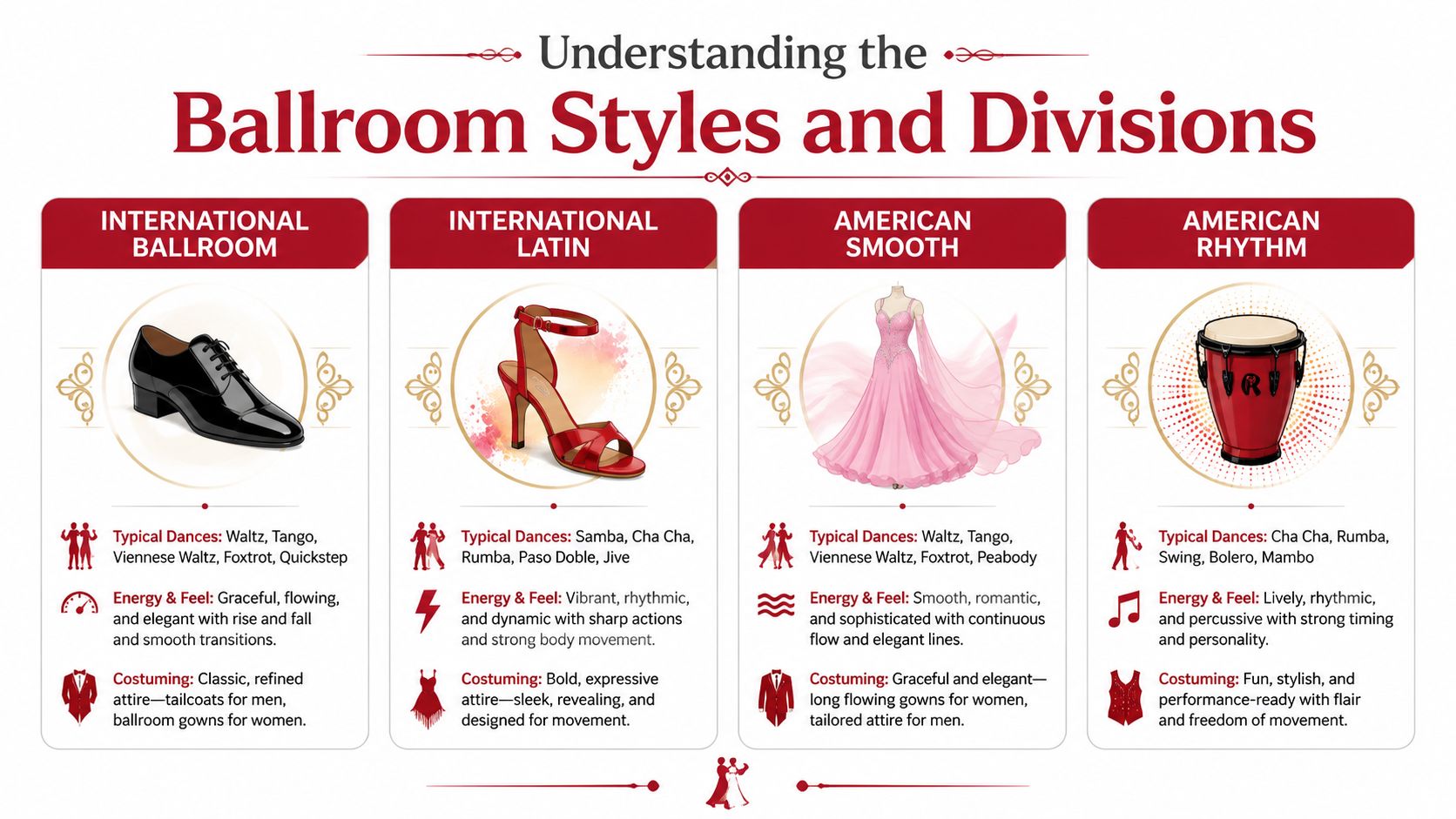
The four competitive families
International Ballroom is the classic formal look many beginners picture first. Couples stay mostly in closed hold, travel around the floor, and aim for clean body flight, a stable frame, and polished rise and fall where the dance calls for it. The five dances in this group are Waltz, Tango, Viennese Waltz, Foxtrot, and Quickstep.
International Latin shifts the feeling completely. The movement is more grounded and rhythm-driven, with clearer use of body action and sharper changes of energy. Instead of one long, continuous silhouette, judges often see more contrast, precision, and individual expression inside a coordinated partnership.
American Smooth shares some DNA with Ballroom, but it allows couples to break out of closed position. That freedom creates bigger shapes, side-by-side moments, and a more theatrical look. For dancers who love sweeping motion but also want room for personal expression, Smooth often feels like a natural home.
American Rhythm is compact, textured, and percussive. It asks for timing you can feel in the body, not just count in the head. Many new dancers connect with Rhythm quickly because the dances often feel direct, musical, and socially familiar, even though competing in them still requires a lot of technical control.
Comparison of Competitive Ballroom Styles
| Style | Key Characteristic | Dances Included | Partnership |
|---|---|---|---|
| International Ballroom | Traveling, elegant, closed-hold focus | Waltz, Tango, Viennese Waltz, Foxtrot, Quickstep | Strongly unified frame, mostly closed position |
| International Latin | Dynamic, expressive, rhythm-driven | Latin dances within the International system | Individual action within coordinated partnership |
| American Smooth | Expansive, flowing, theatrical | Five-dance American Smooth structure | Closed and open positions both matter |
| American Rhythm | Grounded, syncopated, percussive | Five-dance American Rhythm structure | Closer rhythmic interaction and body timing |
For a beginner, one simple comparison helps. Ballroom and Smooth usually reward the look of traveling partnership. Latin and Rhythm usually reward the quality of rhythm, body action, and grounded timing. That is not the whole story, but it is a reliable starting map.
How divisions help keep things fair
Style is only one way competitions sort dancers. Events are also divided by proficiency and age, which gives competitors a clearer lane and keeps the field more comparable.
There is another layer that often surprises first-timers. Some events test a dancer in one dance, while others test versatility across a group of dances. In the international system, dancers may compete in 10-Dance, which combines Ballroom and Latin. In the American system, 9-Dance combines Smooth and Rhythm. Those categories ask for range, adaptability, and consistency across very different movement qualities.
That matters if your goal is not just entering a local event in Philadelphia, but understanding how the sport is structured nationally. A local studio might help you start in one style first. A broader competition path can later expose you to multi-dance events, style specialization, or both.
How to choose your first style
Choose the style you will gladly practice on a Tuesday night when nobody is watching. That choice usually leads to better progress than picking the style that merely looks impressive from the audience.
A few questions can make the decision easier:
- Do you love gliding movement and a classic frame? Start with International Ballroom or American Smooth.
- Do you enjoy sharper rhythm and more grounded action? American Rhythm or International Latin may suit you better.
- Do you want structure that clearly teaches partnered body organization? International Ballroom often gives beginners that feedback fast.
- Do you want more freedom to open out and shape the dance visually? American Smooth may feel more inviting.
For Philadelphia dancers, the practical first step is local, not theoretical. Try a lesson or introductory group in more than one style and notice what makes you want to come back. Judges reward quality inside the style you are dancing. They do not reward picking the “fanciest” category. If your style choice helps you build stronger timing, better posture, cleaner lead and follow, and more confident performance, you are already heading in the right direction.
How a Ballroom Competition Actually Works
The first competition can look chaotic until you know what you're seeing. Once you understand the flow, the event starts to make sense. It's less like a mystery and more like a tournament day.
The day has a clear rhythm
Most dancers arrive early, check in, get dressed, warm up, and keep track of when their events are called. You'll usually wear a number so judges can identify you on the floor. Then you dance your assigned rounds as they come up.
The term heat often confuses beginners. A heat is one scheduled event or round on the floor. If several couples are entered in the same dance and category, they share the floor at the same time. That's why traffic awareness matters so much.
Levels and categories organize the field
Competitions usually separate dancers by two major filters:
Proficiency level
Many dancers begin in syllabus categories such as Bronze, then move upward as their technique develops. The broader progression system leads toward Championship.Age division
Dancers are grouped so they're competing against others in a comparable age category.
That structure is one of the reasons competitive ballroom feels more welcoming than many beginners expect. You aren't being thrown onto the floor against everyone. You're being placed in an organized category.
Rounds work like elimination in other sports
If enough couples enter an event, judges narrow the field through multiple rounds. A common sequence looks like this:
- Early rounds or heats: Couples first present the dance under initial judging.
- Callbacks: Judges select the couples they want to see again.
- Semi-final: The group gets smaller, and the comparison becomes tighter.
- Final: The remaining couples dance for placements.
If you've watched sports brackets, the idea is similar. Each round filters the field until the final set of competitors remains.
A callback is simply a judge saying, through their marks, “Bring that couple back. I need to compare them again.”
Why the format matters for preparation
Competition training isn't just about one good run-through. It's about repeatability. You may need to dance more than once, keep energy stable, and stay mentally sharp while waiting between rounds.
That's why experienced competitors practice entrances, exits, floor awareness, and recovery just as seriously as choreography. The event rewards dancers who can perform clearly in a real environment, not only in the privacy of a lesson.
The Judge's Perspective What Really Wins Points
When dancers ask, “What are judges looking for?” they usually expect a short answer. In reality, judges are looking at many things at once, and the most successful couples make those qualities feel effortless.
According to the USA Dance Competitor Guide, competitive ballroom uses a standardized technical rubric that includes poise, hold or frame, posture, musicality, timing, body alignment or shape, floor craft, foot and leg action, and presentation. That list is helpful, but it becomes much clearer when you translate it into what judges notice in motion.
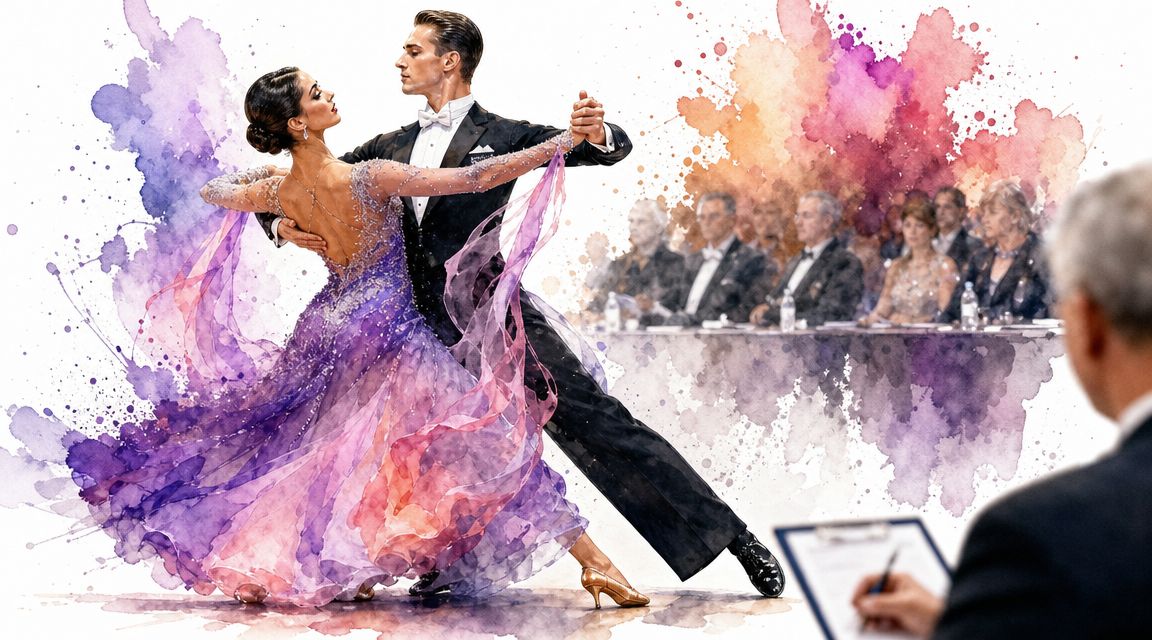
The visible fundamentals
Some qualities read instantly across the floor.
- Poise and posture: Does the couple look organized from head to toe, or do they look collapsed and uncertain?
- Frame or hold: In partnered movement, does the connection stay stable, or does it wobble whenever pressure changes?
- Timing and musicality: Are they dancing with the music, or merely alongside it?
- Presentation: Do they project confidence and clarity, even when the choreography is simple?
Musicality deserves special attention because beginners often reduce it to “staying on beat.” It's more than that. It includes how movement quality matches the character of the music. If you want a deeper plain-English breakdown, this guide on what musicality means in dance is a useful companion.
What judges often reward under pressure
An important underserved truth in competitive ballroom dancing is that winning isn't only about flashy movement. Elite coaches consistently point to composure, space management, and recovery as decisive qualities in a crowded event. That insight appears in this coaching discussion on what judges reward, which emphasizes posture, connection, poise, musicality, floorcraft, and the ability to recover calmly after contact or mistakes.
That matters because competitions rarely happen on an empty floor.
If another couple cuts in front of you, judges are watching your reaction as much as your technique.
Floorcraft separates polished couples from rattled ones
Floorcraft means navigating shared space well. In practical terms, it includes avoiding collisions, choosing safe movement paths, and adapting without breaking partnership.
Consider three common competition moments:
Another couple stops suddenly ahead of you
A weaker couple panics, breaks frame, and looks irritated. A stronger couple shortens the movement, protects space, and keeps the dance alive.You get bumped in passing
A weaker couple shows the mistake on their face. A stronger couple regains balance and continues as if the interruption barely happened.Your choreography won't fit the traffic pattern
A weaker couple tries to force it anyway. A stronger couple adjusts with control.
Judges notice those choices because they reveal real command. Anyone can look good in ideal conditions. Competition tests what happens when conditions stop being ideal.
Clean basics usually beat frantic effort
New competitors sometimes think they need to dance “bigger” to get noticed. Often that backfires. Bigger without control looks wild. Faster without timing looks late. Stronger without connection looks rough.
A couple with quieter choreography can place well if they show stable frame, accurate timing, coordinated body action, and mature floor awareness. In many events, the winners aren't the people trying hardest to look impressive. They're the ones who look most secure.
Your Roadmap to Becoming a Competitor
The path into competitive ballroom dancing gets much easier when you stop treating it like one giant leap. It's a sequence. Learn the environment. Build your basics. Test your skills. Adjust. Repeat.
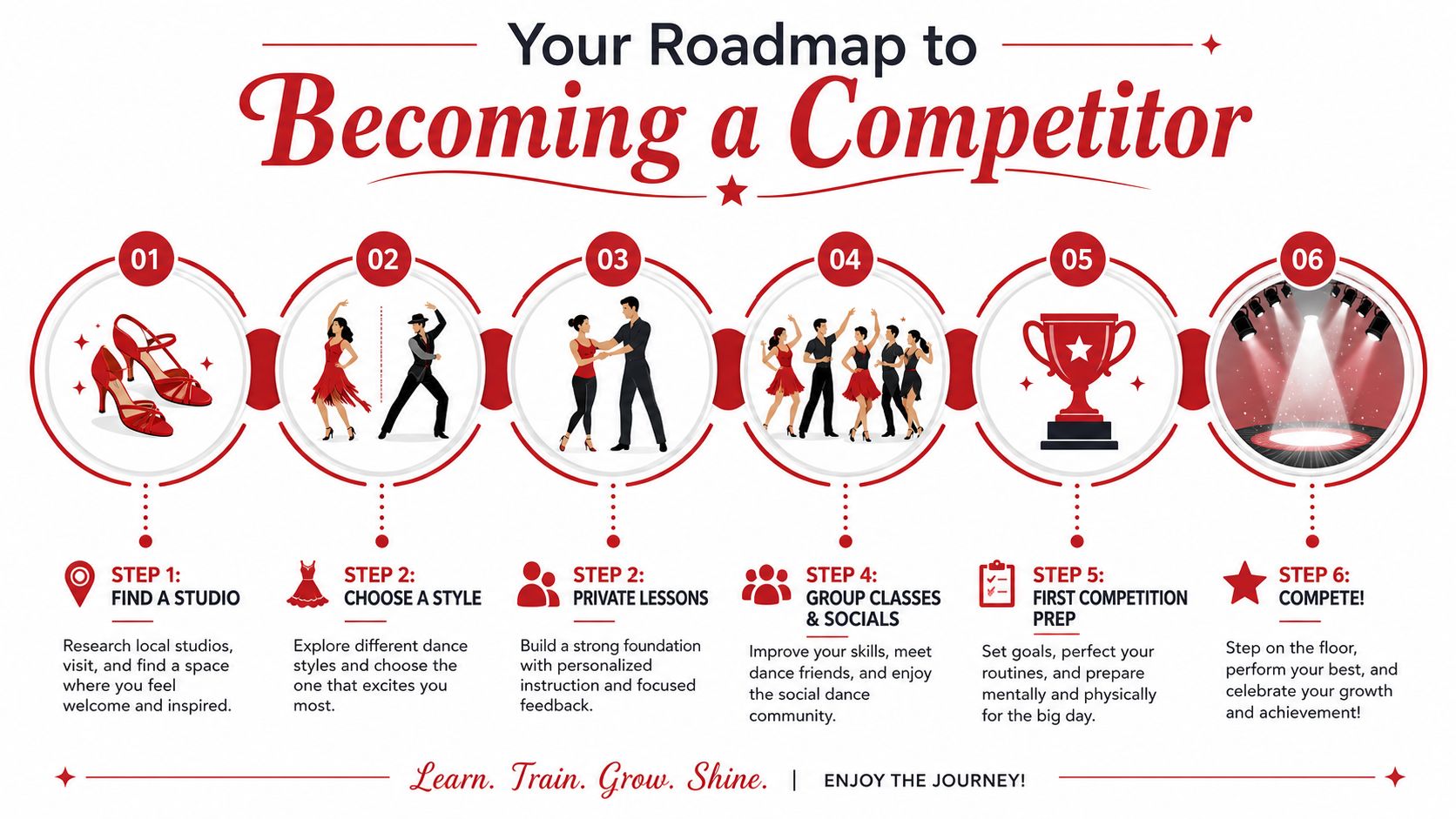
Step one, find the right training environment
Your first priority isn't costumes or competition schedules. It's instruction.
Look for a studio or coach that can do three things well:
- Teach fundamentals clearly: You want corrections you can apply, not vague praise.
- Train for the level you need: A beginner competitor needs basics, not advanced styling too soon.
- Create a welcoming room: You'll improve faster where you feel safe enough to make mistakes.
If posture is one of your weak spots, support your dance training with simple off-floor habits. Resources like these posture exercises and ergonomic tips can help reinforce the body awareness that ballroom demands.
Step two, choose your entry path
Not every competitor starts the same way. Some dance with a personal partner. Others compete with an instructor in a pro-am setting. Some begin with one style, others test more than one before deciding.
A good beginner decision framework looks like this:
- If you already have a reliable partner: You can build partnership habits together from the start.
- If you don't have a partner: Don't let that stop you. Many dancers begin through coached instruction and develop from there.
- If you love structure: One style first is usually easier.
- If you're unsure what fits: Try enough lessons to feel the personality of each option.
Step three, build a training week you can sustain
Consistency beats intensity.
A beginner who trains steadily, listens, and reviews basics often progresses more reliably than someone who overdoes it for a short burst and then disappears for weeks. A practical training rhythm might include private coaching, group class exposure, and solo review time between lessons.
A few useful habits matter early:
- Keep a lesson notebook: Write down corrections in plain language.
- Review short sections: Don't always run the whole routine.
- Practice entrances and beginnings: First impressions count in competition.
- Train recovery: Start again calmly after a missed step.
Here's a good mindset to keep: your practice should feel organized, not dramatic.
Step four, prepare your body and your brain
Competition nerves don't mean you're unprepared. They usually mean you care.
Physical prep is simple in concept. You need enough stamina to repeat quality movement, enough body control to hold posture under pressure, and enough mobility to move cleanly. Mental prep is equally important. You need to stay focused when the floor is crowded, when the music starts unexpectedly fast, or when a round doesn't feel perfect.
This short video offers a useful visual complement to that process:
Coach mindset: Your first competition is not a final exam. It's a diagnostic. You go to learn what training needs next.
Step five, get practical about attire and logistics
Beginners often worry about the “look” before they understand the event. Start simpler.
You'll need attire that lets you move well, shoes that support the style you're dancing, and a basic understanding of how your event schedule works. Save your energy for quality movement and clean presentation rather than trying to manufacture a polished image too early.
Useful prep questions include:
- What dances am I entering?
- What level am I entering them in?
- How long will I wait between rounds?
- What warm-up routine helps me feel settled?
- What are my top three technical priorities?
Step six, treat the first event as the start, not the verdict
After your first competition, ask better questions than “Did I win?”
Ask:
- Where did I lose composure?
- Which corrections held up under pressure?
- Did my timing stay stable?
- How was my frame when traffic got tight?
- What looked better on video than it felt, or worse?
That approach turns competition into a learning engine instead of a one-day emotional roller coaster. The dancers who last in this world aren't always the fastest starters. They're the ones who keep showing up, keep refining basics, and keep letting each event teach them something useful.
Start Your Dance Journey in Philadelphia
If you live in or near Philadelphia, the good news is that this doesn't have to stay theoretical. You can move from reading about competitive ballroom dancing to trying it in a local setting with real instruction.
Philadelphia dancers have a practical advantage. You can learn the national structure, understand what judges reward, and then build those habits close to home instead of waiting for some imaginary future moment when you'll feel more qualified. If you want a sense of what local training options look like, these Philadelphia ballroom dance classes give a useful starting point.
For dancers who like organized pathways, national organizations such as USA Dance can help you understand the broader competitive environment. But local progress is what matters first. A nearby studio, a dependable coach, and a clear first goal will do more for your confidence than reading ten more competition recaps online.
What your first local step should look like
Keep it small and specific.
You do not need to choose your lifelong style this week. You do not need to know whether you'll prefer Smooth, Rhythm, Ballroom, or Latin before your first lesson. You don't need a perfect wardrobe, a dramatic routine, or years of dance history behind you.
You need a beginning.
That beginning usually looks like learning how to stand, connect, count music, and move with intention. From there, everything becomes easier to understand. Competitions make more sense. Judging criteria become less abstract. The floor stops looking intimidating because you can finally see the logic beneath the glamour.
This is the simplest next move if you're ready to stop wondering and start learning:

A first lesson won't turn you into a champion overnight. It will do something better. It will replace guesswork with experience. Once you've felt the frame, heard the counts, and moved across the floor with guidance, competitive ballroom stops being an abstract dream and starts becoming a real skill you can build.
If you're ready to take that first real step, book a free complimentary lesson with Danza Academy of Social Dance. It's the easiest way to explore ballroom in a welcoming setting, ask your questions, and find out which path fits you best. You can book your lesson through the contact page.