The usual advice about the best social dance to learn starts with a style: choose Salsa for energy, Swing for fun, or Waltz for elegance. That skips the question that can determine whether you return: how does the class help a newcomer participate? A welcoming lesson with clear progression may be a better choice than your favorite dance taught in a format that leaves you standing at the edge of the floor.
Choose the experience you want first, then the dance that supports it. Music matters, but so do partner arrangements, teaching pace, and whether you feel comfortable asking questions.
Quick Picks for Every Learner Goal
Choosing a dance by style alone can miss a practical factor: how the class gets beginners involved. A group lesson that welcomes newcomers and lets students meet people may suit a social goal better than a style you like but a class format that does not fit. The right pick depends on what you want from dancing and how the instruction is organized.
A 2024 evidence synthesis of dance-health trials involving older adults found that physical and motor functioning appeared in 77.7% of trials with quantitative measures, while 48.5% of 495 physical- and motor-function tests showed statistically significant improvements after group dancing. These results support dance as a worthwhile activity, but they do not establish one style as medically superior.
Quick picks by learner goal
Use these as starting points, then check how a specific class is taught.
| Your Goal | Start With | Why It Fits | Main Trade-off |
|---|---|---|---|
| Meet people in a group | Salsa or Hustle | Group classes let students meet new people while learning classic moves | Ask how partner rotation works |
| Learn a repeatable routine | Swing or West Coast Swing | Basic patterns can be practiced repeatedly in class | Progress depends on the class level and teaching pace |
| Moderate cardio with rhythm | Salsa | A moderate, rhythm-driven workload can make it a practical active choice | Intensity can vary with tempo and movement |
| Practice timing, posture and navigation | Waltz or Foxtrot | Ballroom instruction gives you structured patterns to learn | The pace and patterns may feel different from club-style dancing |
| Dance with a friend or join solo | Country Two-Step or Hustle | Danza Academy welcomes beginners, and no partner is needed for lessons | Check whether the class uses partnered instruction or another format |
| Prepare a wedding first dance | Waltz or Foxtrot | Ballroom patterns can provide a starting point for couple choreography | Allow time to practice the routine |
Choose a starting point, not a permanent identity
Danza Academy of Social Dance offers private, group, wedding, and social dance options, with classes including Salsa, Swing, West Coast Swing, Hustle, Country Two-Step, Waltz, Foxtrot, and Cha-Cha. The academy welcomes beginners, and students can choose a learning format as well as a dance style.
Class design can shape the learning experience. A group class may offer opportunities to meet people, while private lessons provide one-on-one coaching suited to a student's goals and pace. A beginner-friendly progression can make a complex style more approachable; the dance name alone does not tell you how the first lesson will feel.
Treat your first choice as a trial. Look for instruction you can follow, a format that lets you participate comfortably, and a style you want to practice again.
How Tempo and Counting Decide Difficulty
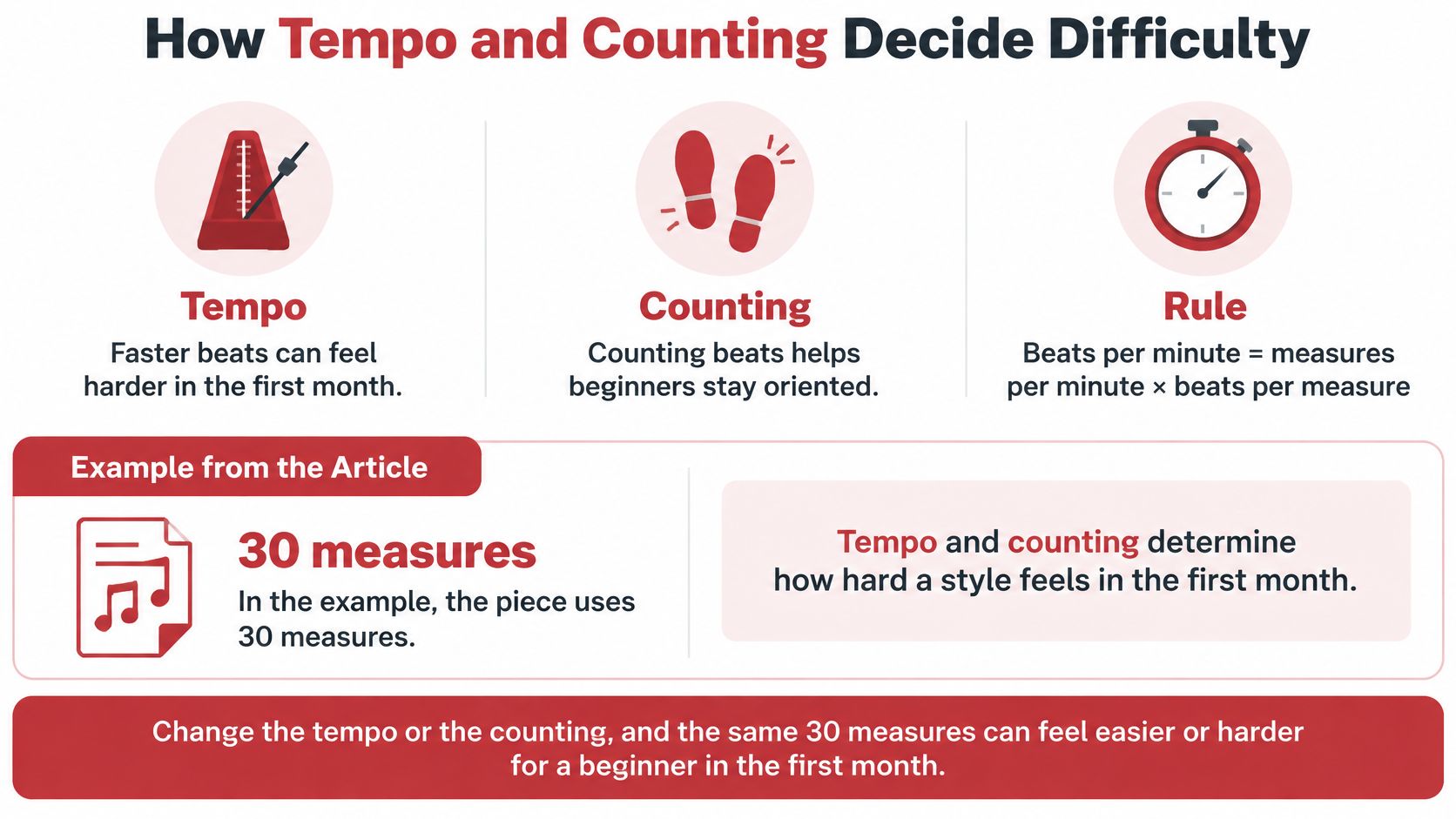
Beats per minute equals measures per minute multiplied by beats per measure, so music at 30 measures per minute produces 90 BPM in three-beat meter but 120 BPM in four-beat meter, as illustrated by the Ballroom Pages tempo chart. Comparing measures alone can therefore give a beginner the wrong impression of musical speed.
Tempo affects how much time you have to move. Counting affects whether you know when to move, and those aren't the same problem.
Tempo and count by ballroom and social dance
The numeric ranges below are competition references from the LoDance tempo guide, which lists Waltz at 84–90 BPM, Viennese Waltz at 174–180 BPM, and Quickstep at 200–208 BPM. They're useful comparisons, not a requirement for the music used in your first lesson.
| Dance | Meter and Count | Tempo (BPM) | Beginner Note |
|---|---|---|---|
| Waltz | 3/4, counted 1-2-3 | 84–90 | A slower starting option for learning timing |
| Foxtrot | 4/4, slow-slow-quick-quick | Select a teaching track with a manageable walking pulse | Smooth walking pattern at a steady pace |
| Cha-Cha | 4/4, 2-3-4&1 | Choose a practice track that leaves room for the split beat | Syncopated count can be harder to hear initially |
| Viennese Waltz | 3/4, fast rotating waltz | 174–180 | Better deferred until basic timing and turning are secure |
| Quickstep | 4/4 | 200–208 | A fast Standard option, not the simplest first lesson |
The Ballroom Pages counting guide describes Waltz's 1-2-3, Foxtrot's slow-slow-quick-quick, and Cha-Cha's 2-3-4&1 patterns. In practice, Waltz asks you to recognize a recurring group of beats, Foxtrot asks you to distinguish longer and shorter step durations, and Cha-Cha introduces a split beat.
This visual separates the musical variables you'll encounter.
Learn the pulse before the decoration
Start by transferring your weight to a slow, regular pulse. Keep your steps small enough that you can arrive on time without lunging, then add changes of direction and partner connection.
Learn an even count before adding syncopation. That doesn't mean Cha-Cha is a poor beginner choice. It means the teacher should establish the pulse before asking you to manage its more intricate rhythm.
Swing, Hustle, and Country Two-Step don't have a single useful beginner tempo independent of the song and class. Ask to hear the actual practice music rather than judging from a competition clip.
Our guide to dance music tempo can help you connect the count to the music you're hearing.
Practical rule: Choose music slow enough to place your weight deliberately. Add speed when you can keep your timing and partner connection without gripping or rushing.
A slower track won't solve every coordination problem, but it gives you room to identify one. Fast music is less forgiving when you're still deciding which foot should move next.
Class Design, Social Life and How to Test a Class
Partner dancing isn't automatically the best route to social connection. The class's social design matters more than the mere presence of partners.
A review of group dance and wellbeing describes opportunities for community-building, autonomy, and reduced isolation, while also noting gaps in representation across groups including men, middle-aged adults, Indigenous people, LGBTQIAP+ communities, and migrants. That limits how confidently anyone can promise that a particular dance environment will feel welcoming to everyone.
The useful question isn't whether a class is social in a basic sense. It's how people are invited to participate, change partners, and set boundaries.
Match the social format to your comfort
A partner-rotation class changes partners at instructor-led intervals. It can suit someone who wants to meet several people without having to initiate every interaction.
A couples-focused lesson concentrates on an existing partnership. That can be useful for shared goals, but it doesn't necessarily offer the wider interaction a newcomer wants.
A solo-friendly group class lets someone enter without bringing a partner. Check whether that means individual choreography, partnered instruction with rotation, or another arrangement, because these are different experiences.
Look for an environment where participation is structured rather than left to chance.
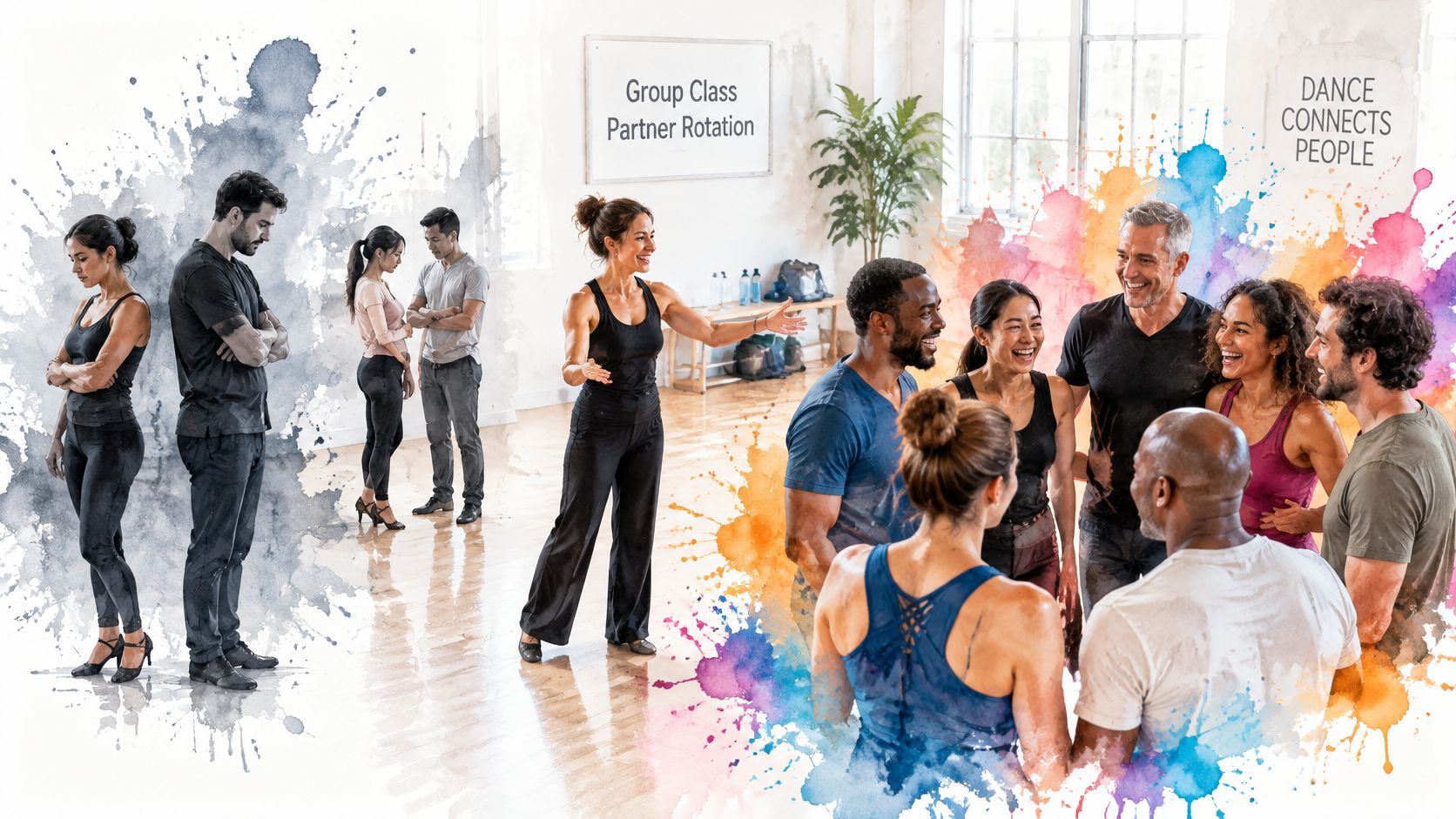
Say you're shy and arrive alone. An instructor who introduces the rotation process removes the need to negotiate every practice partnership yourself.
If you want no romantic expectations, look for explicit teaching language about dance roles and consent. If you're unsure how to request a dance, ask the instructor to explain invitations, refusals, and how to end a dance politely.
Our Group Dance classes let students meet new people while mastering classic moves. No partner is needed to take lessons, and your significant other can join lessons for free.
Test the room before choosing the style
- Book a complimentary first lesson. Use it to assess the teaching style and your comfort in the space, not to judge whether you already look accomplished.
- Ask how partnering works. Find out whether partners rotate, whether rotation is optional, and whether students can explore different roles.
- Clarify who can attend with you. You're welcome without a partner; if you'd like your significant other involved, we welcome them to join for free.
- Check the starting count. Look for an introduction you can follow before the teacher adds rhythmic complexity.
- Watch how patterns are broken down. The instructor should separate foot placement, weight transfer, and partner connection rather than demonstrate a finished sequence repeatedly.
- Notice how newcomers are treated. Pay attention to introductions, invitations, and whether beginners receive space to practice without pressure.
- Choose a trial period. Consider four to six sessions as a personal decision window, not an evidence-based deadline for becoming confident.
Avoid judging a class by videos of advanced dancers, choosing by style name alone, or deciding that one awkward lesson proves you can't dance. Private instruction is another option when you want one-on-one coaching matched to your pace.
Practical preparation matters, too. If you're planning to dance in Highland formalwear at an event, finding your Gordon kilt fit through Kilts4Less is a relevant clothing resource; rehearse in event clothing to check comfortable movement rather than assuming your usual practice outfit tells you enough.
Our guide to choosing a dance studio offers further decision criteria.
A good beginner class doesn't require you to arrive confident. It gives you clear ways to participate while confidence develops.
Fitness and Brain Benefits by Style
Measured and reported benefits by dance style
A dance's physical demands depend on the session, not just its name. Exercise-intensity measurements, controlled interventions, and participant reports answer different questions, so the evidence should be read by type.
| Style | Reported Benefit | Evidence Type | Best Fit |
|---|---|---|---|
| Salsa | 3.9–5.5 METs across lessons, rueda de casino, and nightclub dancing in the salsa comparison study | Single comparison study measuring workload | Moderate cardio with rhythm |
| Ballroom, including Waltz, Foxtrot, and Rumba | Better spatial memory after about 69 one-hour sessions in the controlled older-adult program | Controlled intervention using a mixed dance repertoire | Navigation and sequence learning |
| Partnered modern dance | 92% reported better coordination; 82% reported better memory or ability to learn new things, among 225 participants, in the partnered-dance participant study | Self-reported perceptions, not clinical performance tests | Learners interested in coordination and learning |
| Group dance for older adults | Reviews report improvements across physical-function measures in multiple group-dance interventions | Evidence synthesis covering multiple interventions | Endurance, balance, and strength |
Among these findings, Salsa has the clearest style-specific link to cardiovascular workload: the comparison study measured moderate intensity across several dance settings. A fast tempo alone, however, does not show how much of a class is spent moving.
The ballroom intervention produced better spatial-memory results after participants learned a mixed repertoire that included Rock and Roll and Salsa. Its results cannot be attributed to Waltz, Foxtrot, or Rumba individually.
Don't turn an association into a promise
Longitudinal evidence summarized in the ballroom paper associated dancing at least three times weekly with lower dementia risk, with a hazard ratio of 0.24 and a 95% confidence interval of 0.06–0.99. This was an association, not proof that dancing alone caused the difference or that a particular style prevents dementia.
The partnered-dance percentages describe what participants believed had improved. They do not establish that memory or coordination changed by a measured amount on clinical tests.
The studies discussed here do not directly establish benefits for Swing or Hustle. Their absence from the table reflects a gap in style-specific evidence, not evidence that these dances offer no benefit.
Evaluate the workload you actually receive
A session's demands depend on tempo, footwork complexity, time spent dancing, partner changes, and breaks. A fast-sounding class with long explanations may involve less sustained movement than a simpler lesson with repeated practice.
For fitness, regular participation and the amount of active practice matter alongside style. Danza Academy of Social Dance offers Salsa and other social dance classes; the class format can shape how much time students spend moving. For broader context, read the benefits of social dancing.
If you are planning meals around an active schedule, Gym Snack's guide to workout nutrition covers food choices. It does not provide evidence about dance's health effects.
Which Dance Fits Your Learner Profile
The best social dance to learn depends on what you need your lessons to accomplish. Treat the following recommendations as decisions about instruction and purpose, rather than rankings of artistic value.
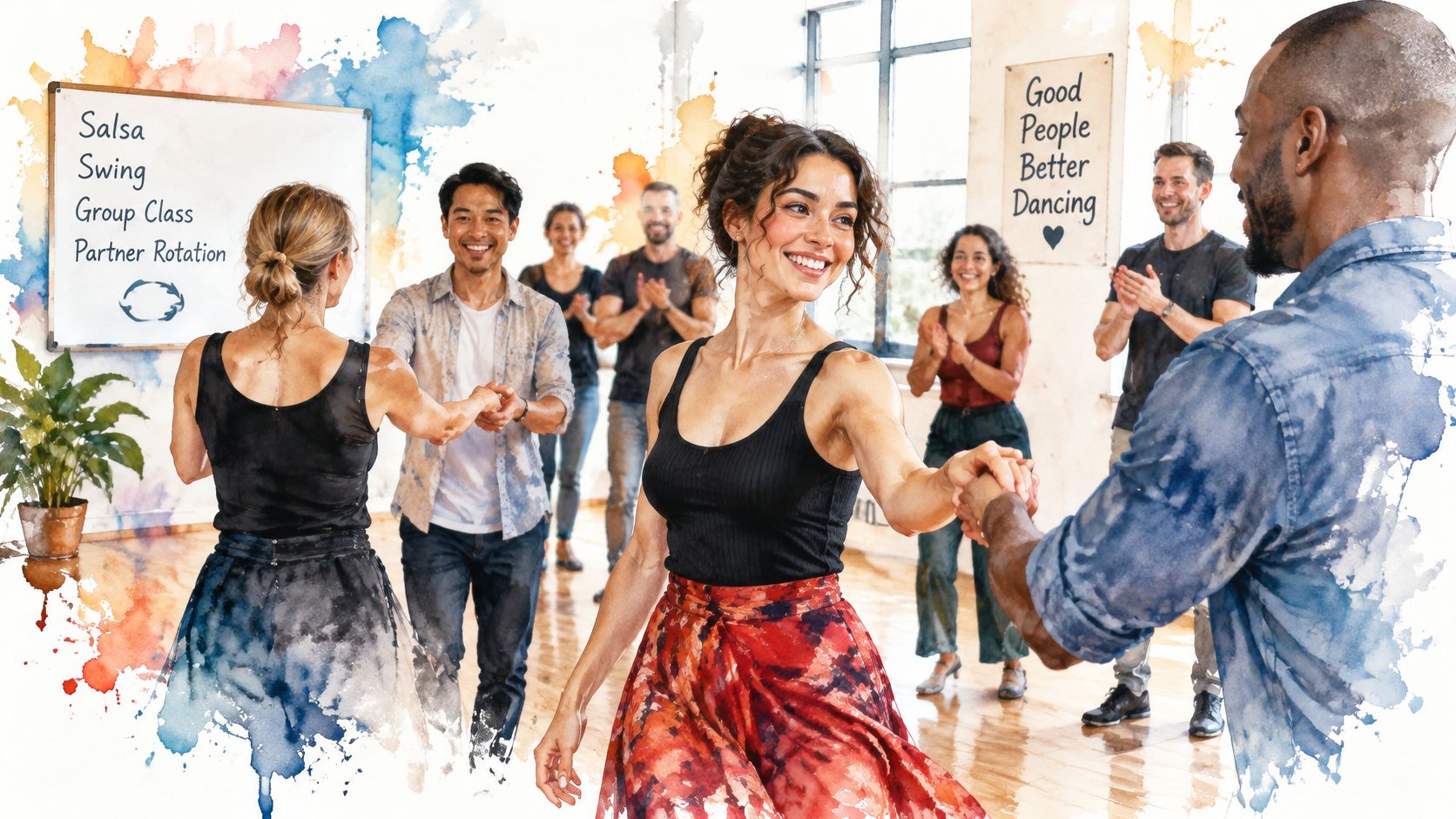
A group setting can make the learning experience feel shared rather than solitary.
First-time adults seeking social confidence
Start with a beginner Salsa or Swing group class that explains its partnering arrangements. Your early objective should be recognizing the basic rhythm, completing a repeatable pattern, and communicating comfortably with a partner, not collecting complicated turns.
Expect to spend your initial lessons revisiting fundamentals. The partnered-dance study found that experienced dancers reported greater perceived benefits than novices, which suggests continued participation may matter, but doesn't prove experience alone caused those differences.
Next step: Choose an introductory group and set a personal attendance window before judging your progress.
Fitness-focused adults
Choose Salsa with substantial active practice. Ask how much of the lesson involves moving to music, and favor instruction that introduces turns gradually rather than sacrificing control for speed.
A useful class should challenge your movement without making you rush through weight changes. Tell the instructor if your goal is sustained recreational activity rather than performance.
Next step: Request a beginner lesson with a manageable pace and room to progress.
The video below offers another way to consider the studio experience before attending.
Couples preparing a wedding first dance
Consider Waltz or Foxtrot, then match the choice to your song. Don't force a favorite recording into an unsuitable rhythm because a style sounds traditional.
Our Wedding Dance lessons help couples create their first dance for their wedding day. Starting several months ahead can leave room for choreography, comfortable entrances and endings, and practice in wedding shoes, but the appropriate schedule should reflect your routine and availability.
Next step: Bring your song choice and describe whether you want a simple, relaxed dance or more developed choreography.
Parents choosing for a child
Choose a children's program rather than an adult social class adapted informally. Our Dancing for Kids program aims to build coordination, discipline, and creativity from an early age.
Those are program goals, not outcomes established for our students by the adult dance studies discussed here. Look for instruction your child can understand and a pace that keeps participation enjoyable.
Next step: Discuss your child's experience and readiness for structured instruction.
Experienced social dancers and competitors
Choose Professional Training or discuss Pro/Am coaching rather than repeating a general beginner course. Advanced goals require more targeted work on technique, musical interpretation, partner communication, and performance.
Our Professional Training serves competitive or advanced dancers seeking mastery. A familiar style taught with precise technical feedback may be more useful than adding another style without a clear purpose.
Next step: Identify the specific skill or competitive goal you want coaching to address.
Book Your Free Lesson and Start Dancing
Your first lesson is complimentary, so you can replace uncertainty with a direct experience of the studio before deciding how you'd like to continue. You don't need to arrive knowing the terminology, owning a repertoire of steps, or having chosen your permanent dance style.
At Danza Academy of Social Dance, we have studios in Center City Philadelphia and Exton, PA. Choose the location that fits your routine, because a convenient lesson is easier to make part of an ordinary week.
Bring a goal, not a performance
Come ready to explain what you want from dancing and what pace feels comfortable. That conversation gives your instructor a useful starting point for matching instruction to your level.
You might want to feel less hesitant at parties, learn alongside your significant other, or prepare for a specific event. If you're undecided, name a starting style from the quick picks and explain what attracted you to it.
- For social confidence: Say whether you're arriving alone and what kind of group interaction feels comfortable.
- For a wedding: Bring your music choice and describe the kind of first dance you want.
- For technique or fitness: Explain your current experience and the activity you want to build into your schedule.
Make the first appointment concrete
Use the BOOK your free lesson button on our home page, or book your complimentary first lesson through our contact page. Include your preferred studio and your main goal so you can begin with a focused conversation.
After the introduction, choose a manageable practice commitment rather than demanding immediate fluency. Give yourself enough repeated instruction to distinguish unfamiliarity from a genuine mismatch.
The best social dance is the one you keep coming back to.
Danza Academy of Social Dance offers private instruction, group classes, wedding preparation, and social dance options to help you find a style that fits your goals. Visit Danza Academy of Social Dance and use the BOOK your free lesson button to arrange your complimentary introduction in Philadelphia or Exton.