
The date is booked, the gown is ordered, and the court has said yes. Then someone asks who is teaching the waltz, and the kitchen table goes quiet. That silence is where a lot of quinceañera plans start to wobble, because the dance is the one piece of the celebration you can't buy, borrow or hand to a vendor in the final week.
Treat the waltz dance for quinceanera as a project with three moving parts: the choreography, the teenagers performing it, and the room it happens in. Get the order right and the routine looks calm and inevitable. Get it wrong and you get a court counting under its breath while the track runs on without them.
Choosing Solo, Court and Surprise Choreography
A court of fifteen teenagers with eight weeks to rehearse needs a different plan than a father and daughter with a free month of Sundays. Pick the format before the song, because the format decides how many bodies have to learn the same counts, how much floor space the routine eats, and how much the lessons will cost.
The traditional shape is well documented. Britannica's overview of the quinceañera describes the celebrant performing with a court of honor of damas and chambelanes, who accompany her formal presentation and join a group waltz called the vals. That court format is the most demanding version of the dance, because every dancer has to hit the same counts, the same entrance and the same spacing on the same night.
| Format | Dancers | Typical Length | Beginner Difficulty | Best Fit |
|---|---|---|---|---|
| Father-daughter waltz | Celebrant and father | One song, cut to a single edit | Low to moderate | One personal moment in a short timeline |
| Court vals | Celebrant with damas and chambelanes | 3 to 5 minutes | High | Large groups with 2 to 4 months of rehearsal |
| Solo or short ballroom sequence | Celebrant, optionally 2 to 6 court members | One song, edited shorter than the court vals | Moderate | Limited time or a small venue |
| Surprise or modern number | Celebrant and friends or cousins | One upbeat song, usually the last dance of the formal set | Moderate | Energy after the formal waltz |
What each format asks of the court
The father-daughter waltz buys you the most emotional value per rehearsal hour. Two dancers, one short piece, a handful of lessons, and it lands as a personal moment rather than a production. It also spares the court's limited rehearsal budget for the group number, which matters when every extra hour of coaching is a line item the family has to approve.
The court vals is the opposite trade. It looks the most impressive and costs the most coordination. If one chambelan misses rehearsal for three weeks, the whole formation drifts. Shorten the sequence for the weakest dancer in the group rather than adding turns for the strongest. Plan the pacing like a coach, not a choreographer: teenagers dancing three to five minutes in formalwear need rest breaks built into every rehearsal, and the routine itself should front-load the difficult figures while legs are fresh, saving simple walking steps for the final minute.
A solo or short ballroom sequence suits a tight timeline or a small banquet floor. Six court members is plenty for a clean picture, and fewer bodies means fewer collisions when the venue's dance floor turns out smaller than the one you rehearsed on. Measure the reception floor before you fix the formations, because a vals staged for a big ballroom will not survive a narrow rectangle between dinner tables.
The surprise number works best when it's built on a simpler pattern than the vals. Friends and cousins who joined late can learn a repeated eight-count hook faster than a waltz phrase with partner changes, and a simpler pattern keeps late joiners from slowing down the core group's waltz practice.
Some families want a different group pattern entirely. The documented history of the quinceañera records a Cuban variation in which 14 couples waltz around the celebrant, a very different staging problem from a line of paired damas and chambelanes. Ask which custom the family wants before you teach a single step, since a circle of couples needs far more floor space and far more rehearsal time than a standard court line.
Then check the running order. A published reception timeline places the father-daughter waltz and court dance at 7:50 p.m. with the surprise dance at 8:20 p.m., and other sample schedules push the court waltz later into the evening. Confirm the order with the emcee and the DJ, because the waltz is the formal handoff before the party turns loud, and the gap between the vals and the surprise number is the court's only chance to rest, hydrate and fix wardrobe problems.
That same gap is where most receptions slide in the photo montage or a video tribute, so the timing of the screen matters to the timing of the floor. Families building that montage can draw on birthday video inspiration from Photo for Video and then place it where it gives the dancers a real break instead of splitting their warm-up. Every minute the montage runs is a minute the court is either recovering or getting cold, so treat it as part of the rehearsal plan rather than a separate project.
Families weighing the court format against a simpler plan can start with quinceañera dance classes at Danza Academy, where private and group options let the celebrant train alone while the court works together, and the format gets settled before the choreography begins.
Plan the Rehearsal Timeline Before the First Lesson
A family that books lessons six weeks out often finds out at the first rehearsal that the court cannot count the phrases. A court waltz is a choreographed performance, not social dancing, and it needs a runway.
Pelazzio's quinceañera venue timeline recommends rehearsing the court vals for roughly 2 to 4 months and reports that each choreographed dance commonly lasts about 3 to 5 minutes. That duration is long enough to demand planned formations, musical transitions, an entrance and a defined ending pose, and short enough to hold a reception crowd.
So the first work session isn't a dance lesson. It's a music decision. Pick a 3/4 waltz with a steady, walking-pace beat that the least experienced chambelan can count aloud, not a fast Viennese whirl. Cut it to a clean edit inside that 3 to 5 minute window, with an obvious first downbeat and a clear final chord to pose on. Then send the same file to the DJ, the emcee and every court member, so nobody rehearses to a different version.
| When | Focus | Goal | Check Before Moving On |
|---|---|---|---|
| 4 months out | Lock the music and assign roles | Basic timing and foot pattern without turns | Steps counted to the music at half tempo |
| 3 months out | Add partner frame and weight transfer | Phrases practiced in 8 to 16 count blocks | Clean weight changes in both directions |
| 2 months out | Add quarter-turns and traveling pathways | Full sequence with the court | Spacing holds across three run-throughs |
| 6 weeks out | Add entrance, formations and ending pose | Staged run in a venue-sized space | Recovery after a missed cue |
| 2 weeks out | Dress and shoe test with floor markers | Full run in costume | No new steps introduced |
| Final week | Taper and rest | Light marking only | Routine feels fresh, not exhausted |
The venue test you can't skip
A formation that looks generous in a studio turns into a traffic jam on a banquet floor. Book one rehearsal in a space that resembles the venue, or at minimum mark out the actual usable floor with tape and set a chair where the head table will be.
The same source warns that a routine rehearsed only in a studio can crowd up on the night, so run the entrance and the exits at performance width. If the room is narrower than the studio, cut the traveling sequence rather than squeezing the spacing. Tight spacing is what causes collisions, stepped-on hems and the panicked look that reads on camera.
How to Teach the Waltz Basics in Order
Sequence beats volume. A court that learns the pattern in the right order looks composed after six sessions; a court that jumps straight to the full routine with the music looks lost after twelve. That difference is not talent. It is planning. Teach the waltz like a rehearsal-safety project, with timing, footwork, spacing, floor limits and lesson time treated as one schedule.
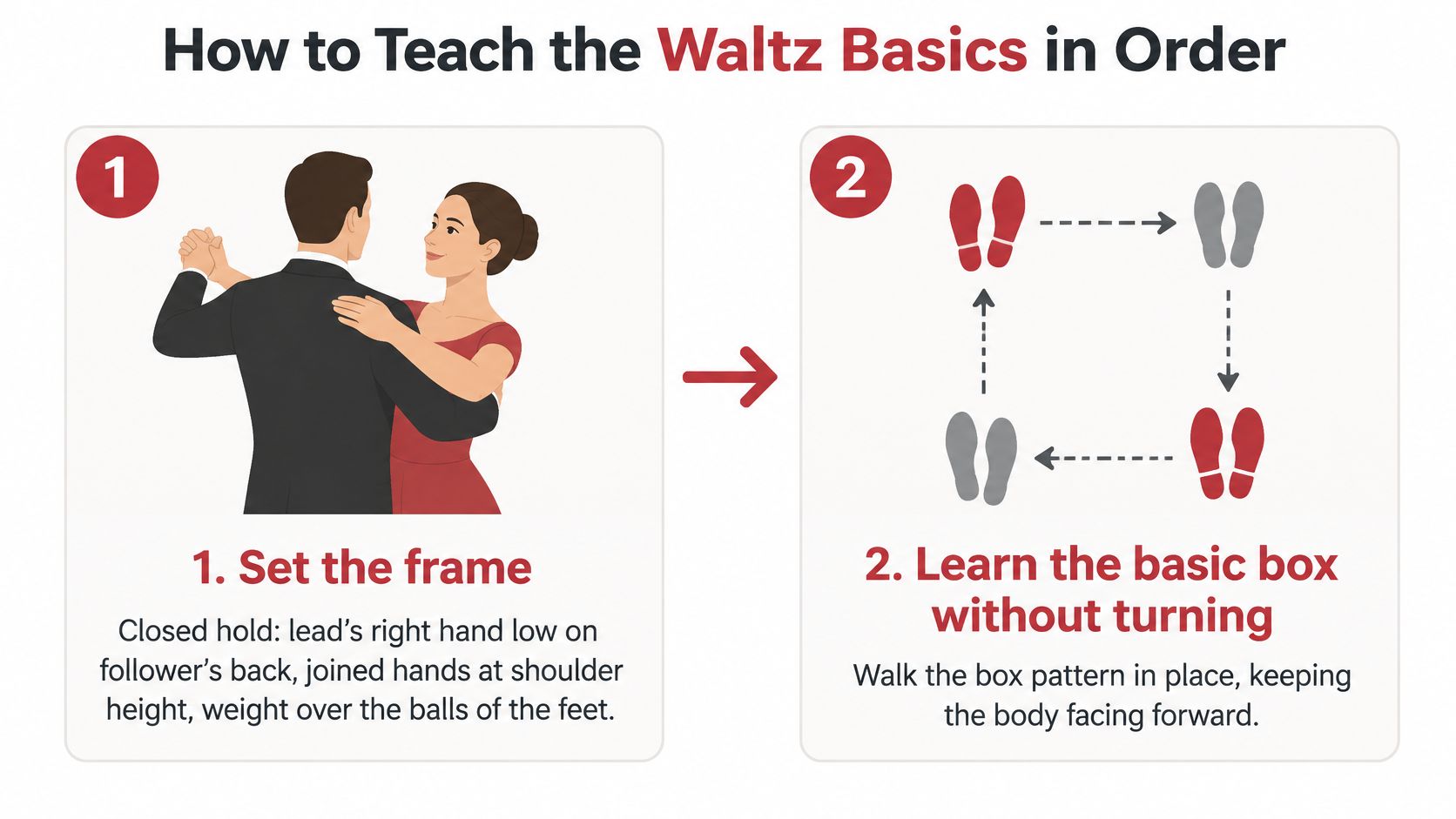
Use this order for the first teaching block: timing and foot pattern without rotation, then frame and weight transfer, then quarter-turns and traveling pathways, and only then the entrance, formations and ending pose. A study of waltz instruction and feedback belongs in the wider discussion of how feedback supports learning, but the teaching order below is a practical sequence for a court working toward a dated event.
Set the frame. A closed hold with the lead's right hand low on the follower's back, joined hands at shoulder height, weight over the balls of the feet. Frame first because a collapsed frame makes every later correction harder to feel.
Learn the box without turning. The lead steps forward left, side right, close left. The follower steps back right, side left, close right. No rotation, so the court can watch their own feet without spinning into each other.
Add rise and fall. Rise on the first beat, lower through the second and third. A flat, stiff waltz is a common look in quinceañera rehearsals, and this is the fix. Keep the movement small until the count is steady.
Count aloud in short blocks. Work 8 to 16 counts at a time, alternating slow marking with full-tempo repetitions. Short blocks expose errors while they're still fixable. One clean block repeated well is better than a full routine performed in panic.
Add quarter-turns, then travel. Keep the knees soft through every turn and turn from the frame, not the arms. It is at this stage that the court learns to move as a group rather than as couples. Add travel only after every couple can hold the same spacing.
Add the entrance and pose last. Once the pattern is automatic, the walk-on and the final picture take one session instead of five. Save these layers until the dancers can recover from a missed cue without colliding.
Here's the pattern at tempo, so the court can see what the counts look like once they're joined together.
The feedback rule that saves weeks
Name one specific error, give one actionable fix, then reinforce the improvement immediately. "Your backward step is too long, take it half the size, that's it" beats "good job" every time. Keep corrections short because teenagers retaining a full routine need one clear task, not a lecture. Demonstrate footwork and spacing visually, because technical movement is easier to copy than to decode from words. Explain musicality and performance quality in words, because phrasing and expression need language.
Coaching benchmark: record a rehearsal from the audience's point of view and score four things separately, timing, spacing, posture and frame, and recovery after a mistake. A routine is performance-ready when it completes three consecutive full run-throughs without stopping while staying on the music and keeping safe spacing.
Waltz basics give dancers transferable ballroom skills. They teach counted movement, partner awareness, smooth weight changes and controlled travel, all of which help later in ballroom classes such as Waltz, Foxtrot, Tango, Quickstep and Jive. The habits also protect the schedule. A court that learns the basics cleanly spends fewer sessions repairing spacing and more sessions polishing the music, the formation and the ending.
Keeping Teen Dancers Safe Without Overtraining
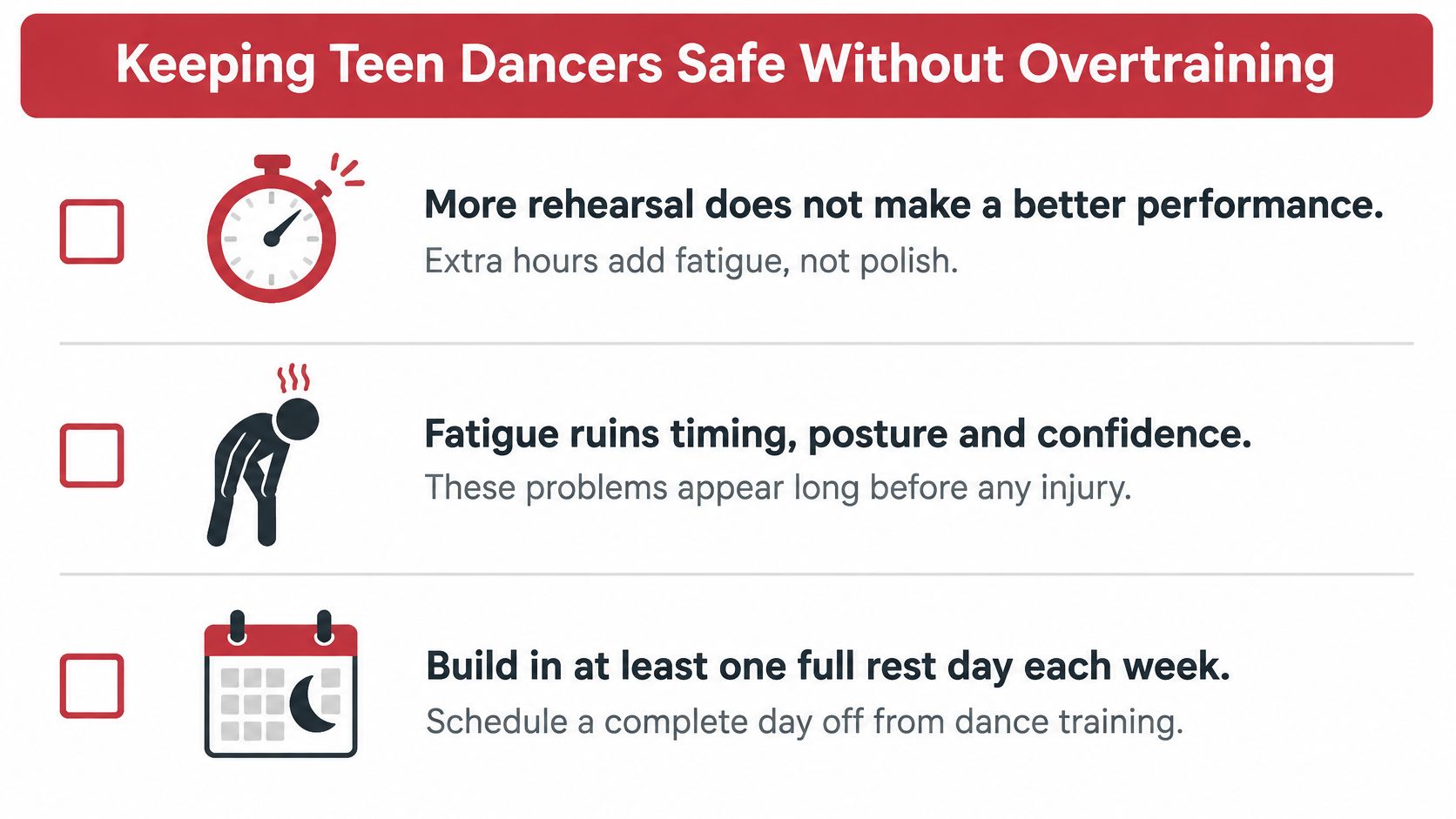
A tired court does not just look tired. Timing spreads, posture drops and confidence goes quiet, often well before anyone calls it an injury. A dancer who has rehearsed eight times may look worse at 9 p.m. on a Saturday than a rested dancer who knows four fewer moves.
Youth dance guidance is blunt about the limits. Published injury-prevention guidance for adolescent dancers recommends at least one full rest day each week and 2 to 3 months away from organized activity each year, and notes that injury risk may increase when weekly organized dance hours exceed the dancer's age in years. For a 15-year-old, that makes 15 organized hours a week a rough ceiling. School sports count toward it. So does a late rehearsal after a full day of classes.
- Warm up before every session with progressive movement and basic weight-transfer drills. Static stretches held in heels do not prepare a dancer for box steps, turns or the stop-start rhythm of an entrance.
- Add two or three balance sets per side, twice weekly. Use thirty to forty-five seconds of controlled single-leg stance, reach patterns and a slow quarter-turn recovery. Keep the drill boring and repeatable. Balance work belongs in the routine because waltz asks teenagers to control weight while moving through space, not just while standing still.
- Taper in the final week. Cut volume and keep marking. Extra full-out rehearsals at the end buy anxiety, not polish. The floor pattern should already be known by then.
- Pause on the warning signs. Persistent pain, limping, unusual fatigue or loss of coordination means rest and a medical check. A racing heart and a tight stomach before the entrance are ordinary nerves.
Plan the waltz around school, club sports, growth spurts and venue limits. Put rest on the calendar before the first lesson, then fit rehearsals into the space that remains. Families who want teenagers to keep dancing after the celebration can build coordination in a structured setting through our youth dance programs, where progression is paced rather than crammed.
Common Waltz Problems and How to Fix Them
The same handful of problems appear in nearly every quinceañera rehearsal, and each one has a fix you can apply in the next fifteen minutes.
Oversized steps wreck spacing before they wreck anything else. If the court drifts apart by the second phrase, the step length is the cause. Bring every step back to box width and mark the formation positions with floor tape.
Locked knees during turns make the dancer look rigid and put the balance on the joint instead of the muscle. Soften the knees, keep the core engaged, and the turn slows down and stabilizes at the same time.
Pulling a partner through the rotation is the lead's error, not the follower's. The lead guides from the frame with the torso, and the arms stay quiet. Drill the turn in hold with the hands barely touching so the lead can feel the difference.
Rehearsing only in sneakers hides the problem until the night. Practice in the actual shoes early, because heel height changes posture, step length and turning room.
Introducing the costume in the final rehearsal is the mistake that ruins the entrance. Move the dress test to week two. A heavy gown or long train shortens the safe step and eats the turning room, so cut the travel and retest the turns in the dress rather than hoping it behaves.
Take the routine out of the studio
Uneven outdoor ground, a crowded banquet floor and a narrow dance area all change what the choreography can be. Measure the usable floor, place markers for each formation, and rehearse the entrance from the actual doorway the court will use. If the room is tight, reduce traveling pathways and keep the turns in place.
"Traditional" is not one fixed sequence. Preserving the waltz's musical character and ceremonial meaning matters more than reproducing a difficult turn.
Build a low-travel version
When a court member can't lift, dip or travel far, offer a no-lift, low-travel version that keeps the same counts and the same formation shape. The group picture survives, and nobody gets injured proving a point. A dancer who must sit or use a mobility aid can stay in the design by moving the formation around her position rather than cutting her from the piece.
Hold the principle steady: keep the music's character and the ceremonial meaning, and drop the difficult turns first.
What Lessons Cost and How Many to Book
Lesson packages look similar until you run the division. A $750 price tag means nothing until you know whether it buys five hours of basic frame work or five hours of full routine building. The table below maps each published 2025 rate to the studio that publishes it, so you can compare hourly values before committing.
| Studio and package | Lessons or Time | Price in 2025 |
|---|---|---|
| You Can Dance Co. preparation package | 5 lessons | $330 |
| You Can Dance Co. preparation package | 15 lessons | $850 |
| Austin Inspired Movement choreography package | 5 lessons | $750 |
| Austin Inspired Movement choreography package | 10 lessons | $1,275 |
| The Dance Network Quinceañera and Sweet 16 package | 5 lessons | $435 |
| The Dance Network Quinceañera and Sweet 16 package | 10 lessons | $815 |
| Top Hat Dance Studio court-dance rate | Up to 12 participants, per hour | $100 |
| Top Hat Dance Studio court-dance package | 6-hour package | $525 |
At You Can Dance Co., the 5-lesson preparation package works out to about $66 a lesson and the 15-lesson package to about $57. At Austin Inspired Movement, the 5-lesson choreography package comes to about $150 a lesson against about $128 on the 10-lesson package, so check closely what each tier covers, whether it's frame work, counts or a full routine. At The Dance Network, the split is about $87 a lesson against about $82, and the group waltz is listed as one of the celebration's three customary dances. For a court, Top Hat Dance Studio publishes $100 per hour for up to 12 participants, or about $88 an hour across a 6-hour package.
Which booking fits your situation
Budget is a logistics decision, not merely a price comparison. Money spent on lessons competes with money for the venue, the dress, and the floor time your court needs, so book the smallest package that handles the routine rather than the largest one you can afford.
A solo dancer or a single couple can cover the basic box, rise and fall and first turns in 5 lessons. A full court needs 10 or more hours, because the entrance, formations and missed-cue recovery eat time that basic instruction doesn't. Hourly booking suits a group that already knows the steps and needs floor time; a package suits a court that needs repeated drilling.
One more scheduling reality: teenagers burn out when rehearsals pile up in the final weeks. Ten hours spread across two months teaches more than ten hours crammed into the last ten days, and spacing the sessions costs the same. Book early enough that rest days exist between rehearsals, and leave one unscheduled slot in reserve for the court member who misses a session or struggles with the turns.
Ask for the rate in writing, including what counts as a lesson, whether rehearsal time with the court is included, and what happens if a court member drops out. For a fuller picture of how private instruction is priced across styles, see what private dance lessons cost.
Book Your Complimentary Lesson Before Rehearsals Start
A date on the calendar changes the booking conversation. Before you book anything, choose the music file, mark the rehearsal dates from the timeline, and count the court members who can genuinely attend. That gives an instructor enough detail to answer with a workable plan instead of a generic yes.
Then book your complimentary lesson at our contact page. Your first lesson at Danza Academy is complimentary and easy to book, and beginners are welcome, so nobody has to audition for the privilege of learning a box step.
Use that session to test the chosen format against reality. Bring the music file, the shoes or dress you plan to wear, and a list of court members with their availability. Ask the instructor to check step counts, rise and fall, and spacing on a floor sized like your venue, so problems surface while the routine can still change. Private coaching is one-on-one and paced to the student's goals, which matters when the goal is a specific date rather than a general skill.
Book the free lesson, then set the next rehearsal date while the calendar still has room in it. Danza Academy of Social Dance has been teaching Philadelphia and Exton dancers since 1976, and private lessons are fitted to your goals. Bring your rehearsal dates and court list to the complimentary first lesson, then build the plan around the time, floor space, and attendance you truly have.