
A lot of families reach the dance part of quince planning and suddenly feel stuck. The dress is being discussed, the guest list is growing, and someone finally asks, “When are we supposed to start the vals?” That’s usually the moment dance stops feeling like a fun idea and starts feeling like a project.
The good news is that dance classes for quinceaneras become much easier once you treat them like a plan instead of a last-minute task. You don’t need a court full of trained dancers. You don’t need a perfect rehearsal schedule on day one. You need a clear timeline, realistic choreography, and a way to help beginners and stronger dancers improve together.
Your Quinceañera Dance Planning Timeline
Most families feel overwhelmed because dance planning seems like one giant decision. It’s not. It’s a series of smaller decisions made in the right order.
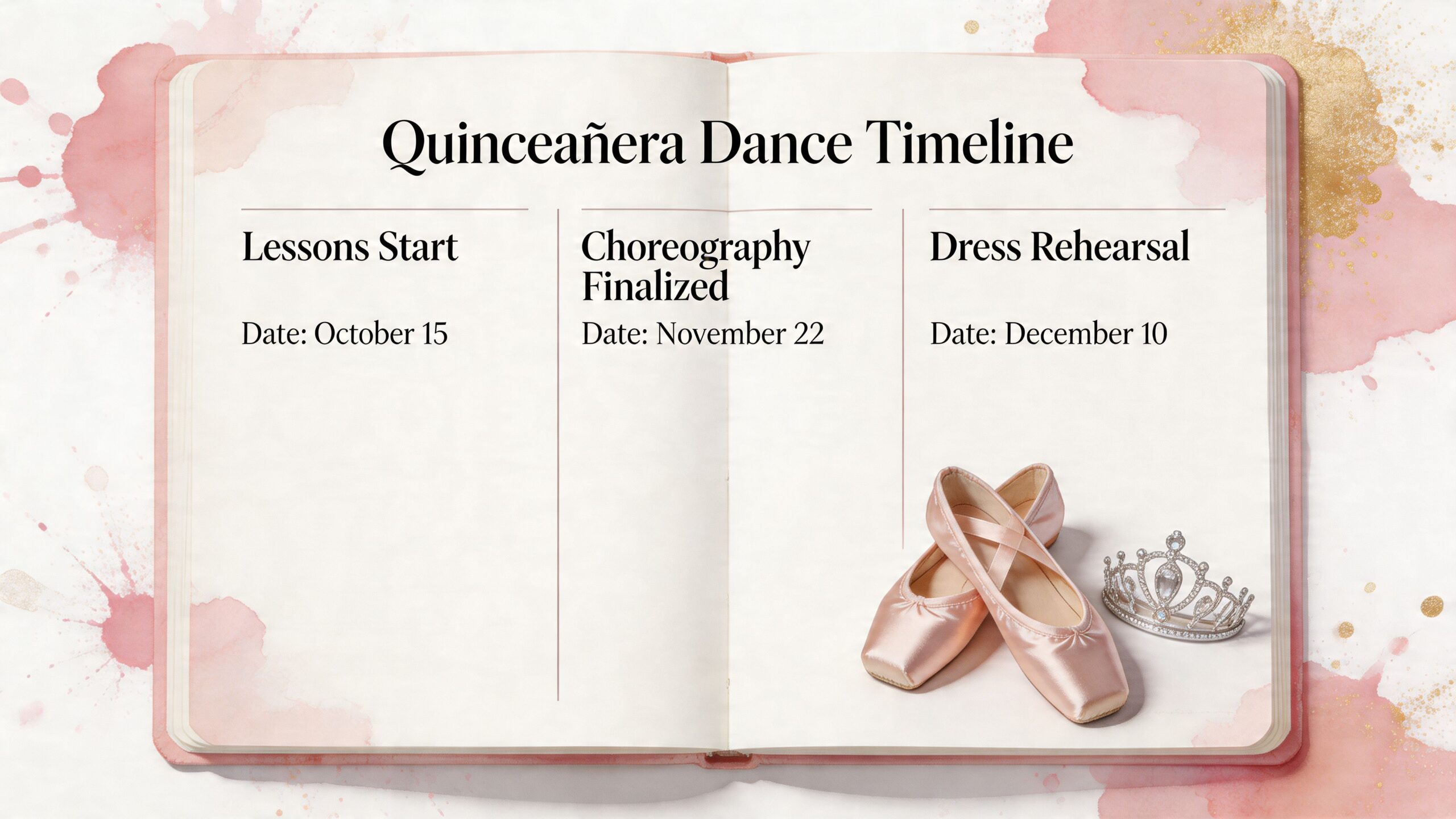
A practical way to think about it is this: choose your people, choose your dances, book instruction early, then build rehearsals around real life. Professional quinceañera dance preparation typically takes 5 to 10 hours of instruction, and studios commonly recommend starting at least 4 months in advance so dancers have time to learn and perform comfortably, especially for the vals and group choreography, according to Dance Engagements' quinceañera dance planning guide.
Start with the big dates
Before anyone learns a single step, lock in the date of the celebration and think backward. Families often plan the overall quince celebration 12 to 18 months in advance, and the dance portion works best when it’s folded into that larger planning calendar instead of treated as a separate emergency.
If your event includes a court, ask people early. Teens have sports, school events, jobs, and family commitments. A “yes” in theory doesn’t always mean “available for practice.”
Practical rule: A beautiful routine usually comes from consistent attendance, not complicated choreography.
A simple month by month rhythm
Here’s a workable planning rhythm many families find manageable:
- About 6 to 8 months out: Choose whether you want a traditional vals only, a vals plus father-daughter dance, or a full program that also includes a surprise dance. Start confirming your court.
- About 5 to 6 months out: Book your dance instruction. Early booking gives you better scheduling options, which matters when you’re coordinating multiple teens and adults.
- About 4 months out: Begin lessons. That timing lines up with the common studio recommendation to start at least four months before the party.
- About 2 to 3 months out: Keep regular rehearsals going and begin polishing spacing, timing, and entrances.
- Final month: Practice in event shoes and clothing that mimics the final outfit. Confirm music cuts, floor spacing, and who stands where.
A detail families often miss is the space around dance. Seating affects entrances, exits, and what the audience can see. If you’re organizing tables while mapping your performance area, a visual planning tool like this seating chart tool can help you avoid blocking your dancers with furniture or crowding the dance floor.
Build a rehearsal schedule that teens can follow
The best rehearsal plan is the one people can keep. Families sometimes create an ambitious calendar, then cancel half of it because it never fit anyone’s week.
A better approach is to choose one or two consistent rehearsal windows and protect them. If someone misses, they need a catch-up plan right away. Don’t wait until the next group practice and hope they’ll figure it out.
Shorter, focused rehearsals usually work better than long, unfocused ones. Use each practice for one main goal:
- Formation day: Where everyone stands and how they enter.
- Step day: Basic timing and partner connection.
- Clean-up day: Hands, posture, eye focus, transitions.
- Run-through day: Dance it from beginning to end without stopping.
Keep the planning meeting separate from the first lesson
Many families make the first lesson do too much. They want to choose songs, assign partners, build choreography, and dance all at once. That usually creates confusion.
Instead, have a planning conversation before serious choreography starts. Studios often hold planning meetings around a month before classes begin, which helps everyone arrive at the first dance lesson with a shared vision, basic music choices, and realistic expectations.
A few questions to settle early:
- Who is definitely in the court
- Which dances are must-haves
- Whether the father or escort needs separate rehearsal time
- How experienced the dancers are
- What level of complexity matches the group
When families do this early, the whole process feels calmer. The dancers walk in knowing what they’re building, and the adults stop feeling like they’re making every decision under pressure.
Choosing Your Signature Dance Styles and Music
The most memorable quince dances don’t feel random. They tell a story about the young woman at the center of the celebration.
One family may want a formal, elegant entrance and a classic vals that honors tradition. Another may want the same waltz, then switch into a lively surprise dance that feels playful and personal. Both can work beautifully if the music and choreography sound like they belong to the same event.
The vals still carries real meaning
A good place to start is the vals. Historically, quinceañera dance traditions treated the waltz as a girl’s first authorized public dance with a male partner, and even though those older social rules have softened, the symbolic importance remains. Modern celebrations often keep the waltz while blending in styles such as salsa, cumbia, or merengue to reflect the quinceañera’s personality, as noted in the historical overview of quinceañera traditions.
That history matters because it helps families understand why the vals often feels different from the other dances. It isn’t just a formal routine. It’s the ceremonial heart of the performance.
A simple way to choose each dance
Think of the main dances as playing different roles.
The vals sets the tone. It often feels graceful, structured, and visually balanced.
The father-daughter dance carries emotion. It doesn’t have to be technically difficult to be meaningful.
The surprise dance gives the quinceañera room to show humor, confidence, energy, or current musical taste.
Some of the best dance choices come from asking one question: “What do we want people to feel during this part?”
If the answer is elegance, choose music with a clear, steady flow. If the answer is joy and celebration, the surprise dance can open up into something more rhythmic and expressive.
Match the music to the dancers, not just the mood
Families sometimes pick songs before thinking about who has to dance to them. That can create problems fast.
A song may be beautiful but hard to count. Another may be popular but awkward for entrances and partner transitions. For dance classes for quinceaneras, the best song is the one that supports clean movement and gives dancers a clear sense of timing.
A few helpful filters:
- For the vals: Choose music with a steady waltz feel and enough length to build an entrance, a central sequence, and a finish.
- For father-daughter: Pick a song that feels sincere and manageable. Comfort matters more than complexity here.
- For surprise dance: Choose something the court can perform with confidence, not just something trending online.
When lyrics feel distracting or too busy for choreography, many families explore instrumental music to popular songs. These versions can keep the emotional feel of a familiar song while making cues, counts, and transitions easier to hear.
Let the quinceañera lead the personality
The strongest performances feel personal because the quinceañera had a real voice in the choices. I’ve seen shy teens choose a soft, elegant vals and then surprise everyone with a playful surprise dance. I’ve also seen confident performers choose a classic approach from start to finish because that matched how they wanted the evening to feel.
If the family is split between traditional and modern, use both. Keep the ceremonial dances rooted in tradition, then let the final group number show personality.
Here’s a good way to narrow the options:
- Choose one essential tradition: Usually the vals.
- Choose one emotional highlight: Often the dance with dad.
- Choose one personal statement: The surprise dance, or a musical twist inside the court routine.
Later in the process, watching examples can help teens understand tone, spacing, and performance quality before they commit to a style.
Music choice isn’t about impressing people with something unusual. It’s about making every section feel intentional. When the songs fit the moment and the dancers fit the songs, the whole celebration feels more polished.
Private Lessons or Group Classes for Your Court
Here, many families hesitate. They know they need help, but they’re not sure what kind.
The question isn’t which format is better in general. The question is which format fits your court. A court full of cousins who already move well on a dance floor needs something different from a mixed group where some dancers are confident and others have never counted music out loud.
A 2023 Dance Magazine survey of Latin American event planners found that 68% of quinceañera coordinators struggle with court synchronization due to skill disparities among groups of 6 to 14 members, according to this overview of quinceañera dance lesson challenges. That problem shows up in almost every real rehearsal room. One dancer learns instantly, another needs repetition, and two more miss a practice because of school.
When private lessons make the most sense
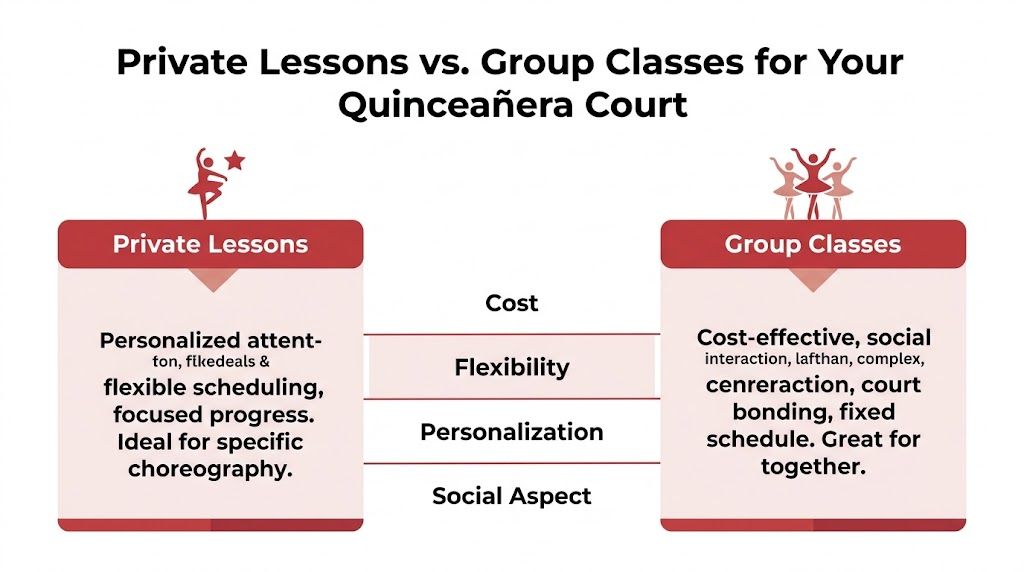
Private lessons are excellent when the dance needs individual attention. That might mean the quinceañera wants to sharpen her own movement quality, the father-daughter dance needs extra support, or one pair in the court needs targeted help.
Private work is especially useful when:
- A dancer feels nervous: Some teens open up much faster in a one-on-one setting.
- Scheduling is messy: Private sessions are often easier to place around school and family calendars.
- You need focused correction: Hand placement, posture, turns, and timing usually improve faster with direct feedback.
- The choreography is specific: If the routine includes custom transitions, private coaching helps clean them up.
If you’re weighing the broader pros and cons, this guide on group vs private dance classes gives a helpful side-by-side view.
When group classes help the court most
Group classes shine when the main goal is unity. If your challenge is getting everyone to move together, practicing together matters.
A court learns more than steps in a group setting. Dancers learn spacing, awareness, timing with partners, and how to recover if someone enters late or turns the wrong direction. Group rehearsals also build trust, which matters more than families expect.
Here’s what group work does well:
| Format strength | Why it helps |
|---|---|
| Shared timing | Everyone hears the same count and learns the same musical cues |
| Court bonding | Dancers become less self-conscious when they practice together |
| Formation memory | People learn where they belong by seeing the full picture |
| Performance energy | Group rehearsals create the feeling of a real event |
The smartest option for mixed skill levels
For many families, a hybrid approach works best. Group sessions teach the shared choreography. A smaller number of private sessions fix specific problems.
That structure keeps beginners from feeling left behind and prevents experienced dancers from getting bored. It also avoids a common mistake. Families sometimes assume strong dancers will pull weak dancers along automatically. Usually, the opposite happens. The whole group starts dancing at the level of its least prepared transitions.
If your court has mixed experience, don’t force equal teaching for unequal needs. Teach the shared material together, then give extra support where it’s needed.
A practical mixed-skill strategy looks like this:
- Teach the full group the entrance and formation changes together.
- Pull out beginners for extra work on rhythm, posture, and partner basics.
- Give stronger dancers polishing tasks such as arm styling and cleaner turns.
- Bring everyone back together to rehearse the full sequence.
That approach keeps the choreography inclusive without making it look basic. The secret isn’t making every dancer do the same thing at the same level. It’s making the whole group look coordinated.
What to Expect Inside the Dance Studio
The first lesson is usually much less intimidating than families expect. No one walks in and gets thrown into a full routine.
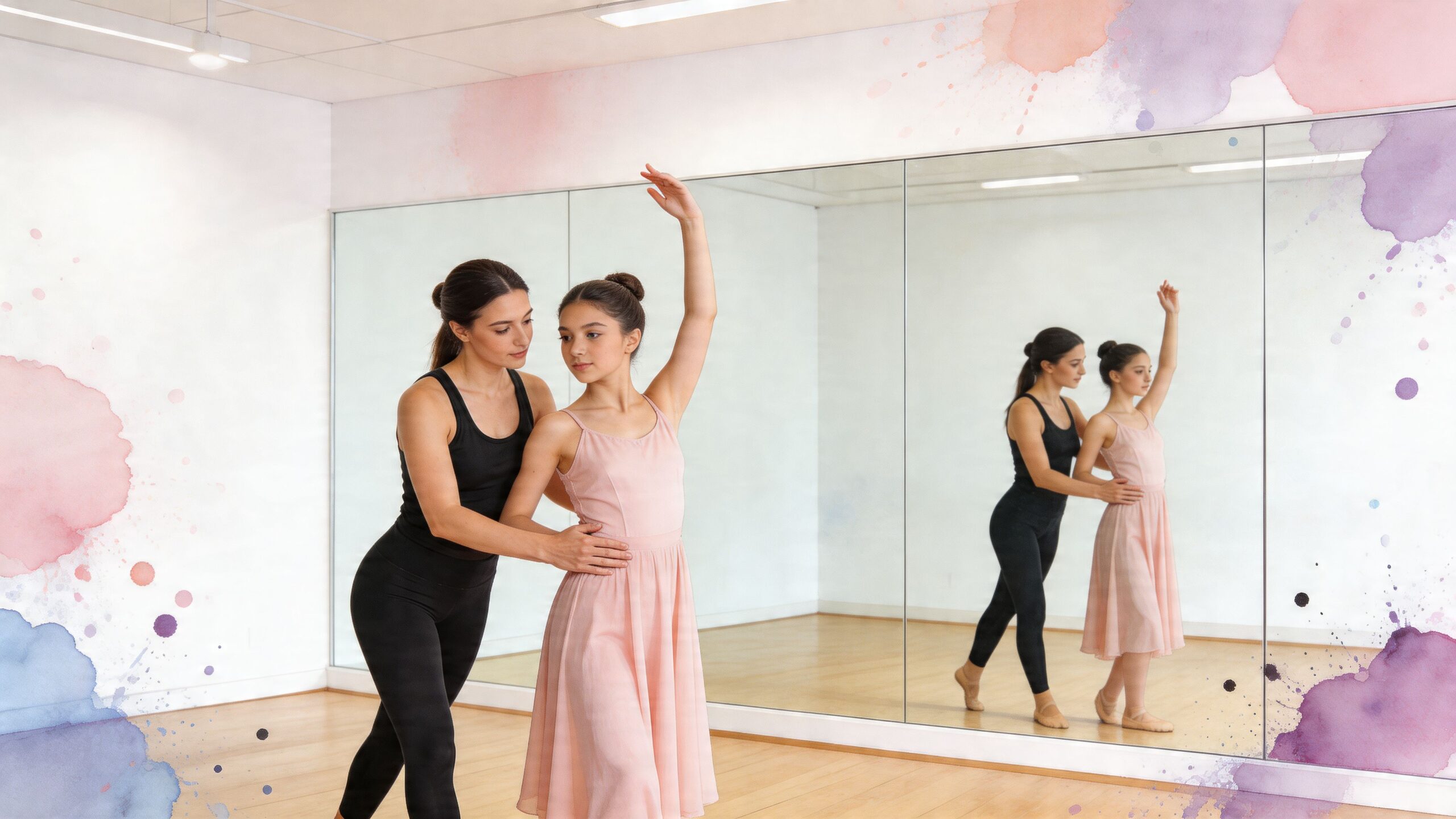
A strong quince lesson builds confidence in layers. Dancers learn how to stand, how to count, how to move with a partner, and how to travel through space before the choreography starts to look like a performance. That sequence matters because it keeps beginners from feeling lost.
The lesson usually starts with basics, not performance
Families often expect choreography on minute one. A better lesson starts with orientation.
That means simple things: where to place the feet, how to hold frame, how to find the beat, and how to move without rushing. For first-time dancers, these basics are the difference between panic and progress.
A few things help before class begins. Wear comfortable clothes you can move in. Bring the shoes you think you may wear later, even if you practice in something simpler at first. If you’re brand new to lessons, this article on how to prepare for your first private dance class answers many of the little questions families forget to ask.
The choreography is built in three parts
A structured quinceañera waltz often follows three core parts: Entrance, Main Waltz, and Exit. Instructors commonly build the dance this way so students can learn the routine in chunks rather than trying to memorize one long sequence. Experts also recommend 5 to 10 hours of professional instruction and 2 to 3 months of practice to help groups synchronize and avoid timing problems, as described in this quince waltz choreography walkthrough.
That framework makes the process easier to understand.
Entrance
The entrance introduces the court and sets the tone. Dancers practice where to walk, who faces whom, and how the group settles into the opening picture. This part looks simple, but it takes attention because spacing problems usually begin here.
Main waltz
The core steps are central. Many groups begin with basic box steps, then add turns, directional changes, and partner figures once the timing feels secure. If the group struggles, the instructor may simplify transitions before adding more detail.
Exit
The exit gives the dance a finished shape. It can mirror the entrance, create a final tableau, or flow directly into the next dance. A clean exit helps the audience feel that the performance was intentional from first step to last.
Ask questions the moment something stops making sense. Confused dancers rarely fix timing by staying silent.
What beginners usually worry about
Most new dancers worry about the wrong things. They worry about looking awkward, forgetting steps, or being judged by stronger dancers.
In practice, the most common beginner issue is not talent. It’s hesitation. When dancers half-commit, they forget more. When they move fully, even imperfectly, instructors can correct them.
Here’s what helps beginners settle in:
- Count out loud: It connects music to movement faster.
- Mark the steps at home: Small practice in the kitchen still helps memory.
- Use names for sections: “Entrance,” “turn pattern,” and “ending pose” are easier to remember than one giant routine.
- Practice with intention: One clean repetition teaches more than several distracted ones.
By the final rehearsals, the routine usually feels much more manageable than it did at the start. That’s the benefit of a studio process that breaks the dance into parts and teaches each part for a reason.
Tips for a Flawless Quinceañera Dance Performance
Learning the routine is only half the job. Performing it well takes a different kind of preparation.
The best quince performances feel relaxed, even though everyone has worked hard. That calm usually comes from simple habits repeated early enough that nothing feels unfamiliar on event day.
Rehearse in real-world conditions
A dance can look solid in sneakers and then feel completely different in formal shoes. The same is true for a full skirt, fitted jacket, or accessories that change how dancers turn and travel.
Practice in shoes close to the actual pair. If the dress is elaborate, rehearse in a practice skirt that gives the quinceañera a similar sense of movement and space. The point isn’t to copy the outfit perfectly. The point is to remove surprises.
Train presence, not just memory
Some groups know every step and still look uncertain. That usually happens when all rehearsal energy goes into memorization and none goes into presentation.
To improve stage presence, ask dancers to focus on these details:
- Lift the chest: Posture changes how confidence reads from across the room.
- Finish the arms: Half-finished styling makes polished choreography look unfinished.
- Find eye focus: Look at a partner, a hand line, or the audience intentionally.
- Hold the ending: Don’t drop the pose as soon as the music stops.
The audience forgives a small step mistake much faster than they forgive low energy or blank expression.
Clean the transitions
Most visible mistakes happen between figures, not inside them. A turn may be fine, but the dancers rush to the next place. A formation may be correct, but everyone arrives with different timing.
That’s why smart rehearsals spend time on “the spaces between.” Practice how dancers walk on, change partners, reset after a turn, and arrive in the final picture. Those quiet moments make the whole routine look professional.
A short performance checklist helps:
| Before the event | Why it matters |
|---|---|
| Confirm music version | Avoid wrong edits or unexpected starts |
| Walk the floor | Check size, entrances, and slippery areas |
| Practice first and last moments | Audiences remember the opening and ending most |
| Assign a lineup helper | Keeps the court organized before dancing |
| Review recovery plan | If someone misses a step, the group keeps moving |
Give the court permission to recover
Perfection is not the true goal. Composure is.
If one dancer blanks, the others should keep counting and moving. If spacing shifts slightly, don’t freeze. Audiences notice panic more than they notice small imperfections.
That mindset is especially important for dance classes for quinceaneras because the group often includes a mix of personalities and experience levels. A confident recovery plan protects the whole performance. Keep smiling, stay with the music, and finish with pride.
Frequently Asked Questions About Quinceañera Dances
Families usually have a few practical worries that don’t come up until rehearsals are underway. These are the questions I hear most often.
What if a chambelán or dama drops out late?
Simplify first. Don’t rush to rewrite the entire routine unless you have to. Many formations can be adjusted by widening spacing, creating a staggered line, or shifting one featured moment to a smaller group.
If the dropped dancer had a major partner role, assign the strongest available person to that spot and clean only the affected sections. Keeping most of the choreography intact is usually less stressful than starting over.
How do we handle mixed focus levels in the court?
Set expectations early and repeat them. Families often assume everyone understands rehearsal etiquette, but teens need specifics.
Use a few simple rules:
- Arrive ready to dance
- Stay off phones during instruction
- Ask questions right away
- Practice missed material before the next rehearsal
If one or two dancers are consistently distracted, give them responsibility. Put them in charge of counting a section or helping line up the formation. Responsibility often improves focus.
How much space do we need to practice at home?
You don’t need a ballroom to remember choreography. For home practice, enough open floor to mark partner positions, counts, and directional changes is often enough.
Use home practice for memory and timing. Save full traveling runs for the studio or a larger rehearsal space. Small-space practice is still valuable if dancers stay precise.
What if my child has never danced before?
That’s common. Beginners often do very well because they listen closely and don’t arrive with habits that need to be corrected.
The key is matching choreography to the dancer’s current comfort level. If you’re still deciding how many featured moments to include, this guide on how many dances are in a quince can help you choose a format that fits your family’s celebration.
Should the father or escort practice separately?
If the father-daughter dance or escort role has special transitions, separate practice can help a lot. It gives that dancer time to focus without slowing the full court rehearsal.
Even one focused coaching session can make the social and emotional parts of the dance feel smoother.
What’s the best next step if we haven’t started yet?
Don’t panic. Start with a planning conversation, choose your must-have dances, and get professional guidance before the schedule gets tighter.
Here’s the simplest next move:
| CTA Button Text | URL |
|---|---|
| Book Your Free Complimentary Lesson | Book Your Free Complimentary Lesson |
If you want warm, experienced guidance for dance classes for quinceaneras, Danza Academy of Social Dance offers a free complimentary lesson to help your family get started with clarity and confidence. It’s a simple way to discuss your timeline, court, music ideas, and any mixed-skill concerns before the pressure builds. Book your free complimentary lesson and take the first step toward a polished, joyful quinceañera dance.