
You arrive at your first rumba dance class a few minutes early, hoping the other students won't notice that you don't know where to stand, what to do with your hands, or whether everyone else already has a partner. The room may be full of mirrors, music, and confident-looking dancers, but the instructor expects beginners to feel uncertain. You don't need previous dance experience, a partner, or perfect rhythm to begin learning.
Adult students often worry about looking awkward, moving too slowly, or remembering the counts. Those concerns are normal. A well-taught class breaks the dance into manageable actions, gives you time to understand the reason behind each movement, and builds confidence through repetition rather than pressure.
Stepping Into Your First Rumba Dance Class
Your first class may begin with something much simpler than a dramatic Latin routine. The instructor might ask you to stand comfortably, shift your weight from one foot to the other, listen to the music, and notice how your knees and hips respond. That quiet beginning matters because rumba depends on control, balance, and deliberate weight transfer more than on large steps.
You may work alone at first, even in a partner-based class. This gives you a chance to find the rhythm without worrying about whether you're leading or following correctly. When partner practice begins, studios commonly rotate partners or pair students according to the exercise, so arriving alone shouldn't prevent you from participating.
A useful first-class mindset: You aren't expected to perform rumba immediately. You're learning how to listen, transfer weight, and respond to another dancer.
Rumba's history also explains why the studio version can feel both familiar and surprisingly structured. The dance's roots are usually traced to Afro-Cuban music and dance traditions that developed in Cuba during the mid-19th century, as described by the Smithsonian's history of rumba. After slavery in Cuba ended in 1886, rumba continued developing into distinct forms, including columbia, yambú, and guaguancó.
The dance became visible beyond Cuba by the early 20th century. Britannica describes rumba as a ballroom dance with Afro-Cuban folk-dance origins that became internationally popular during that period. A 1925 Cuban ban on certain public “bodily contortions” and drums of African nature also shows that rumba had become culturally prominent enough to attract state attention.
By the 1930s, rumba had spread broadly into United States popular dance culture. Historical accounts connect its popularity with the 1935 film Rumba and the earlier success of El Manisero. The rumba taught in many studios today is therefore not one untouched ancient sequence. It's a codified social and ballroom tradition shaped by cultural exchange, adaptation, and formal teaching.
That context gives your first class more meaning. You're not memorizing a box step. You're learning a formalized movement language with deep Afro-Cuban roots and a long history of changing as dancers, musicians, teachers, and communities carried it into new settings.
Core Techniques and Musical Timing
A new adult student may worry that rumba requires natural hip movement, a partner, or unusual flexibility. It does not. In class, you can learn the technique alone, using your feet and weight as a clear starting point. Rumba looks smooth because each action follows the one before it, so the goal is coordination rather than force.
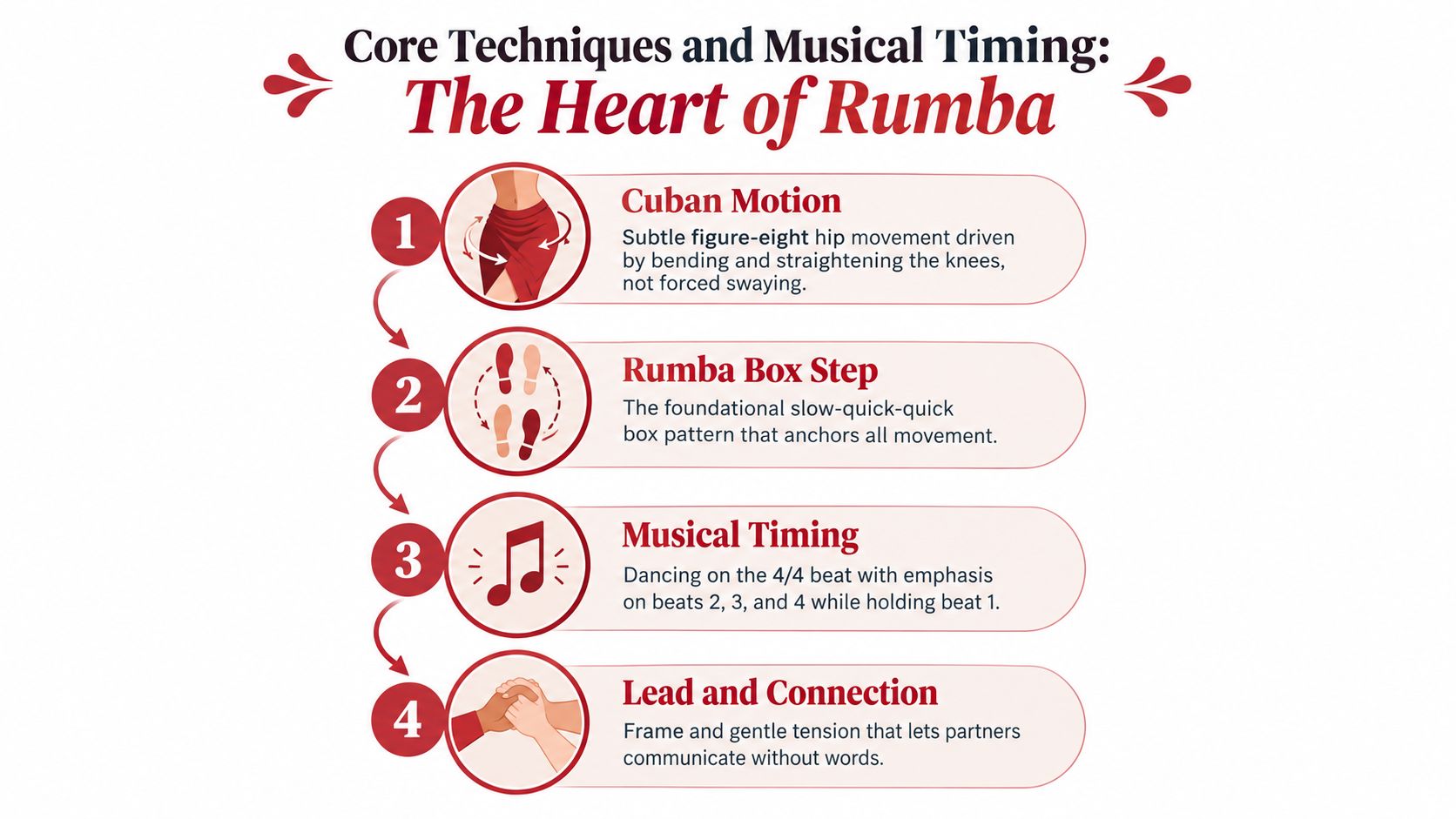
Let the weight create the movement
Cuban motion develops from weight transfer. Trying to push the hips from side to side often creates stiffness or unnecessary strain. A safer sequence is:
- Take a compact step.
- Release the knee as the weight begins to move.
- Transfer the weight fully to the new standing leg.
- Straighten the support leg.
- Let the hip settle during the latter part of the count.
Your standing leg works like a pole supporting a flag. The fabric responds when the pole changes position, rather than needing to be shaken. Your hip should respond to the transfer of weight in the same way. This approach gives adult beginners something practical to monitor and reduces the temptation to exaggerate the action.
Expert technique guidance connects hip action with delayed weight transfer, knee release, and straightening the support leg, rather than with an isolated hip gesture. Compact steps help you remain balanced over the standing leg and give you more control during breaks and turns. The ballroom technique guide to rumba movement explains this relationship.
Hear the delayed beginning
International ballroom rumba is generally taught in 4/4 time, with a practical tempo of around 27 bars per minute, or about 105 beats per minute. The familiar timing is “2-3-4-1,” with steps on counts 2, 3, and 4, followed by count 1 as a held or settling beat. The Dance Central rumba timing guide explains how this delayed first step creates the dance's characteristic contra-tiempo feeling.
Instructors also describe the pattern as slow-quick-quick. The slow action lasts two beats, while each quick action lasts one beat, matching the common 4/4 structure used in instruction, as outlined in this rumba dance guide.
Let the slow count finish. Complete the weight change, then allow the hip to settle through the remaining part of the count. That pause gives your body time to organize the movement and prevents the bouncing quality caused by rushing between steps.
A historical tempo reference helps explain how teaching practice changed. Sources from the 1930s often cite around 40 4/4 measures per minute or higher, roughly 160 beats per minute, according to Rumba Through the Ages. Modern international ballroom instruction uses a much slower practical benchmark, giving students more time to coordinate, observe, and refine each action.
Use this beginner guide to dancing the rumba as a visual reminder, while letting your instructor check your weight placement in person. A mirror can show that your body moved, but it cannot always show whether the correct foot is carrying your weight.
Progression from Beginner to Advanced Levels
An adult beginner may worry that rumba requires a partner, athletic flexibility, or a perfect memory for long sequences. A well-planned curriculum removes those pressures. Each level adds a different responsibility: beginners organize balance and rhythm, intermediate dancers coordinate with another person, and advanced dancers make clear artistic choices within the structure.
| Skill Level | Primary Focus | Key Milestones |
|---|---|---|
| Beginner | Weight shifts, compact steps, timing, and basic body action | Finding counts 2, 3, 4, and 1, completing a basic box pattern, and staying balanced |
| Intermediate | Partner connection, turns, directional changes, and varied rhythms | Communicating clearly, controlling rotations, and adapting patterns to the music |
| Advanced | Musicality, body isolation, styling, and performance precision | Shaping phrases, refining Cuban motion, and using technique consistently under pressure |
Beginner foundations
Early progress often looks quiet. You may shift weight without traveling, practice a basic box step, or repeat the slow-quick-quick rhythm until the delayed beginning feels comfortable. These drills give you a physical vocabulary for later figures, much like learning individual words before forming complete sentences.
Solo practice also answers a common adult beginner concern: you can improve even when no partner is available. Mark the counts with your feet, shift your weight fully, and keep the upper body calm. This solo rumba practice guide also starts with weight shifts, timing drills, and simple patterns before choreography.
Keep the effort manageable. Rumba asks for controlled bending, weight transfer, and hip action, so a student who feels strain should reduce the range of movement and ask the instructor to check alignment. The aim is clear control, not forcing the body into a larger shape.
Intermediate coordination
Intermediate classes introduce communication between lead and follow roles. The lead suggests direction and timing through the connection, while the follow responds without guessing ahead. Both roles require attention, and practicing each one can clarify how information travels through the body.
Turns, directional changes, and syncopated rhythms make the work more demanding. Remembering a longer combination is only one part of the task. You must keep the steps compact, complete each weight transfer, and preserve a comfortable connection as the pattern changes.
Advanced refinement
Advanced dancers focus on musical phrasing and stylistic control. They may isolate different body areas, vary the quality of a step, or shape movement around the character of the music. Technique becomes the support system, allowing expression without losing balance or timing.
Competition offers one example of standardized rumba in organized performance settings. An independently compiled DanceSport record lists rumba across 165 competitions, with 4,715 total points and an average score of 7.17, while one televised ballroom dataset records rumba being danced 165 times. These figures are documented in DanceSport and televised ballroom tracking.
Competitive goals are optional. A social dancer may remain comfortable at an intermediate level, while another student may enjoy advanced styling. Your instructor can help set a pace that supports curiosity, physical comfort, and steady progress rather than intimidation.
A Sample Lesson Plan and What to Wear
A rumba class often feels easier when you know how the hour is likely to unfold. The exact structure varies by studio and instructor, but a typical session moves from preparation to technique, then from isolated practice into connected dancing.
The opening portion
The instructor may begin with gentle movement that wakes up the ankles, knees, hips, and spine. You might rehearse weight changes in place, walk through the timing, and practice holding your posture while the feet move underneath you.
The next portion usually isolates one technical idea. For example, the class may work on bending the knee, transferring the weight fully, and straightening the supporting leg. This can feel repetitive, but repetition lets you identify the moment when the hip settles naturally.
The teaching portion
After the body is prepared, the instructor may introduce a basic figure or combination. First, you'll likely perform it without music. Then the teacher adds counts, demonstrates the lead and follow roles, and gradually brings in the song.
A useful lesson might follow this sequence:
- Warm-up: Mobilize the joints and establish relaxed posture.
- Weight practice: Repeat transfers and settling actions without traveling.
- Pattern instruction: Learn a compact box or another foundational figure.
- Partner application: Practice connection, direction, and timing with guidance.
- Musical repetition: Dance the combination several times, correcting one detail at a time.
The instructor may interrupt the music to adjust a foot, knee, shoulder, or hand position. That's normal. Good correction should make the movement clearer, not make you feel judged.
Clothing and footwear
Wear clothing that lets you bend your knees and take compact steps comfortably. Your instructor should be able to see enough of your legs and torso to assess alignment, so extremely loose garments can make technical feedback harder.
Footwear matters because rumba includes weight changes, controlled pivots, and directional movement. Shoes with suede or leather bottoms generally allow more controlled turning than rubber soles, which can grip the floor and make rotation uncomfortable. Avoid dancing in socks unless the instructor specifically recommends it.
The guide to what to wear to dance class offers practical preparation advice. You don't need to purchase expensive dancewear before attending your first lesson. Choose secure shoes, comfortable clothing, and something that lets you move without constant adjustment.
If you arrive without a partner, tell the instructor when you check in. Partner rotation can help you learn to communicate with different body types and timing habits, and it prevents you from depending on one person's familiar response.
Physical and Social Benefits of Learning Rumba
Rumba asks for more physical control than its graceful appearance suggests. Compact steps, repeated weight transfers, knee action, balance, and torso organization all require attention. Over time, that practice can support coordination, posture, balance, and body awareness, although the results depend on your consistency, starting condition, and how the class is taught.
The cognitive demand is just as important. You listen for the beat, remember a sequence, monitor your own body, interpret a partner's information, and adjust your position in space. Those tasks make social dancing an active learning experience rather than a routine performed on autopilot.
Technique is part of injury prevention
Adults returning to movement should take rumba's repetitive demands seriously. Research and academic coverage identify ballroom-dance injuries involving the ankle, foot, toes, back, and neck among common problem areas, while a 2025 review emphasizes prevention and rehabilitation needs in ballroom dance. These findings are discussed in the academic review of ballroom-dance injuries.
That doesn't mean rumba is unsafe. It means progression matters. A supportive instructor should adjust the amount of repetition, reduce unnecessary force, and distinguish between productive muscular effort and sharp or persistent pain.
Practical rule: Mild unfamiliar effort can be part of learning. Sharp pain, swelling, numbness, or pain that changes your movement deserves a pause and appropriate professional advice.
Older adults and returning dancers can start with smaller ranges of motion, slower practice, and longer recovery between demanding repetitions. Keep your steps underneath your body, avoid forcing the hip action, and let the knee release rather than locking it abruptly.
Dance also appears in therapeutic and rehabilitation settings, which broadens the way adults can think about its value. Rumba doesn't replace medical care or individualized exercise guidance, but a well-managed class can provide a meaningful reason to practice balance, coordination, and controlled movement.
The social confidence effect
Partner dancing creates a structured way to meet people. You don't have to invent conversation or perform socially before you're ready. You can begin with a shared exercise, exchange a few words about the pattern, and gradually become more comfortable in the room.
Many students also gain confidence from handling small moments of uncertainty. You miss a count, recover, and continue. You forget a figure, listen for the next phrase, and rejoin. Those experiences make the social dance floor feel less threatening because you learn that mistakes don't end the dance.
Choosing the Right Studio and Instructor
The right rumba class should make technical progress feel possible. Look for an instructor who explains the reason behind a movement, demonstrates both roles when partner work is involved, and offers corrections that you can apply immediately.
Class size affects the experience. A crowded group may offer energy and variety, but beginners can receive less individual feedback. A smaller class or private lesson may provide more focused attention, especially if you need to manage a physical limitation or want to prepare for a particular event.
Questions to ask before enrolling
Use the first conversation with a studio to learn how its teaching style fits your needs.
- Partner policy: Ask whether you can attend alone and how partner rotation works.
- Beginner support: Find out whether new students can join at any point or whether the class follows a fixed sequence.
- Physical accommodations: Explain past injuries, stiffness, or concerns before movement begins.
- Learning format: Compare group classes, private lessons, workshops, and practice opportunities.
- Goals and styles: Confirm that the instructor teaches the kind of rumba you want to learn, whether social, ballroom, wedding-focused, or competition-oriented.
The guide to choosing a dance studio can help you evaluate teaching quality, atmosphere, scheduling, and progression before you commit.
A welcoming environment matters because adults learn best when they can ask questions without embarrassment. The instructor should treat mistakes as information, not as evidence that you lack ability. You should also hear clear guidance about footwear, warm-up, safe movement, and when to reduce intensity.
An option for Philadelphia-area learners
Danza Academy of Social Dance has over 40 years of teaching experience and offers ballroom, Latin, and social dance instruction through locations in Center City Philadelphia and Exton, Pennsylvania. Its offerings include private lessons, group classes, wedding dance preparation, children's programs, and professional coaching for competitive dancers.
The academy teaches rumba alongside styles such as Salsa, Cha-Cha, Samba, Waltz, Foxtrot, Tango, Quickstep, Hustle, Swing, West Coast Swing, and Country Two-Step. Students can attend without a partner, and significant others are welcome to join. That arrangement suits adults who want to learn socially but don't want partner logistics to become a barrier.
A complimentary first lesson lets you experience the teaching environment before deciding on a longer path. Use it to explain your goals, ask how the instructor structures beginner rumba, and discuss any physical concerns. Booking a lesson is more useful than trying to judge a studio from its class descriptions alone.
Frequently Asked Questions About Rumba Classes
Do I need a partner?
No. Many classes welcome solo students and rotate partners during practice. You can also begin with solo timing, weight shifts, and footwork before adding connection. Bringing a friend or significant other is welcome, but it isn't a condition of learning.
Is rumba suitable for older adults?
It can be, provided the class progresses appropriately for your current ability. Start with compact steps and manageable repetition, tell the instructor about relevant health concerns, and stop if pain changes your movement. A qualified teacher should help you build control rather than push you to imitate an advanced dancer immediately.
How long does it take to feel confident?
Confidence develops through repeated exposure rather than one fixed timetable. You may feel comfortable with basic counts before you feel relaxed with a partner, and you may understand the pattern before the Cuban motion looks natural. Regular attendance, solo practice, and asking specific questions can make the process more manageable.
Is rumba difficult to learn?
The basic steps are approachable, but refined technique takes patience. Beginners usually find the delayed count and weight transfer more challenging than the step pattern itself. Once you understand that the hip action comes from the legs and weight, the movement becomes less mysterious.
What's the difference between American and International rumba?
Both belong to the broader ballroom and social-dance world, but they use different conventions for figures, styling, and teaching. International rumba commonly uses the 4/4 structure and 2-3-4-1 timing described earlier. Ask your instructor which style the class follows so you know what technique and vocabulary to expect.
Can I start if I feel uncoordinated?
Yes. Coordination is a skill the class develops. Your first task isn't to look polished. It's to identify your standing leg, hear the counts, and complete one weight transfer at a time.
Danza Academy of Social Dance offers rumba instruction through group and private lessons, with welcoming classes where no partner is required and guidance suited to social, wedding, fitness, or performance goals. Book your complimentary first lesson by visiting Danza Academy of Social Dance, and take the first comfortable step toward learning rumba with an instructor who can meet you at your current level.