
A slow song comes on at a wedding. A few couples step onto the floor. Someone near you says, “Come on, let’s dance,” and suddenly your brain goes blank.
That moment is why many people look up how to dance the rumba.
You do not need to be naturally graceful. You do not need years of dance training. You do not even need a partner to begin. Rumba is one of the most approachable Latin dances for adults because it gives you time to feel each step, settle your weight, and move with intention instead of rushing.
What makes rumba special is not flashy choreography. It is the feeling. Rumba has a quiet pull to it. The dance asks you to listen, breathe, and connect. If you only learn the foot pattern, it can look stiff. If you understand the rhythm, the weight transfer, and the conversation between two bodies, it starts to feel smooth and expressive.
I teach a lot of adults who start exactly where you may be right now. They feel awkward at first. They worry about their hips, their timing, or whether they will look silly. Then a few lessons later, something clicks. Their shoulders relax. Their steps stop looking like memorized directions. They begin to dance instead of just surviving the music.
Feel the Music The Heartbeat of Rumba
A beginner often thinks the first problem is the feet. It usually is not. The first problem is tension.
At social events, I see it all the time. Someone wants to join in, but they stay seated because they think rumba is too romantic, too polished, or too advanced. Then they watch one couple moving slowly across the floor and assume there must be some secret they missed.
The secret is simpler than often expected. Rumba is less about doing more and more about doing less, better.
The dance has a reputation for being the “dance of love,” and that can make beginners nervous. They picture dramatic poses and intense eye contact. In real life, a good beginner rumba feels like a calm conversation. One person suggests movement. The other responds. Both people breathe with the music.
That is why so many new dancers find rumba rewarding once they get past the first lesson. The slower pace gives you room to notice what your body is doing. You can feel your weight move from one foot to the other. You can hear the rhythm more clearly. You can work on connection without feeling like the music is dragging you around the floor.
If you enjoy Latin dance in general, you can explore related styles through Danza Academy’s Latin dance offerings. Rumba fits beautifully into that family because it teaches control, musicality, and body awareness that help in many other dances too.
Tip: If rumba feels intimidating, remove the word “romantic” from your mind for a minute. Think “controlled,” “grounded,” and “musical.” That mindset helps beginners relax.
The best way to begin is to stop trying to perform. Just learn to hear the pulse, settle into the floor, and let the dance become natural one piece at a time.
Understanding Rumba Rhythm and Soul
Rumba did not begin as a ballroom syllabus. It carries history in its sound and movement.
Its origins trace back to the 16th century with the arrival of enslaved Africans in Cuba, and it evolved by the mid-19th century. In 1925, President Gerardo Machado banned its “bodily contortions” and African drums in public, yet rumba spread internationally in the 1930s, helped by “The Peanut Vendor.” Early sources placed rumba tempos at 160 to 200 bpm, while today’s ballroom version is much slower at 25 to 27 measures per minute. That long evolution shaped the rumba many dancers study today, including the ballroom traditions taught in studios over 40 years of instruction practice such as those described by DanceTime’s rumba history overview.
That history matters because rumba is not supposed to feel rushed or casual. It carries tension, softness, rhythm, and restraint all at once.
Hear the count before you move
Most beginners do better when they stop staring at their feet and start listening for the rhythm.
Rumba music is counted in 4/4 time, and the basic feel is:
- Slow: This lasts for two beats of music.
- Quick: This lasts for one beat.
- Quick: This lasts for one beat.
So when dancers say “slow, quick, quick,” they are talking about duration. The slow step breathes. The quick steps pass by more briskly.
Try this without dancing yet. Put on rumba music and clap like this:
- Clap and hold for two beats on “slow”
- Clap once on “quick”
- Clap once on “quick”
Keep repeating it. You want your body to feel that pattern before you ever try a box step.
A lot of confusion happens because new dancers count numbers but do not understand what the numbers mean in time. They rush the slow and freeze on the quicks. The result looks hesitant. The fix is simple. Let the slow step stretch.
Why rumba feels different from other Latin dances
Rumba has space in it. That space is where expression lives.
In a faster dance, you may focus on survival. In rumba, you have enough time to shape the movement. You can settle your weight, use your standing leg, and allow the body to finish one action before beginning the next. That is one reason adult beginners often enjoy it. The music gives them a chance to process.
This also explains why rumba can feel harder than it looks. The slower the dance, the more visible every detail becomes. If your posture is tense, it shows. If your weight never fully transfers, it shows. If you are ahead of the music, everyone can see it.
A simple listening exercise
Use this short drill any time you feel lost:
- Start with the drum and bass: Ignore everything else and find the steady pulse.
- Say the rhythm out loud: “Slow, quick, quick.”
- Rock your weight side to side: No steps yet. Just shift your weight with the timing.
- Add one breath per slow: This keeps you from rushing.
Here is a helpful visual reference while you listen and count:
If you want a broader view of where rumba sits in ballroom and Latin dance, Danza Academy also has a simple guide to the 10 traditional dances of ballroom dance. That bigger picture can help you hear what makes rumba distinct.
Key takeaway: Rumba starts in your ear, not your feet. If you can hear “slow, quick, quick” and stay calm inside that timing, the dance becomes much easier to learn.
Mastering the Rumba Box Step and Cuban Motion
Most beginners learn rumba through the box step. That is a practical starting point because it gives your body a simple map. But the true goal is not to march around in a square. The goal is to move with grounded, smooth action so the box feels alive.
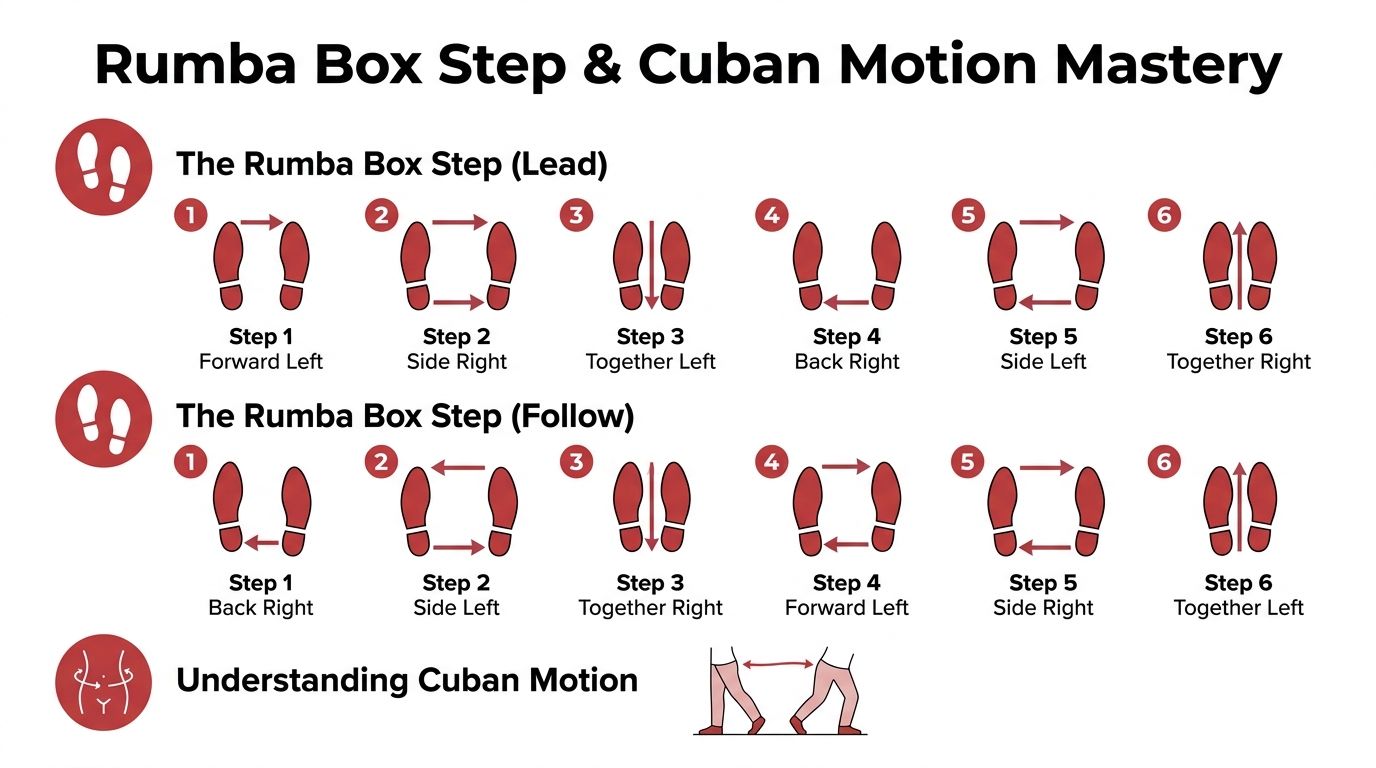
The first thing to know is this. Cuban Motion is not decoration you glue onto the dance later. It comes from weight transfer.
Start with your standing leg
In International Rumba, the basic movement uses 4-1 timing with a slow-quick-quick rhythm. Strong dancers create the action with sharp knee switches, a continuous figure-8 hip action, and controlled use of the obliques. A frequent beginner mistake is lifting the heels, which weakens ground connection and stability, while elite dancers keep their heel usage highly disciplined, as described in the Dance Central rumba technique breakdown.
Even if you are learning a social box step first, that principle still helps. Your hips do not swing because you wiggle them. They respond because you changed weight clearly.
Think of your hips like a pendulum with intelligence. They settle because the leg beneath them changes. Your feet start the action. Your body completes it.
The leader’s box step
For a simple social rumba box, the leader usually begins forward.
Try it this way:
- Step forward with the left foot on the slow.
- Step to the side with the right foot on quick.
- Close the left foot to the right foot on quick.
- Step back with the right foot on the slow.
- Step to the side with the left foot on quick.
- Close the right foot to the left foot on quick.
That completes the box.
Do not worry if it feels too simple. Basic does not mean unimportant. In partner dancing, basic often means useful.
The follower’s box step
The follower mirrors that action by starting back.
It goes like this:
- Step back with the right foot on the slow.
- Step to the side with the left foot on quick.
- Close the right foot to the left foot on quick.
- Step forward with the left foot on the slow.
- Step to the side with the right foot on quick.
- Close the left foot to the right foot on quick.
If you practice solo, do both parts. That is one of the fastest ways to understand partner timing later.
How to make the box feel like rumba
A beginner box step often looks flat for three reasons:
- The dancer changes feet but not weight
- The knees stay locked
- The body arrives all at once instead of flowing through the step
To fix that, use this checklist.
- Keep a soft knee: Not a deep squat. Just enough release so your hips can respond naturally.
- Finish the weight transfer: If you are between feet, your hips will not settle.
- Let the standing leg straighten as the free leg releases: That creates a more natural Latin action.
- Keep the feet connected to the floor: Avoid bouncy stepping.
Understanding Cuban Motion in plain language
The phrase sounds technical, but the sensation is easier to understand than the name suggests.
Picture drawing a small figure 8 with your hips. Not a giant circle. Not a shimmy. A controlled, continuous pathway.
Your rib cage stays lifted. Your spine stays organized. Your hips rotate and settle underneath you because your knees and weight are changing. The side body, especially the obliques, helps manage that action.
Here is a useful image for your body:
- The legs create the engine.
- The center steers the movement.
- The hips show the result.
If you try to “do hips” first, the motion usually looks forced. If you move your weight with patience, the hips start showing up on their own.
Tip: Practice the basic with your hands on your waist. If the hips only move when you consciously shove them sideways, reset and focus on the legs.
A drill for the knee switch and hip settle
Stand with your feet under your body.
Then do this slowly:
- Put weight into one leg.
- Release the opposite knee.
- Switch weight cleanly to the other leg.
- Let the hip settle over the standing leg.
- Repeat without traveling.
This tiny drill teaches the heart of rumba. No partner needed. No choreography needed.
A lot of adults get confused because they expect a big visible hip movement right away. That usually creates tension in the lower back. Instead, think small and grounded. Good rumba often feels subtle from inside and looks elegant from outside.
Posture that supports the movement
Your upper body should not be stiff. It should be calm.
Use these ideas:
- Head lifted: Look ahead, not at your feet.
- Chest open but not puffed: Think broad across the collarbones.
- Shoulders relaxed: They should not rise with effort.
- Core awake: Supportive, not rigid.
Many dancers separate posture from movement. In rumba, posture is part of movement. If your shoulders are tense, your hips will struggle. If your ribs collapse, your balance becomes unreliable.
Common beginner fixes
Here are the mistakes I correct most often in first lessons.
- Walking too big: Smaller steps usually improve control immediately.
- Rocking the torso: The hips can move while the upper body stays composed.
- Popping the hip sideways: Rumba is smoother than that.
- Lifting the heels early: Stay connected to the floor.
- Starting the arms too soon: Let the body organize first.
If you want detailed one-on-one feedback on body action, timing, and partner basics, private dance lessons can help you sort out habits much faster than guessing in front of a mirror.
Building Your Connection and First Partner Patterns
When two people dance rumba well together, it does not feel like pushing and pulling. It feels like shared balance.
That starts with connection, not force.
Build a frame that can listen
Your frame is the shape and tone you create with your upper body and arms. It is how information travels between partners.
A beginner frame should feel:
- Stable: Your elbows do not droop.
- Responsive: Your arms are not rigid like boards.
- Comfortable: No squeezing, yanking, or clamping.
If you are in a basic closed position, keep enough tone in the arms and upper back that your partner can feel direction. Too loose, and messages disappear. Too tense, and everything feels mechanical.
Leaders often think they must use their hands to steer. Followers often think they should guess what is coming. Both habits create trouble.
A better rule is this:
- The leader initiates from the center and allows that intention to travel through the frame.
- The follower receives first, then responds after feeling the lead.
What leaders should focus on
A clear leader is calm.
If you lead by shoving with your arms, your partner receives pressure but not information. If you move your own body first and let the frame carry that change, the signal becomes easier to read.
Focus on these habits:
- Start your own weight change first
- Keep the timing steady
- Lead early enough that your partner can respond
- Use the hand connection to suggest, not drag
Good leading feels considerate. It gives your partner time.
What followers should focus on
A responsive follower is not passive. A responsive follower is present.
The biggest beginner mistake is anticipation. You think, “I know an underarm turn is next,” and you start spinning before the lead arrives. That breaks the conversation.
Try this instead:
- Stay over your standing leg.
- Wait for the invitation.
- Move when you feel the lead, not when you predict it.
This makes social dancing much smoother because each pattern feels shared rather than pre-programmed.
Key takeaway: In partner rumba, your job is not to control the other person. Your job is to make communication easy.
Your first simple partner pattern
One of the most useful early patterns is the underarm turn. It introduces rotation without overwhelming the couple.
A simple version works like this:
For the leader
- Dance the basic with steady timing.
- On the side step where the turn begins, raise the connected hand clearly.
- Create a pathway, not a circular yank.
- Continue your own basic while allowing the follower to turn.
For the follower
- Keep your steps compact.
- Walk through the turn rather than spinning wildly.
- Spot gently by keeping your eyes level.
- Reconnect without collapsing your frame.
The underarm turn is not about speed. In rumba, even turning should feel measured.
How to keep it comfortable in social dancing
Social floors are not practice studios. There are other couples nearby, uneven skill levels, and sometimes not much space.
That means your partner work should stay simple and readable.
Try these habits:
- Use smaller shapes: Compact movement works better than oversized styling.
- Keep turns controlled: A neat turn is more social than a flashy one.
- Protect your partner’s balance: Do not lead anything they are not ready for.
- Reconnect gently: Hands should meet, not slap.
If a pattern falls apart, do not freeze. Return to the basic. The basic is home base.
Practice Drills and Fixing Common Mistakes
Most rumba tutorials jump straight to partner patterns. That leaves solo learners stuck, even though many people begin without a partner. Many adults want to build confidence privately before dancing with someone else. That gap is exactly why guidance on solo practice, mirror work, and body mechanics is so useful for students at studios that welcome people with no partner required, as noted in this discussion of the need for partner-free rumba instruction.
Solo practice is not second-best practice. It is where many dancers build their strongest habits.
A home practice routine that works
You do not need a huge room. You need consistency.
Try this sequence:
Weight shifts in place
Stand tall and move your weight from foot to foot without stepping. Feel when one leg fully receives you.Slow-quick-quick walk drill
Walk small steps across the room using rumba timing. Keep the pace calm. This teaches rhythm without choreography.Box step with a pause
Dance the box and pause briefly after each full weight transfer. That pause reveals whether you are balanced.Mirror check for posture
Watch your shoulders and ribs. Many adults discover they tense the upper body without noticing.Arm practice last
Do not start with styling. Add soft arm shaping only after your feet and center feel organized.
Fix the errors that show up most
Most beginner problems in rumba are fixable once you know what caused them.
You keep looking at your feet
This usually means you do not trust your pattern yet.
The fix is to shrink the movement. Use smaller steps and practice near a mirror. Look forward and let your peripheral vision handle the floor.
Your hips feel fake
That happens when you try to wiggle instead of transferring weight.
Go back to in-place knee and weight changes. Let the motion come from the standing leg.
Your timing falls apart
Many dancers rush because silence inside the music feels uncomfortable.
Count out loud. Then speak only the rhythm words. “Slow, quick, quick” often lands better in the body than number counting.
Your hands look stiff
Some instructors jokingly call this “pancake hands.” The fingers flatten, the wrists freeze, and the arms stop breathing.
Keep your hands alive but quiet. Think of lightly holding a scarf, not presenting a stop sign.
Your back gets tired
That usually means you are forcing hip movement or gripping your lower back.
Make the steps smaller, soften the knees, and use less effort. Rumba should feel grounded, not strained.
Tip: Adult learners often improve faster when they practice for short, focused sessions instead of one long marathon. Clean repetition beats exhausted repetition.
Adult bodies need smart progression
Many adults in the 30 to 50+ range bring different mobility, balance, and confidence needs than younger dancers. Standardized rumba instruction often skips that reality. A better learning approach includes modifications for mobility, attention to injury prevention, and realistic expectations for goals such as a first wedding dance, as discussed in this adult-focused rumba learning perspective.
That means your practice should be honest, not punishing.
Helpful adjustments include:
- Use shorter steps: They reduce strain and improve control.
- Warm up ankles and hips first: Gentle circles and weight shifts help.
- Practice on a stable surface: Slippery floors can create fear and tension.
- Stop before fatigue ruins form: Bad repetitions teach bad habits.
Social rumba and ballroom rumba are not identical
This confuses many beginners, especially after watching videos online.
Here is a simple comparison:
| Feature | American Style (Social) | International Style (Ballroom) |
|---|---|---|
| Basic feel | Often taught with a box step | Often taught with a forward and back basic |
| Typical use | Social dancing and beginner settings | Ballroom study and competition settings |
| Entry point | Friendly for many new dancers | More technical in body action and timing details |
| Partner experience | Often more relaxed and practical | Often more exacting in precision |
Neither style is “wrong.” They organize the dance differently. If you are learning for weddings, parties, or social nights out, you may encounter the social approach first. If you continue training, you may study the ballroom version in more depth.
One practical option for beginners who want structured instruction and a welcoming start is Danza Academy of Social Dance, which offers ballroom, Latin, private lessons, group classes, and instruction for adults without requiring a partner.
Taking Your Rumba to the Dance Floor
The first true victory in rumba is not perfection. It is saying yes when the music starts.
A social floor asks for different skills than your living room. You need awareness, adaptability, and enough confidence to keep going even when something feels imperfect.
Use less than you know
On a crowded floor, smaller movement usually looks better and feels safer.
Keep these ideas in mind:
- Protect your space: Do not send a partner into another couple’s lane.
- Choose compact patterns: A clean basic and a simple turn are enough.
- Adjust in real time: If the floor gets crowded, shorten your steps.
- Stay musical: Good timing matters more than a long pattern list.
A wedding dance works the same way. People remember comfort, connection, and presence. They do not sit there grading your syllabus.
Social confidence comes from simple habits
Many adults worry they will forget everything under pressure. That is normal.
Use this mental checklist before you start dancing:
- Hear the rhythm
- Find your posture
- Take a full first step
- Breathe
- Return to the basic if needed
That last point matters. The basic is not a fallback because you failed. It is the foundation of the dance.
Respect your body and your timeline
Adult learners often compare themselves to younger dancers or to polished videos online. That comparison rarely helps.
Many adults aged 30 to 50+ need instruction that respects mobility, confidence, and practical goals such as dancing comfortably at a wedding or party. Standardized teaching often misses that. A better path includes modifications, injury-aware practice, and realistic progress markers, as noted in this adult learning discussion around rumba instruction.
If you are organizing classes or events and want to see how studios streamline scheduling and student management, tools like Dance School Booking Software can be useful for understanding how modern dance programs handle bookings and communication.
What matters most on the dance floor is this. You do not need to look advanced to have a good rumba. You need to hear the music, trust your basics, and stay connected to the person in front of you.
If you have read this far, you are already much closer than you think.
If you want help turning these ideas into something you can feel in your body, book a free complimentary lesson with Danza Academy of Social Dance. You can schedule it on the contact page. It is a simple, low-pressure way to get personal guidance on timing, hip action, partner connection, and the kind of rumba that works in real social settings.