
A great song comes on. It has that clean pulse, a little swagger, and enough drive to make standing still feel wrong. You want something smoother than random club steps and more social than dancing alone. That is where Hustle fits.
Beginners often think Hustle belongs in a disco costume and a movie montage. It does not. Modern Hustle is a partner dance you can use at parties, weddings, social dances, and plenty of contemporary tracks with a strong groove. If you want to learn how to dance the Hustle without getting lost in flashy spins too early, start with rhythm, posture, and connection. Those three things matter more than memorizing a long list of patterns.
Rediscovering the Timeless Cool of the Hustle
A lot of dancers first come to Hustle after trying to fake their way through upbeat music. They know how to sway. They might know a little two-step. But when the music asks for something sleek, playful, and connected, they need a real answer.
That answer has history behind it. The Hustle originated in late 1972 in the South Bronx among Puerto Rican teenagers, then exploded internationally after Van McCoy’s “The Hustle” hit #1 in 1975, and its partner format was pushed further into the mainstream by John Travolta in Saturday Night Fever in 1977, as noted in this history of the Hustle. If you enjoy the way social dances evolve across eras, this broader look at ballroom dance history adds useful context.

Why Hustle still works now
Hustle survived because it solves a real dancing problem. It gives two people a clear structure without making them look stiff. It can feel polished in a ballroom, relaxed in a social setting, or playful at a wedding.
The modern version also feels cleaner than people expect. It is not only about big disco lines and dramatic posing. Good social Hustle rides the music with compact footwork, a slotted pathway, and turns that look effortless when the lead and follow are connected properly.
What beginners usually get wrong
Many new dancers assume they need speed first. They do not. Speed without control turns Hustle into chasing the beat.
What works is simpler:
- Hear the groove first: If you cannot identify the pulse, the feet will always feel late.
- Keep the movement compact: Hustle gets messy when steps grow too large.
- Treat it as a partner conversation: Even solo practice should prepare you for shared timing and shared balance later.
Tip: The coolest Hustle dancers are rarely the busiest. They look relaxed because their timing is settled and their movement has direction.
If you can walk with rhythm, stop your momentum cleanly, and move forward again with purpose, you already have the raw ingredients. The rest is training them into a pattern that feels natural.
Mastering the Hustle Rhythm and Basic Footwork
Before you dance with a partner, learn to organize your own body. That is where beginners either build confidence or build bad habits.
The core timing to understand is 1-2-&3. The foundational rock step uses that timing, and beginners do better when they focus on the “3” step position instead of obsessing over the exact placement of the “&” step. Large steps break the movement, and shoulder bouncing makes Hustle look and feel wrong, as explained in this breakdown of the Hustle count and rock step.
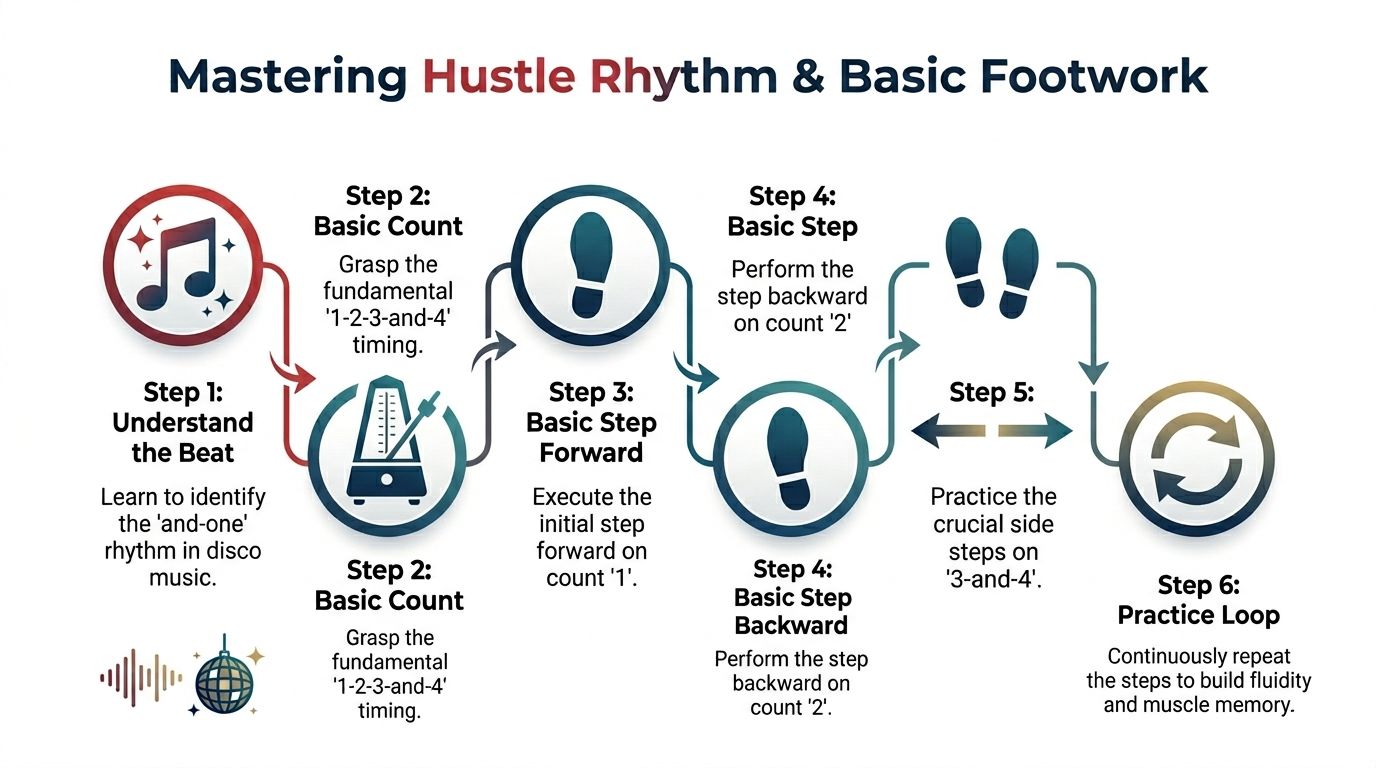
If you want a second solo-practice reference, these easy dance moves anyone can learn help with balance, rhythm, and body control.
Count it before you dance it
Say it out loud first. Not forever. Just long enough to make the rhythm real.
Try this:
- Count “1” and step the rock step.
- Count “2” and replace weight.
- Count “&3” as a compact gathering action that sends you forward again.
That last part matters. The “&” is not a decoration. It is a preparation. The “3” is the launch.
Solo footwork for leaders and followers
You can practice both roles by yourself. Doing that makes your understanding better, even if you plan to dance only one role socially.
Leader footwork
Use a narrow track, as if you are moving along a hallway.
- Count 1: Step back on the left foot. Keep it ball-flat. Do not lean your torso back.
- Count 2: Replace weight forward onto the right foot. Think of this as a straight rock, not a dramatic dip.
- Count &: Bring the feet together in a compact compression step.
- Count 3: Step forward on the left foot with intent.
Follower footwork
Mirror the pathway with the same compact feeling.
- Count 1: Step forward on the right foot.
- Count 2: Rock back onto the left foot and stop momentum cleanly.
- Count &: Gather and compress.
- Count 3: Move forward again with purpose.
What good basic footwork feels like
Good Hustle does not feel jumpy. It feels like your body stores energy, then releases it.
A useful perspective:
| Part of the count | What your body does | What should not happen |
|---|---|---|
| 1 | Begins the rock and controls momentum | Reaching too far |
| 2 | Replaces weight and stabilizes | Torso tipping |
| & | Compresses and prepares | Extra bounce |
| 3 | Launches forward cleanly | Delayed push |
Three habits that speed up progress
Some drills work. Some just make people tired.
- Practice small: Short steps teach timing better than giant ones.
- Stay level: Hustle is smooth. If your shoulders bob up and down, trim the movement.
- Land your “3” clearly: That is the step that gives the dance shape.
Key takeaway: Beginners improve faster when they stop fussing over the “&” and learn to arrive in the right place on “3.”
A simple home drill helps. Put on one song with a steady groove. Spend one verse only walking the rhythm. No turns. No styling. Just 1-2-&3 over and over until the body stops arguing with the music.
Your First Partner Patterns and Connections
The first shock for many beginners is this: knowing the footwork is not the same as dancing the Hustle with another person.
Partner Hustle lives or dies on connection. If the frame collapses, the timing collapses right after it. In Hustle, 80% of stalls at the intermediate level are traced to wrist or elbow collapse, and strong dancing depends on a flat wrist hook grip and bent elbows, with modern club Hustle favoring slotted efficiency over theatrical 1970s lines, according to this technical Hustle guide.
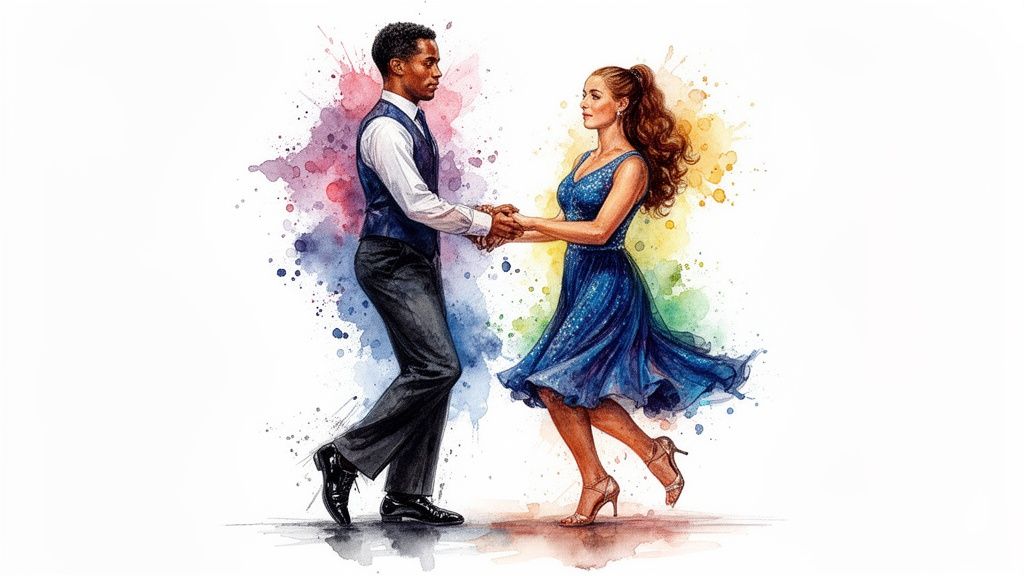
For couples learning together, this idea of movement as shared communication is one reason dancing with your partner builds trust so quickly.
Build the frame before the pattern
Do this before you attempt turns.
Stand facing your partner with comfortable bent elbows. Keep the wrists flat. Hold without squeezing. The connection should feel alive, not rigid.
Think in these terms:
- Compression: You can gently move toward each other without collapsing the arms.
- Tone: The arms are available and responsive, not limp.
- Slot: Each partner respects a clear line of travel.
If one person starts reaching, hanging, or pulling with the shoulders, the pattern loses clarity.
Closed basic
This is the first pattern I teach because it reveals everything. Timing, posture, connection, and travel all show up immediately.
For the leader
Start in closed position with bent elbows near the sides.
- Step back on 1
- Replace on 2
- Gather on &
- Move forward on 3
Keep the invitation clear through the center of your body, not by shoving with the arms.
For the follower
Mirror the pathway.
- Step forward on 1
- Rock back on 2
- Gather on &
- Move forward on 3
Do not anticipate. Wait for the lead to create the direction.
Tip: If the hold feels heavy, the problem is usually not strength. It is shape. Reset the elbows and flatten the wrists.
Open basic
Once closed basic feels stable, open the partnership slightly and let the slot become more visible.
The mistake here is overextending the arms. Beginners often think “open” means far apart. It does not. You still want structure through the elbows and center.
Use the same basic rhythm, but allow the connection to stretch lightly without losing tone. That stretch gives the next move somewhere to go.
Underarm turn
The underarm turn is a classic first turn because it teaches both partners to stay calm while something changes overhead.
The leader raises the connected hand clearly and early enough for the follower to read the path. The follower tracks under the hand without rushing, ducking, or spinning from panic.
A few practical cues help:
- Leaders: Lift the hand with intention, then get out of the way. Do not stir your partner like soup.
- Followers: Keep your steps under you. The turn works better when your feet stay compact.
- Both: Finish the turn back on time. Fancy is optional. Timing is not.
Here is a visual reference that helps many beginners see the flow of partner movement in real time.
A short partner checklist
Before adding more patterns, ask these questions:
| Check | Good sign | Warning sign |
|---|---|---|
| Grip | Wrist stays flat | Hand folds inward |
| Elbows | Bent and available | Straight and locked |
| Travel | Movement stays in a slot | Partners drift sideways |
| Timing | Both land together | One person finishes late |
Most beginners do not need more patterns. They need cleaner basics. A closed basic, an open basic, and a simple underarm turn done well will take you much further socially than six sloppy combinations.
Common Mistakes and Essential Styling Tips
The biggest beginner myth is that Hustle problems come from not knowing enough moves. Most problems come from doing the simple things badly.
A lot of online tutorials teach solo line-dance material and skip the partner cues that modern social dancers need. That leaves people with the same question over and over: how do you move from solo steps into a real hold without losing the beat? That gap shows up in frequent unresolved forum questions about transitioning into partner connection, as noted in this discussion of online Hustle tutorial limitations.
Mistakes that make the dance fall apart
These show up every week in beginner classes.
- Dancing too big: Hustle needs room to breathe, but not giant steps. Oversized movement kills timing and makes turning harder.
- Leading with the arms only: Your partner should feel direction from your body, not from random hand pressure.
- Watching your feet: The floor is not going anywhere. Looking down disconnects you from the music and your partner.
- Rushing turns: Many dancers survive the turn and miss the next count.
What to do instead
Correcting Hustle usually means subtracting, not adding.
Fix your timing first
If you keep drifting off the beat, stop dancing full patterns for a minute. Walk the basic. Count aloud. Then put the pattern back in.
Clean up the frame
Bent elbows, settled shoulders, and a stable center solve more problems than extra force ever will.
Finish one action before starting the next
A turn is not complete because the hand went up. It is complete when both partners arrive balanced and on time.
Tip: If a pattern only works when both people already know it, the lead is unclear. Social dancing needs readable information, not guesses.
Add style without wrecking technique
Styling should support the dance, not interrupt it. Beginners often try to “perform” before they can control momentum. That usually produces flailing arms and late footwork.
Use these instead:
- Head position: Keep the chin level and the eyes alive. That alone changes how polished you look.
- Hip response: Let the body respond naturally to weight changes. Do not force exaggerated action.
- Arm finish: In open work, let the free arm complete a line softly instead of hanging dead at your side.
- Stillness: One of the strongest style choices is not doing too much.
A useful contrast
| If you do this | It usually looks like | Better choice |
|---|---|---|
| Throw big arms | Panic or overacting | Finish lines with control |
| Bounce with the beat | Swing energy, not Hustle | Glide level through the count |
| Rush the spin | Off-balance recovery | Smaller steps and clearer exit |
| Stare at the floor | Uncertain dancing | Keep the focus outward |
The best-styled Hustle dancers are readable. You can see the music in them, but you can also see the partnership. That balance is what makes the dance look social instead of staged.
Your 4-Week Hustle Practice Plan and Music Guide
Dancers often improve at Hustle when practice stays short, focused, and repeatable. One long session full of frustration does less than several smaller sessions with a clear target.
This plan works well for singles and couples because it builds from solo control into partner clarity.
Week 1 and Week 2
Week 1 with rhythm and walking drills
Spend your first week making peace with the count.
Use one or two songs with an obvious pulse. Walk 1-2-&3 across the room. Then walk it in place. Then try it facing a mirror.
Your goals:
- Hear the count: Do not guess where the “3” lands.
- Reduce size: Keep steps under the body.
- Stay level: No shoulder bounce.
A useful drill is thirty seconds of counting aloud, then thirty seconds silent, then back to counting aloud. That exposes whether the rhythm is really internal yet.
Week 2 with solo basic and direction control
Now make the footwork cleaner.
Practice leader footwork for part of the session and follower footwork for part of it, even if you only plan to dance one role socially. It improves timing and empathy.
Focus on:
- Clear weight changes
- Compact gather on “&”
- Strong arrival on “3”
At the end of each session, do one song without stopping. The point is not perfection. The point is continuity.
Week 3 and Week 4
Week 3 with partner frame and closed basic
Add a partner if you have one. If not, shadow the hold shape with your arms and imagine the slot.
Work only on:
- Closed basic
- Opening slightly without losing elbow position
- Returning to neutral connection
Spend more time resetting than adding material. Good partner dance training often looks slow from the outside.
Week 4 with turns and simple combinations
Dancers often get greedy at this stage. Do not.
Add one turn, then return to the basic. Build a short sequence like this:
- Closed basic
- Open basic
- Underarm turn
- Back to basic
If the timing goes bad, remove the turn and rebuild.
Key takeaway: The goal of a four-week plan is not to know everything. It is to build a basic you can trust in public.
Music that helps instead of hurts
For practice, choose songs with a steady groove and clean phrasing. Avoid tracks that change feel constantly or hide the pulse under too many accents.
Try two buckets:
- Classic disco and groove-driven tracks: Good for hearing the pulse and learning consistent travel.
- Modern pop, R&B, and electronic tracks with a clear beat: Good for testing whether your basic holds up outside retro music.
A practical rule works well. If you can clap the beat easily and keep walking without hesitation, the song is probably useful. If you spend the whole track trying to find the count, save it for later.
Taking Your Hustle to the Next Level
Learning how to dance the Hustle comes down to a few essentials. Keep the rhythm honest. Keep the steps compact. Build a frame that can communicate. Then practice enough that the dance starts to feel social instead of mechanical.
That is also why in-person coaching matters. A teacher can spot the exact thing you cannot feel yet. Maybe your wrist is collapsing. Maybe your rock step is too big. Maybe your turn lead is late. Small corrections change the entire dance.
This is especially important for groups that generic tutorials often ignore. There is a 35% rise in Google searches for “Hustle kids dance classes” and a 22% increase in Philadelphia couples requesting Hustle for their wedding dance, and studios that adapt progressions for those groups see stronger beginner retention, according to this overview of Hustle interest among kids and wedding couples. That matches what good instructors already know. Different dancers need different entry points.
If you are learning solo, you need partner-ready technique. If you are a couple, you need clean communication under pressure. If you are preparing for a wedding, you need movement that looks natural in your clothes, to your music, in your space.
The next level is not more tricks. It is better basics, better connection, and better coaching.
If you want expert help turning these steps into real social dancing, book a free complimentary lesson with Danza Academy of Social Dance. Whether you are coming in solo, with a partner, for a wedding, or for a kids’ program, the team will meet you at your level and help you build confidence fast.