
Learning to dance the foxtrot is like learning the secret to floating. It’s all smooth, gliding movements set to that iconic slow-quick-quick rhythm. This classic ballroom dance is a showstopper at social events, on cruise ships, and especially at weddings, making you feel utterly elegant from the first step.
To get started, you just have to understand its unique character and master that fundamental timing.
Your First Steps Into the World of Foxtrot
Welcome to the dance that’s been the very definition of sophistication for more than a century. The foxtrot blends the grace of a waltz with a distinctly American swagger, which makes it both impressive to watch and so much fun to learn. And unlike some of the faster, more complex dances out there, it’s incredibly welcoming for beginners.
At its core, the foxtrot is really just a walking dance. Seriously. If you can walk with a bit of confidence and rhythm, you already have the building blocks. The magic comes from turning that simple walk into a continuous, flowing motion with your partner.
To give you a head start, here's a quick rundown of the essential elements.
Foxtrot Fundamentals at a Glance
Here's a quick summary of the core elements every new foxtrot dancer needs to know to get started.
| Element | Description | Quick Tip |
|---|---|---|
| Rhythm | The foundational timing is Slow-Quick-Quick. | Count it out loud: "Slooow, quick-quick." This helps internalize the rhythm. |
| Time Signature | It's danced to 4/4 time music. | Almost all popular music is in 4/4, so you have endless songs to practice with. |
| Character | Smooth, progressive, and continuous. It travels across the floor. | Think of it as "walking on clouds." Avoid any bouncing or jerky movements. |
| Basic Steps | Based on walking forward and backward. | If you can walk, you can foxtrot. Focus on long, gliding steps for the "slows." |
Getting these fundamentals down will give you a solid base to build upon as you learn more complex patterns.
The Signature Foxtrot Rhythm
What gives the American Style Foxtrot its signature laid-back feel is its rhythm. It’s built on a simple count that lines up perfectly with 4/4 time music—the same time signature behind the vast majority of pop songs you hear on the radio.
The core timing pattern is Slow-Quick-Quick.
- A Slow step takes two full beats of music.
- A Quick step takes just one beat.
- The second Quick step also takes one beat.
Put it all together, and one Slow-Quick-Quick sequence fits perfectly into a four-beat measure of music. This pattern feels so natural and intuitive that most beginners can feel the music and start moving right away, without getting stuck on complicated counting. It has a rhythm that’s almost like a heartbeat with a little skip.
The Foxtrot’s smooth, progressive character makes it ideal for navigating a dance floor. You'll learn to travel with long, gliding steps, creating an illusion of effortless movement that is the hallmark of a skilled foxtrot dancer.
A Rich and Enduring History
The foxtrot isn’t just a collection of steps; it's a living piece of history. The dance first burst onto the scene in 1914, thanks to a vaudeville star named Harry Fox, who literally "trotted" his way into dance history at the New York Theater.
By the 1920s and 30s, it had completely taken over the social dance world. Some estimates suggest that over 90% of the records released during that era were foxtrot tunes! This enduring legacy is a real testament to its adaptability and charm.
Today, at studios like ours where we have over 40 years of teaching experience, the foxtrot remains a cornerstone of both the American and International Styles. It's the perfect choice for everything from a first wedding dance to a sophisticated night on the town. Want to dive deeper into its fascinating past? Check out our complete guide on the history of the foxtrot.
Mastering the Foxtrot Frame and Posture
The secret to that signature smooth, gliding look in the foxtrot isn't just in your feet—it's all in the frame. A strong, elegant posture and a connected frame are what allow a couple to move as one, turning what are essentially walking steps into something truly magical. This is the foundation you need to dance the foxtrot with real confidence.
Think of your frame as the communication system between you and your partner. It’s not about being stiff or rigid. Instead, it's about creating a consistent "tone" in your arms and upper body. This tone is how a leader sends clear signals and a follower can receive them instantly, all without saying a word.
A proper frame should feel like you and your partner are holding a large, lightweight beach ball between you. It's wide, rounded, and maintains its shape, creating space and connection at the same time.
Achieving the Correct Dance Hold
For the leader, your left hand gently holds the follower's right hand. Your right hand rests comfortably on the follower’s left shoulder blade, keeping your fingers together and pointed toward their spine. This hand is your primary tool for leading direction and rotation.
For the follower, your right hand rests lightly in the leader’s left. Your left arm drapes gracefully over the leader’s right arm, with your hand resting on their shoulder. It’s absolutely crucial to maintain your own posture here and not lean on your partner for support. You're a team, not a support structure!
Building Muscle Memory for Perfect Posture
Consistent posture is non-negotiable for a beautiful foxtrot. You want to feel tall, with your shoulders relaxed and pulled back, your chest open, and your core engaged. As you develop your foxtrot frame, it's a great time to also learn how to correct forward head posture for better alignment and a more polished look on the floor.
Here are a couple of simple drills you can practice pretty much anywhere:
- The Wall Check: Stand with your back flat against a wall. Make sure your heels, hips, shoulder blades, and the back of your head are all touching it. This is what perfect dance posture feels like. Now, try to hold that alignment as you step away from the wall.
- Posture Walking: As you walk around your house or even the office, consciously think about maintaining your dance posture. Keep your head up, shoulders back, and imagine a string is pulling you upward from the crown of your head.
Mastering your frame takes practice, but it's hands-down the fastest way to improve your dancing. Ready to feel the difference expert guidance can make? There's no substitute for in-person feedback. Claim your free introductory lesson now and let our instructors help you build a flawless frame in just one session. Book your free complimentary lesson on our contact page.
The Core Foxtrot Patterns You Need to Know
Once you've got your frame and posture dialed in, it's time to put that connection into motion. Learning the foxtrot is really about building a vocabulary of a few core patterns. Think of them as your building blocks for traveling around the floor, changing direction, and adding a bit of personal style.
We’ll break down the essentials here, covering what both the leader and follower need to do. You'll find that executing these patterns gracefully comes down to the importance of balance, which is what makes the dance look so effortless.
The Foundational Box Step
While the Box Step won't get you across the room, it's one of the most valuable tools for any beginner. It's a simple, stationary pattern that drills the slow-quick-quick rhythm into your muscle memory. This is your "home base," a perfect way to get comfortable moving with a partner without the added pressure of navigating a busy floor.
- Leader's Part: Step forward with your left foot for "slow." Next, step side with your right foot for "quick," and bring your left foot to meet your right for the second "quick." To finish the box, step back with your right ("slow"), side with your left ("quick"), and close your right foot to your left ("quick"). You've just drawn a box on the floor.
- Follower's Part: Your job is to mirror the leader. You'll start by stepping back on your right foot ("slow"), then side with your left ("quick"), and close your right foot to your left ("quick"). Now, step forward on your left ("slow"), side with your right ("quick"), and close your left foot to your right ("quick").
Pro Tip: When you're just starting out, keep your steps small and tidy. The goal isn't to travel; it's to nail the timing and footwork while keeping your frame solid. The Box Step is also a lifesaver on a packed dance floor when you need to dance in place for a moment.
The Progressive Magic Step
This is where the Foxtrot truly comes alive. These are the walking steps that create that signature smooth, gliding look. Often called the Magic Step or simply the forward and back basic, this pattern is what you'll use to travel around the dance floor with elegance.
The leader moves forward with a Slow-Slow-Quick-Quick count, and the follower mirrors by moving backward to the same rhythm. The leader steps forward left (slow), forward right (slow), forward left (quick), then closes the right foot to the left (quick). This simple, flowing sequence is the absolute essence of social foxtrot.
The Elegant Promenade
Ready to add a little flair? The promenade is a beautiful pattern where both partners open up to face the same general direction—the leader's left and the follower's right—without breaking the dance frame. It’s your go-to for navigating corners and adding visual interest.
From this open "V" shape, both partners step forward in the same direction, usually with a slow-quick-quick timing. The lead is subtle; the leader initiates the turn by rotating his upper body, guiding the follower into the open position. After a few steps, he guides her right back into a closed frame.
This infographic breaks down the three key parts of a strong frame, which is essential for leading and following moves like the promenade.
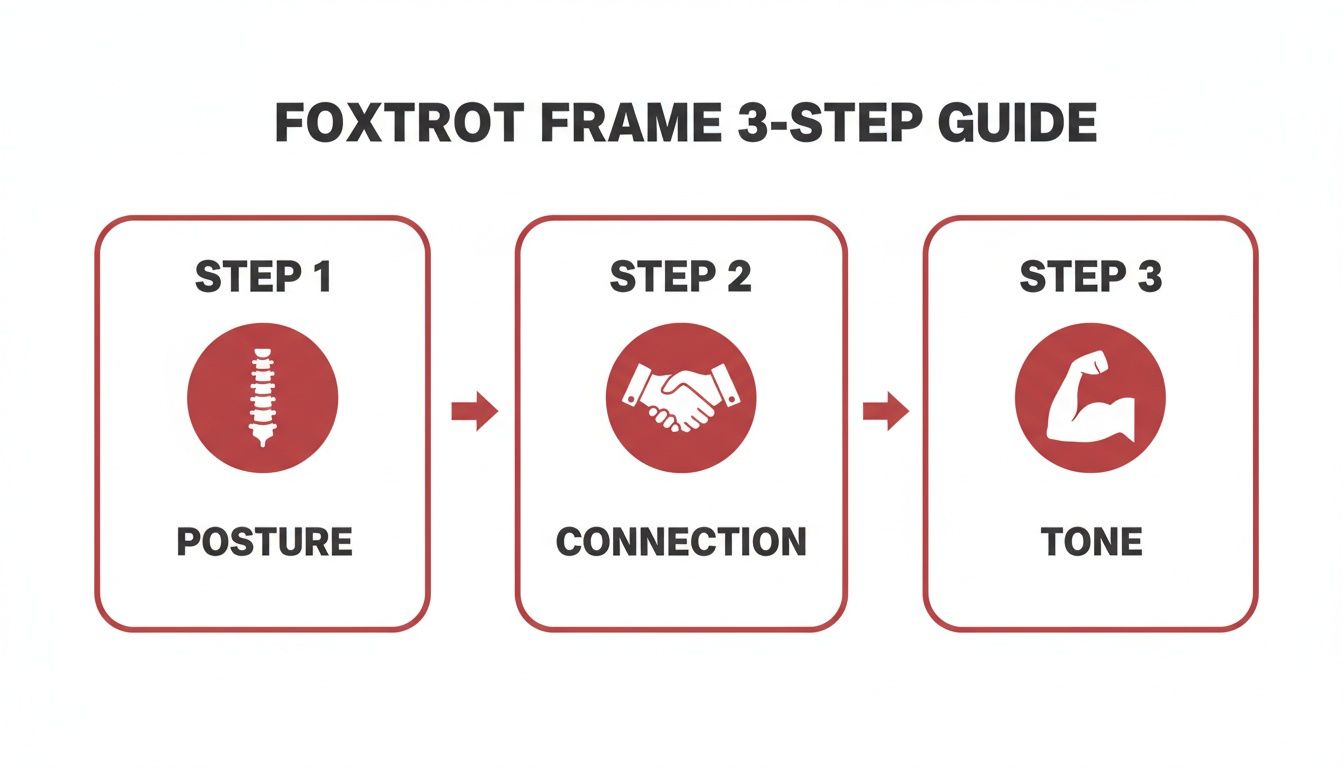
Nailing your posture, connection, and arm tone is what allows every signal to be sent and received clearly, making the dance feel seamless.
The Versatile Underarm Turn
The Underarm Turn is a classic move that gives the follower a moment in the spotlight. It's simple but looks fantastic. The leader just raises his left arm, creating an arch for the follower to turn right under.
- Leader's Role: Your main job is to be a stable anchor. As you lead the follower into her turn, you'll perform a simple side-together step in place. Keep that frame steady!
- Follower's Role: You’ll step forward and walk in a small, neat circle under your partner's arm. The turn is typically completed over two "slow" counts.
Once you feel these patterns click, it’s a genuinely satisfying moment. Curious about the other traditional dances of ballroom dance? Many of them share these foundational principles of lead, follow, and frame.
Developing Musicality and Effortless Flow
If you've mastered the foxtrot patterns, you know the words. Now, it's time to learn how to write poetry with them. This is where you stop just counting "slow-quick-quick" and start having a real conversation with the music and your partner.
The secret to that effortless foxtrot glide you see from experienced dancers? It’s all in the musical phrasing. Go ahead, put on a classic foxtrot track. You'll hear the music isn't just a steady metronome—it swells, softens, and builds. Great dancing mirrors that journey.
This has been part of the foxtrot's DNA since the beginning. When it first hit the scene in 1914, it quickly became known for its sophistication, perfect for both grand ballrooms and intimate dance floors. By the 1930s, foxtrot records were outselling all other dance music genres by a 5-to-1 margin in the US and Europe. You can read all about it in our article on the foxtrot's captivating history.
Feeling the Rise and Fall
One of the most beautiful elements of the foxtrot is its signature "rise and fall." This isn't a big, bouncy movement like you’d see in a Waltz. Think of it more as a subtle, rolling wave that lets you float across the floor.
The Rise: This happens near the end of your "slow" steps. Just before you transition to your "quick" steps, you'll rise smoothly through your knees and ankles.
The Fall: As you begin your next "slow" step, you gently lower or "fall" back down, letting your knees absorb the movement. Picture a cat landing gracefully on its feet.
This continuous, flowing motion is what creates that polished, effortless look. It helps you cover more ground with less work and makes the dance feel incredibly smooth for both you and your partner.
The key to musicality isn't just hearing the beat; it's about translating the feeling of the music into your body. Let the long, smooth notes of a saxophone inspire your slow, gliding steps.
Leading and Following with Intention
Musicality is a team effort. The leader’s job is to interpret the music and suggest how to express it. The follower’s job is to listen—to both the music and the lead—creating a dance that feels spontaneous and alive.
For leaders, this is your chance to get creative. Don't just tick off patterns from a list. Try adding a slight hesitation before a turn or extending a forward glide during a particularly lush musical phrase. You're telling a story, not just reciting steps.
For followers, the key is to stay present and connected. When you feel your partner initiate that subtle rise or a gentle sway, let your body respond in kind. This back-and-forth is what turns a sequence of steps into a truly beautiful, shared experience.
This connection is often the hardest part to grasp on your own. Why not feel it for yourself? Your first lesson is on us. This is the perfect risk-free opportunity to see how our instructors can help you find that effortless flow and connect with the music. Book a free complimentary lesson on our contact page.
Book Your Free Lesson at Danza Academy
Reading about the foxtrot is a fantastic start—you've taken the first step! But there's a world of difference between knowing the steps and feeling the dance. True confidence, that effortless glide across the floor, and a real connection with your partner… that all happens when you get on your feet.
This is where theory meets reality, and it's where our world-class instructors at Danza Academy in Center City Philadelphia and Exton can make all the difference. We provide the kind of hands-on, immediate feedback a screen or a book simply can't offer. We'll help you refine your frame, lock in your timing, and turn what feels like mechanical movements into a dance that's smooth, natural, and truly yours.
From Reading to Dancing
So, what's your goal? Maybe you're getting ready for a wedding, searching for a fun new hobby, or you just want to feel poised and confident at the next party you attend. We get it. Taking that first step into a studio can feel like a big deal, but our entire mission is to make it fun, welcoming, and completely stress-free.
The single most effective way to improve your dancing is with one-on-one instruction. Studies on motor learning show that personalized feedback accelerates skill acquisition by over 50% compared to just watching or reading.
We want you to see for yourself. That's why we invite you to our studio for a free complimentary lesson. It's not a sales pitch; it's a genuine, no-strings-attached chance to meet our team, see our space, and discover how quickly you can start feeling like a dancer.
What to Expect in Your First Lesson
Your free lesson is all about you. We’ll chat for a minute about what you’re hoping to achieve, and then we’ll get you moving with some foxtrot basics. It's the perfect way to get a feel for our teaching style and the friendly atmosphere we’ve nurtured for over 40 years.
Here’s what you’ll gain:
- Personalized Feedback: Get immediate, actionable tips on your posture and frame.
- Rhythm Practice: Finally feel the "slow-quick-quick" rhythm with an expert guiding you.
- A Clear Path Forward: We'll help you understand what your dance journey could look like with us.
Whether you're curious about group classes or the focused attention of private dance lessons, this first session is the perfect introduction.
Ready to stop reading and start dancing? It's time to take that next step. Click the link to book your free lesson—we can't wait to welcome you to the Danza Academy family.
Book Your Free Complimentary Lesson at Danza Academy
Your Top Foxtrot Questions, Answered
Thinking about learning the foxtrot? You probably have a few questions. We get it. After helping thousands of beginners at Danza Academy step onto the floor, we've heard them all. Here are the straight-up answers to the questions our new students ask most often.
Do I Need a Partner to Learn the Foxtrot?
Absolutely not. This is probably the biggest myth that keeps people from ever starting. We welcome both singles and couples in all our classes.
In our group sessions, we actually encourage rotating partners. Honestly, it's one of the best ways to get good, fast. Dancing with different people forces you to sharpen your lead or follow skills and makes you a much more adaptable, confident dancer at any social event. Don’t let flying solo hold you back.
What Kind of Shoes Should I Wear?
Don't rush out and buy professional dance shoes for your very first lesson. The most important things are comfort and making sure the shoe stays firmly on your foot.
- For followers: A comfortable, low heel is usually better than a flat. It naturally helps your posture and balance. Just stay away from stilettos or anything super high.
- For leaders: A dress shoe with a smooth sole (not rubber) is perfect. You need to be able to glide and pivot without your feet sticking to the floor.
- What to avoid at all costs: The absolute worst things you can wear are sneakers, flip-flops, or any shoe with a grippy rubber bottom. That grip makes turning and gliding—the heart and soul of foxtrot—nearly impossible.
Is Foxtrot a Good Wedding First Dance?
Foxtrot is a fantastic—and hugely popular—choice for a first dance. It’s elegant, timeless, and fits perfectly with everything from Frank Sinatra classics to modern hits by Michael Bublé or Ed Sheeran.
The best part? The basic steps are quite simple to pick up. With just a few lessons, you and your partner can look graceful, connected, and completely comfortable. At Danza Academy, we even specialize in crafting wedding choreography that feels authentic to you as a couple.
How Long Does It Take to Get Good?
That’s the big question! And the honest answer is: it all depends on what "good" means to you. Most of our students can learn the basic rhythm and a couple of key patterns in their very first lesson.
You can feel confident enough to get on the dance floor at a wedding or party after just a few weeks of consistent lessons and a little practice.
Of course, mastering advanced figures and developing true musicality takes longer. But the journey is a huge part of the fun. Consistency is way more important than intensity. With regular practice and good instruction, every step you take is a win.
Ready to turn these answers into action? The fastest way to build confidence is with an expert by your side. At Danza Academy of Social Dance, we're so sure you'll love the experience that your first lesson is on the house. No catches, no pressure—just a fun opportunity to discover your inner dancer. Secure your free spot now.