You walk into a social dance night expecting a few familiar disco songs, then a couple glides past you with effortless turns and a quick, almost elastic rhythm. Their feet barely leave the floor, their hands stay connected, and every movement seems to answer the beat. You may wonder, what is the Hustle dance, and whether someone who has never taken a partner-dance class can learn it today.
The short answer is that the Hustle is an evolving social partner dance, not a museum piece from the disco era. Its smooth traveling action, compact footwork, and adaptable timing make it useful on contemporary social floors, especially for adults who want a dance that feels energetic without requiring large jumps or complicated choreography.
Picture This on a Friday Night
The room is dim, the floor reflects the colored lights, and a four-on-the-floor track pulses through the speakers. Near the edge of the room, newcomers are still deciding where to stand. In the center, a couple rotates smoothly through the crowd, using a close partner hold, quick changes of direction, and long, whiplike arm lines that seem to stretch and recoil with the music.
They don't bounce like they're doing a fast swing pattern. Instead, they slide, turn, and travel along a narrow slot, making room for other couples while keeping their movement controlled. One partner gives a small change through the body, the other responds, and the pair turns without forcing the arms or breaking the rhythm.

Plainly stated, the Hustle is a partnered slot dance built around compressed syncopation over disco and pop-disco music. Its movement vocabulary developed from mambo footwork, then changed to suit crowded New York nightclubs and the smooth, continuous energy of disco.
The technical surprise comes from the timing. The basic action often compresses into three beats of music, while the dancer organizes the movement as four steps, using quick and slow actions. That creates the recognizable Hustle quality, a feeling of moving slightly ahead of or inside the beat rather than stepping evenly from one count to the next.
This scene matters because the Hustle remains social, adaptable, and learnable. Its 1970s reputation can make it seem dated or intimidating, but the dance itself has always changed in response to its music, dancers, and venues. Understanding its history, timing, connection, and beginner pathway makes the first lesson much less mysterious.
The Hustle's New York Origin Story
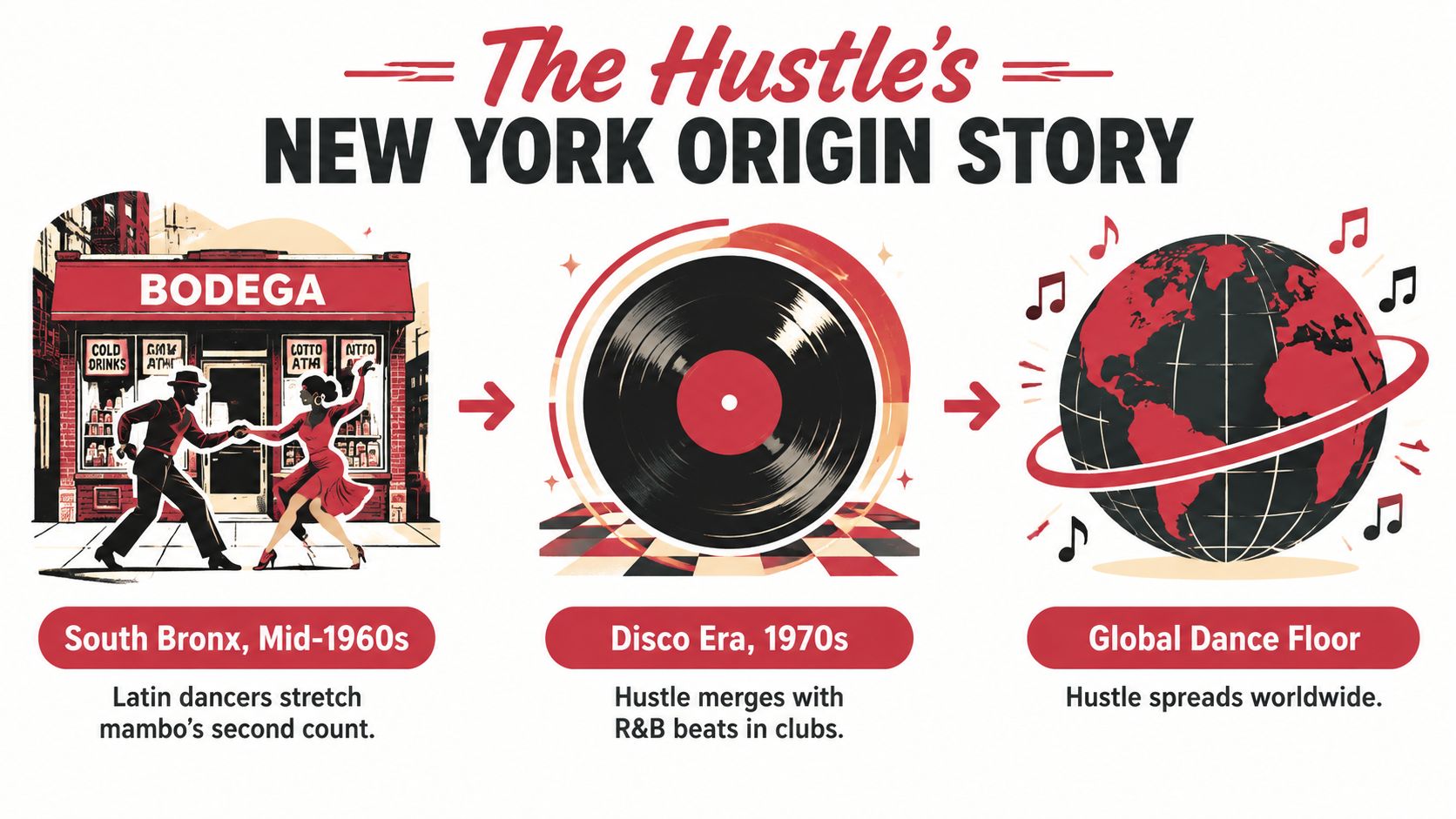
The Hustle's history doesn't begin with a record label or a television dance show. It begins in New York, where young dancers experimented with existing movement traditions in crowded neighborhoods and clubs.
Multiple independent histories place the dance's roots in the South Bronx among Puerto Rican teenagers and in disco-era club culture. One account places its beginning in late 1972 as a five-count partner dance, while another describes an earlier six-count line dance that later developed into partner variations. These accounts don't have to cancel each other out. They show that the Hustle was evolving quickly rather than following one official invention story. (The Art Gallery of Ontario's history of the Hustle)
By 1973 and 1974, dancers were already using names such as the Rope Hustle and Push and Pull Hustle. By the mid-1970s, the dance was widely known as the Latin Hustle or Spanish Hustle. The names reflected a living social vocabulary, with dancers adapting patterns to different musical arrangements, club spaces, and communities.
Two origin stories, one evolving dance
One account emphasizes Puerto Rican and Black dancers reshaping mambo-related footwork for longer R&B and disco arrangements. Another gives more attention to studio dancers and teachers who helped formalize patterns for lessons, performances, and competitions. Treating these as complementary makes more historical sense than searching for a single person who “invented” every version.
The dance moved from street and club communities into discotheques, studios, and competitions. Dance historian Ralph Giordano has described Hustle as the first Latin dance indigenous to the United States, a distinction that places it within American dance history rather than presenting it as a direct import from another country. (The Hustle dance history overview))
Then music gave the movement a national platform. Van McCoy released “The Hustle” on April 18, 1975, and the song reached No. 1 on Billboard on July 26, 1975. Smithsonian reports that the recording sold 10 million copies, helping transform an existing local craze into a national phenomenon. (Smithsonian's account of Van McCoy's “The Hustle”)
The 1977 film Saturday Night Fever reinforced disco's place in mainstream nightlife. By the late 1970s, Hustle had become one of the defining partner dances of the era, but its earlier multicultural development remained part of its identity.
The Music and the Tricky Timing
Hustle music usually sits on a strong 4/4 disco foundation. You can hear an even pulse underneath the song, often marked by a steady kick drum on each beat and bright offbeat percussion that keeps the track moving forward. That feel differs from salsa's rolling tumbao, which tends to organize the body around a more layered, circular rhythmic conversation.
The Hustle's challenge is that the basic action often compresses movement into three beats of music, while the dancer takes four steps. Beginner teachers commonly use counts such as 1-2-3 or &1-2-3, with the “and” creating the quick pickup before the main count. The exact execution can change with the music and the local social style. (Harold Sears's Hustle timing guide)
Try a simple analogy. Snap your fingers twice quickly, then make one clear snap on the beat. Your body is still moving in relation to the regular pulse, but one part of the phrase is compressed. In dance, that compression creates the Hustle's quick, smooth quality.
Timing rule: Keep the pulse steady first. Add speed to the steps only after your weight changes feel clear.
A beginner often walks every action evenly and arrives half a beat late. An experienced dancer looks “in the pocket” because the steps land with precise placement around the bass drum rather than directly on every obvious beat. That difference isn't a mystery or a special talent. It comes from practicing weight transfers slowly, then adding music.
For a practical way to explore energetic tracks before practicing, browse these high energy karaoke music picks. As you listen, notice which songs give you a steady pulse and which ones make the offbeats easy to hear. Developing that listening habit is part of understanding musicality in dance, not a separate skill reserved for advanced performers.
Basic Steps and Partner Connection
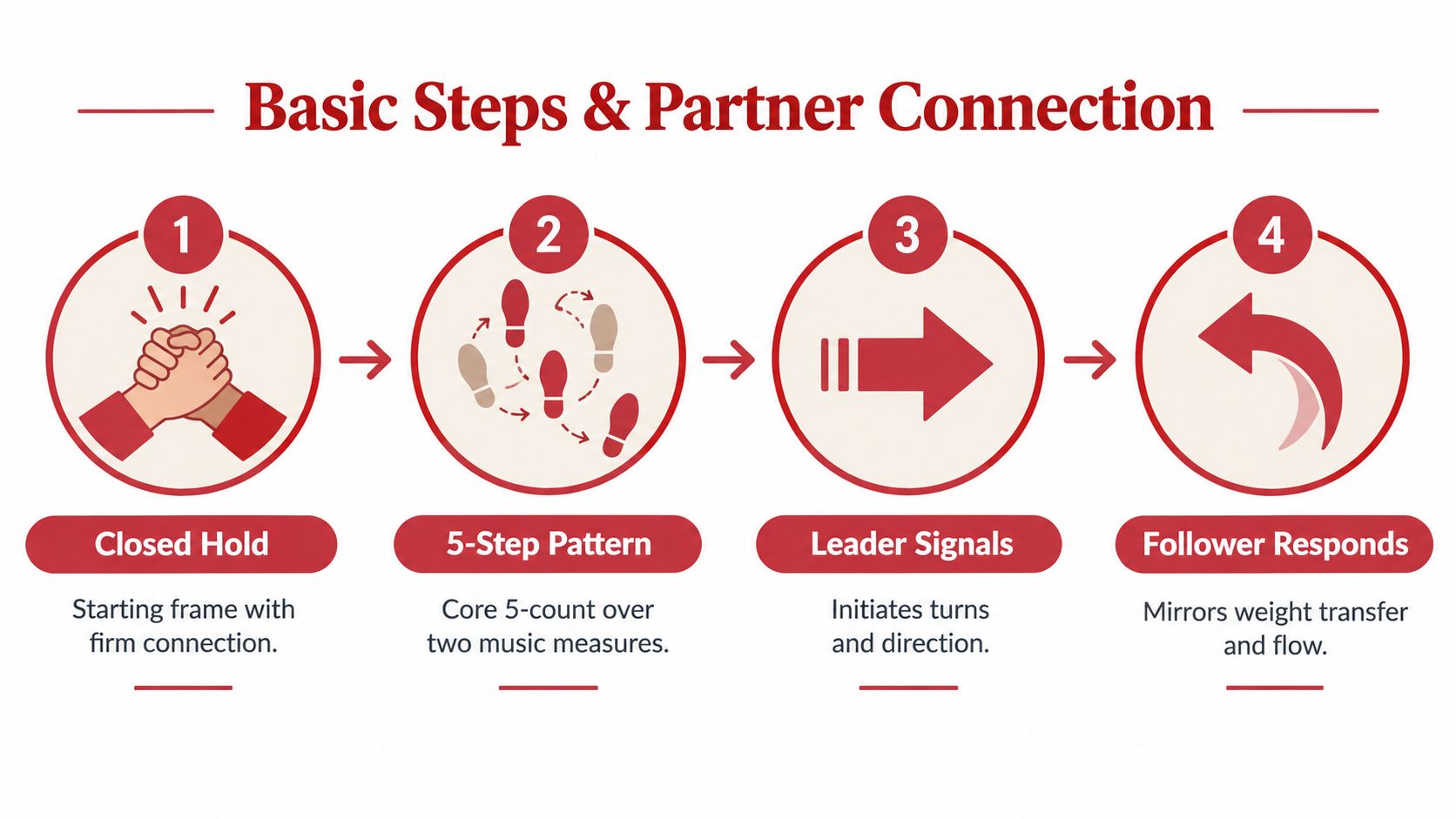
The partner Hustle has a simple architecture, even though its timing can feel unfamiliar. In many beginner lessons, you'll work with a closed two-hand hold, a repeating five-step pattern, and a shared sense of direction along the slot.
Start by counting while standing in place. Think of the pattern as a small rock or weight change followed by traveling steps. You're not trying to memorize a complicated diagram. You're learning to place your weight, collect your feet, and remain available for the next movement.
Build the pattern through weight
The leader initiates direction and the follower responds through the connection. Both dancers transfer weight clearly, so the movement doesn't depend on one person dragging the other. A useful image is walking past a doorway while turning your shoulder toward it. Your body changes direction first, and your feet organize underneath you.
Keep the frame light. The hands stay connected, but they shouldn't grip. The leader offers information through the body and frame, while the follower reads the leader's ribcage and overall movement rather than reacting to isolated arm motions.
The most common early mistake is trying to turn during the rock step. Keep that action as a weight change first. Once the weight has settled, the body can travel or rotate without the feet feeling rushed.
Connection reminder: Your hands communicate direction, but your center organizes the dance.
The pattern repeats through many Hustle variations, which is encouraging for a new student. Once you understand the relationship between the quick timing, weight transfer, and slot travel, later figures become changes on a familiar foundation. You can also reinforce the sequence with this practical guide to how to dance the Hustle.
Here's a short visual lesson to help you see how the partner connection works in motion:
Common Hustle Variants Worth Knowing
The word “Hustle” describes a family of related social dances rather than one universal routine. The distinctions can sound confusing at first, so use the table below as a practical map. The names tell you something about the community and musical setting, but dancers may still adapt the style from one floor to another.
Hustle variants at a glance
| Variant | Origin / Scene | Step Pattern | Typical Tempo | Best Setting |
|---|---|---|---|---|
| New York or Three-Count Hustle | New York partner-dance and studio tradition | Compressed three-count timing with traveling partner patterns | Disco, pop-disco, and energetic social tracks | Beginner classes, social dance nights, showcases |
| Latin Hustle | Latin-influenced club and social scenes | Faster single-rhythm action, often danced with circular movement | Brisk club music | Informal club floors and Latin-oriented events |
| Two-Step Hustle | Texas and country-influenced dance communities | Two-step-based traveling structure | Country, crossover, and pop tracks | Country-social settings and regional dance events |
| Night Club Two-Step | Nightclub adaptation using Hustle-like slot travel | Slower, spacious patterns with extended weight changes | Slow ballads and relaxed contemporary music | Nightclub socials, weddings, and slower partner sets |
The New York or Three-Count Hustle is the version most likely to appear in a traditional studio introduction. It feels smooth and rotational, with a clear partner relationship and enough structure for a teacher to build turns gradually.
The Latin Hustle feels quicker and more circular. It shares a family resemblance with the partner Hustle but may look less like a narrow slot dance when dancers move in club formations.
The Two-Step Hustle makes sense to students who already enjoy country or traveling two-step environments. Its identity comes from the way Hustle ideas blend with regional social-dance habits.
Night Club Two-Step is usually slower and more spacious. It borrowed the idea of slot travel and partner connection for ballads, so it belongs in the broader conversation even though it doesn't feel like classic disco Hustle.
At a first social event, expect the New York or Three-Count version where Hustle is taught as a studio or ballroom social dance. Other versions may appear depending on the local community, the DJ, and the evening's music.
Why the Hustle Still Fills Studios
The Hustle lasts because dancers keep changing it. Nostalgia may bring someone through the door, but adaptability gives the dance a life beyond its original disco moment.
Its movement has absorbed ideas associated with swing's slot-based travel, Latin styles' rotational vocabulary, and nightclub dancing's slower, more spacious interpretation. That flexibility lets teachers match the same general connection principles to disco, pop, remixes, and other social music without turning every class into a fixed historical reenactment.
A studio also teaches Hustle because the skills transfer. The light frame, directional lead, responsive follow, and slot awareness can support later work in West Coast Swing and Night Club Two-Step. Students aren't only collecting one routine. They're developing a way to communicate through weight, timing, and movement.
The most useful way to think about Hustle is as a social-dance language with a strong accent, not a single sentence frozen in the 1970s.
The disco label can still create resistance. Some adults hear “Hustle” and picture a costume, a television routine, or a dated party song. Contemporary playlists and remixes challenge that assumption because dancers can apply the vocabulary to music that feels current, provided the pulse and phrasing support the movement.
The practical appeal is just as important. Hustle uses manageable footwork, travels smoothly rather than relying on jumps, and gives adults a clear repeating structure. Social classes often rotate partners, so students practice communication with different body types, timing habits, and experience levels.
That combination explains why a dance born in New York nightlife remains useful. It offers rhythm training, partner awareness, and room to personalize the style without demanding that a beginner become a performer on the first night.
Where to Learn and How to Start
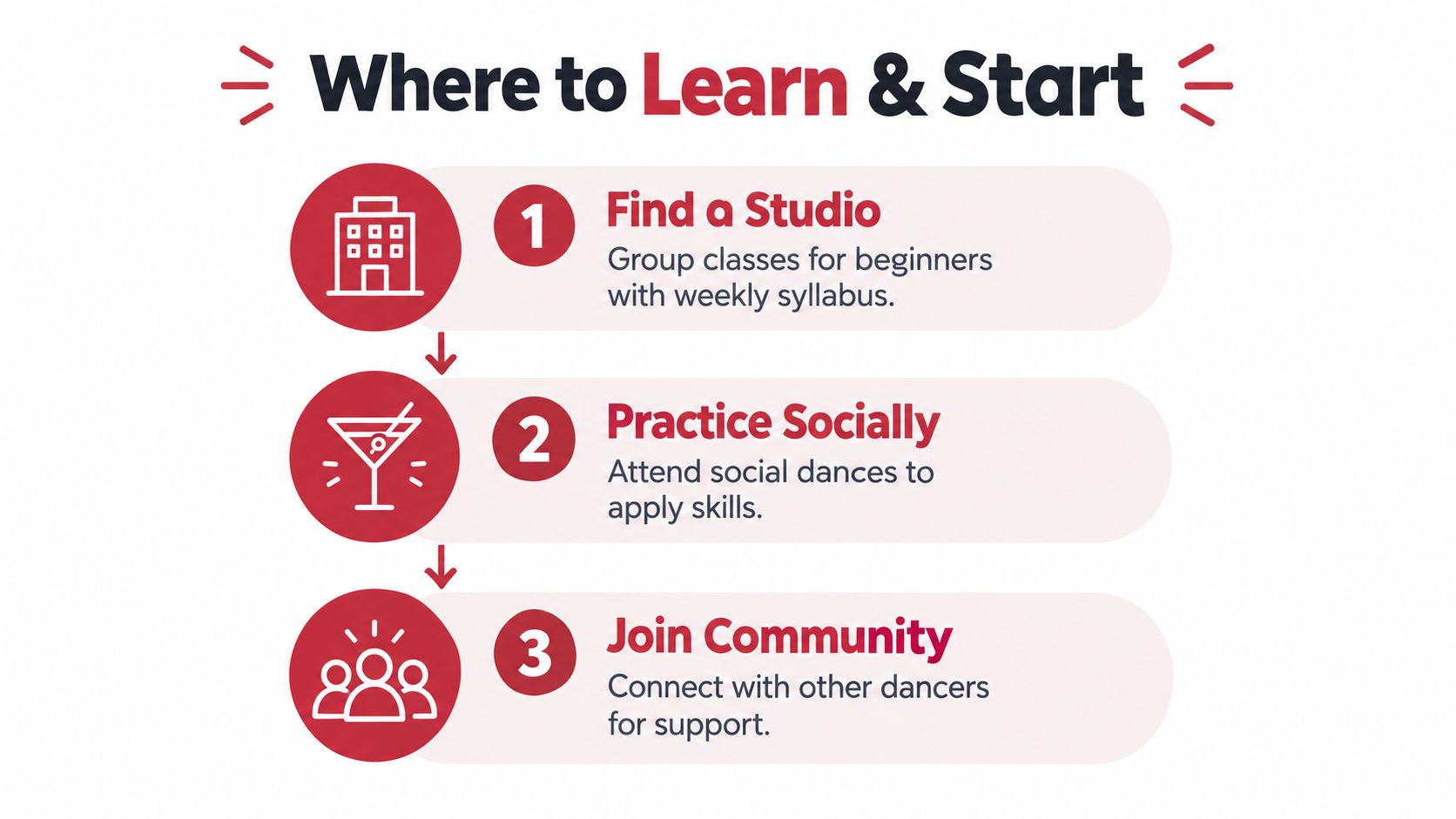
A local studio gives you the clearest starting route because a teacher can see whether your weight is transferring, whether your frame is too tense, and whether you're rushing the syncopation. Look for a class labeled beginner or introductory, then ask whether the instructor follows a structured progression rather than changing patterns every week.
Group classes work especially well for Hustle because you can experience the dance with multiple partners. A social dance night or practice party then gives you a low-pressure place to repeat the basic pattern, listen to different songs, and learn how to share the floor.
A practical starting route
Observe first. Watch an advanced social dancer for a few minutes. Notice how little force the partners use and how they preserve space around other couples.
Commit to one course. Give a structured beginner series enough time for the timing and connection to settle before deciding whether the dance suits you.
Practice between lessons. Review the basic weight changes at home, then attend social events when you can. Partner dancing improves when your body learns to respond without lengthy verbal instructions.
At-home learning can help with review. Search for instructors who focus specifically on Hustle rather than general party-dance compilations, and use video to check posture, hand position, and timing. The limitation is obvious, though. A solo dancer can rehearse footwork, but a screen can't give you the pressure, direction, and response of another person.
You won't need elaborate equipment. Wear comfortable clothing, bring water, and choose shoes with soles that let you turn without sticking to the floor. Before joining, check whether the studio allows smooth-soled dance shoes or recommends a particular style for its surface.
Danza Academy's adult beginner dance lessons are one local option for adults exploring structured social-dance instruction, including partner styles such as Hustle.
The lowest-risk way to test the experience is to book the academy's free complimentary lesson. You can ask questions, try the basic timing with an instructor, and decide whether the Hustle feels enjoyable in your body rather than judging it from a video.
Beginner Questions Answered
Is the Hustle hard to learn?
The footwork is approachable, but the dance has two details that need practice: partner connection and syncopated timing. Many adults understand the basic pattern quickly, then need more repetition to make the quick steps feel relaxed instead of hurried.
You don't need to arrive with musical training. A teacher can slow the pattern down, separate the weight changes from the turns, and add music only after your body understands the sequence.
Do I need a partner?
No. Group studios commonly rotate partners, and solo students are expected. Partner rotation can even help you progress because you learn to communicate with different people instead of depending on one familiar response.
You also don't have to choose a permanent role immediately. Trying both leading and following can improve your understanding of the dance, even if you eventually prefer one role.
Will I look silly?
You'll probably make mistakes, but that's normal rather than embarrassing. Every experienced social dancer has had a first lesson where a count disappeared, a turn arrived too early, or the feet went in the wrong direction.
Beginners often blend into the room more than they expect because social dancers focus on keeping their own connection and protecting their partner's comfort. A welcoming class treats errors as information, not as a performance review.
Permission to begin: Your first goal isn't to look polished. It's to stay present, keep a light connection, and finish the pattern with your partner.
The Hustle's community appeal comes from that shared learning culture. You're joining a social activity where people expect variation, recovery, and conversation. If you can walk to a steady beat and stay curious, you have enough to begin.
Danza Academy of Social Dance offers group and private instruction in Hustle and other Ballroom, Latin, and social styles, with no partner required for newcomers. Visit Danza Academy of Social Dance to book the complimentary lesson, try the timing with an instructor, and find out whether the Hustle belongs in your Friday-night routine.