You're standing at the edge of a crowded social floor. The band or DJ moves from a relaxed groove to something much faster, couples seem to know exactly what to do, and you're left wondering whether the problem is your steps or the song. Usually, it's neither. You're learning to hear a musical family with several styles, tempos, and rhythmic personalities.
Swing dance music makes more sense when you approach it tempo first, then consider the dance, phrasing, and energy. A track around 150 BPM can feel like a comfortable, classic Lindy Hop choice, while a slower song may suit West Coast Swing and a much faster track may favor Balboa. This guide will help you identify those differences, understand the vintage roots, explore modern crossover music, and build playlists you can use this week.
Stepping Onto the Social Floor
A new dancer often listens for the wrong thing. They hear horns, a walking bass line, or a familiar vocal and try to decide whether the song is “real” swing. On a social floor, dancers usually need a more practical answer: Can I hear the pulse, and does this tempo fit the dance I know?
Start with tempo. If a song sits around 150 BPM, it falls comfortably within a commonly used Lindy Hop range, giving you enough energy for swing-outs, rhythm variations, and traveling movement without forcing every step. That number won't tell you everything, but it gives you an anchor when a recording's style or instrumentation feels unfamiliar.
Practical rule: Choose the dance first, identify the tempo second, then judge the song's phrasing and energy.
Swing dance music isn't one fixed sound from one decade. It's a family of danceable approaches connected by pulse, phrasing, partner connection, and rhythmic momentum. Vintage big-band recordings remain central, but modern social floors may also include neo-swing, electro-swing, remixes, and tracks influenced by R&B, country, or electronic music. The question isn't only whether a song sounds old. It's whether the arrangement gives dancers something clear and responsive to work with.
That's why beginners benefit from structured practice rather than random playlist browsing. A class such as beginner swing dance lessons can connect the sound you hear to the weight changes, triple steps, and timing you're trying to produce.
By the end of this guide, you'll be able to recognize the main swing styles, estimate useful BPM bands, listen for phrasing and swing feel, and make sensible choices for classes, socials, and weddings. You don't need to memorize every recording. You need a reliable way to decide what belongs under your feet.
What Swing Dance Music Actually Is
Swing dance music grew from jazz and big-band traditions that developed through the late 1920s and early 1930s. Its clearest U.S. mass-market peak came during the swing era, commonly dated from 1935 to 1946 or 1947, when big-band swing dominated American popular music and became the most dance-oriented jazz style in circulation. Benny Goodman's breakthrough performance at the Palomar Ballroom in Los Angeles on August 21, 1935 is widely cited as the symbolic start of that era. (Historical overview of the swing era)
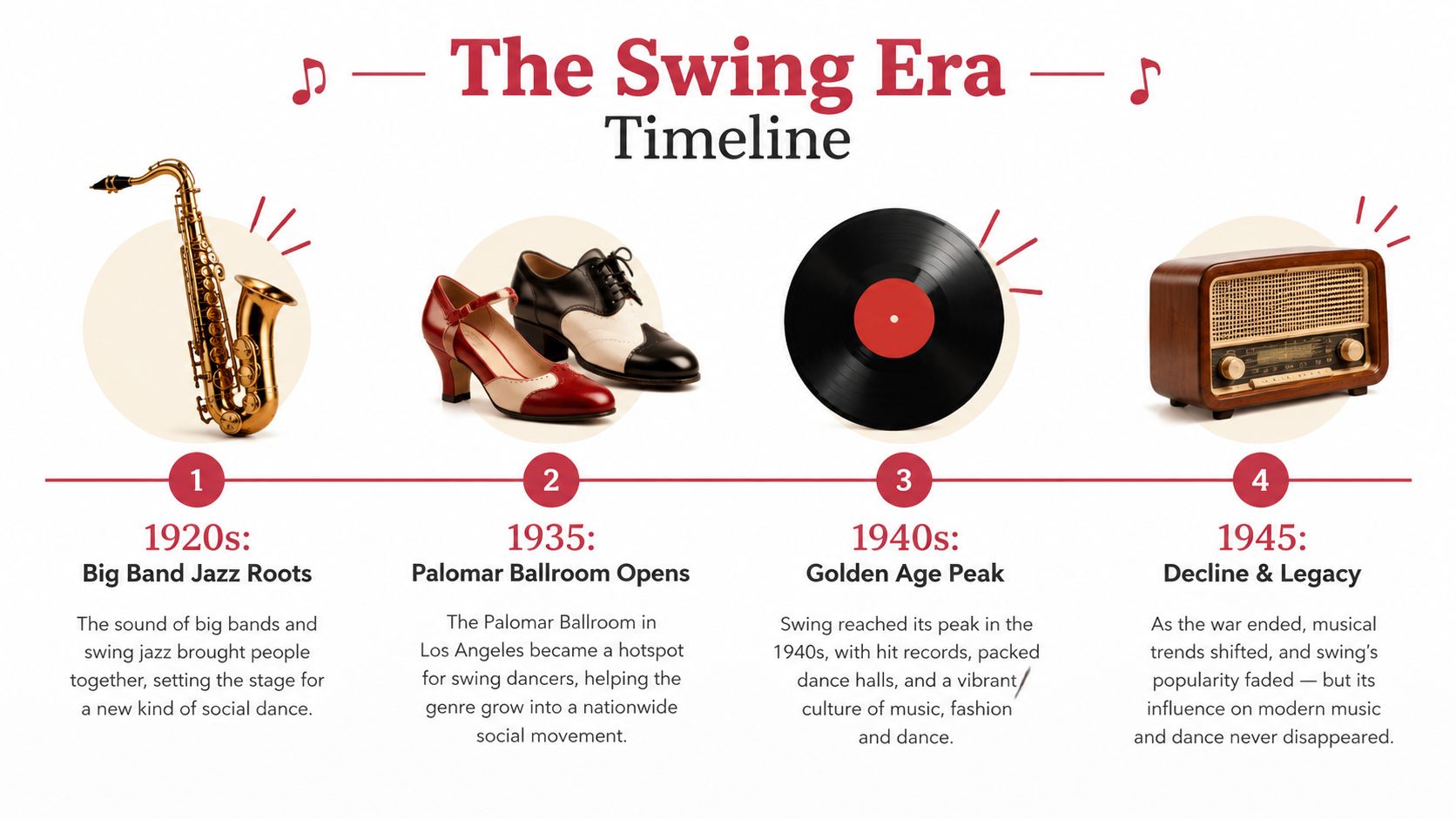
The historical context matters because swing wasn't created only for attentive listening. Big bands functioned as dance bands, playing in ballrooms and theaters where dancers needed a steady pulse, clear sections, and enough rhythmic space to respond to partners. The Lindy Hop became especially associated with this environment, combining grounded footwork, elastic connection, improvisation, and a strong relationship with the band's rhythmic accents.
Listening swing and dancing swing
A smooth jazz ballad or a vocal standard may contain swing language without working well for a social dance. Dancers need more than a pleasant melody. They need a pulse they can locate, phrasing they can anticipate, and a rhythm section that supports consistent weight changes.
Listen for these practical features:
- A stable four-beat pulse: You should be able to tap evenly without chasing the drummer.
- Clear phrasing: Musical sections should give you opportunities to begin, develop, and resolve ideas.
- A propulsive rhythm section: Bass, drums, piano, or guitar should keep the floor moving.
- Room for interaction: Dense arrangements can be exciting, but dancers also need breathing space.
Canonical reference points help train your ear. Benny Goodman highlights the precision and brightness of a classic big band. Count Basie demonstrates how a lighter arrangement can create enormous forward motion. Chick Webb brings powerful rhythmic drive, while Ella Fitzgerald shows how a vocalist can play with timing, accents, and phrasing without losing the underlying pulse.
A useful resource for exploring recordings and production options is where to find royalty free jazz, especially if you're creating practice videos, class materials, or event content. Use it as a discovery aid, then evaluate each track for danceability rather than assuming every jazz recording will suit a social floor.
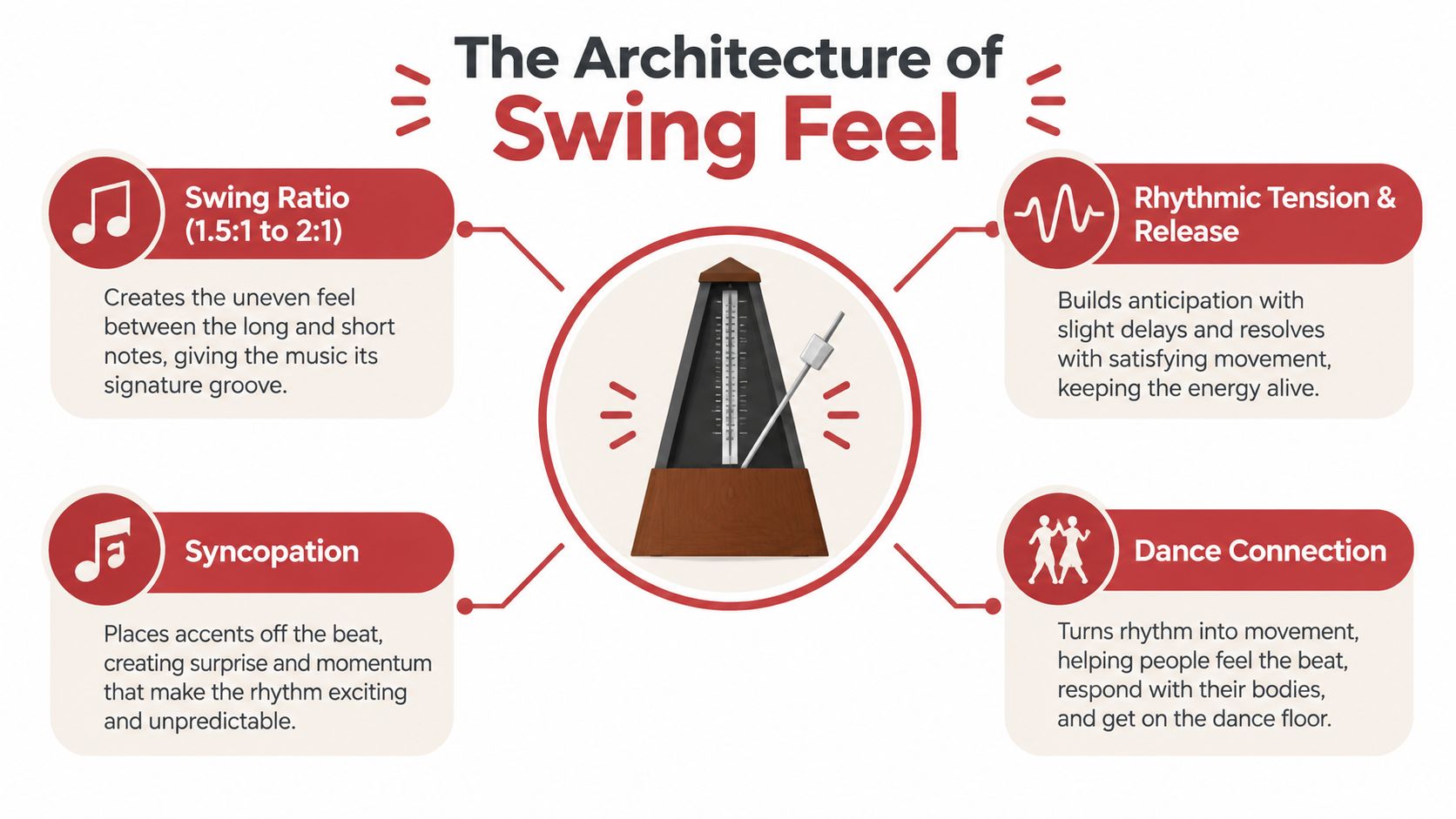
Swing also has a technical quality called the swing ratio. In simple terms, paired eighth notes are performed with a longer first note and a shorter second note. That long-short relationship creates the push and pull dancers feel as a groove. The ratio changes with tempo, which is one reason the same written rhythm can feel relaxed in one song and nearly even in another.
Swing Styles and Their Tempo Ranges
A beginner arrives at a social dance, hears one song at a comfortable pace, then watches the DJ move from a relaxed blues groove to a fast big-band number. The useful question is not whether every song sounds like 1930s swing. Start with the dance, then choose the tempo range that gives its movement enough room.
Tempo bands overlap, and musicians or DJs may count the same recording differently. Treat BPM as a practical guide, not a rigid rule. Common references place East Coast Swing around 126 to 148 BPM, Lindy Hop around 120 to 180 BPM, Charleston around 200 to 300 BPM, and West Coast Swing around 80 to 130 BPM. Other teaching references list East Coast Swing at 120 to 250 BPM, Lindy Hop at 110 to 190 BPM, and Balboa at 140 to 270 BPM. (Dance-specific tempo ranges) (Swing music reference ranges)
| Style | Tempo (BPM) | Feel | Example Track |
|---|---|---|---|
| Lindy Hop | 140 to 180 | Energetic, elastic, bouncy | “Sing, Sing, Sing” |
| East Coast Swing | 130 to 160 | Accessible, buoyant, direct | “In the Mood” |
| West Coast Swing | 90 to 130 | Slower, slot-based, bluesy | “Blues in the Night” |
| Charleston | 140 to 200 | Bright, rhythmic, kick-driven | “Sing, Sing, Sing” |
| Balboa | 180 to 260 and beyond | Fast, compact, close-embrace | Fast big-band swing |
Match the track to the movement
Lindy Hop works across a broad tempo range. At a moderate pace, dancers can explore swing-outs, pass-bys, and rhythmic variations. As the tempo rises, the vocabulary usually becomes simpler, with greater attention to pulse, connection, and efficient movement. “Sing, Sing, Sing” can suit a lively practice, while a slower recording gives a new dancer more time to organize each phrase.
East Coast Swing is approachable because single-time and triple-step options fit music with a clear, buoyant beat. “In the Mood” offers beginners an obvious pulse, though its exact tempo can vary by recording. A song that feels easy for basic steps may still become demanding once turns or faster footwork enter.
West Coast Swing generally favors slower music with a strong groove and space for a slot-based pattern. Its range reaches beyond traditional big-band swing, so blues, R&B, and contemporary tracks can work when the beat and phrasing stay stable. Learn more about the difference between East Coast and West Coast Swing before choosing one playlist for both dances.
Charleston often uses faster, more explosive music. Open-position kicks, rotational actions, and solo variations need enough clarity to stay readable, so the track should create energy without forcing constant complexity.
Balboa is designed for speed and compact movement. A fast song that overwhelms a beginner Lindy Hop class may suit an experienced Balboa dancer because the movement stays close and economical.
A broader guideline places the core swing-jazz dance range at 120 to 180 BPM. Songs slower than 105 BPM or faster than 195 BPM are generally treated as exceptional choices because those extremes can challenge many dancers. (Swing music tempo guidance) Another reference lists Lindy Hop around 75 BPM, East Coast Swing around 88 to 94 BPM, fast East Coast Swing at 116 BPM and above, and West Coast Swing around 100 to 120 BPM. These differences reflect counting systems and teaching contexts. (DJ tempo guidance for social dance)
For this week's practice, identify the target BPM band, play one suitable track, and test your basic movement before adding complexity. Know your target BPM band before you choose a song, then listen for enough space for the particular dance.
How Swing Music Feels and Flows
Tempo tells you how quickly the beat arrives. Swing feel tells you how the beat is shaped. A pair of eighth notes can sound like a long step followed by a quick step, creating a subtle forward lean that dancers translate into grounded movement and elastic connection.
A useful teaching approximation places the swing ratio around 1.5:1 to 2:1, meaning the first eighth note lasts longer than the second. The exact ratio isn't fixed. Research summarized in peer-reviewed sources reports that it can reach 3.5:1 at slow tempi and approach 1:1 at fast tempi, where the notes become increasingly even. (Research on swing ratio and tempo)
Hear the musical map
Many swing recordings use recognizable song forms. A 32-bar structure may follow AABA, where the opening idea returns after a contrasting bridge. ABAC offers a different pattern, but both forms give dancers a sense of musical direction. A chorus can feel like a complete statement, while a bridge often creates contrast before the main idea returns.
That structure helps social dancers make choices without choreographing every measure. You might begin with a comfortable basic, add a variation during a repeated phrase, and simplify when the bridge changes the arrangement. Phrasing gives you a map, not a script.
Syncopation adds surprise by placing an accent before or after the expected emphasis. Horn punches, a piano response, or a vocal pickup can invite a dancer to delay a step, add a break, or change the texture of a pattern. The most musical response isn't always the biggest movement. Sometimes it's a small pause that lets the accent land.
Count Basie and Ella Fitzgerald offer a useful contrast. Basie's arrangements often leave generous breathing space around the rhythm section, so dancers can settle into a relaxed groove and respond to small details. Fitzgerald can fill the same general rhythmic environment with vocal play, crisp accents, and unexpected phrasing. The tempo may remain steady, but the density and conversational quality change the way your body listens.
Listen for the conversation, not just the count. Horns, piano, bass, drums, and vocals may each offer a cue, and your movement can answer without copying every sound.
A practical introduction to this listening skill is musicality in dance. Start by clapping the main pulse, then mark the phrase endings, and only afterward add variations.
Choosing Music for Classes, Socials, and Weddings
Music should serve the dancers in the room. A beginner class needs clarity more than novelty, while an advanced social can reward speed, breaks, and dense arrangements. A wedding dance needs emotional meaning alongside a pulse that lets the couple move comfortably.
| Setting | Tempo (BPM) | Recommended Style | Energy Cue |
|---|---|---|---|
| Beginner class | 120 to 140 | Comfortable Lindy Hop | Strong downbeats and clear four-count phrasing |
| Mixed social | 130 to 160, 145 to 175, or 90 to 110 | Lindy Hop, East Coast Swing, and West Coast Swing | Rotate energy and leave room for different dancers |
| Advanced night | 170 to 200 | Fast Lindy Hop, Charleston, or selected Balboa | Sharper timing, compact movement, controlled intensity |
| Wedding first dance | 110 to 130 | Swing-inspired four-beat song | Stable phrasing, melodic hook, and meaningful lyrics |
Beginner classes
Start with tracks around 120 to 140 BPM for an introductory Lindy Hop class. New dancers need time to hear the downbeat, shift weight cleanly, and coordinate with a partner. Strong four-count phrasing makes it easier to connect a verbal count to actual musical sound.
A song can be technically suitable and still be a poor teaching choice if the arrangement is crowded. Choose recordings where the bass and drums remain audible, the melody doesn't disappear under layered effects, and the chorus feels easy to recognize.
Social dances
A healthy social playlist changes texture as well as speed. You might rotate Lindy Hop selections around 130 to 160 BPM, East Coast Swing around 145 to 175 BPM, and West Coast Swing around 90 to 110 BPM. The exact order matters less than avoiding a long run of songs that asks every dancer to use the same energy.
For a DJ, watch the floor. If beginners are freezing, lower the tempo or choose a clearer arrangement. If experienced dancers are waiting for challenge, introduce faster tracks gradually rather than making every selection a test.
Advanced sets and weddings
An advanced night can move toward 170 to 200 BPM for fast Lindy Hop and demanding Charleston work. At those speeds, dancers often need cleaner compression, fewer unnecessary steps, and more economical partner movement. The goal is control, not surviving a fast song.
Wedding music follows a different logic. For a first dance, look for a stable 4/4 structure around 110 to 130 BPM, a recognizable melody, and lyrics that mean something to the couple. After the first dance, a reception playlist can widen into neo-swing covers and accessible crossover tracks, as long as the pulse stays easy to find and the song supports the guests' comfort.
Beyond Vintage Swing Modern Tracks That Work
Swing dancing doesn't require every recording to come from the 1930s or 1940s. Those recordings form an essential historical foundation, but modern social dancers also use music that borrows swing phrasing, big-band color, blues structure, or vintage performance style.
Neo-swing acts such as Big Bad Voodoo Daddy, Cherry Poppin' Daddies, and the Brian Setzer Orchestra offer clear examples of modern bands working with swing-oriented arrangements. Electro-swing artists and producers including Parov Stelar, Caravan Palace, and Jamie Berry add sampled textures, electronic beats, and contemporary production. Crossover performers such as Postmodern Jukebox, Royal Teeth, and JD McPherson can also provide useful options when the track preserves a steady dance pulse.
The genre label matters less than the musical function. A track tends to work well when dancers can hear the downbeats, locate a stable four-beat pulse, and recognize where phrases begin and end. Lyrics should leave enough breathing space for movement, and the arrangement should provide room for partners to interpret rather than forcing a nonstop wall of sound.
Try this filtering test before adding a song to your playlist:
- Tap your foot on the main beat.
- Count 1-2-3-4 steadily.
- For an eight-count pattern, try 1-2-3-5-6-7-8.
- Notice whether the accents support your weight changes.
- Dance a basic pattern before deciding whether the track belongs in a class or social set.
If you can count cleanly and the groove supports your movement, the recording may work for Lindy Hop or East Coast Swing even if it doesn't sound like a classic big band. West Coast Swing dancers may accept an even broader range because the style often works with contemporary popular music, provided the phrasing and groove remain usable.
Modern and vintage tracks can share the same DJ setlist. A classic arrangement can establish historical character, an electro-swing song can refresh the room, and a neo-swing recording can connect the two without treating either sound as the only legitimate choice.
Sample Playlists and Trusted Music Resources
Build your first playlist around a purpose, not a genre label. The sets below use approximate target tempos and recognizable tracks, so you can test how different arrangements feel under your feet. Confirm the actual BPM of the recording you select because versions, remixes, and live performances can differ.
| Playlist | Tempo Range | Sample Track 1 | Sample Track 2 | Best For |
|---|---|---|---|---|
| Beginner Lindy Hop | Around 135 BPM | “Sing, Sing, Sing”, Benny Goodman, 1937 | “Jumpin' at the Woodside”, Count Basie, 1938 | Learning pulse and basic phrasing |
| Faster Savoy-style | Near 160 BPM | “Shiny Stockings”, Count Basie, 1956 | “Flying Home”, Lionel Hampton, 1942 | Experienced Lindy Hop dancers |
| West Coast Swing pocket | 90 to 110 BPM | “Blues in the Night”, Ella Fitzgerald, 1956 | “Satin Doll”, Duke Ellington, 1953 | Slot-based, groove-focused dancing |
| Wedding-friendly swing | Around 110 to 130 BPM | “It Don't Mean a Thing”, Duke Ellington, 1931 | “Mr. Sandman”, Postmodern Jukebox, 2015 | First-dance ideas and receptions |
Streaming platforms such as Spotify and Apple Music are useful for discovery, especially when you search by dance style rather than only by artist. Dedicated DJ communities, including the Floorplay and Swing Deez crews, can help you hear how experienced selectors balance tempo and energy across a social event.
For reference work, Jazz on the Air and SongbookDB can support deeper searches into recordings, tempo, and key information. YouTube channels that post filmed social-dance sets are valuable for a different reason. You can watch whether dancers appear relaxed, rushed, grounded, or disconnected from the music.
Keep a personal note beside each track. Record the style it suits, the approximate BPM, and whether it feels better for class practice, a social floor, or a wedding. Danza Academy of Social Dance's curated playlists and upcoming DJ nights can provide another practical way to hear these choices in a live social setting.
Bringing It All to the Dance Floor
Pick one playlist from the table, identify its approximate BPM, and take that number into your next class or social. Notice how the same basic movement changes when the tempo rises, the swing ratio narrows, or a new phrase gives you space for a break.
That awareness turns music selection from guesswork into a usable dance skill. An instructor can label phrases in real time, match partners to an appropriate tempo, and help you feel the small weight changes that make Lindy Hop, East Coast Swing, West Coast Swing, Charleston, and Balboa distinct.
Book a first group class or social-dance pass when you're ready to turn listening into movement. A welcoming studio gives you the repetition, partner practice, and musical feedback that a playlist alone can't provide.
Danza Academy of Social Dance offers welcoming Swing, East Coast Swing, and West Coast Swing instruction, along with group classes, private lessons, and wedding dance preparation. Book your free complimentary lesson by visiting Danza Academy of Social Dance, and bring your favorite swing track so an instructor can help you match its tempo and feel to your dancing.