You're standing outside a dance studio, shifting your weight from one foot to the other while couples glide across the floor. You want to join them, but the class names blur together, and you're not sure whether you need private coaching, a beginner series, or something more relaxed.
A dance training program should remove that uncertainty. It's more than a list of classes. It's a curriculum that connects your goal, practice schedule, skill level, instructor feedback, and next milestone. Whether you're preparing a wedding dance, building social confidence, improving fitness, or pursuing performance, the right structure gives you a clear way forward.
What a Dance Training Program Actually Is
A drop-in class gives you an experience. A dance training program gives you a path.
A well-designed program starts with a defined outcome, such as dancing comfortably with a partner, performing a choreographed routine, or developing technique for competition. It then organizes instruction into levels, so each new skill rests on something you've already learned. Instead of asking you to memorize random combinations, the instructor explains how posture, timing, balance, weight transfer, and partner connection work together.
The four building blocks
Most effective programs include four connected parts:
- A style focus: Ballroom, Latin, swing, hip-hop, contemporary, and other styles use different movement languages. You should know what vocabulary you're learning and why.
- A skill ladder: Beginner material should lead naturally into more demanding patterns, musical interpretation, styling, or performance work.
- Scheduled practice: Regular lessons matter, but so does the work between lessons. Short, focused practice helps your body recognize movement rather than relying on memory alone.
- A feedback loop: An instructor watches, corrects, and adjusts your technique. Good feedback might address foot placement, frame, rhythm, balance, or how clearly you communicate with a partner.
Casual social lessons can be enjoyable, but they may not retest earlier skills or define an advancement standard. A curriculum does. You might revisit a basic turn until your timing stays steady, then move to a more complex figure once your balance and connection are reliable.
Practical rule: If you can't explain what you're learning now, what comes next, and how your teacher will know you're ready, you're probably looking at a class schedule rather than a complete program.
Dance training also fills an important educational gap. The 1995 National Center for Education Statistics report found that only 43% of public elementary schools offered any dance instruction, while just 4% offered dance as a separate subject taught by a specialist. More recent reporting from the Arts Education Data Project found that, across 17 states in 2018–2019, dance was offered in only 15% of high schools, 6% of middle schools, and 4% of elementary schools. That limited access helps explain why private programs often provide the consistent progression schools can't offer.
Main Program Types You Will Encounter
Studios use different names, but four program shapes appear most often. The important question isn't which one sounds most impressive. It's which format matches your goal, availability, comfort level, and preferred way of learning.
A group beginner series usually follows a fixed syllabus over 6 to 8 weeks, with one class each week and a shared pace. It suits newcomers who want structure, a manageable commitment, and the energy of learning with other students. A private coaching track moves differently. One instructor can adapt the lesson to your body, schedule, partner dynamic, and immediate priorities, which may help you progress faster when you need a specific outcome.
Social dance clubs are less formal. Drop-in practice nights, rotating partners, and an informal atmosphere let you repeat skills in changing situations. They're useful for adults who want to feel comfortable at Saturday events rather than prepare for a judged performance. Competitive or performance teams sit at the other end of the range. They may involve auditions, rehearsals, choreography, cross-style training, and a stronger expectation of attendance.
For a closer look at technique-focused class options, explore dance technique classes.
Dance Training Program Archetypes Compared
| Program Type | Typical Format | Best For | Time to First Milestone | Skill Ceiling |
|---|---|---|---|---|
| Group beginner series | Weekly group classes with a fixed syllabus | New dancers who want structure and community | After completing the opening sequence | Intermediate social or recreational dancing |
| Private coaching track | One-on-one lessons at a customized pace | Specific goals, partners with different levels, or limited schedules | Based on the student's goal and starting point | Advanced technique, performance, or competition |
| Social dance club | Drop-in practice, rotating partners, and social events | Confidence, repetition, and real-world dancing | Once basic patterns feel usable with others | Strong social fluency, depending on ongoing practice |
| Competitive or performance team | Auditioned rehearsals, choreography, and coaching | Students seeking performance or competition | After learning the team's movement material | High-level performance and competitive development |
Session length varies by studio, so ask before enrolling. A group class may be efficient for broad exposure, while private coaching gives the teacher more time to identify exactly why a turn feels unstable or why a lead-follow signal isn't clear. Your age matters less than your objective and physical readiness, although children, older adults, and dancers returning after a break may benefit from more flexible pacing.
Sample Curricula from Beginner to Competitive
Progress feels less intimidating when you can see the sequence. A thoughtful curriculum doesn't expect a beginner to produce performance quality immediately. It builds movement in layers, from vocabulary and coordination to interpretation and presence.
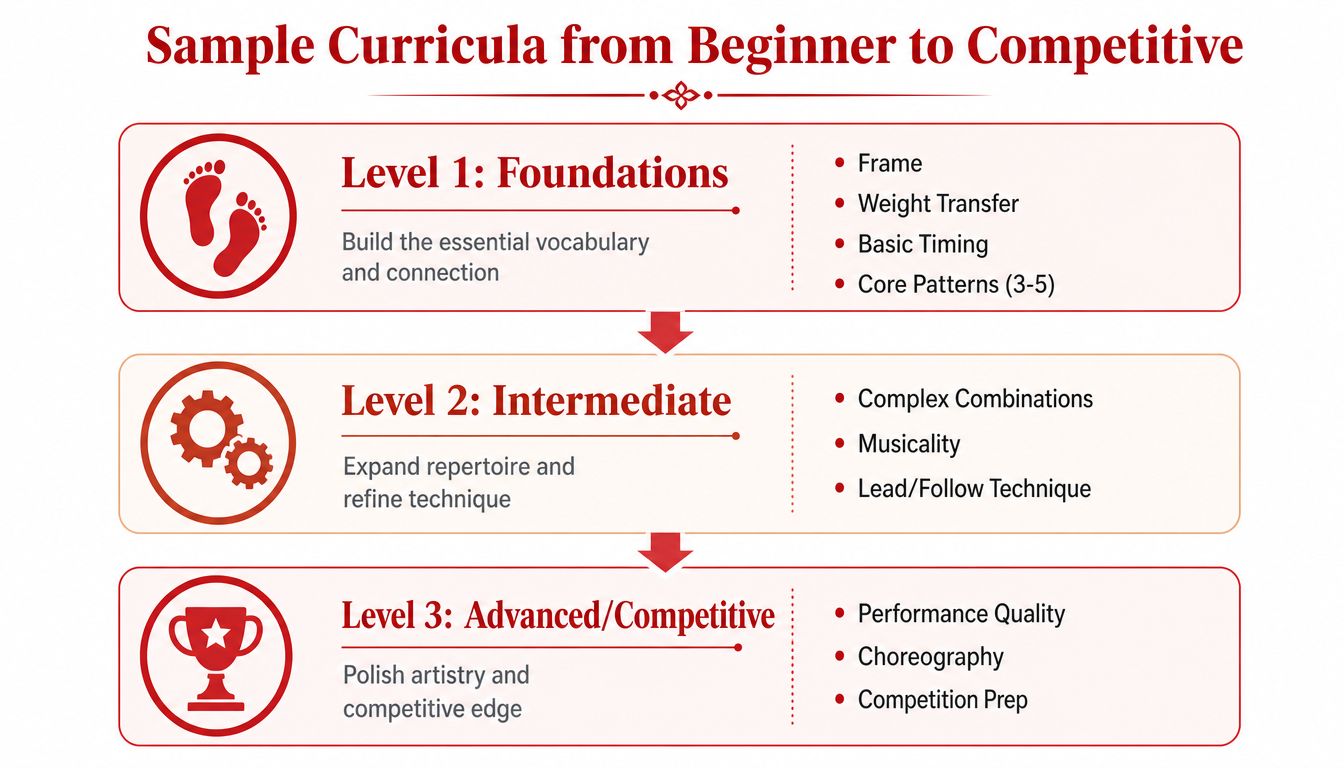
Levels 1 and 2
Level 1, Foundations, establishes frame, weight transfer, basic timing, and three to five core patterns over eight weeks. Practice between lessons should focus on repeating footwork slowly, counting music, and noticing whether your weight finishes over the correct supporting foot. The first milestone isn't speed. It's completing the core patterns with stable timing and a relaxed connection.
Level 2, Development, adds lead-follow clarity, rotational figures, musicality drills, and partner connection exercises over another eight to twelve weeks. You'll begin responding rather than recalling. Before advancing, you should be able to maintain rhythm while changing direction, communicate a basic figure without force, and recover calmly when a partner or song doesn't behave as expected.
Levels 3 through 5
Level 3, Intermediate, introduces styling, more than one dance style, and improvisation within familiar patterns. The work shifts from “What comes next?” to “How can I make this movement fit the music and partnership?” Practice should include changing tempo, starting from different points in a phrase, and keeping technique intact while adding personality.
Level 4, Advanced, emphasizes complex combinations, technical refinement, and freestyle. Your instructor may focus on smaller details, such as the efficiency of a step, the quality of a turn, or the relationship between torso and footwork. Advancement depends on consistency under pressure, not just successful execution in a quiet lesson.
Level 5, Competitive, layers choreography, performance coaching, judging criteria, and mental preparation. Rehearsal includes more than memorizing sequence. You'll work on projection, transitions, recovery after mistakes, presentation, and the ability to repeat quality movement when tired.
Practice expectations should rise gradually. A student moving through the levels needs enough repetition to make skills dependable, but not so much volume that fatigue replaces useful technique. Your teacher should identify the milestone that matters for your goal, because a social dancer and a competitive performer don't need identical tests.
Two Real Scenarios That Shape the Right Program
Maya and Jordan arrive with a clear date on the calendar. They want a choreographed first dance that feels personal, looks polished, and remains manageable under wedding pressure. Their teacher begins with an intake conversation about the song, clothing, floor space, comfort with lifts or turns, and how much time they can rehearse together.
They choose a focused 12-week crash plan with one consistent teacher, one private lesson each week, and two group sessions. Early lessons break the song into sections and establish basic timing. Middle sessions connect transitions and memory cues. Later rehearsals prioritize synchronization, musical accents, and performing the routine without stopping. A practical first-dance planning guide recommends beginning 3 to 6 months before the wedding for a fully choreographed routine, about 2 months for a simpler polished dance, and at least two lessons. Those benchmarks come from first-dance lesson planning guidance, but the couple's actual readiness still depends on rehearsal consistency.
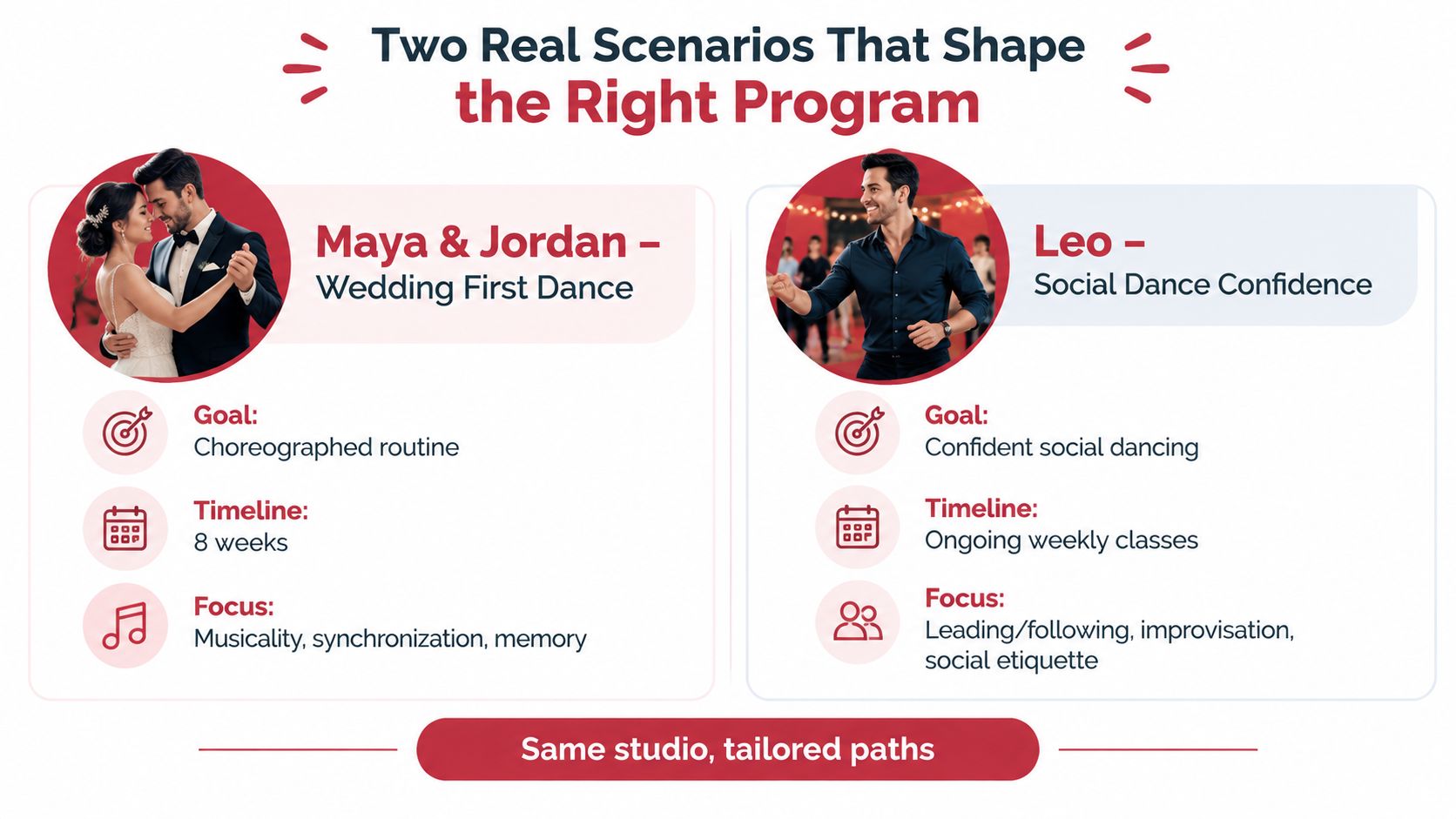
Leo has a different destination. He wants to feel comfortable at Saturday social events, not memorize one routine. His intake centers on partner experience, preferred music, nerves, and the situations that make him hesitate. He joins a multi-month track with rotating partners, social practice events, and progressive technique work.
His milestones are functional. First, he keeps time through basic patterns. Then he leads or follows clearly with several partners. Eventually, he can adapt when someone uses a different style or misses a cue. Maya and Jordan need reliable repetition for one event. Leo needs adaptable movement for many evenings. Timeline, social context, and desired outcome shape the program just as much as starting skill.
Benefits and Outcomes You Can Expect
Structured dance training develops more than a collection of steps. The first changes often feel practical. You may stand more naturally, recognize your supporting foot sooner, or stop freezing when the music changes. Over a longer training season, repeated correction and varied practice can make movement more economical and responsive.
Physical changes
A lesson may ask your body to coordinate posture, footwork, balance, and partner connection at once. That combination can support body awareness and movement control. Dance also counts as meaningful physical activity. A peer-reviewed review found that dancing accounted for 29% of an individual's moderate-to-vigorous physical activity over one week (review of dance and physical activity).
Early physical progress might include improved alignment and less unnecessary tension. With continued practice, you may notice stronger endurance, steadier turns, and better recovery between combinations. These are reasonable training outcomes, not guaranteed deadlines. Your instructor should adapt the workload to your current conditioning, medical considerations, and movement history.
Cognitive and social changes
Dance asks you to divide attention. You listen to rhythm, remember a pattern, monitor your own balance, interpret a partner's signal, and decide what happens next. Repetition gradually reduces the mental effort required for familiar movements, leaving more attention for musicality and interaction.
Partner work also creates a low-stakes way to practice communication. You learn to give space, accept correction, recover from mistakes, and continue without apologizing for every imperfect step. For many adults, that confidence carries into social settings because they've practiced entering an unfamiliar room and participating before they feel fully ready.
A visible early win might be remembering a sequence without verbal prompting. A deeper win is staying present when the sequence changes.
Injury prevention deserves a place in the curriculum, especially for beginners and hobbyists who increase training suddenly. Recent dance education evidence describes injuries as frequently overuse-related and concentrated in the lower limbs, with student injury rates estimated at 0.8 to 9.3 per 1,000 hours in one source, while teacher pain reports reached 732 per 1,000 hours in that study (dance injury evidence). A balanced program should treat recovery as part of progress, not as lost training time.
How to Choose the Right Program for You
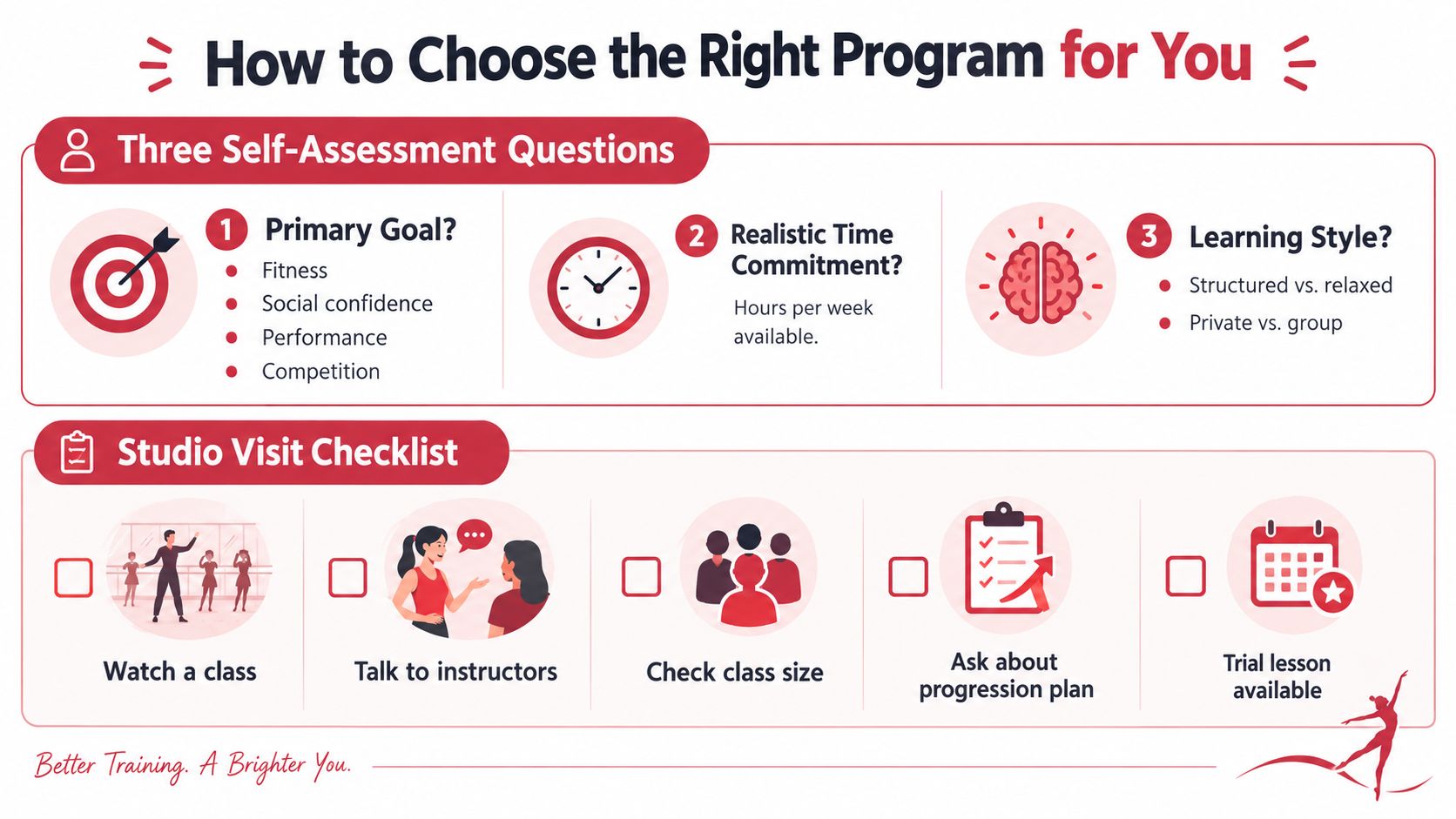
Start before you visit a studio. Write down the answer to three questions, then use those answers to filter formats rather than letting a persuasive sales conversation choose for you.
- What's your primary goal? Fitness, social confidence, performance, and competition require different levels of repetition and feedback.
- What time can you reliably protect? Count the hours you can maintain during an ordinary week, not the ideal week you rarely have.
- How do you learn best? Private instruction suits students who want customized correction. Group classes create community and partner variety. A mixed plan combines individual attention with shared practice.
A student with limited time and a precise performance goal may need private coaching. Someone who wants relaxed practice and new connections may prefer a social club. If you're unsure, begin with a group series and add private support when a specific obstacle appears.
Questions to take into the studio
Use this checklist during a visit or trial lesson:
- Teacher credentials: Ask about training, teaching experience, and familiarity with your chosen style.
- Class size: Find out whether beginners can receive individual correction.
- Curriculum transparency: Request the level sequence and examples of skills taught at each stage.
- Progress benchmarks: Ask how the instructor decides when a student is ready to advance.
- Make-up policies: Clarify what happens if work, illness, travel, or a family obligation interrupts attendance.
- Contract terms: Read cancellation, expiration, renewal, and payment conditions before signing.
Watch a class if possible. Notice whether the instructor explains the reason behind a correction, whether students are treated respectfully, and whether the pace allows people to learn instead of merely survive the sequence. A useful guide to evaluating studios is how to choose a dance studio.
Be cautious if level descriptions are vague, no progression path exists, beginner classes are too large for meaningful feedback, or staff pressure you to purchase a long package on your first visit. When several programs look similar, rank your priorities. Put flexibility, cost, instructor fit, and community in order, then choose the option that satisfies your top priorities rather than chasing every feature.
A Practical Weekly Training Schedule
A useful week balances focused training, repetition, and recovery. Treat it like a curriculum: each day has a job, and the lighter sessions give your body time to absorb the harder work. A working adult or serious student can adjust this six-day pattern around commuting, family, and energy levels.
- Monday, technique and footwork: Review alignment, weight transfer, and foundational drills.
- Tuesday, partner practice: Develop lead-follow mechanics and clear communication.
- Wednesday, active recovery: Choose gentle stretching, mobility work, or an easy walk.
- Thursday, choreography and styling: Connect combinations and work with musical details.
- Friday, social floor time: Practice with different partners in a less predictable setting.
- Saturday, rehearsal and review: Complete a longer rehearsal, then use video to select one or two priorities.
- Sunday, rest: Take a full break or keep activity gentle.
Start every demanding session with at least 15 minutes of warm-up. Include gradually increasing movement, joint mobility, and dance-specific patterns. Pause between intense sections instead of rushing from one difficult combination into the next. Drink regularly. Add Pilates or another form of cross-training on a day when it supports core strength without reducing the quality of your technical practice.
Pain is information, not a test of commitment. Shin splints, persistent soreness, ankle instability, or a noticeable change in landing quality call for a discussion with your instructor and, when appropriate, a qualified health professional. The dance injury-prevention model described by the 11+ Dance injury-prevention model centers on strength, balance, jumping and landing mechanics, and ankle, knee, and hip alignment. A targeted prevention program was associated with a lower injury rate and longer intervals between injuries in a randomized investigation of professional ballet dancers (randomized injury-prevention investigation).
Training only three days? Combine technique, partner work, and one social or rehearsal session. Competitive dancers may schedule six sessions plus private lessons, while still protecting lighter days and periodic deloads. Instructors can use a scheduling or client-management resource such as replace Dubsado with Coachful to organize lessons, reminders, and follow-up while keeping student recovery visible.
Your Next Step and Common Questions
The best choice connects three things: a curriculum that makes progress visible, a program format that fits your goal, and a schedule you can maintain. You don't need to identify your lifelong dance style before your first lesson. You need enough information to tell the instructor what you want, how much time you have, and what feels difficult or uncertain.
Wear clothing that allows your shoulders and hips to move freely. Ballroom dancers commonly use leather-soled shoes, while hip-hop students may prefer socks or appropriate indoor footwear. On day one, expect a conversation about goals, a short movement assessment, introductory steps, and feedback about placement. Tell the instructor whether you're preparing for a wedding, returning after a long break, managing an old injury, or hoping to dance socially.
Common questions
How long before I see results? Many students notice small practical changes during the first month, such as better timing or less hesitation. Larger improvements depend on attendance, practice, and the complexity of your goal.
Do I need prior experience? No. Beginner curricula start with fundamental movement and connection.
What does it cost? Prices vary by location, instructor experience, lesson length, and whether the format is group or private. Ask for the complete pricing and cancellation terms before committing.
Are group or private lessons better? Neither is universally better. Groups offer shared energy and partner variety. Private lessons provide individualized correction and customized pacing.
How long until I can dance socially? You may begin using simple patterns once you can keep time, maintain basic connection, and recover from mistakes. Comfort develops through repeated practice with different partners.
Am I too old to start? Age alone doesn't decide suitability. A responsible instructor can modify intensity, range of motion, balance demands, and practice volume for the student in front of them.
Book a complimentary first lesson to experience the teaching style before making a larger commitment. Wear comfortable clothes, bring your questions, and treat the lesson as a conversation about fit. The best program is the one you'll attend consistently and enjoy enough to keep practicing.
Danza Academy of Social Dance offers welcoming, results-driven instruction in Ballroom, Latin, and social dance, with private lessons, group classes, wedding preparation, kids' programs, and competitive coaching. Visit the academy to book your free complimentary lesson, share your goals, and find a dance training path that fits your schedule and starting point.