
You've probably seen Samba online and thought two things at once: “That looks amazing,” and “There's no way I can do that.” That reaction is normal. Most beginners aren't intimidated by the joy of Samba. They're intimidated by the speed, the bounce, and the difference between what they see in Carnival clips and what they'll learn in a studio.
That's why the best way to start isn't with flashy patterns. It's with rhythm, body action, and a simple understanding of what kind of Samba you're learning. Once that clicks, the dance stops feeling chaotic and starts feeling playful.
Welcome to the Vibrant World of Samba
Samba carries a special kind of energy. It feels buoyant, grounded, and alive all at once. Historically, Samba originated in the Bahia region of Brazil in the 1880s as an Afro-Brazilian dance called Mesemba, and over time it evolved into one of Brazil's most recognized cultural expressions, later becoming known as the national dance of Brazil, as described in this history of Samba and its rhythm structure.
For a new dancer, though, the most useful thing to know is simpler than the history. The Samba you'll usually learn in a studio is the social or ballroom version, not the Carnival style many people picture first. That distinction matters because it changes your expectations from the first lesson.
What beginner Samba actually feels like
Instead of thinking, “I need to move fast,” think, “I need to feel the music in my knees and center.” Good beginner Samba has a light spring to it. The body stays organized. The feet stay close to the floor. The rhythm gives the movement its personality.
If you're curious what that studio style looks like in a class setting, this page on Samba dance lessons near me gives a clear picture of the partner-based version many adults start with.
Samba doesn't ask you to be perfect on day one. It asks you to listen, soften your knees, and let the rhythm organize your movement.
Why beginners get confused so quickly
Most first-time students come in after watching videos that mix multiple Samba traditions together. One clip shows solo Carnival movement. Another shows ballroom couples. A third shows a performance version with advanced styling. Then a beginner tries to copy all of it at once.
That usually leads to two problems:
- The rhythm feels slippery because the dancer is chasing speed instead of pulse.
- The body gets tense because they're trying to “look like Samba” before they understand how Samba works.
A better starting point is to treat your first lesson like music training with movement. Learn the bounce first. Learn how the weight changes feel. Then add the basic.
Feeling the Beat and Mastering the Samba Bounce
If you only remember one thing from your first Samba lesson, remember this: the bounce is the engine. Without it, the steps look flat and rushed. With it, even a very simple basic starts to look like Samba.
Hear the rhythm before you step
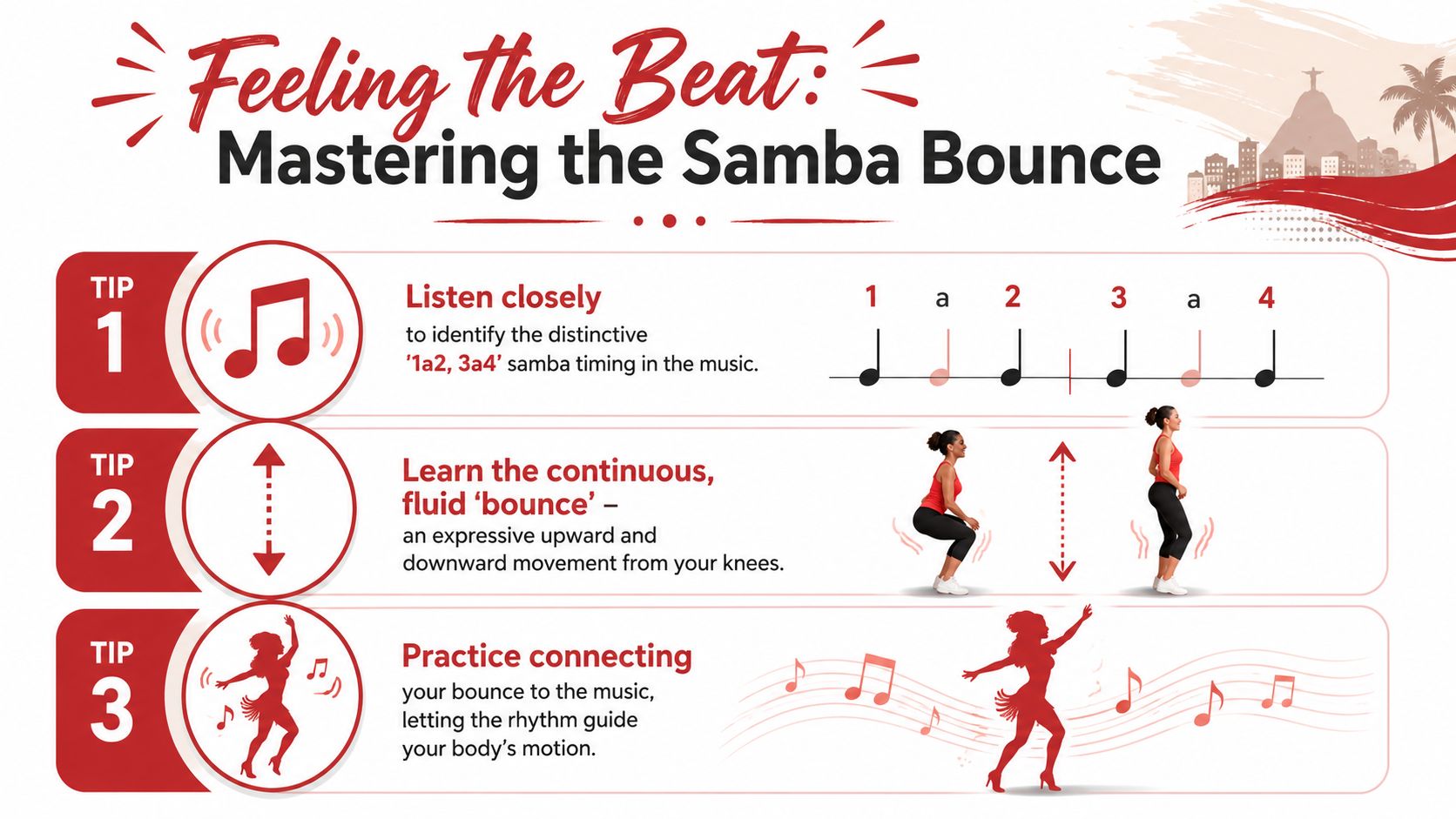
The basic Samba rhythm is counted as “1a2, 3a4,” where the “a” represents a rapid step on a quarter of a beat. Step “1” takes ¾ of a beat, “a” takes ¼ of a beat, and “2” takes a full beat. This creates the signature bounce action, a continuous knee-bending and straightening technique, as outlined in this breakdown of International Samba technique and timing.
That sounds technical at first, but here's the practical version. Don't count it like four equal marching beats. Count it with a little catch in the middle:
- 1a2
- 3a4
That tiny “a” is what gives Samba its syncopated feel. It's quick, but it isn't hurried.
If rhythm is your weak spot, spend a few minutes with this guide on how to find the beat in music before you practice steps. It makes Samba much less mysterious.
Learn the bounce without footwork
A lot of adults try to learn Samba by memorizing feet first. That's backwards. Start with the knees and body timing while standing nearly in place.
Try this drill:
Stand with soft knees
Keep your feet under you, not wide apart. Let the knees bend naturally.Count slowly out loud
Say “1a2, 3a4” several times without moving your feet much.Let the knees absorb and release
Think of a controlled spring. You're not jumping up and down. You're bending and straightening in rhythm.Keep your weight organized
The body should feel centered, not tossed around.
What the bounce should not look like
Beginners often overdo it. They bob aggressively, throw the shoulders, or try to force hip action from the top of the body. That creates strain and usually throws off the timing.
Practical rule: If your head is bouncing more than your knees are working, you're probably doing too much.
A better image is this: the knees create a gentle elastic action, and the rest of the body responds. The movement is lively, but it's still controlled.
A solo exercise that works
Put on music and don't dance yet. Just mark the rhythm with your knees and whisper the count. Then add tiny weight changes. Then pause. Then repeat. That sequence helps your body learn the feel of Samba before your brain gets overloaded by directions.
Once you can keep the bounce going steadily, the first basic step becomes much easier to understand.
Your First Steps with the Foundational Samba Basic
Now you can put footwork under the rhythm you've already started to feel. Keep it modest at first. The goal isn't travel or style. The goal is clean weight transfer while staying calm in the body.
The leader and follower patterns
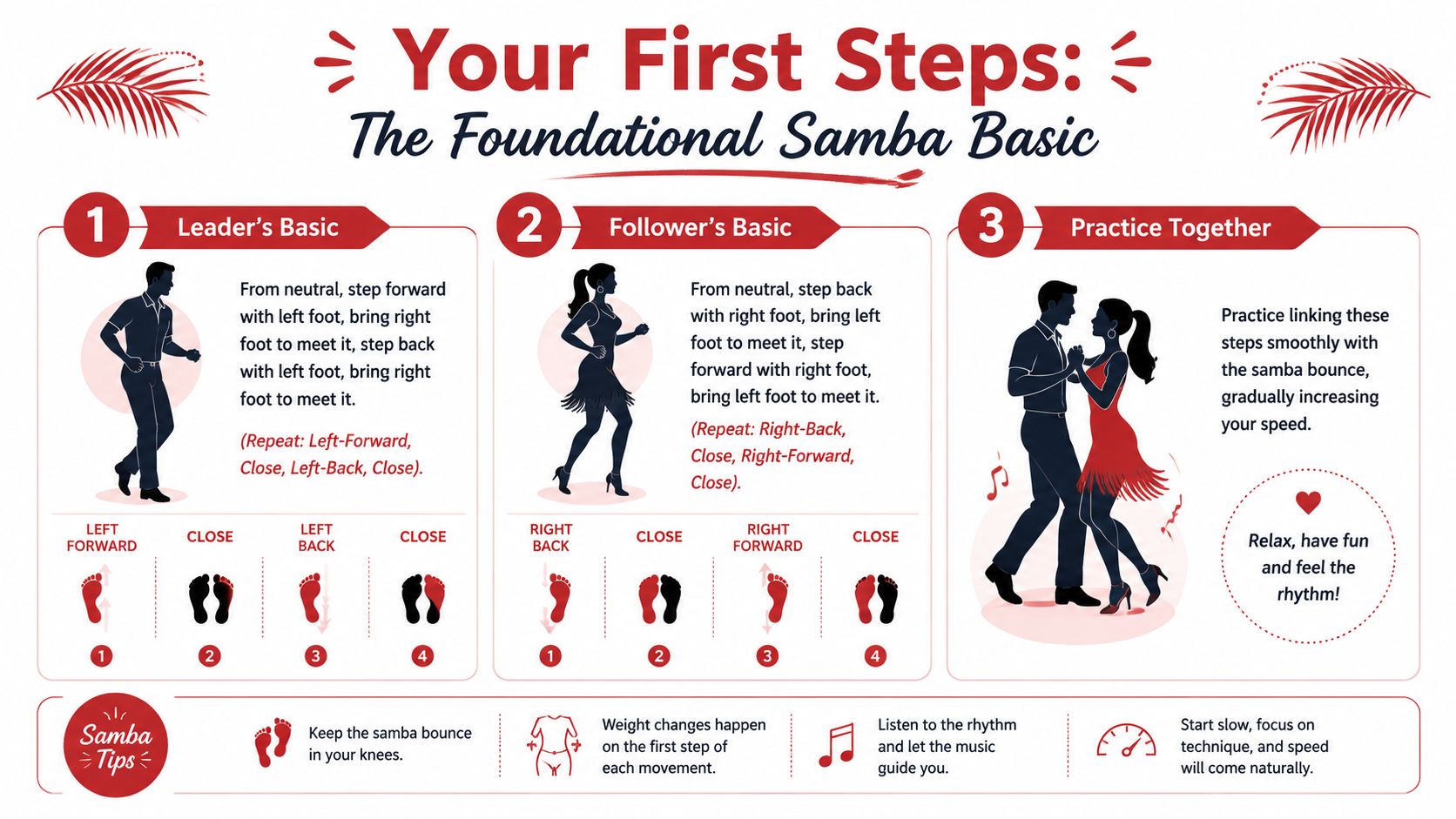
The foundational Samba basic follows a 4-count rhythm where men step forward-left, close-right, left-in-place, then backward-right, close-left, right-in-place. Ladies execute the mirror pattern starting backward-right. Every numbered count is danced on a flat foot with a bent knee to create the “bounce”, according to this beginner Samba basic explanation.
Here's that same idea in plain language.
| Role | First half | Second half |
|---|---|---|
| Leader | Step forward with the left foot, bring the right foot in, settle the left in place | Step backward with the right foot, bring the left foot in, settle the right in place |
| Follower | Step backward with the right foot, bring the left foot in, settle the right in place | Step forward with the left foot, bring the right foot in, settle the left in place |
The phrase “in place” matters. You're not trying to travel across the floor during the basic. You're learning how to change weight cleanly while preserving the Samba action.
How to practice the basic without freezing
Most beginners improve faster when they separate tasks. First rhythm. Then feet. Then coordination.
Use this order:
- Round one. Walk the pattern slowly with no music.
- Round two. Add the count out loud.
- Round three. Bring back the knee action from the previous section.
- Round four. Try music, but keep the steps small.
To help you visualize the action, watch this simple demonstration after you've read the pattern once or twice:
What to pay attention to on each step
A beginner often asks, “Which part should I focus on first?” My answer is usually this short checklist:
- Stay low through the legs so the action doesn't become jumpy.
- Close the feet neatly instead of letting the legs open too wide.
- Finish each weight transfer before worrying about the next one.
- Keep the count alive in your voice if the rhythm starts to slip.
Your first Samba basic should feel smaller than you expect. Small and clear beats big and messy every time.
A common self-test
Practice one full basic and ask yourself three questions:
- Did I keep the movement compact?
- Did I transfer my weight each time?
- Did the rhythm feel even in my body, even though it was syncopated in the music?
If the answer is “not really,” that's fine. Go back to a slower pace. Beginners don't fail in Samba because they move too little. They struggle because they usually try to do too much, too soon.
Posture and Connection Essentials for Partner Samba
Once the solo basic starts feeling familiar, partner work becomes much more enjoyable. The trick is not to hold on tighter. It's to organize your posture so your partner can feel your timing clearly.
Keep the body lifted and the feet quiet
Beginners must maintain feet parallel and low to the ground. Lifting feet disrupts the goal of the basic step. Arm coordination follows a simple rule: when the right leg moves, the right arm moves forward, mirroring walking mechanics and helping the upper body stay balanced, as explained in this Samba technique demonstration for beginners.
That gives you several useful corrections right away.
- Feet parallel means don't let the toes splay outward while you step.
- Low to the ground means the feet skim rather than pop upward.
- Natural arm coordination means the upper body supports the movement instead of decorating it too early.
What connection should feel like
Connection in partner Samba is subtle. You're not pushing or dragging each other. You're sharing timing through posture, frame, and center.
Think of the hold this way:
- The chest stays open.
- The shoulders stay released.
- The elbows stay alive, not floppy.
- The hands communicate direction lightly.
If a leader tries to move the follower with the arms alone, the dance feels rough. If a follower waits passively without maintaining tone in the frame, the dance feels delayed. Both people need to contribute.
Two habits that make partner dancing easier
First, keep your gaze up. Looking down at your feet makes your posture collapse and weakens the connection.
Second, let your steps stay modest. In early Samba, a smaller movement usually creates a cleaner partnership because each person can feel the timing more clearly.
When the frame is stable, the lead becomes easier to read and the follow becomes easier to trust.
That's the core purpose of posture in Samba. It isn't about looking formal. It's about making movement readable.
Avoiding Common Pitfalls on the Dance Floor
Every beginner hits a few predictable roadblocks in Samba. That's not bad news. It's useful news, because once you know what the common mistakes are, you can correct them early instead of building them into your habits.
The biggest confusion of all
A common point of confusion for beginners is the failure to distinguish between the rhythmic “bounce” of Brazilian Samba (Samba no Pé) and the controlled “pulse” of International Samba. Learners try to replicate the aggressive up-and-down bobbing seen in carnival videos, which is incorrect for the ballroom style, as clarified in this comparison of Brazilian and International Samba movement.
This explains why some new students feel frustrated right away. They're practicing one style while copying the body action of another.
Quick fixes for the mistakes I see most
Here are a few common problems and the simplest correction for each.
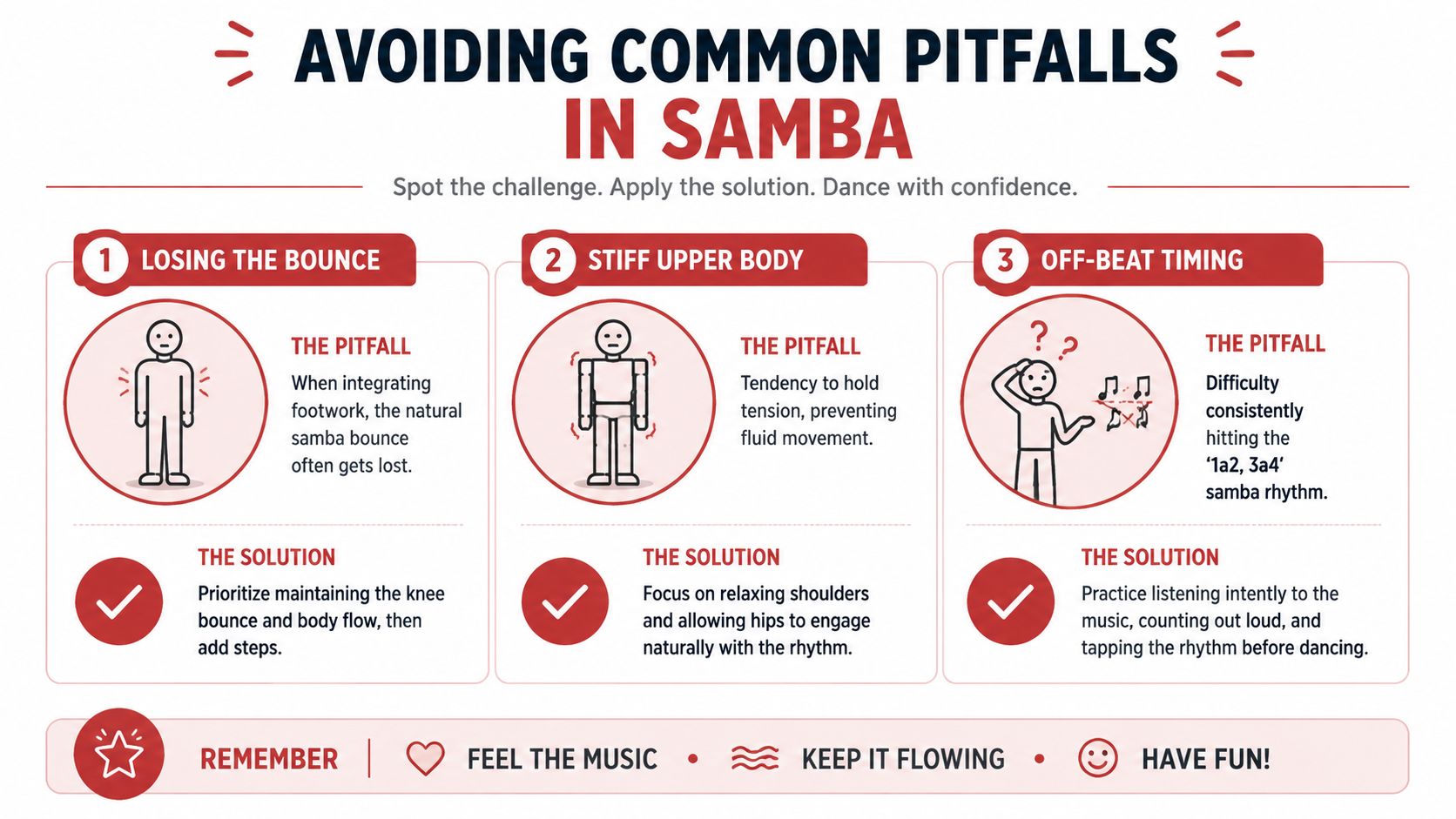
You lose the bounce when the feet start moving
Go back to standing nearly in place and rehearse the knee action alone. Then add only one half of the basic.Your upper body gets stiff
Soften the shoulders and jaw. Tension often starts in places dancers don't notice.You drift backward
Make the steps smaller and think “in place” more strongly. Samba basics work best when the weight transfers clearly without excess travel.
For general movement health while practicing any social dance, it also helps to review smart dance injury prevention habits so you don't turn tension or overuse into soreness.
A better mindset for correction
Don't label mistakes as proof that you “can't dance.” Label them as information. If your timing falls apart, that means the rhythm needs more isolation practice. If the movement feels clunky, your step size is probably too large. If it looks forced, you're likely trying to perform instead of organize.
Most Samba problems shrink when you reduce the size of the movement and return to the rhythm.
That's why good Samba dance for beginners is less about memorizing many figures and more about refining a few essentials until they feel natural.
Build Your Confidence with a Simple Practice Plan
Adults do well with structure, especially when a dance feels fast. You don't need marathon sessions. You need repetition you can sustain.
Data on motor skill acquisition shows that short, daily practice sessions of 15–20 minutes yield better retention for adult beginners than occasional long lessons. This approach helps prevent overwhelm and builds muscle memory more effectively, as noted in this guide to Samba practice for beginners.
A practice week that feels manageable
Here's a simple way to use those short sessions.
| Day | Focus | What to do |
|---|---|---|
| Day 1 | Rhythm only | Clap or tap the Samba count and mark it in your knees |
| Day 2 | Bounce only | Practice the body action in place with no full basic |
| Day 3 | Foot pattern | Walk the leader or follower basic slowly without rushing |
| Day 4 | Coordination | Combine rhythm, bounce, and small steps |
| Day 5 | Partner awareness | If you have a partner, practice frame and timing together. If not, practice posture and arm organization |
| Day 6 | Music day | Try a slower track and stay relaxed |
| Day 7 | Review | Repeat the hardest piece, not the easiest one |
If you want help hearing layered rhythm more clearly, musicians often use focused listening tools. Something like Isolate Audio for drum practice can be useful when you're trying to pick out percussion and pulse before dancing to a full song.
Keep early wins small and specific
Don't measure progress by how advanced you look. Measure it by what feels more stable this week than last week.
For example:
- You can hold the count without stopping
- Your steps stay smaller and cleaner
- Your body stays calmer at faster music
- You don't confuse Carnival styling with ballroom technique anymore
This is also a helpful point to use a simple booking page if you want a clear next step and direct feedback from an instructor.

If you've been reading this and thinking, “I'd learn this much faster with someone watching my timing and posture,” you're probably right. Samba improves quickly when a teacher can adjust your bounce, step size, and connection in real time.
If you're ready to turn these basics into real movement, book a free complimentary lesson with Danza Academy of Social Dance. It's a welcoming way to get personal feedback, feel the Samba rhythm in your body, and start with guidance that matches your level. You can reserve your lesson on the contact page.