You may be standing at the edge of a dance floor, hearing tango music for the first time and wondering why it feels so different from other partner dances. Maybe you've seen a stage performance and assumed tango is dramatic, difficult, and packed with fixed moves. Then you walk into a social dance setting and notice something unexpected. The couples don't all look like they're doing the same routine.
That's the key to understanding what Tango dancing is. At its heart, tango isn't just a sequence of steps. It's an improvised social conversation between two people, shaped by music, timing, balance, and attention. One partner suggests direction and energy. The other responds in real time. Together, they build the dance one moment at a time.
A good way to think about tango is to compare it to speaking with someone you trust. You don't memorize an entire conversation before you begin talking. You listen, pause, respond, and adjust. Tango works the same way. The music gives the mood. The embrace creates the connection. The movement comes from communication, not from reciting choreography.
That's why beginners often feel both intrigued and confused. They expect to learn “the tango steps,” but what they need instead is a way to hear the music, connect with a partner, and move clearly enough to improvise.
Introduction to Tango Dancing
Tango often catches people off guard. You hear the pull of a bandoneón, see a couple walking in close embrace, and assume something mysterious is happening. In a sense, it is. But it isn't magic, and it isn't reserved for experts. Tango becomes much easier to understand when you stop treating it like a performance and start seeing it as a social language.
In plain terms, tango dancing is a partner dance built on walking, rhythm, connection, and improvisation. That last word matters most. In social tango, dancers usually aren't repeating a fixed routine. They're making choices in the moment, based on the music, the available space, and the communication they feel through the embrace.
That's also why two tango dances rarely look identical, even when the same song is playing.
What makes tango different
Many dances teach combinations first. Tango teaches awareness first. You learn how to stand, how to shift weight, how to walk with another person, and how to pause without losing connection.
Tango makes more sense when you think of it as “walking with meaning” rather than “collecting fancy moves.”
A beginner usually gets confused in one of three places:
- The embrace feels unusual: You're close enough to communicate through the body, but you still need your own balance.
- The music feels emotional: Tango music invites pauses, changes of speed, and quiet moments. It doesn't always push you into constant motion.
- There's no single routine: You're not trying to memorize one correct sequence. You're learning how to create a dance with another person.
What you're really learning
If you stay with tango, you build a skill set that goes beyond steps:
- Physical control: Better posture, clearer weight shifts, steadier balance.
- Listening: Not just to music, but to timing and pressure from a partner.
- Social awareness: You learn how to share space, invite connection, and respect boundaries.
That combination is why tango stays compelling. It's technical, social, musical, and personal all at once.
History and Evolution of Tango Dancing
A crowded hall in Buenos Aires helps explain tango better than a timeline alone. Couples move in the same room, but no two conversations look the same. One pair takes small, careful steps. Another pauses for a beat, then turns. That social setting, the milonga, is the best place to start because tango grew there as a shared language, not as a fixed routine.
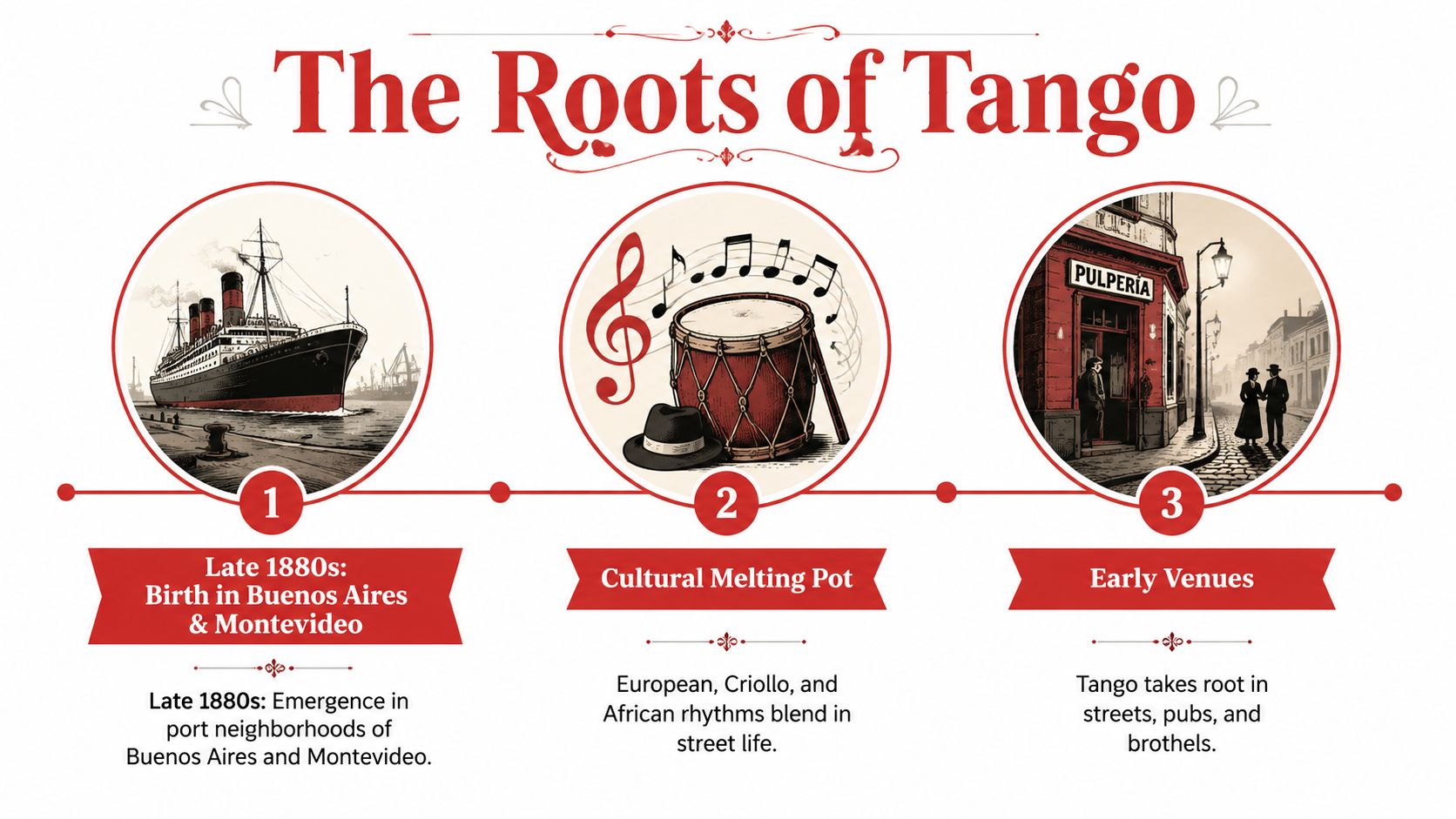
Tango developed in the late 19th century around the port cities of Buenos Aires and Montevideo, where immigrants, local communities, and Afro-Rioplatense traditions mixed music, movement, and social habits into something new. Its roots were blended from the beginning. You can hear that in the music and see it in the dance. Tango did not arrive as a neat system with named combinations first. It formed the way spoken language forms, through repeated use among real people in real places.
That origin matters for beginners. If you picture tango as stage choreography, the dance can seem mysterious or intimidating. If you picture it as a social conversation shaped inside crowded dance gatherings, many later features make sense. The close embrace, the walking, the pauses, and the constant attention to a partner all come from the practical needs of dancing with another person in a shared room.
Early tango also carried the marks of its social environment. It appeared in working-class neighborhoods and in venues with mixed reputations, from informal gathering spots to nightlife spaces. Because of that background, elite society did not welcome it right away. Over time, public taste changed. Tango moved from the edges of urban life into theaters, salons, and eventually international attention.
By the early 20th century, tango had traveled far beyond the Río de la Plata region. Paris played a major role in that shift. Once European audiences embraced tango, it gained a new level of legitimacy back in Argentina as well. That pattern is common in cultural history. A local form leaves home, earns prestige abroad, and returns with a different status.
The period many dancers call the Golden Age came later, when tango music and social dancing were woven into daily life in Buenos Aires. This was the era of packed dance halls, live orchestras, and strong codes of floorcraft in the milonga. In other words, tango matured as a social practice before it was packaged for classrooms. Many of the habits beginners still learn today, such as walking clearly, respecting the line of dance, and listening closely to musical phrasing, make more sense when you know they were shaped by busy social floors.
A simple timeline helps:
| Era | What changed |
|---|---|
| Late 1800s | Tango formed in port communities around Buenos Aires and Montevideo |
| Early 1900s | Tango spread to Europe and gained broader public acceptance |
| Golden Age | Social dancing and live tango music became central to milonga culture |
| Late 20th century | Stage productions and renewed international interest helped revive tango worldwide |
| Today | Tango is practiced globally as both a social and performance dance |
Tango later declined during periods of political and social disruption, but it did not disappear. Social dancers kept the form alive in milongas, small communities, and teaching lineages. The late 20th century brought a wider revival, helped by stage productions and growing international curiosity. UNESCO later recognized tango as Intangible Cultural Heritage of Humanity in its tango heritage listing.
Today, that history still shows up in the way tango is taught and danced. A beginner in Argentine Tango classes is not just learning steps from the past. They are entering a tradition built around listening, responding, and co-creating a dance in the moment. That is why tango feels both old and alive. Its history lives inside the milonga, where the dance still works as a conversation between partners, the music, and the room.
Styles of Tango Dancing
You walk into a milonga and notice something surprising. No two couples are dancing the same sequence, yet the room still feels coherent. That is the clearest way to understand tango styles. They are not just different sets of steps. They are different ways of holding a conversation with a partner, the music, and the shared floor.
Beginners often hear many labels at once: Argentine, Salon, Milonguero or Apilado, Nuevo, Show, American Ballroom, International Ballroom, even Finnish tango. That can sound like a long menu. It helps to sort them by purpose instead. Some styles grew on crowded social floors. Some were shaped for teaching systems or competition. Some were built to read clearly from a stage.
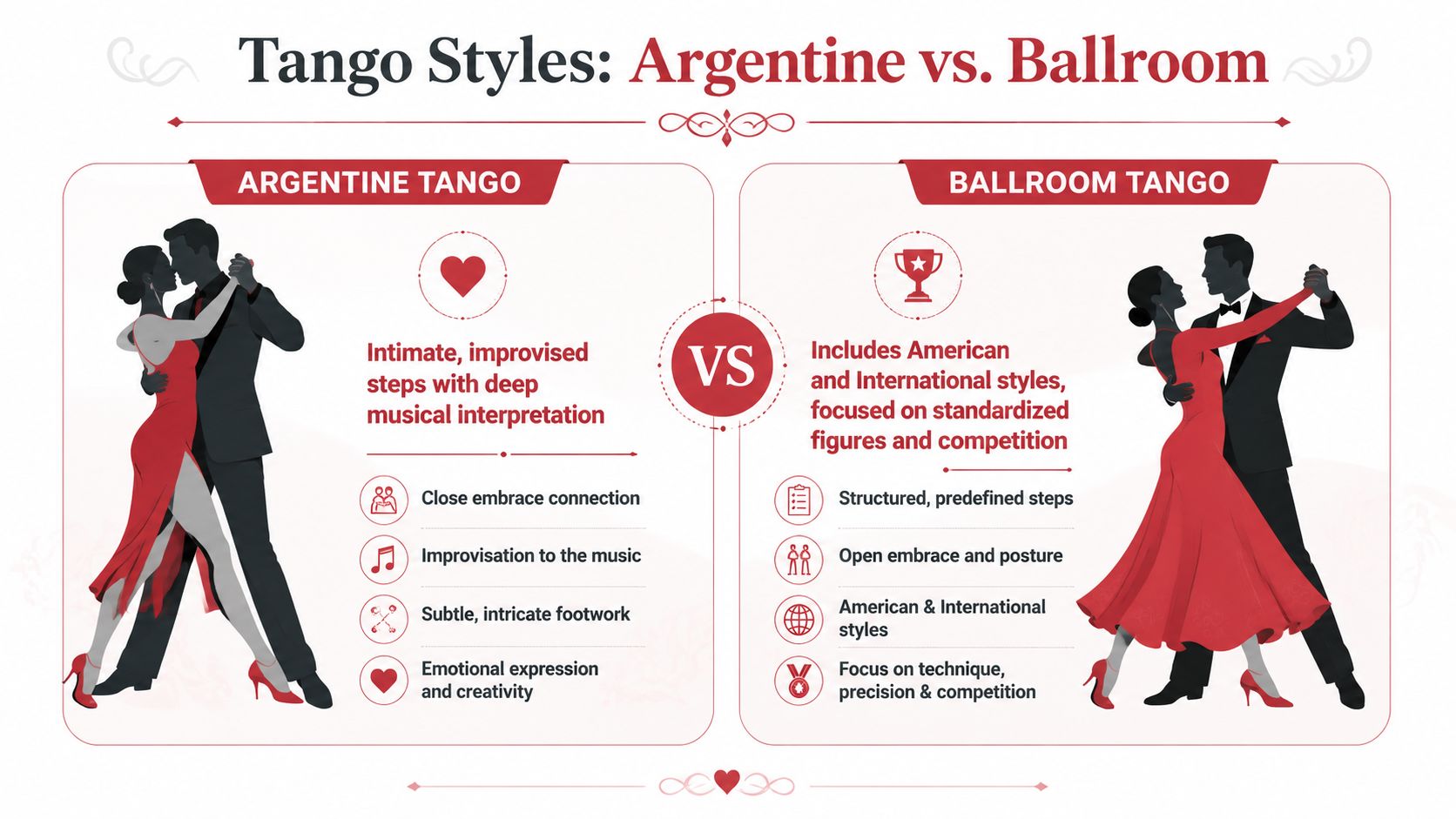
For a new dancer, the first useful distinction is simple. Argentine Tango is rooted in social improvisation in the milonga. Ballroom Tango is usually taught through clearer codified patterns and performance-oriented shapes. They share family resemblance, but they solve different problems.
Argentine Tango
Argentine Tango works like a spoken conversation. You do not memorize one script and recite it from start to finish. You listen, respond, pause, change direction, and adapt to what is happening around you.
That is why teachers often describe Argentine Tango as an improvised social dance first. The embrace may be close or more open, but the goal stays the same: create movement together in real time. On a busy floor, that matters. A couple cannot rely on a long preset routine if another pair stops suddenly in front of them.
A studio offering Argentine Tango classes will usually start with skills that support that conversation: walking with balance, changing weight clearly, turning without rushing, and noticing how small leads create clear responses.
Common features include:
- Improvisation: Partners build the dance moment by moment instead of reciting fixed choreography.
- Connection: Small shifts in timing, direction, and energy carry meaning.
- Floorcraft: Dancers adjust to the ronda, the line of dance around the room.
- Musical phrasing: The same basic walk can feel calm, sharp, playful, or suspended depending on the orchestra and the moment.
Within Argentine Tango, you may also hear sub-style names such as Salon, Milonguero, Nuevo, or Show Tango. These labels describe tendencies, not sealed boxes. Salon often suggests a social style with space for turns and elegant movement. Milonguero or Apilado usually points to a closer embrace suited to crowded rooms. Nuevo often refers to exploratory movement ideas and a more open structure. Show Tango stretches the dance toward stage presentation, where larger shapes and dramatic lines matter more than social traffic.
Ballroom Tango
Ballroom Tango developed along a different teaching path. It is often organized through syllabi, standard figures, and a stronger visual frame. If someone's image of tango comes from a competition floor or a dance show with sharp head positions and dramatic stops, they are often picturing ballroom tango.
This style can be satisfying for dancers who like clearly defined structure. The patterns are easier to name and repeat, and the technique is often taught in a more formal progression. American and International Ballroom Tango differ from each other, but both usually place more emphasis on shaped presentation than a social milonga does.
A quick comparison helps:
| Style | Main setting | Main goal | What a beginner learns first |
|---|---|---|---|
| Argentine Tango | Milongas and social dance events | Improvised connection | Walking, embrace, navigation, musical response |
| Ballroom Tango | Classes, showcases, and competitions | Clear form and repeatable figures | Patterns, frame, shaping, timing |
Neither style is the “correct” version for every dancer. The better question is what kind of experience you want. If you want tango as a social conversation, Argentine Tango usually makes the most sense. If you want a structured vocabulary with a more formal visual style, ballroom may fit better.
That distinction saves beginners a lot of confusion. Two dances can share the name “tango” while asking your body to do very different things.
Core Technique and Musicality in Tango Dancing
Tango looks refined because small details matter. The walk, the pause, the turn, and the embrace all depend on control. Strip the dance down, and the foundation is simple. You need posture, balance, weight transfer, and timing.
A beginner often wants “moves.” A teacher usually starts with walking. That isn't because tango is basic. It's because the walk reveals everything. If you can't shift weight clearly, stay balanced, and hear the beat, every advanced figure becomes harder than it needs to be.
How the body works in Argentine Tango
One of the most important technical ideas in Argentine Tango is weight distribution. According to this technical explanation of Argentine Tango mechanics, the leader maintains weight on both feet for stability while the follower shifts weight to one foot to enable immediate directional changes, creating sensitivity to micro-movements.
That sounds abstract until you feel it.
Think of the leader as creating a stable platform for intention. Think of the follower as staying available for change. If both people are unstable, the dance feels muddy. If both people are rigid, the dance feels blocked.
This is also where beginners get nervous in close embrace. They worry they'll lean, collapse, or lose control. The solution isn't to hold tighter. It's to keep your own axis and meet your partner through connection rather than hanging on them.
Four things to notice in your first lessons
You don't need to memorize many concepts at once. Focus on these:
- Posture: Stand tall without stiffness. Your chest is available, but your ribs and shoulders stay calm.
- Embrace: The hold should communicate, not squeeze.
- Weight transfer: Finish one step before starting the next.
- Rhythm: Walk with the music before you decorate the music.
If you want a broader explanation of how dancers hear accents, phrasing, and pauses, this guide on musicality in dance gives useful context.
Practical rule: If you can pause comfortably together, your connection is improving. If every pause feels like a wobble, go back to posture and weight transfer.
Musicality is not “doing more”
New dancers sometimes think musicality means adding extra movements. Usually it means the opposite. It means choosing movement that fits what you hear.
A useful analogy is conversation. If someone whispers something important, you don't respond by shouting. In tango, when the music stretches, softens, or suspends, your body can reflect that with stillness, smaller steps, or a delayed change of direction.
Here's a simple practice idea:
- Listen for the beat and walk to it.
- Notice where the music asks for calm instead of speed.
- Let pauses count as part of the dance.
The more you treat tango as listening through the body, the less mysterious it becomes.
Social Etiquette and Settings for Tango Dancing
Many beginners think tango happens mainly in classes or on stage. In practice, its home is the milonga, the social setting where people gather to dance. That matters because tango is an improvised social dance rooted in the milonga, not a choreographed performance, as discussed in this academic discussion of tango and social improvisation.
If you only learn steps and ignore etiquette, social dancing feels confusing fast. A milonga has flow, spacing, nonverbal customs, and shared expectations. Those aren't random traditions. They help many couples dance safely and respectfully in the same room.
Where tango happens
You'll usually see tango in a few settings:
- Classes: Good for learning fundamentals, asking questions, and rotating partners if the class allows it.
- Practicas: More relaxed sessions where dancers experiment, repeat material, and work out problems.
- Milongas: Social events where the emphasis is dancing with others, navigating the floor, and respecting the room.
- Performances: Choreographed presentations designed for an audience, not the same thing as everyday social tango.
For beginners, classes and practicas are often the easiest entry points. If you're looking for a first structured step, tango lessons for beginners usually introduce not only movement but also the customs that make social dancing feel less intimidating.
Etiquette that makes the room work
Social tango asks for awareness. You're not dancing in a private bubble.
A few common principles help:
- Invitation matters: In many tango communities, dancers use eye contact and a nod to invite each other.
- Space matters: Big movements that work in a studio can create problems in a crowded room.
- Consent matters: Close embrace should feel mutual, adjustable, and respectful.
- Navigation matters: You move with awareness of the couples around you, not through them.
Good tango etiquette isn't about being formal. It's about making your partner and everyone around you feel safe enough to enjoy the dance.
When people say tango is social, this is what they mean. The dance is built not only on technique, but on shared courtesy.
Benefits of Tango Dancing
Tango gives people a rare combination of challenge and connection. It works your body, but it also sharpens attention. It asks you to stay present, but it doesn't require athletic showmanship to feel rewarding.
Physically, tango can improve how you carry yourself. You spend time organizing posture, controlling steps, and transferring weight with care. That often changes how you stand and walk outside the studio too. People notice they're less collapsed through the chest, steadier on one leg, and more aware of how tension travels through the shoulders and neck.
Why it feels good beyond the steps
Tango also trains focus. You can't drift through it on autopilot. You're listening to music, sensing a partner, and adapting in real time. That kind of concentration can feel refreshing because it pulls your mind away from the usual noise of the day.
The emotional side is just as important:
- Connection: You practice nonverbal communication with another person.
- Confidence: Progress comes from repeated small wins, not from instant perfection.
- Community: Social dance settings create regular contact with people who share a common interest.
- Relief from stress: Attention shifts from screens and schedules to music, movement, and presence.
Everyday effects people often notice
A few changes show up in ordinary life:
| Area | Common effect |
|---|---|
| Posture | You sit and stand with more awareness |
| Listening | You become better at noticing timing and nonverbal cues |
| Composure | You get more comfortable pausing instead of rushing |
| Social ease | Entering a room full of new people feels less daunting over time |
Tango rewards patience. The benefits often appear quietly, through better balance, better listening, and a stronger sense of ease with other people.
That's part of its appeal. You aren't only learning a dance. You're practicing presence.
Getting Started with Tango Dancing
Starting tango is easier when you know what your first few classes are for. They're not auditions. They're not tests of talent. They're places to build a base.
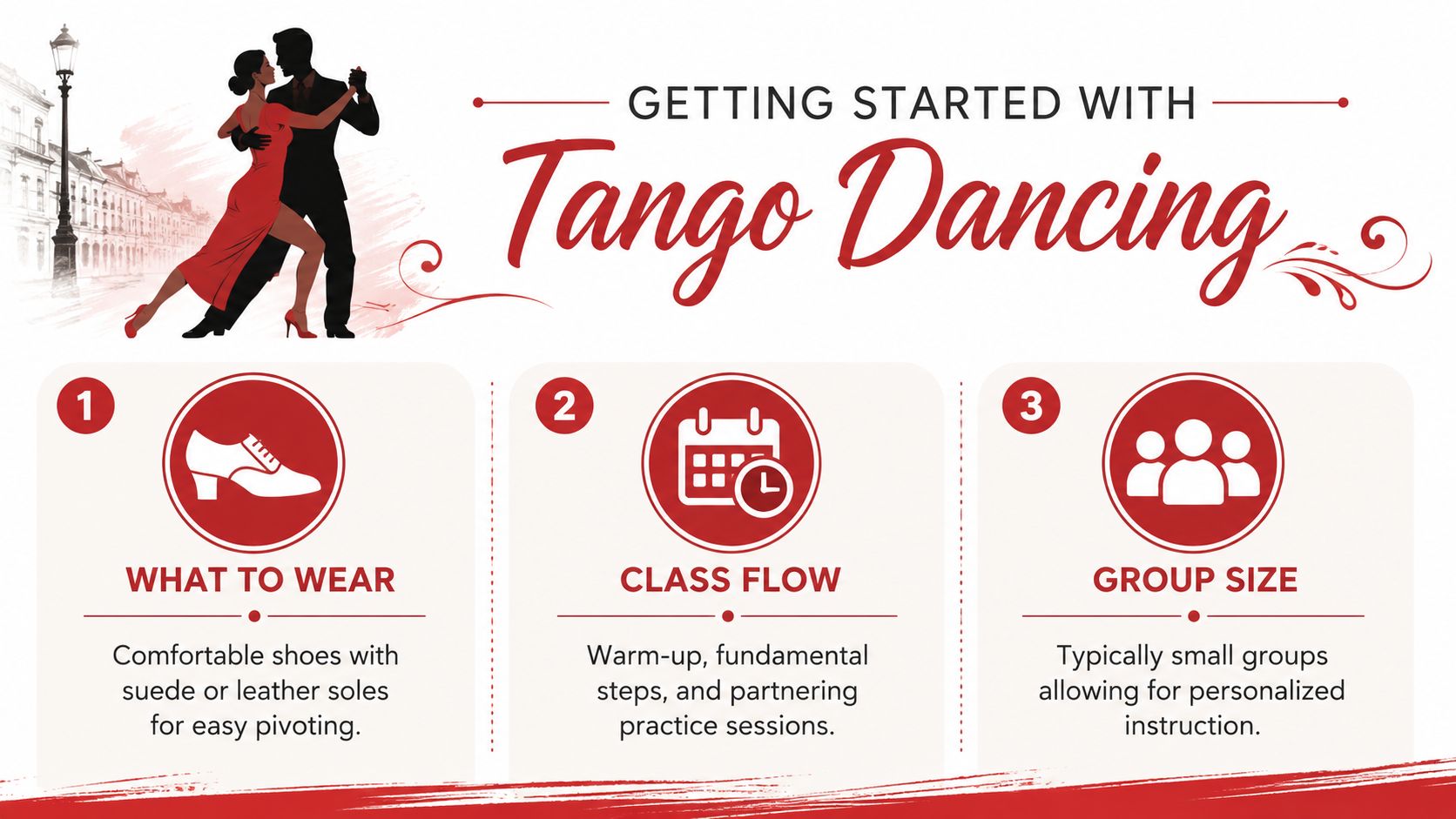
Wear clothes you can move in and shoes that let you pivot without sticking. Many dancers prefer leather or suede soles because they make turning easier. You don't need a dramatic outfit. Comfort and control matter more than appearance in the beginning.
A first class often includes a warm-up, basic walking, posture work, partner exercises, and simple navigation. You may rotate partners, or you may stay with one person depending on the setting. Either way, the point is to learn how tango feels in the body.
What to focus on first
A useful beginner benchmark comes from this video guidance for new leaders, which says beginner leaders should focus on four core skills immediately: posture, embrace, navigational skills, and the ability to hear and walk on the beat, with navigation often cited as the most challenging.
That's a smart checklist even if you're not leading, because it keeps your attention on essentials rather than flashy figures.
- Posture first: If your alignment is off, everything else gets harder.
- Embrace next: You need a connection that communicates clearly.
- Navigation matters early: Social tango happens around other people.
- Timing keeps the dance coherent: Walking on the beat makes the partnership feel reliable.
Here's a short visual introduction for beginners:
How to practice without overcomplicating it
You can make progress between classes with simple habits:
- Stand in front of a mirror and check whether you're balanced over your feet.
- Practice slow, deliberate weight changes from one foot to the other.
- Listen to tango music and clap or step to the beat.
- Attend practicas when you can, so the material moves from theory into actual dancing.
A lot of people worry they're “not ready” for tango because it looks refined. In reality, beginners improve by repeating basics until they feel natural. One clear walk, one balanced pause, and one well-led change of direction matter more than a pile of half-learned figures.
FAQs and Next Steps with Danza Academy
Beginners usually have a few concerns that don't get answered by a simple definition of tango. Those concerns are normal. Most of them become much less intimidating once you understand that tango is social, improvised, and learned gradually.
Can I practice improvisation at home
Yes, but don't think of solo practice as pretending to do the whole dance alone. Practice the ingredients. Work on posture, weight transfer, walking in rhythm, and pausing without wobbling. You can also listen to tango music and mark the beat with your steps.
Improvisation grows from clear basics. It doesn't come from inventing random moves.
Can I go to a milonga without a partner
Usually, yes. Social tango communities often include people who arrive solo. What matters more is understanding the room, watching how invitations happen, and entering with respect for the event's customs. If you're nervous, a class or practica often feels like a gentler first step.
What is Queer Tango
Queer Tango is a documented global movement in which dancers exchange or rethink traditional leader and follower roles to reject heteronormative expectations, as described in this overview of Queer Tango. For many dancers, that makes tango feel more open, flexible, and representative of real social choice.
Tango is a communication system, not a rule that says one kind of person must always dance one kind of role.
Some of the healthiest tango communities teach roles as skills, not identities.
I'm afraid I'll fall on my partner in close embrace
That fear is common. The answer is to maintain your own balance while sharing connection. In close embrace, you're not supposed to collapse onto someone else. You meet your partner through posture, grounding, and subtle body communication. If the embrace feels heavy, the issue usually isn't “closeness.” It's alignment.
How much experience do I need before I'm intermediate
It depends on the school, but one published guideline says an intermediate Argentine Tango student typically has 1 to 5 years of dancing and about 200 to 1,000 hours of practice, lessons, and dancing, while Beginner Plus is under 1 year or under 200 hours, according to this tango level guide. That's useful because it reminds beginners that tango takes time. Slow progress is still real progress.
If you want in-person guidance, one option is Danza Academy of Social Dance, which offers social dance instruction in Philadelphia and Exton, including a complimentary first lesson through its contact page. That kind of first lesson can help you answer the questions that are hard to solve from articles alone, such as which style fits you, how the embrace should feel, and what your next class should be.
If you're curious about tango and want a clear, low-pressure way to begin, book a free complimentary lesson with Danza Academy of Social Dance. It's a practical way to feel the music, try the connection, and see how tango works in real life without needing a partner or prior experience.