
You might be here because you saw a couple spin across a dance floor, laughing, catching the beat like they were part of the band, and thought, “I want to do that, but I have no idea what it's called or where to start.”
That feeling is exactly how many people find swing. It looks playful, social, musical, and somehow both relaxed and electric at the same time. The good news is that swing dancing isn't reserved for performers, vintage experts, or naturally gifted dancers. It's a social dance family that regular people learn every day, one step and one song at a time.
What Is This Joyful Dance Called Swing
If you've ever watched dancers move to jazz with a buoyant pulse and an easy partner connection, you've probably already seen swing dancing. At its heart, swing is a family of social dances connected to jazz music and shared movement. It isn't just about flashy turns or old movies. It's about rhythm, play, and the simple pleasure of dancing with someone else.
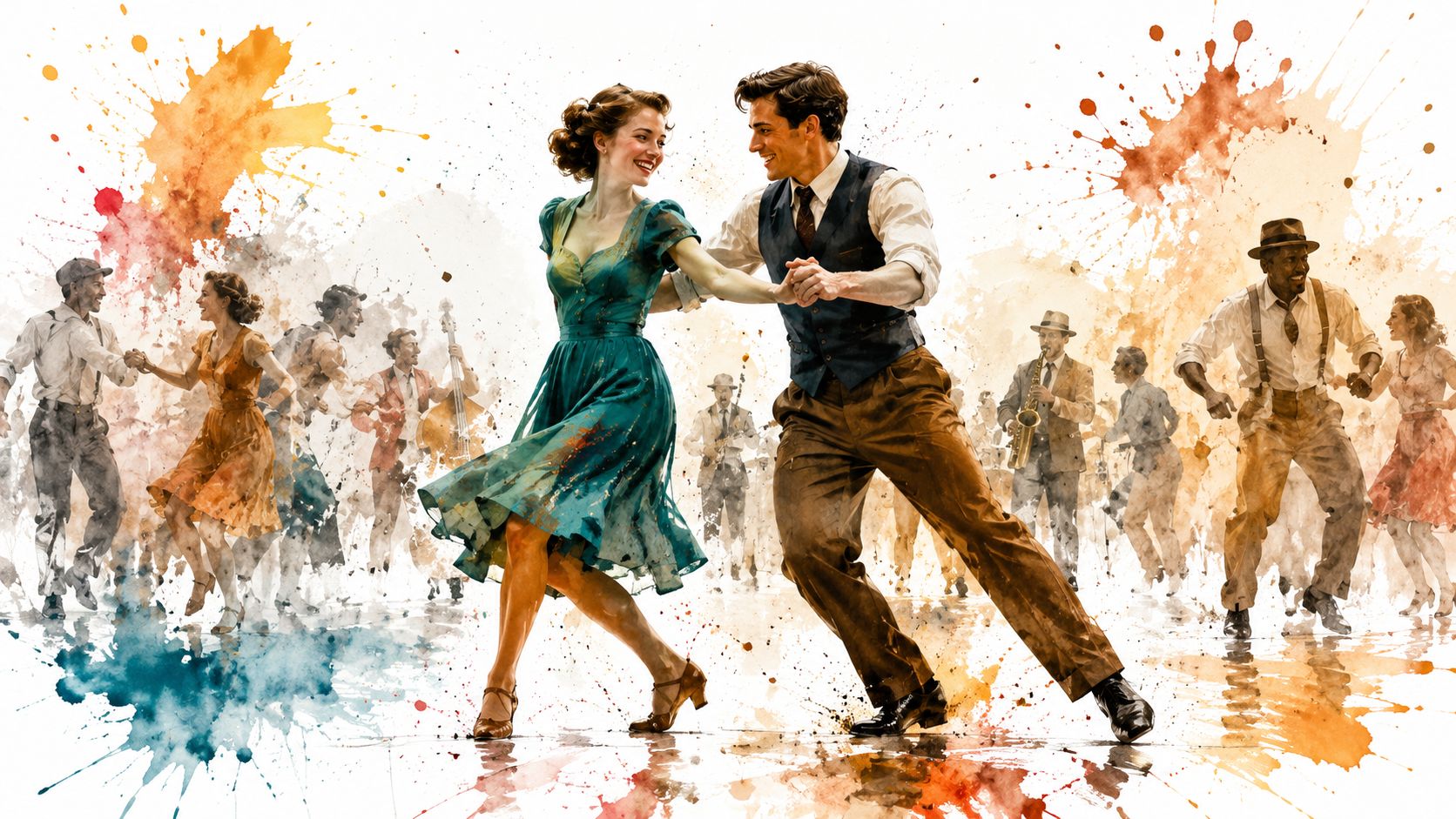
Some people ask, “What is swing dancing exactly?” A practical answer is this. It's an umbrella term for partner dances that grew out of American jazz from the late 1920s into the 1950s, with four primary styles people commonly encounter today: Lindy Hop, East Coast Swing, West Coast Swing, and Balboa, all tied together by lead-and-follow and a relationship to jazz music, as described by DanceSeekers' overview of swing styles.
It feels social before it feels technical
What makes swing special is the feeling you get before you understand all the mechanics. You hear the music. Your foot starts tapping. Then someone invites you onto the floor, and suddenly the dance becomes a conversation.
That's why swing lasts. People come for the steps, but they stay for the connection.
Swing is one of the few dances where you can look like you're having the time of your life even while learning the basics.
It's a family, not one single dance
When beginners picture swing, they often imagine one fixed set of moves. In reality, swing includes several related styles with different moods. Some feel lively and circular. Some feel smooth and stretchy. Some are ideal for classic big band jazz, while others fit modern music better.
A few things nearly all swing styles share:
- Partner connection that lets two people move together without needing constant words
- Rhythm-driven footwork that matches the pulse and phrasing of the music
- Improvisation so the dance feels alive instead of memorized
- Social energy because swing was built for dance floors, not just stages
If you're curious, slightly nervous, and hoping this dance might be for you, that's a perfect place to start.
The Rich History and Culture of Swing Dancing
Step into a crowded ballroom for a social dance, and you can still feel the history in the room. A beginner laughs after missing a turn. A more experienced dancer answers the music with a playful kick. Two strangers meet for one song and walk off smiling. Swing has always been more than steps. It is a shared language built through rhythm, creativity, and community.
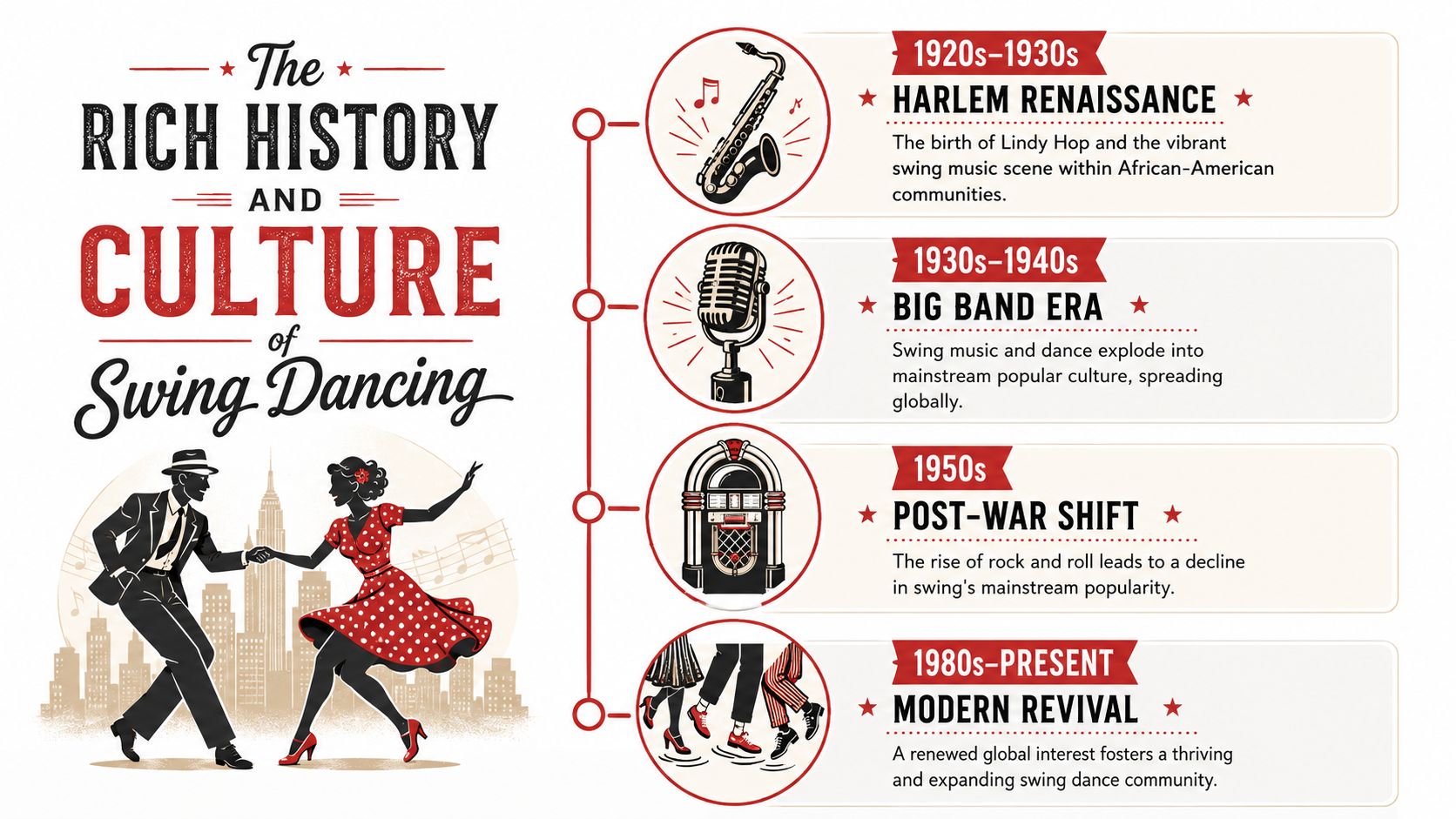
Swing grew alongside jazz in the early twentieth century, especially as big band music spread across dance halls in the 1930s and 1940s. The dance changed as the music changed. Faster songs invited sharper energy. Looser rhythms invited bounce, groove, and improvisation. That close relationship between music and movement is part of why swing still feels alive instead of frozen in the past.
Black communities created the foundation
Swing came out of African American communities, and that history deserves plain, respectful attention. Black musicians and dancers shaped the rhythms, the movement quality, the improvisation, and the social spirit that people still recognize in swing today.
Lindy Hop, one of the best-known swing dances, took shape in Harlem in the late 1920s and early 1930s. It grew in ballrooms such as the Savoy, where dancers tested new ideas in real time, borrowing from jazz, Charleston, breakaway, and everyday social movement. The result was not a rigid system. It was a living dance conversation.
That point matters for beginners. If swing sometimes feels playful, flexible, and human, that is part of its design.
Harlem helped shape the culture people still love
Harlem during the Renaissance was full of artistic exchange. Musicians, writers, performers, and dancers were building culture together, and social dance floors were one place where that creativity became visible. People brought style, humor, pride, competition, and connection into the room all at once.
A good way to understand swing history is to picture a jazz jam session. One person starts an idea. Another answers. Someone adds personality. The whole room feels it. Swing dancing works in a similar way. Even in partner dancing, there is space for response, surprise, and individual voice.
That is why learning the history changes how the dance feels. You are not just memorizing footwork. You are joining a tradition shaped by joy, resilience, and community.
Swing spread widely, even across social barriers
As swing music became popular across the United States, swing dancing traveled too. Different cities and scenes developed their own versions, and some dances survived more strongly than others. Charleston, Balboa, Lindy Hop, West Coast Swing, and Collegiate Shag are among the forms people still dance today.
Swing also brought people into shared spaces during a profoundly segregated period in American life. Dance did not erase injustice. It did create moments of contact, exchange, and influence across racial lines, even while those same communities faced unequal treatment outside the ballroom. That tension is part of the history too, and it helps explain why cultural credit matters.
The revival happened because the dance still meets a human need
Swing never stayed locked in one era. It returned through films, music scenes, college clubs, local dance communities, and social events where people wanted something many modern activities do not always offer. Face-to-face connection.
Research summarized in historical references to swing dance suggests that mentions of the terms "swing dance" and "swing dancing" increased sharply in newspapers and magazines during the 2000s and 2010s compared with earlier decades. You do not need the exact count to see the bigger picture. People kept coming back because swing gives them a rare combination of structure and freedom.
That is a big part of its appeal now. You learn a few patterns, but the true reward is interaction. One song can feel like meeting someone new, speaking without words, and sharing a joke through movement. For many dancers, that social spark is the heart of swing, and it has been there from the beginning.
Finding Your Rhythm with Swing Music
Before your feet understand swing, your ears need a chance to catch it.
A lot of beginners think they're “bad at rhythm” when the reason is that swing music doesn't feel like straight, even marching counts. It has a bounce. It leans. It breathes. That quality is what dancers mean when they talk about the music swinging.
What swung rhythm feels like
A simple way to hear it is to compare walking on a flat sidewalk with bouncing lightly on a trampoline. Straight rhythm feels even and square. Swing rhythm has a lift and drop to it. The beats still arrive on time, but they don't feel stiff.
If you've ever nodded along to jazz and felt your body want to relax into the groove rather than hit every beat like a machine, you were already sensing the difference.
How to train your ear
You don't need music theory for this. Try listening in layers.
Find the pulse
Clap or tap along with the main beat. Don't worry about fancy accents yet.Notice the bounce
Listen for the way the rhythm seems to skip forward instead of landing flat.Hear the conversation
In swing music, instruments often answer each other. Dancers do something similar with movement.Match your body to the feel
Let your knees soften. Let your steps get lighter. Swing rarely feels best when the body is rigid.
Music helps you dance smaller or bigger
Beginners often find this confusing. They think faster music means bigger movement. Usually it's the opposite. The quicker the song, the more efficient your movement has to become. Good swing dancing isn't about rushing. It's about fitting your energy to the music.
A useful habit is to listen to a range of jazz and swing-era recordings and walk around the room on the beat. That alone starts to build timing.
Don't wait until class to start learning swing. Start by listening.
If a song makes you want to smile, pulse a little, and move with someone, you're already close to the heart of swing.
A Tour of the Most Popular Swing Styles
You walk into a social dance for the first time. One couple is flying across the floor with joyful bounce. Another is dancing in a narrow line, stretching away from each other and reconnecting like a rubber band. A third looks relaxed and tidy, smiling their way through simple turns. They are all swing dancing, but they are not doing the same style.
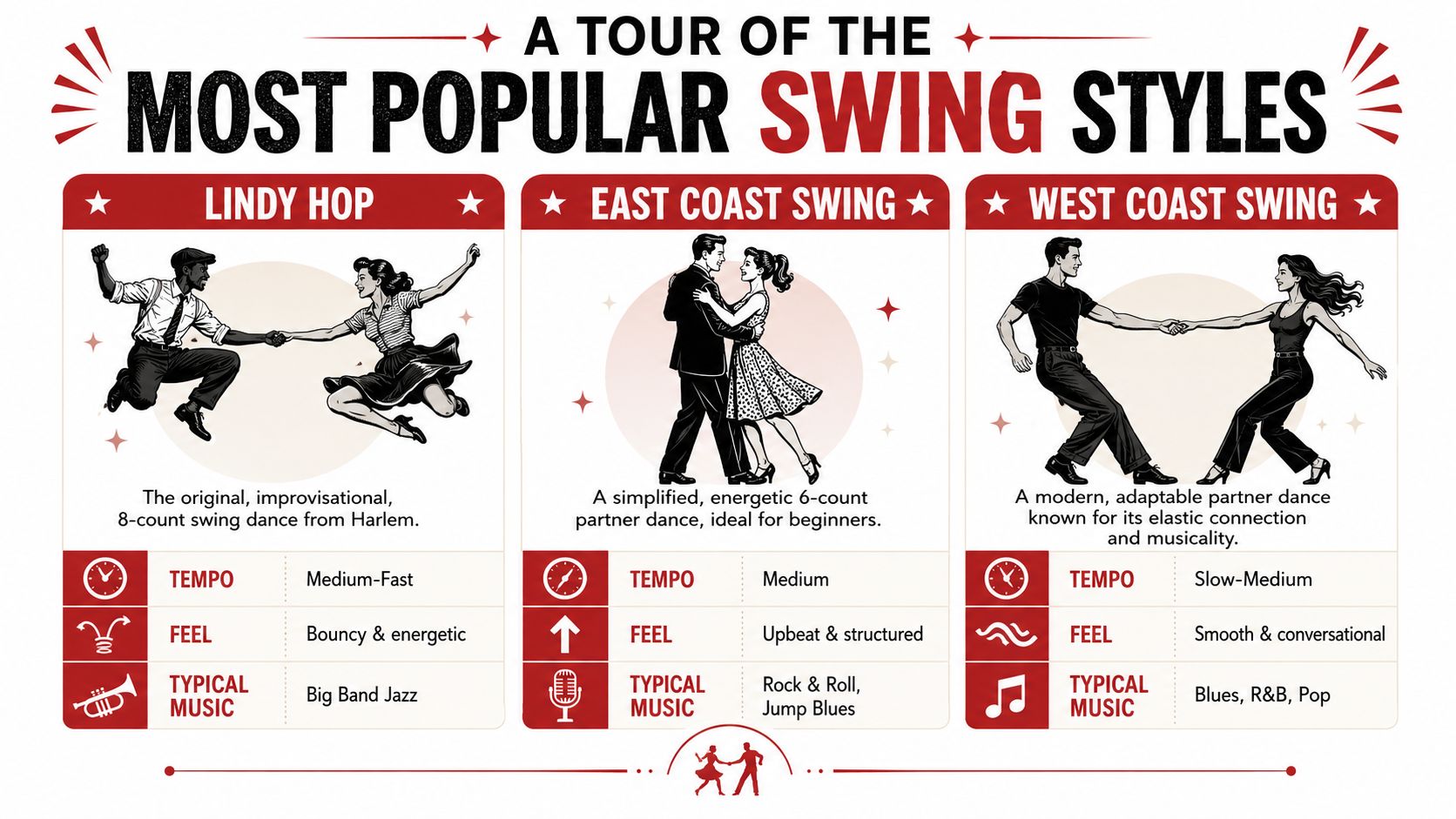
That variety confuses beginners at first. It also makes swing special. Swing is a family of dances shaped by different music, communities, and social settings. Learning the main styles helps you choose a starting point that fits your body, your taste in music, and the kind of connection you want to build with a partner.
Lindy Hop
Lindy Hop is the root many dancers return to. It grew out of Black communities in Harlem during the swing era, and that history matters because the dance still carries the spirit of jazz: improvisation, play, rhythm, and conversation.
On the floor, Lindy Hop often feels springy and grounded at the same time. It can travel, rotate, open up, and then pull partners back together. Some songs invite a relaxed groove. Others bring out bigger energy and faster footwork. That range is part of the joy. Lindy Hop gives partners room to respond to the music and to each other instead of trying to make every dance look identical.
East Coast Swing
East Coast Swing is often the style people meet first in beginner classes, community programs, and wedding lessons. Its structure is easier to recognize, so new dancers can spend less energy wondering what comes next and more energy enjoying the person in front of them.
The feeling is upbeat, compact, and friendly. If Lindy Hop can feel like a jazz conversation with lots of room to riff, East Coast often feels like learning a few clear sentences you can use right away. That does not make it lesser. It makes it welcoming.
Many dancers start here because they can get comfortable social dancing fairly quickly.
West Coast Swing
West Coast Swing has a different look and feel. Partners usually dance in a slot, moving back and forth along a shared line instead of circling around the room. The connection often looks stretchy and elastic, with more space for pauses, accents, and personal styling.
It is also highly adaptable. You might see it danced to blues, R&B, or contemporary pop, which gives it a broad musical range. For dancers who enjoy subtle timing changes, expressive partner dialogue, and a smoother texture, West Coast Swing can feel immensely satisfying. If you want a clearer comparison, this guide on the difference between East Coast and West Coast Swing explains how the two styles differ in feel and floorcraft.
Swing Styles at a Glance
| Style | Energy & Vibe | Typical Music | Basic Rhythm |
|---|---|---|---|
| Lindy Hop | Playful, energetic, improvisational | Big band jazz, swing-era music | Often 8-count, with room for variation |
| East Coast Swing | Upbeat, structured, beginner-friendly | Rock and roll, jump blues, swing | Commonly 6-count |
| West Coast Swing | Smooth, elastic, conversational | Blues, R&B, pop, contemporary music | Slotted patterns with stretch and release |
Which style fits you
A simple way to choose is to start with the experience you want.
- Choose Lindy Hop if vintage jazz makes you want to move and you like the idea of lively partner conversation.
- Choose East Coast Swing if you want a clear, approachable starting point for social dancing.
- Choose West Coast Swing if you enjoy smoother movement, musical interpretation, and a more modern look.
You do not have to pick one forever. Many social dancers try several styles over time, and that cross-training often makes their connection, musicality, and confidence stronger. Swing is broad enough to welcome different personalities, which is one reason people stay with it for years.
Your First Steps The Basic Moves and Language
You step onto the floor, the music starts, and someone says, “We'll begin with a rock step and a triple step.” For many beginners, that is the moment swing sounds harder than it really is. The good news is that these words are just labels for movements your body can learn with practice, rhythm, and a little patience.
The rock step and triple step
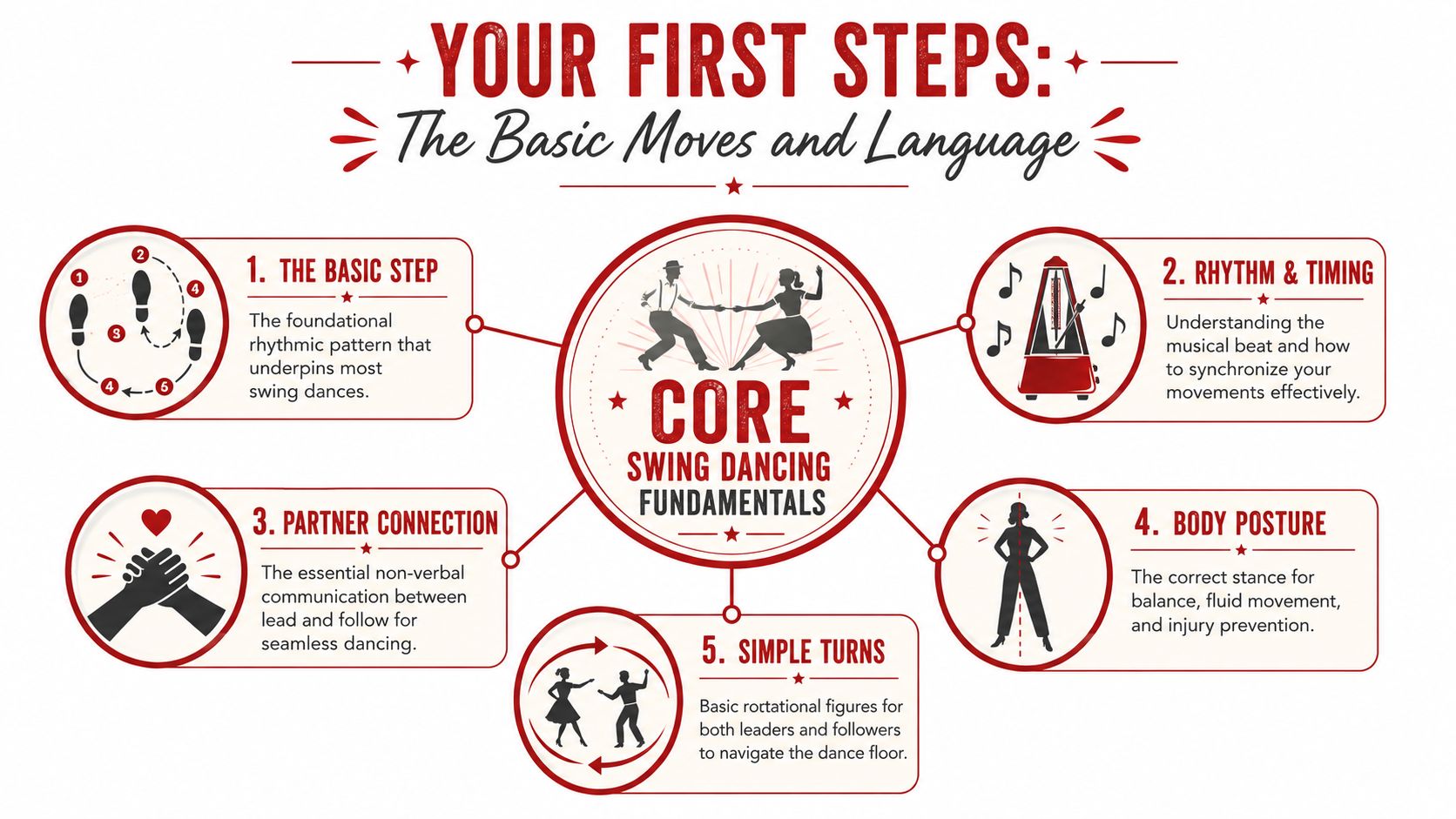
At the beginner level, swing usually starts with a repeating rhythm built from two ingredients. A rock step is a small change of weight back and then back to center. A triple step is three weight changes spread across two beats, which creates that light, bouncy quality people associate with swing.
Those pieces show up in many 6-count and 8-count patterns. You do not need to master every version right away. What matters first is feeling how the rhythm carries you, like a pulse under the dance that keeps both partners moving together.
A rock step creates a little rebound. A triple step fills the music with texture.
How the basic rhythm starts to feel
This exchange works like a shared pulse between two people.
The rock step often feels like preparation. The triple step feels like motion continuing. When those ideas settle into your body, swing starts to look less like memorized footwork and more like people enjoying music together.
The basic step is a rhythm tool that helps you connect.
Here's a visual example to help the footwork click:
Lead and follow are shared roles
Beginners sometimes picture “lead” and “follow” as one person controlling and the other obeying. On a social dance floor, the experience is much more cooperative.
The lead offers information about direction, timing, or shape. The follow receives that information and responds in real time. Then both dancers keep adjusting to each other and to the music. That back-and-forth is part of the joy of swing. You are not just doing steps. You are building a small moment of connection with another person.
This is also why perfect foot placement is not the whole story. Two dancers with simple steps and good timing can feel wonderful together because they are listening through touch, rhythm, and attention.
A few beginner cues that help right away
- Keep steps small so balance stays easy
- Soften the knees so your movement can stay springy
- Commit your weight clearly so your partner can feel where you are
- Use a light connection instead of gripping with the hands
- Stay with the beat even when you forget the pattern
If you want to watch those ideas become real patterns on the floor, this guide to West Coast Swing basic moves shows how simple fundamentals turn into social dancing.
No one begins with flow. Flow grows from repetition, listening, and those first few dances where the rhythm finally clicks and you realize swing is meant to be felt with another person, not just counted in your head.
The Social Side Swing Etiquette and Partner Connection
You walk into a social dance for the first time. The room is buzzing, people are smiling, and songs keep changing before you have time to overthink anything. What makes that room feel welcoming is not fancy footwork. It is the way dancers treat each other.
Swing is a social dance in the fullest sense of the word. Yes, you learn patterns and timing. You also learn how to invite, listen, adapt, and share a few minutes of music with someone you may have met ten seconds earlier. That human side is part of what gives swing its joy.
Connection helps explain why social dancing feels so different from practicing alone. A partnership works a bit like a conversation. One person offers an idea through movement, the other answers, and both keep adjusting so the exchange stays clear and comfortable. When that happens, even simple basics can feel warm, musical, and fun.
Etiquette supports that connection. Good manners are not stiff rules meant to make dancing formal. They are small habits that help everyone relax, especially beginners who are still finding their footing.
Habits that make the floor feel better for everyone
Ask clearly and politely
A simple “Would you like to dance?” is friendly and easy to understand.Accept no with grace
People may be resting, getting water, or sitting out a song. A polite decline is normal. Smile, thank them, and keep the evening light.Rotate partners in class
Rotation helps beginners learn to connect with different people, not just one familiar partner. That practice is often treated as a standard part of beginner teaching, as explained in these beginner Lindy Hop teaching notes.Use floor craft
Pay attention to the space around you. In crowded rooms, smaller movement and better awareness protect both your partner and nearby dancers.Come prepared to share space
Clean clothes, fresh breath, and a considerate attitude make close social dancing much more comfortable.
One point often surprises new dancers. Great partner connection is learned, not mysterious chemistry that only some people have. You build it the same way you build rhythm or balance. One dance at a time, with attention and practice.
That is why a strong beginner program teaches more than steps. It gives you chances to rotate, listen, recover from mistakes, and enjoy dancing with many different people. If you want a clear starting point, these beginner swing dance lessons show what that kind of welcoming class structure can look like.
A memorable swing dancer is rarely the one doing the most. It is usually the person who feels safe, clear, musical, and kind to dance with.
That is the social heart of swing. You are not only learning a dance. You are learning how to create a brief, joyful connection with another person, and that is what keeps people coming back to the floor.
How to Start Your Swing Dance Journey Today
You walk into a room, hear the band settle into a steady groove, and notice something encouraging right away. Not everyone looks polished. People are smiling, missing a turn, finding the beat again, and keeping each other company through it. That is a much more accurate picture of beginner swing than the polished clips people see online.
The best way to start is to give yourself contact with the live experience. Hear the music. Feel the pulse in your body. Stand in a room where swing is happening and let it become familiar. Swing often feels easier once it is no longer an idea in your head, but an experience your body recognizes.
A simple starting plan works well. Listen to a few swing songs and clap along to the beat. Watch a range of swing styles and notice what draws you in. Then take a beginner class, because partner dancing makes more sense when another person is part of the conversation.
A good beginner program usually helps new dancers build confidence through social dancing early on, instead of loading the first experience with too many technical corrections. You are learning a language. Before you worry about sounding elegant, it helps to speak a few simple sentences and enjoy being understood.
When you choose a first class, look for a space that helps beginners relax and participate. Good signs include clear rhythm teaching, enough time spent dancing, partner rotation, and an atmosphere where questions are welcome. The goal is not to impress anyone. The goal is to leave thinking, “I can do this again.”
If you want a concrete example of what that first experience can look like, these beginner swing dance lessons show a structured, welcoming path into the dance. Danza Academy of Social Dance offers group classes and private lessons, which gives new dancers a couple of practical ways to begin.
Start small. One class is enough. One social dance is enough.
Swing often becomes more than a hobby because it meets people on several levels at once. You get music, movement, history, and human connection in the same hour. That is part of its joy. You are not only learning steps. You are joining a living social tradition built on listening, responding, and sharing a little energy with the people around you.
A complimentary first lesson is a simple way to test swing dancing without pressure. If you'd like to experience the music, partner connection, and social energy for yourself, you can book a free complimentary lesson with Danza Academy of Social Dance through the contact page for scheduling your first lesson.