
A lot of people meet the waltz before they ever try it. They see it in a wedding first dance, in an old film, or in a grand ballroom scene where everything looks polished, floating, and just out of reach. Then they think, “Beautiful, but probably not for me.”
That reaction is common. The waltz has a formal reputation, and formal things can feel exclusive. But once you understand how it works, the dance stops looking mysterious and starts feeling learnable.
The surprising part is that waltz isn't built on dozens of complicated tricks. It's built on a few clear ideas: moving with a partner, hearing a repeating rhythm, and letting the body rise and settle in time with the music. If you can walk, count, and stay curious, you can begin.
What Is Waltz Dancing
At its heart, waltz dancing is a partner dance known for its smooth turning motion, flowing travel around the room, and unmistakable ONE-two-three rhythm. It's the dance many people picture when they think of elegance, but in a lesson, it often feels much simpler than it looks from the outside.
At a wedding, for example, a couple might start with a basic pattern, breathe into the music, and suddenly look far more confident than they expected. They're not performing magic. They're using structure. The waltz gives dancers that gift. It creates a graceful result from repeatable movement.
The feeling most beginners notice first
Beginners usually expect footwork to be the hardest part. Often, the bigger challenge is trusting the flow. Waltz doesn't rush. It asks you to move continuously, not in sharp stops. That can feel unfamiliar at first, especially if you're used to stepping in place or counting too fast.
The waltz feels easiest when you stop trying to “hit” every beat and start moving through the measure.
That's why the dance often becomes an achievable dream for people learning for social fun or a first dance. You don't need a performer's background. You need a sense of direction, a little posture, and patience with the music.
A simple definition you can use
If someone asked me in class, “What is waltz dancing?” I'd say this:
- It's a partner dance in 3/4 rhythm with a clear three-count pulse.
- It travels around the floor instead of staying mostly in one spot.
- It uses turning movement to create its signature sweeping look.
- It feels elegant because of timing and body movement, not because dancers are born knowing it.
That last point matters. Waltz isn't reserved for experts. It's one of the classic dances people learn specifically because it makes ordinary movers feel graceful.
From Folk Dance to Ballroom Scandal
The waltz has polished manners now, but its beginnings were much earthier. Before it belonged to chandeliers and formalwear, it grew out of village dancing in Austria and Germany. That matters because it explains why the dance still feels warm and human in the body, even when it looks grand from across the room.
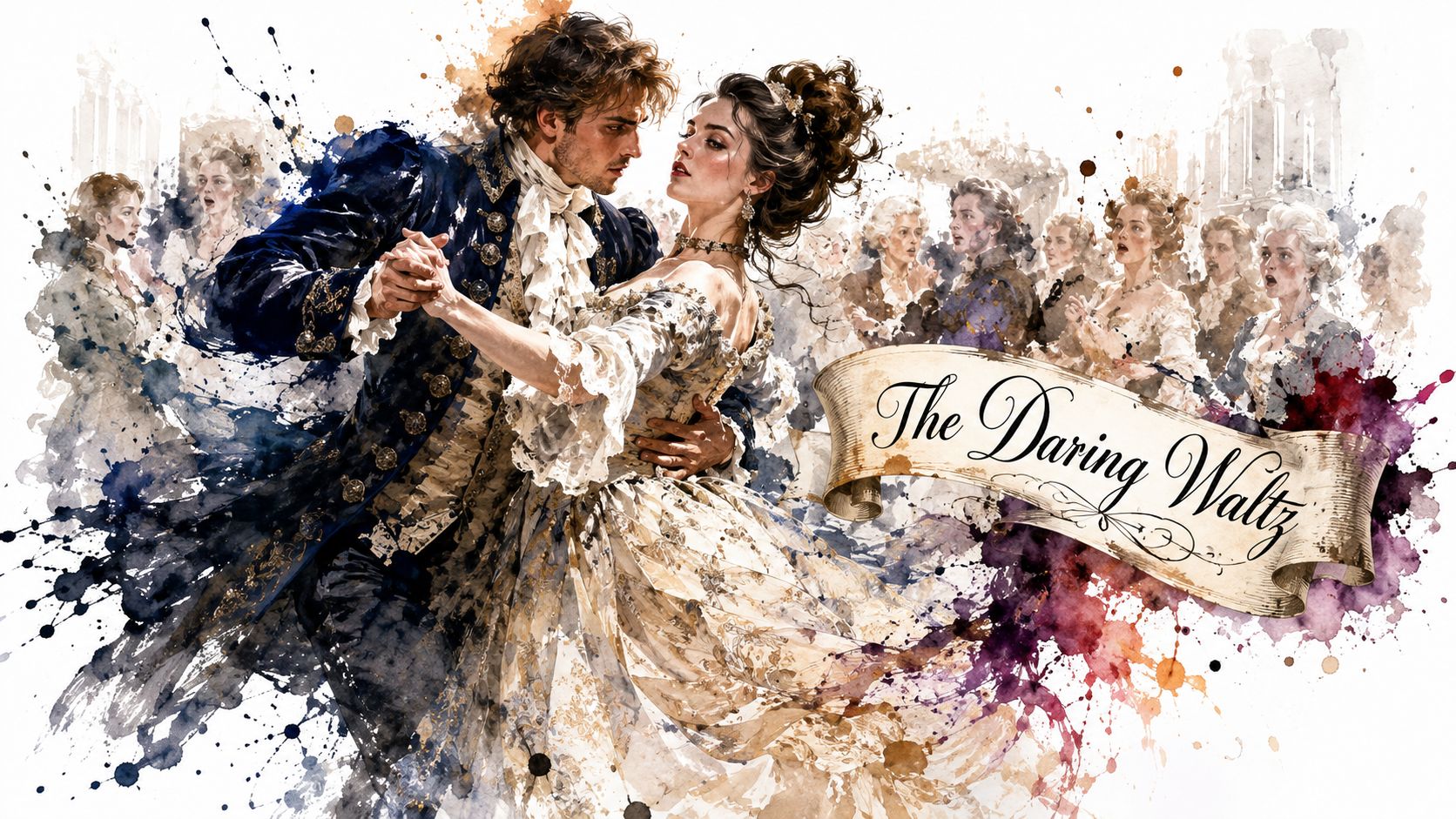
From country turning dance to social sensation
The history of the waltz traces its roots to older folk dances such as the Ländler and notes that the name comes from the German “waltzen,” meaning “to turn” or “to roll.” That turning idea is the thread that runs all the way from early village forms to the ballroom versions people recognize today.
What startled people was not only the rotation. It was the hold.
Earlier social dances often kept partners at more of a distance and organized everyone into shared patterns. The waltz brought one couple into closer contact and let them move as a pair. To modern eyes, that sounds ordinary. In the early 19th century, it felt bold enough to spark criticism, especially in polite society. The Encyclopaedia Britannica overview of the waltz describes how the dance was once considered daring because of that closed position and intimate style of movement.
Why people reacted so strongly
A beginner can miss the point if history is told only as costume and dates. The fundamental change was social.
The waltz gave couples more independence. Instead of waiting for a larger group figure to direct the action, two dancers could travel, turn, and shape the experience together. It worked a bit like switching from reciting lines in a chorus to having a conversation with one person. That freedom made the dance exciting, and for some observers, unsettling.
Vienna helped turn that excitement into fashion. As the dance spread through city ballrooms, composers such as Johann Strauss and Joseph Lanner helped shape the musical world that people still connect with classic waltz culture.
The same feature that once made the waltz seem improper now makes it feel romantic and personal.
Why this history helps beginners
History is useful here because it points straight to the feeling of the dance. Waltz was never only about looking formal. It was about two people sharing direction, timing, and turning movement in a way that felt new.
That idea makes the dance less intimidating. If you understand waltz as a partnered turning conversation, not a museum piece, the technique starts to make sense. Posture supports connection. Rotation gives the dance its character. Smooth travel comes from moving together, not from trying to look fancy. That is part of what makes waltz an achievable dream. Its elegance comes from clear principles that ordinary beginners can learn.
Viennese Waltz vs Slow Waltz
One of the biggest beginner questions is whether there's just one waltz. There isn't. When one asks what is waltz dancing, they're usually thinking of one of two familiar versions. They may not know the names yet, but they can feel the difference almost immediately.
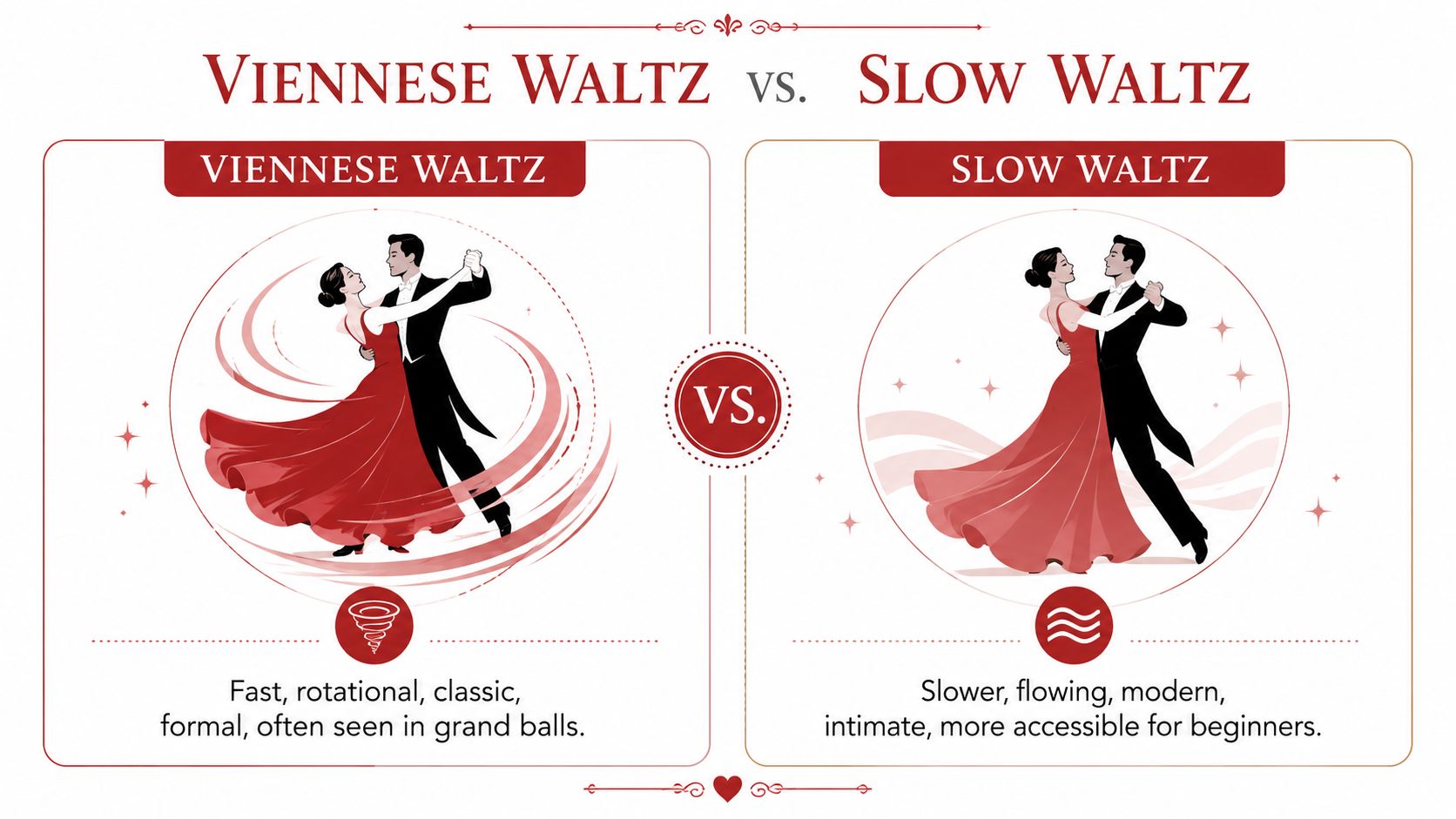
The quick distinction
Viennese Waltz is the older, faster, more continuously rotating style many people associate with grand ballrooms and sweeping formal events. It feels exhilarating, circular, and more relentless in motion.
Slow Waltz, often called English Waltz or International Waltz, gives dancers more time to shape movement. It still turns and travels, but it emphasizes glide, softness, and suspended elegance rather than nonstop spin.
For many social dancers, wedding couples, and first-time learners, Slow Waltz is the easier entry point.
Viennese Waltz vs. Slow Waltz at a Glance
| Characteristic | Viennese Waltz | Slow (English) Waltz |
|---|---|---|
| Overall feel | Fast, swirling, formal | Smooth, floating, romantic |
| Movement quality | More constant rotation | More rise, lowering, and shaping |
| Beginner experience | Can feel dizzy or hurried at first | Usually easier to absorb |
| Common setting | Grand ballroom feel, showcases, formal events | Social lessons, weddings, ballroom study |
| Visual impression | Continuous turning | Long gliding phrases |
Which one do most beginners want
Usually, people say “I want to learn waltz” when they want Slow Waltz. They want the version that looks calm, elegant, and manageable in a wedding or social ballroom setting.
That doesn't mean Viennese Waltz is off-limits. Some dancers love its energy right away. But if your goal is to feel secure, connected, and musical without getting overwhelmed, Slow Waltz tends to be the kinder teacher.
A practical way to choose
- Choose Viennese Waltz if you love classic ballroom glamour and enjoy fast rotational movement.
- Choose Slow Waltz if you want a first dance, a social skill, or a smoother introduction to ballroom technique.
- Try both eventually because each style teaches something useful about turning, partnering, and control.
If Slow Waltz feels like floating, Viennese Waltz feels like being carried in a circle.
That contrast clears up a lot of confusion. Both are waltz. They ask for different energy from the dancer.
Understanding Waltz Music and Timing
Many people think they need musical training before they can learn the waltz. They don't. You only need to recognize one repeating pattern and let your body organize around it.
The waltz uses 3/4 time, which means you feel the music in groups of three beats. Most beginners hear it best as ONE-two-three, ONE-two-three. The first beat has the strongest accent, and that gives the dance its gentle pulse.
How to hear it without overthinking
Try this while listening to a waltz song:
- Tap the strong beat first. Don't count all three right away. Just notice the recurring “ONE.”
- Add the lighter beats. Once the pulse is clear, layer in “two-three.”
- Sway side to side. Let your body swing softly with each group of three.
- Keep the count even. Don't rush from one phrase to the next.
If finding that pulse feels slippery, this guide on how to find the beat in music can help you practice hearing structure in a simple, usable way.
Why the first beat matters so much
That first beat is where the dance settles. In class, students sometimes count correctly but move without shape because every beat looks the same in their body. Waltz improves quickly once the first count feels grounded and the next two counts feel carried.
It's like a pendulum or a slow breath. There's a clear beginning, then a continuation.
Don't chase the music. Let the first beat land, then travel through beats two and three.
The musical feel you're aiming for
You're not trying to stomp out numbers. You're trying to hear a repeating wave. Once you feel that wave, footwork makes much more sense because the music is no longer random. It becomes a container.
That's why some dancers look relaxed even with basic steps. They trust the rhythm. And in the waltz, trust in the music is half the battle.
Fundamental Waltz Technique Explained
You have the music in your ear. Now your body needs a simple plan.
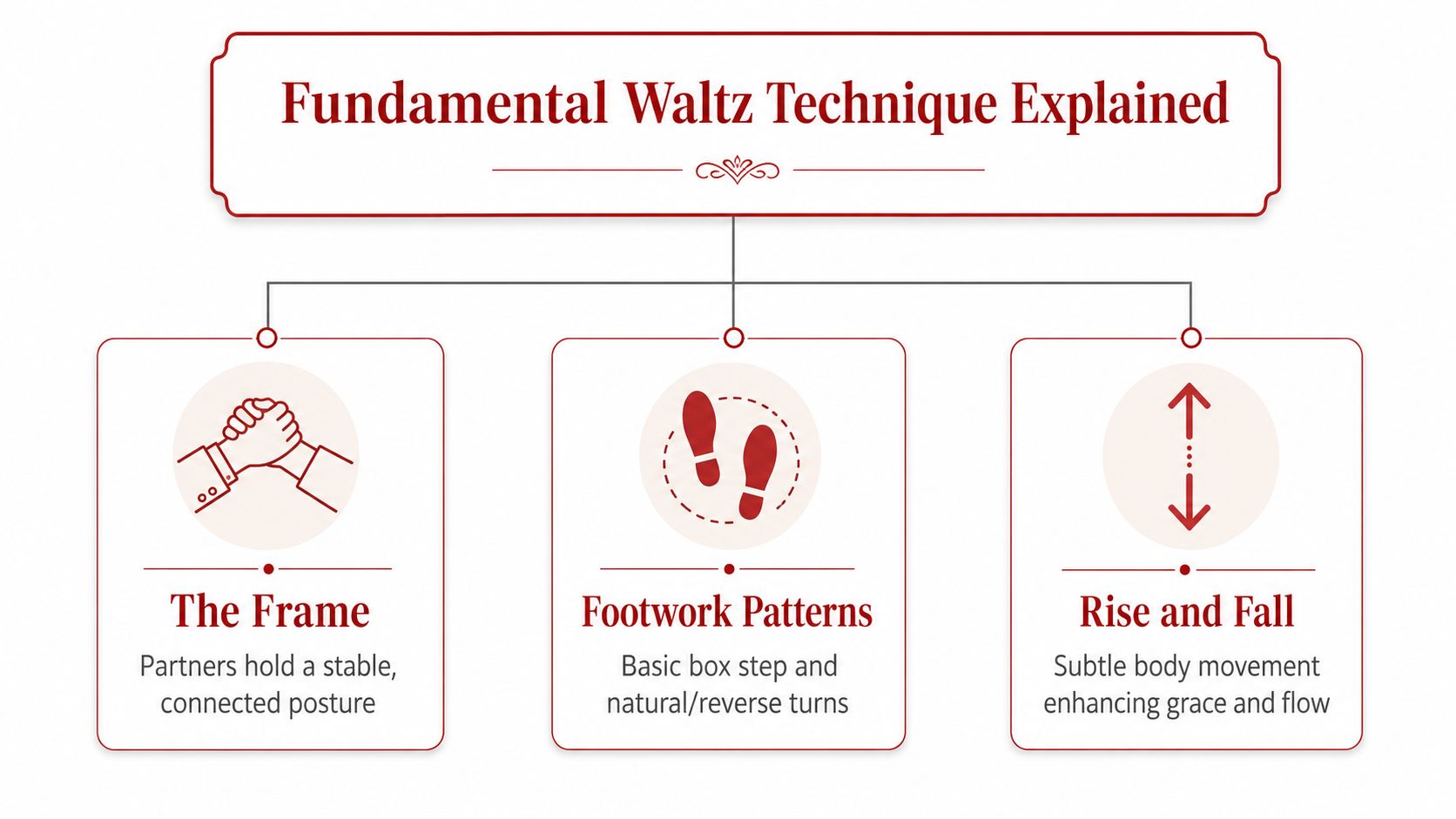
Waltz starts feeling possible when a few core ideas click at the same time. You do not need a long list of rules. You need posture that supports movement, a basic pattern you can trust, and a sense of how the body rises, lowers, and turns without rushing. That is why the dance can look grand in a ballroom and still be very learnable for a wedding or social floor.
The frame
Your frame is the shape that lets two people communicate through the dance hold. It works like the handle on a shopping cart. If the handle is floppy, the cart wobbles. If you grip it with tension, steering gets harder than it needs to be.
In practice, a useful frame means tall posture, open chest, steady arms, and a connection that stays alive as you move. Beginners often focus only on their feet and forget that the upper body is what makes leading and following clear. Hold your own posture well, and your partner immediately gets a clearer message.
The basic box step
The box step is often the first pattern people learn because it teaches three things at once. Direction. Weight transfer. Partnership.
It also gives beginners something priceless: a repeatable home base.
As you practice it, pay attention to these jobs the pattern is doing:
- It teaches where your weight finishes, not just where your foot lands.
- It helps you change feet calmly instead of guessing on the next count.
- It gives the count a physical shape so 1-2-3 feels organized.
- It teaches shared movement so you travel with a partner instead of dancing in parallel.
If you want a clear beginner-friendly walkthrough, Danza Academy's guide to how to dance the waltz step by step gives a practical overview of foundational movement.
Rise and fall
Rise and fall gives waltz its floating quality. Without it, the dance can look flat or bouncy. With it, even a simple basic step starts to feel elegant.
The easiest way to understand it is as a wave through the body. You settle into the floor, move through the step, then lengthen upward with control before returning. New dancers often make the rise too early or too sharp, almost like a little hop. Good waltz technique feels quieter than that.
A simple practice image helps here. Your head should travel like a boat on gentle water, not like a cork popping up and down.
Sway and body movement
Sway confuses many beginners because they try to create it by leaning the shoulders. Real sway is more coordinated. It grows from movement through the standing leg, the body, and the direction of travel.
If the upper body tips on its own, the partnership loses balance and the turn starts to fight itself. If the body stays connected, sway feels natural and helps the dance breathe. You are not adding decoration. You are allowing the shape of the movement to show.
The Natural Turn as an example
A Natural Turn is one of the figures that helps students understand how waltz becomes more than a box. It introduces rotation, floorcraft, and the feeling of traveling while staying connected to the music.
You do not need technical choreography notes on your first day to benefit from it. What matters is what the figure teaches your body:
- A turn unfolds over a phrase, not in one quick twist.
- Your feet and torso must agree about where you are going.
- Partnership gets clearer during rotation because frame and timing have to stay organized.
For many adults, this is the turning point in the learning process. Waltz stops looking like a formal mystery and starts feeling like an achievable skill.
If you are practicing for a reception or first dance, the room setup matters too. Couples often overlook practical details like types, costs, and sizing dance floors, even though the floor changes how secure basic turning patterns feel underfoot.
How to Start Your Waltz Journey
A lot of adults wait too long to begin because they think they need the right moment, the right body type, or the right natural talent. They don't. They need a starting point that feels low-pressure and clear.

Common worries that stop people
Some people worry they have no rhythm. Others think they need a partner before they can even ask about lessons. Wedding couples often fear they'll look awkward in front of guests.
Those concerns are normal. They're also workable.
- No partner: Many studios teach singles and couples.
- No experience: Beginners start with posture, timing, and small patterns.
- Wedding nerves: A structured first dance plan is easier than improvising under pressure.
- Feeling uncoordinated: Repetition solves more than confidence does.
Choosing the learning path that fits you
Group classes are great if you want social energy and regular practice. Private lessons help when you want personalized feedback, faster correction, or a wedding routine designed for your song and comfort level. Home practice matters too, especially if you keep it short and focused.
If you're preparing for an event, practical planning helps beyond the dancing itself. Couples often benefit from reviewing types, costs, and sizing dance floors so the choreography fits the space they'll use.
One option for structured instruction is Waltz lessons at Danza Academy, where adults can study ballroom technique, social movement, and wedding dance preparation in a studio setting.
What your first few lessons should accomplish
Your first phase of learning doesn't need to look dramatic. It should help you do a few things well:
- Hear the count clearly so you stop second-guessing the music.
- Move with calm posture so your partner can read your intention.
- Use a simple basic pattern without freezing.
- Turn a little without losing balance or direction.
Seeing the dance in motion can make the goal feel more reachable. This clip gives a useful visual reference for the kind of smooth, connected movement beginners build toward.
You do not have to become a ballroom performer. You only have to become more comfortable than you are today.
That's why the waltz stays with people. It offers beauty, but it doesn't demand perfection before you begin.
Book a free complimentary lesson with Danza Academy of Social Dance on their contact page if you're ready to try the waltz for yourself. It's a simple first step, whether you want a wedding dance, a new social skill, or a graceful introduction to ballroom.