
So, you're thinking about starting tango lessons. That’s a fantastic first step into a world filled with incredible music, connection, and movement. Whether you're convinced you have 'two left feet' or you're hesitant because you don't have a partner, I'm here to tell you that Argentine Tango is for everyone. This guide is designed to get you past those first-day jitters and onto the dance floor with confidence.
Welcome to the World of Argentine Tango
If you've ever watched tango and felt drawn to its passion and elegance, you're not alone. This beautiful dance, born in the lively neighborhoods of Buenos Aires, has blossomed into a worldwide community. It’s so much more than just a set of steps—it's a unique language spoken without words and an amazing way to meet new people.
So many beginners worry about not being coordinated enough or about showing up solo. Let those worries go. At its heart, tango is simply about walking together with the music. It's a skill anyone can learn, especially in a friendly and supportive space. Plus, the benefits go beyond the dance floor, improving your balance, posture, and even your mindfulness.
A Thriving Global Community
You’re not just starting a new hobby; you’re joining a huge, welcoming network of dancers. An estimated 900,000 people around the globe actively dance Argentine Tango. Its popularity soared after it was recognized by UNESCO as Intangible Cultural Heritage. This means you're learning a language of movement that you can take with you to cities all over the world. You can learn more about the global tango community and its history right here.
Here at Danza Academy, our whole mission is to make your entry into this world as smooth and fun as possible. With over 40 years of experience teaching in Philadelphia and Exton, we’ve helped countless beginners go from their very first steps to feeling confident at a social dance. We're focused on creating a space where you feel comfortable learning, making mistakes, and connecting with others.
Tango is a conversation between two people. You don't need to know the words in advance; you just need to be willing to listen. Our instructors ensure you learn that language from the ground up, starting with simple, foundational techniques.
Feeling ready to see what it’s all about? The best way to begin is to just try it. We invite you to experience the magic for yourself with a 100% free complimentary lesson—no strings attached. It's the perfect, no-pressure way to see if tango is for you. Spots are limited, so claim yours today.
Book your free lesson at Danza Academy today and let's get you on the dance floor
What To Expect In Your First Tango Class

Walking into your first tango class might feel a little nerve-wracking, but knowing what’s ahead can turn those jitters into pure excitement. Let go of any ideas you have about needing perfect dance shoes or memorizing complicated steps. Your first lesson is all about comfort, connection, and finding that simple joy in moving to the music.
Our goal is to make you feel completely at ease from the moment you step through the door. You’ll find a friendly, welcoming space where everyone is starting from the same place you are. The focus is never on getting it perfect—it’s about discovering the fundamental feeling of tango.
The Flow of a Beginner Class
Most instructors will ease you in with a gentle warm-up. This isn’t a workout; it's a series of simple exercises designed to help you get comfortable in your own body and find your posture and balance. Think of it as tuning an instrument before you start to play.
From there, you’ll be introduced to the two pillars of tango:
- The Embrace (Abrazo): This is where the magic begins. You'll learn how to hold your partner in a way that’s comfortable and respectful, creating a frame that makes communication clear and easy.
- The Walk (Caminata): At its heart, tango is a walking dance. You'll practice the basic walking step, focusing on rhythm, how to shift your weight, and how to move as one with a partner.
There are no dizzying sequences to memorize. The entire lesson is built around these core ideas, making sure you have a solid foundation for everything that comes next.
Your first tango lessons for beginners are less about fancy steps and more about learning a new language—one spoken without words. The real connection happens in the embrace, not in the complexity of the moves.
Your First Tango Lesson Checklist
Feeling comfortable is the key to a great first experience. You don't need to run out and buy special dancewear. Simplicity is your best friend.
To make it even easier, here’s a quick checklist so you know exactly what to wear, bring, and expect.
| What to Wear | What to Bring | What to Expect |
|---|---|---|
| Comfortable, non-restrictive clothing that lets you move freely. | Shoes with smooth soles (leather or suede is great). Avoid rubber soles that stick to the floor. | A friendly, welcoming atmosphere with other people who are also just starting out. |
| For shoes, pick something secure that won't slip off your heel as you walk. | An open mind and a willingness to try something new. That's it! | Patient instructors who break everything down into simple, manageable pieces. |
| Both leaders and followers should choose comfort over style for the first class. | You don't need to bring a partner—students often rotate to dance with everyone. | A focus on connection and musicality, not on memorizing choreography. |
Honestly, the most important thing you can bring is a readiness to have fun and connect with the music and your fellow dancers. The skills will follow with a little time and practice.
Ready to see for yourself? Book your free complimentary lesson at Danza Academy and discover the experience firsthand. It's the perfect, no-risk opportunity to take that first step into an exciting new world. Book your free tango lesson on our contact page and start your journey today.
Understanding The Core Elements Of Tango
Tango is so much more than a sequence of memorized steps. At its heart, it’s a non-verbal conversation built on a few fundamental ideas. Once you really get a feel for these, learning the steps becomes so much easier, and your dancing will start to feel more natural and confident. So, for now, forget about remembering complex patterns and let's focus on the building blocks.
It all starts with the iconic tango walk, the caminata. Now, this isn't your everyday stroll to the corner store. Think of it as walking with a quiet intention and grace, where every single step is deliberate and complete. The goal is to move smoothly across the floor as a single unit, with your weight fully committed to each foot before you even think about taking the next step.
Tango is essentially a beautifully complicated way of walking. If you can walk, you can learn tango. The elegance comes from how you walk together.
This shared movement is only possible through a clear connection between partners. And that brings us to the distinct—and equally important—roles of leading and following.
Lead And Follow: A Two-Way Conversation
In tango, the leader's job is to suggest the direction, speed, and character of the movement. This isn't done with your arms; it's communicated primarily through subtle shifts in the torso and frame. The follower's role is to listen to these suggestions through the embrace and respond, interpreting the lead to complete the movement with their own elegance and timing.
It's a huge misconception that the leader is "in charge" while the follower just goes along for the ride. It's a dynamic partnership, plain and simple.
- The Leader Proposes: They initiate the movement, creating a clear and comfortable invitation for what comes next.
- The Follower Interprets: They actively listen and then respond, bringing their own style and musicality to the movement. A great follower makes the leader's ideas look beautiful.
This silent dialogue is what makes every single tango unique. It’s not about one person dictating steps, but about two people creating a dance together, right there in the moment. You can learn more about the rich history and style of this dance by exploring the roots of Argentine Tango in our detailed guide.
Finding Your Posture And Axis
Your posture is everything in this dance—it's the foundation for your balance, your connection, and that classic tango look. A strong, elegant posture allows for clearer communication between partners and makes everything feel easier. Imagine a string gently pulling you up from the crown of your head, elongating your spine while your shoulders stay relaxed and down.
This brings us to the concept of your axis—that imaginary vertical line running right through your body, from head to toe. Maintaining your own axis is critical. Leaning on your partner for balance is one of the most common beginner mistakes, and it makes leading and following nearly impossible. Think of two spinning tops; they can move around each other gracefully only when each one is perfectly balanced on its own point.
Here’s a simple drill you can practice at home to start feeling this:
- Stand with your feet together, feeling tall but relaxed.
- Shift your weight completely onto your right foot. The key is to do this without leaning your upper body.
- Lift your left foot just off the floor for a moment. Feel that balance? That's your axis.
- Step smoothly forward with your left foot, transferring your weight completely onto it.
- Repeat this, alternating feet, and try walking in a straight line. Put on some classic tango music to get in the zone.
This simple exercise builds the muscle memory for the weight changes and balance that are absolutely essential in tango.
Ready to put these ideas into practice with an expert guide? The best way to feel the connection is on the dance floor. Book your free complimentary lesson at Danza Academy and our expert instructors will help you find your footing in person.
Mapping Your First Two Months Of Progress
When you start your tango journey, one of the first questions is always, "How long until I actually feel like I can dance?" I get it. The truth is, tango isn't about some huge breakthrough moment. It’s a collection of small, satisfying wins that build on each other, week after week.
Let’s map out what a typical first eight weeks of consistent tango lessons for beginners looks like. Think of this less as a rigid schedule and more as a general roadmap. Your path will be your own, but this gives you a clear picture of the skills you'll be picking up so you can celebrate your progress along the way.
The foundational elements you’ll focus on first have been part of the dance for generations.
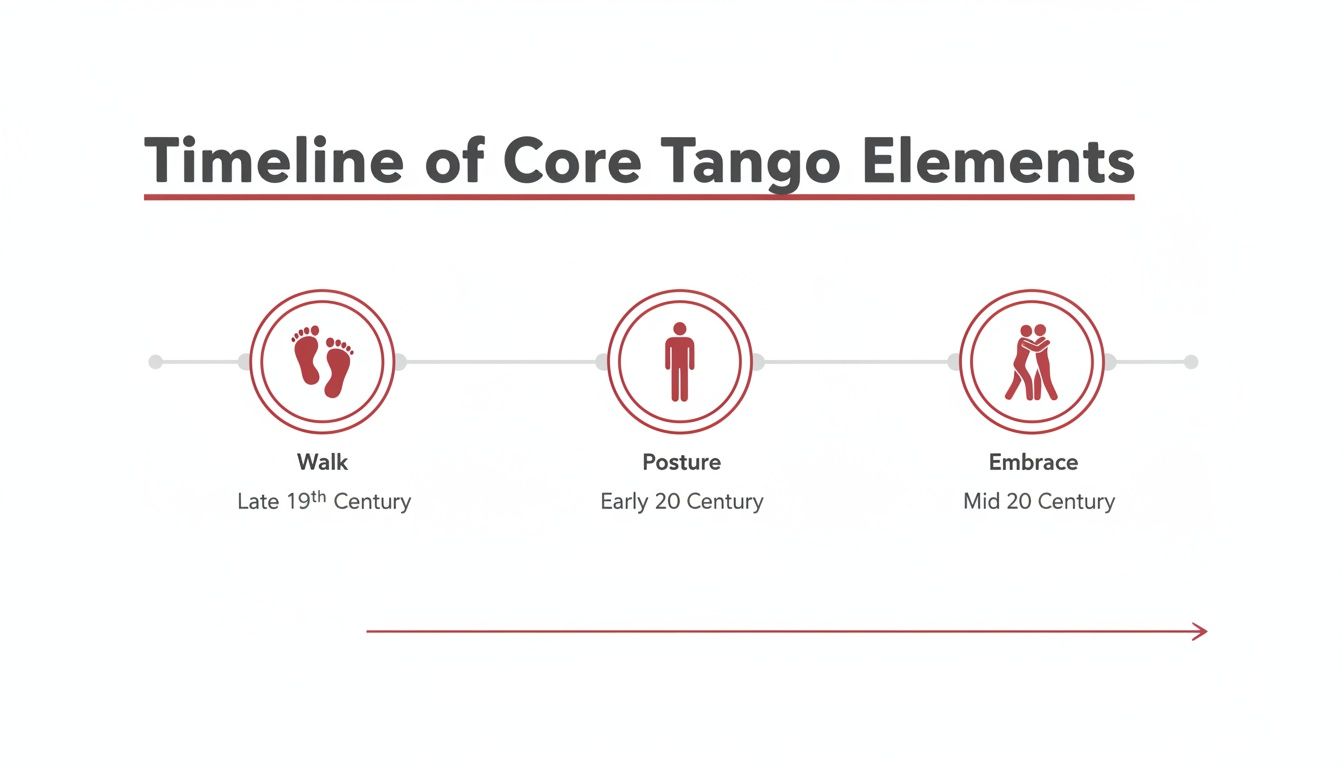
These core pillars—the walk, the posture, and the embrace—are layered together to give you a solid base for everything that comes next.
Weeks 1-2: The Foundation
Your first couple of weeks are all about the absolute essentials. We focus entirely on the tango walk (the caminata) and finding a comfortable, connected embrace (the abrazo). The goal is simple: learn to walk with a partner in a way that feels musical and connected. You’ll spend a lot of time on posture, finding your balance, and learning to feel your partner's subtle weight shifts.
Weeks 3-4: Introducing Basic Vocabulary
Once you're moving together with the walk, we start adding the first pieces of tango vocabulary. You'll likely learn the basic 8-count pattern, known as the salida, which gives you a simple structure to start moving. We'll also introduce followers to forward and back pivots, called ochos. These turns are fundamental building blocks for so many other steps you'll learn down the line.
Tango is built from a few simple ingredients. The walk, the pivot, the embrace. Your first month is all about getting comfortable with these ingredients before you start cooking.
Weeks 5-6: Navigating The Dance Floor
With a few basic moves under your belt, the focus shifts to using them out in the wild. This is where we introduce floorcraft—how to navigate the dance floor, or la ronda, moving counter-clockwise with other couples. It’s a crucial skill for social dancing. This is where you really start to sharpen your lead and follow skills, learning to adapt your steps to the space you have.
Weeks 7-8: Weaving It All Together
In the final weeks of this initial phase, you’ll start to combine everything more fluidly. The goal is to stop thinking about individual steps and start connecting them with a real sense of musicality. We’ll work on smoothly transitioning between walking, the basic pattern, and ochos, letting the music guide what happens next. By now, you’ll have a solid foundation to confidently continue your tango education.
Ready to start your own progress map? The first step is the easiest one to take. Danza Academy is ready to guide you through this entire journey, starting with a free complimentary lesson. Book your spot on our contact page and let's start building your foundation today.
Navigating Tango Socials And Etiquette

Tango is so much more than just a dance—it’s a living, breathing social culture with its own unique customs. When you step into your first social dance, known as a milonga, it can feel a little intimidating at first. But don't worry. Understanding a few key traditions is all it takes to feel comfortable and become part of the community.
You'll quickly notice that people don't always use words to ask for a dance. The traditional, and frankly quite elegant, way is a non-verbal invitation called the cabeceo. It’s all done with eye contact. You catch someone's gaze from across the room, share a subtle nod, and then meet them at the edge of the floor. This beautiful little ritual is a graceful, respectful way to invite someone without the awkwardness of a verbal rejection.
The Flow Of The Music And The Floor
Music at a milonga isn't just a random playlist; it’s played in structured sets called tandas. A tanda is a block of three or four songs, all from the same orchestra and era. The idea is to dance that entire set with one partner, giving you both a chance to build a real connection and explore the music together.
In between each tanda, you'll hear a short musical interlude. That’s the cortina, which literally means "curtain." The cortina is your signal that the tanda is over—it's not for dancing. When you hear it, you thank your partner, walk them off the floor, and head back to your seat, ready for the next invitation.
Understanding the tanda and cortina is crucial. It prevents awkward moments and shows you respect the flow of the milonga. It’s the rhythm of the evening itself.
Navigating the dance floor itself, or la ronda, is another key piece of etiquette. Dancers move in a counter-clockwise circle around the room. The goal is to keep your place in the line of dance and maintain a smooth flow. This means no sudden stops, no weaving in and out of couples, and definitely no stepping backward against traffic. Just think of it like a highway lane—your job is to keep moving with the cars around you.
Respectful Partner Communication
On the dance floor, communication is almost entirely non-verbal and built on mutual respect. As a leader, your main job is to protect your partner from collisions while leading moves that fit the space you have. As a follower, your role is to be attentive and responsive to that lead. You can learn more about how this dynamic works in our guide to the joys of social dance at Danza Academy.
Above all, remember that everyone at a milonga is there to enjoy the music, the dance, and the connection. Be polite, stay aware of your surroundings, and don't be afraid to smile. These simple acts of courtesy will make you a welcome addition to any tango community.
Ready to see it all in action? The best way to learn is to dive in. Take your first step toward feeling confident at any social dance by claiming your free complimentary lesson. Book your free lesson on our contact page and discover the welcoming community waiting for you.
Ready to Start Dancing in Philadelphia?
It’s time to move from curiosity to confidence. That first step onto the dance floor is always the hardest, but we’re here to make it easy. Danza Academy is offering a free complimentary lesson so you can discover if Argentine tango is right for you, with zero commitment.
Think of it as a personal invitation to connect with the music, the movement, and a whole new community. Our instructors have years of experience and are passionate about helping beginners find their footing. With convenient locations in Center City Philadelphia and Exton, there’s a class that fits your life. You don’t even need a partner to start!
This is your chance to stop wondering and start dancing. The hardest part is walking through the door—we’ll make sure the rest is pure fun.
We’ve built a supportive, friendly environment that’s ideal for anyone starting their tango lessons for beginners.
So, ready to create your own tango story? Claim your free lesson today by booking on our contact page and see just how rewarding this journey can be. You can also learn tango at Danza Academy to find out more about what makes our studio so special.
Common Questions About Learning Tango
Taking that first step into any new hobby is bound to bring up questions, and tango is no exception. It's totally normal to have a few hesitations before you dive in. We get it. So, let’s clear up some of the most common concerns we hear from newcomers.
Do I Need a Partner to Start Tango Lessons?
Absolutely not. This is probably the number one question we get, and the answer is a big, resounding no.
Our group classes are designed for everyone to rotate partners frequently. This is actually a huge advantage. Dancing with a variety of people is the single fastest way to sharpen your leading or following skills. You learn to adapt, communicate non-verbally, and connect with different dance styles right from the start.
What Kind of Shoes Should I Wear?
For your first few classes, you can leave the fancy tango shoes at home. The most important things are comfort and function.
Find a pair of shoes with a smooth sole—leather or suede is perfect—that lets you pivot easily on a wooden floor. Steer clear of anything with a rubber or grippy sole, like sneakers. They’ll stick to the floor, making turns and pivots a real struggle (and potentially tough on your knees).
A Quick Tip from the Pros: Good support can make a world of difference. As you get more into dancing, learning about choosing the right insole can be a game-changer for your comfort and endurance on the dance floor.
How Long Does It Take to Learn?
Tango is a journey, not a destination. You’ll be able to dance a few basic steps after your very first lesson—we promise!
Most of our students feel comfortable enough to try out a social dance (what we call a milonga) after about two to three months of consistent, weekly lessons. But everyone learns at their own pace, and that's perfectly okay. The real key is consistency. The more you immerse yourself in classes and practice, the more natural and confident you'll feel.
The goal isn't to master tango overnight. It's about enjoying each step of the process, celebrating the small wins, and falling in love with the movement and the music.
Ready to stop wondering and start dancing? Danza Academy invites you to experience the magic of tango for yourself. Book your complimentary first lesson through our contact page, and let's answer any other questions you have in person—right on the dance floor.