
Your child is 8, full of energy, and probably already dancing somewhere. In the kitchen. In the living room. In the aisle at the grocery store. You might be wondering whether now is the right time to turn that enthusiasm into real classes, or whether formal training will feel too serious too soon.
That question comes up often, and it makes sense. At this age, many parents feel pulled between two extremes. One class sounds fun but vague. Another sounds polished but intense. Most families aren't looking for either extreme. They want a place where their child can learn solid skills, make friends, and feel proud of real progress.
Your 8-Year-Olds Next Big Step into Dance
Eight is a turning point in dance education. A child this age usually isn't a preschool mover anymore, but they also don't need a high-pressure program built around elite competition. They sit right in the middle, which is why choosing a class can feel harder than expected.
A parent might tell me, "My child loves dancing, but I don't know if she should just try something fun or start learning proper technique." That's the exact crossroads many families hit. The challenge isn't that there are no options. It's that the options are often described poorly.
According to Dance Unlimited Miami's overview of a dancer's journey, 8-year-olds are uniquely positioned to start building foundational artistry and technique, yet parents often don't get clear guidance on how to choose a program that balances social confidence with skill refinement. The same source notes that this is a critical window for a child to "sink their teeth into a specific dance style" while still focusing on motor skill development and fun.
Parents usually don't need to choose between joy and structure. A strong class gives a child both.
That balance matters. At 8, children can follow more detailed instruction, remember combinations, and start understanding why posture, rhythm, timing, and focus matter. They also still need warmth, movement, and a sense of belonging. If a class forgets the human side of learning, a child may shut down. If it forgets technique, they may stay busy without building much.
When parents want a clearer picture of what age-appropriate progression can look like, it helps to review a program built specifically for growing students, such as the Young Dancers Academy.
What this age often needs most
- A real skill path: Your child should learn more than "cute routines." They should begin building posture, coordination, rhythm, and style-specific basics.
- A social home: Eight-year-olds still learn best when they feel safe, included, and connected to the group.
- Room to explore: This is often the age when children begin to prefer one style over another, and that preference is worth paying attention to.
If you're looking into dance classes for 8 year olds, the best fit usually sits in that middle lane. Structured, but not rigid. Encouraging, but not aimless.
Exploring Popular Dance Styles for This Age
Parents often ask which style is "best" for an 8-year-old. The honest answer is that the best style depends on the child in front of you. One child loves precision. Another wants freedom and big expression. Another lights up when movement becomes social and musical.
A simple comparison helps.
Dance Styles for 8-Year-Olds at a Glance
| Dance Style | Core Focus | Energy Level | Best For a Child Who… |
|---|---|---|---|
| Ballet | Posture, alignment, control, musical phrasing | Moderate | enjoys structure, detail, and graceful movement |
| Jazz | Sharpness, performance quality, rhythm, coordination | Moderate to high | likes upbeat music and expressive choreography |
| Hip-Hop | Groove, musicality, confidence, grounded movement | High | wants freedom, personality, and athletic energy |
| Social Ballroom and Latin | Rhythm, partner awareness concepts, etiquette, coordination | Moderate | enjoys interaction, clear patterns, and social confidence |
Ballet builds the technical base
Ballet is often the clearest route for learning body control. In a good beginner class for 8-year-olds, ballet teaches how to stand tall, place the feet carefully, move with intention, and listen closely to counts and music.
For some children, ballet feels calm and satisfying. For others, it feels too exact at first. That doesn't mean it's a bad fit. It may mean they need a teacher who explains technique in kid-friendly language and keeps the room encouraging.
A ballet-based class is often a strong choice if your child benefits from routine and likes seeing clear improvement.
Jazz brings energy and performance together
Jazz works well for children who want structure without the formality of ballet. They still learn technique, but they often experience it through more direct, punchy movement and performance-focused combinations.
Children who enjoy showing personality usually connect with jazz quickly. It can help an 8-year-old learn timing, body awareness, and confidence while still feeling lively and accessible.
If your child also loves stage performance, story-based routines, or character work, related classes such as dance for musical theatre may also feel like a natural match.
A child doesn't need to pick a forever style at 8. They need a style that helps them want to come back next week.
Hip-Hop gives high-energy movers a strong outlet
Hip-hop is often the style families choose for a child who has constant motion in their body and wants dance to feel current, bold, and expressive. The benefit isn't just "letting them burn energy." A well-taught hip-hop class builds rhythm, control, listening skills, and confidence in a very direct way.
In youth dance classes, children average 17.2 ± 8.9 minutes of moderate-to-vigorous physical activity, or about 36% of class time, though activity varies widely by style. In the same research, hip-hop reached 57%, while Latin-flamenco was 13.6%. The study also found that only 8% of children met the CDC guideline of 30 minutes of after-school physical activity during a single dance session, and that private class settings produced higher activity levels than community center classes, according to Pediatrics research on physical activity in youth dance classes.
That doesn't mean every child should choose the most physically active style. It does mean the teaching format and dance style affect what your child experiences in class.
Social Ballroom and Latin are often overlooked
This is the category many parents don't think about for 8-year-olds, and that's a missed opportunity. Social dance styles can build rhythm, posture, confidence, and awareness of others in a way that feels different from stage-focused classes.
For a child who enjoys patterns, music, and group interaction, Ballroom and Latin basics can be an excellent fit. These classes often help children learn how to move with others, listen for timing, and carry themselves with poise.
What matters most isn't chasing a "perfect" style. It's matching the class culture and teaching method to your child's personality right now.
More Than Movement The Benefits of Dance
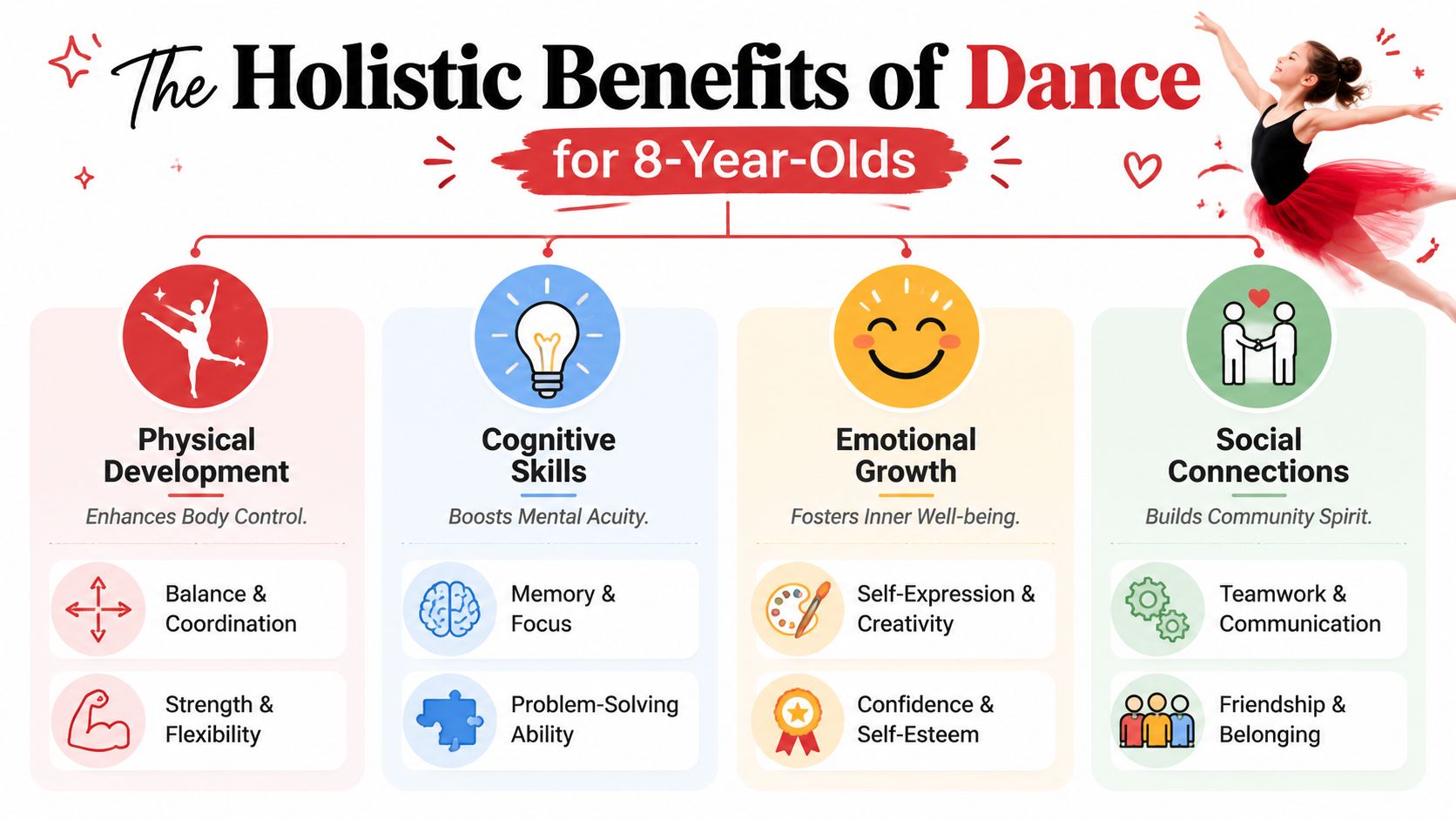
Dance helps an 8-year-old in more ways than one might expect. Parents usually notice the obvious things first. Better coordination. Better focus in class. A child who walks into the studio shy and walks out standing taller.
The deeper benefits are worth understanding because they shape how a child grows, not just how they perform.
Physical growth
At 8, children are refining balance, agility, coordination, and body control. Dance gives them repeated practice in all of those areas. They learn to organize their movements, remember where their body is in space, and use energy with more control.
Dance training also supports flexibility, agility, and heart rate elevation, and it helps children develop a greater range of movement and stronger spatial awareness, as described in Dance Unlimited Frederick's discussion of dance and school performance.
Cognitive benefits
Dance asks a child to listen, remember, sequence, adjust, and repeat. That combination matters. A child has to hear a correction, hold the combination in memory, and apply it with timing.
The same Dance Unlimited Frederick article states that dance lessons enhance memory retention, skill acquisition, and problem-solving capabilities, while arts education is associated with fewer classroom discipline issues, stronger writing scores, and more compassion for others. For parents, that often shows up as a child who follows directions better and sticks with learning longer.
A short look at movement and learning helps bring that to life:
Emotional and social confidence
This age is tender. Children are becoming more aware of themselves, how they compare to others, and how they look in a group. That's one reason the emotional side of dance matters so much.
For 8-year-olds, dance training yields a 50% greater mood improvement compared to lower frequency engagement, and 2 to 3 weekly classes appear to be the sweet spot for self-esteem and positive body image, according to clinical findings on youth dance participation.
Practical rule: If your child loves dance, consistency usually helps more than cramming. A steady routine tends to support confidence better than occasional drop-ins.
Children don't just learn steps in dance. They learn how to enter a room, take feedback, try again, and be part of a group without disappearing inside it.
Finding the Perfect Fit for Your Child
A strong studio doesn't only teach dance. It teaches children how to learn. That's why I always encourage parents to evaluate a class the same way they'd evaluate a school environment. Watch how adults speak to children. Notice how the room feels. Ask clear questions.
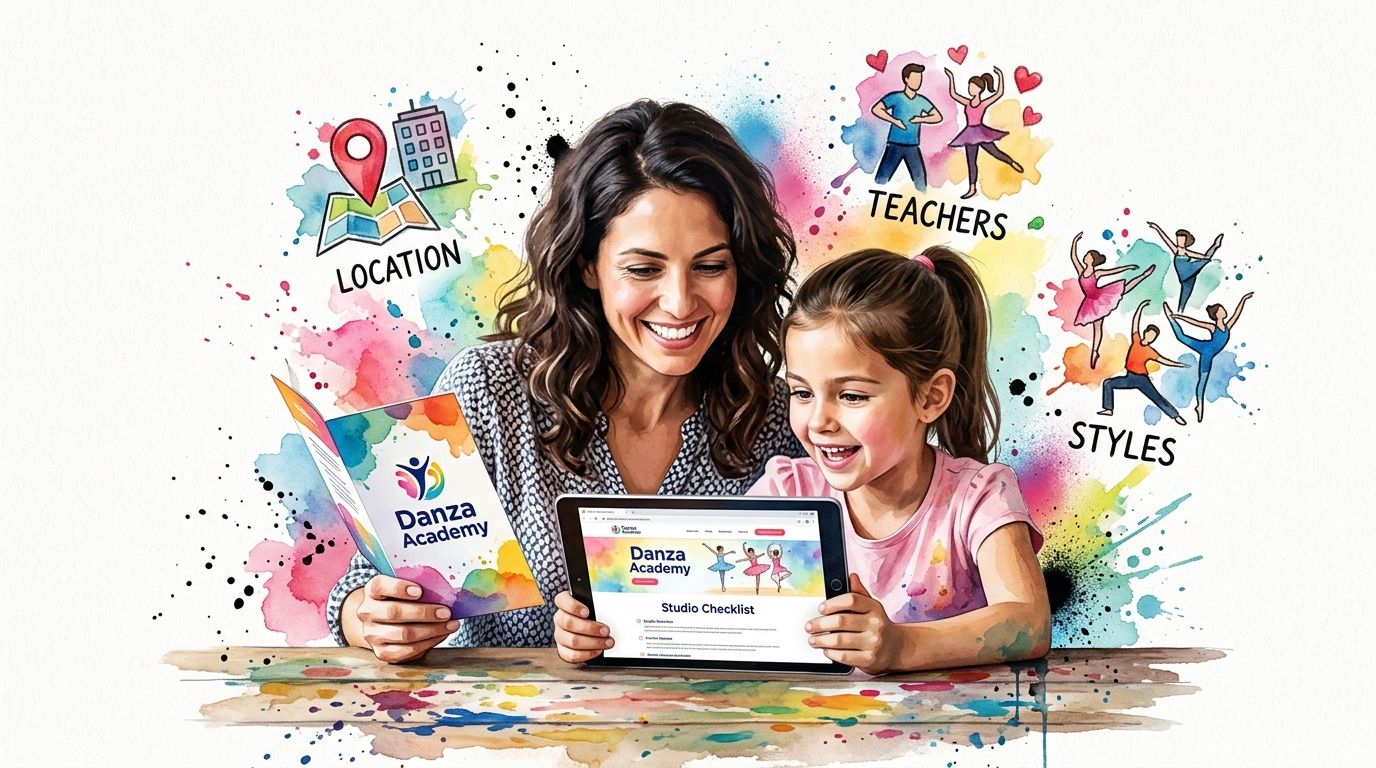
Questions worth asking
Bring a short list with you. You don't need to sound like an expert. Good studios expect thoughtful questions.
- Who teaches this age group: Ask whether the instructor regularly works with elementary-age children and how they handle both shy and energetic students.
- How is the class structured: You want to hear more than "they learn routines." Ask about warm-up, technique work, across-the-floor practice, choreography, and cooldown.
- What does progress look like: A strong answer includes skill growth, listening skills, confidence, and classroom habits, not only recital preparation.
- How do you place students: Some studios group by age, some by level, and some by a blend of both. You want a placement that challenges your child without making them feel lost.
- Can I observe or try a class first: Studios that make the first step easy often remove a lot of pressure for families.
Parents who want more ideas on comparing programs can use a practical checklist like this guide to finding the 7 best dance classes for kids.
What to watch during a visit
When you observe a class, don't focus only on the most advanced child in the room. Watch how the teacher handles the child who needs help.
Look for these signs:
- Clear teaching: The instructor gives short, understandable corrections.
- Respectful energy: Children are expected to focus, but they aren't shamed for mistakes.
- Age-appropriate pacing: The class moves with purpose, but children still have time to absorb directions.
- Visible engagement: Students aren't standing around confused for long stretches.
The best class for your child is the one where they feel safe enough to try and challenged enough to grow.
Red flags parents shouldn't ignore
Some concerns show up quickly once you know what to look for.
- Poor communication: If basic questions about schedule, attire, fees, or expectations are hard to answer, bigger issues may follow.
- Unsafe setup: Floors, spacing, and supervision matter.
- One-note teaching: If every child is expected to learn exactly the same way, some children will get left behind.
- Pressure too early: A class can be serious about teaching without making an 8-year-old feel like they're behind.
Studios also bring in new students more effectively when they offer dedicated trial experiences instead of dropping newcomers into any existing class. In one example, a studio increased monthly trial bookings from 12 to 38, described as a 3.2x improvement, after implementing specific trial class times, according to AgentZap's article on dance studio trial bookings. That matters because a thoughtful first visit often gives families a much clearer read on fit.
A Typical Week and Milestones in Dance
Parents usually feel more relaxed once they know what the week will look like. At 8, many children are ready for a more focused schedule than they had in early childhood, and classes often become more style-specific.
For children around age 8, recreational dancers are typically advised to take 2 to 3 hours of dance per week, while children seeking stronger technical improvement are often encouraged toward 3 to 6 hours weekly. This age also marks the shift from combo classes into full 45 to 60 minute classes per style, according to Music House Chicago's guidance on weekly training hours.
What a class often includes
A typical 45 to 60 minute class may move through a few clear phases:
- Warm-up and body prep to wake up muscles, posture, and focus.
- Skill work such as foot positions, rhythm drills, turns, balance, or traveling exercises.
- Combination practice where children apply those skills in short sequences.
- Closing review so they leave remembering one or two concrete things they learned.
The exact content changes by style, but the pattern is useful. It gives children repetition without making class feel dull.
A realistic weekly rhythm
A recreational student might take two or three classes spread across the week. That gives enough repetition to remember corrections and enough breathing room to stay enthusiastic.
A child who wants more technical growth may add another class in the same style or a second style that supports their main one. The key is keeping the schedule manageable. At this age, consistency matters more than packing the calendar.
Milestones parents can expect
Progress in dance doesn't arrive all at once, and it doesn't only show up as cleaner steps.
Around 3 months, many children begin remembering class routines, following multi-step directions more independently, and moving with more confidence in the room.
Around 6 months, parents often notice better timing, stronger posture, and more comfort performing in front of others. A child may also start using dance vocabulary naturally.
Around 12 months, many students show clearer technical habits, stronger classroom focus, and a sense of identity in their chosen style. They don't just "take dance" anymore. They start to feel like dancers.
Start Their Journey at Danza Academy
Many families looking at dance classes for 8 year olds want something specific, even if they don't say it that way at first. They want a class that teaches real skills, welcomes beginners, and helps a child grow socially as well as technically. That combination matters even more when you're considering social styles, because parents often assume those styles are only for teens or adults.
For 8-year-olds, social dance styles such as Waltz or Cha-Cha can be taught in non-partner, group formats that build coordination and confidence. This helps correct the common idea that children must wait until adolescence for partner work, and it supports early friendship-building and social ease, according to 92NY's children's dance class information.
That's why a social-to-technical approach can work so well. A child can learn rhythm, posture, musicality, and group awareness without the pressure of needing a fixed partner. They get the fun of moving with others while still building strong basics.
One local option parents may consider is Danza Academy of Social Dance, which offers kids' dance instruction in Ballroom, Latin, and social styles with no partner required. For families who want a first experience that feels low-pressure, a complimentary lesson can make the decision much easier.

Why a complimentary first lesson helps
Trying a class before committing solves several parent concerns at once.
- It reduces guesswork: You can see whether your child responds to the teacher and class environment.
- It lowers pressure: Your child doesn't have to decide everything before stepping into the room.
- It makes fit visible: You can watch whether the style, pace, and social atmosphere match what your child needs.
Offering free trial classes is one of the most effective ways to bring new families into a studio because it lets them experience the teacher and class without the anxiety of an immediate financial commitment, as explained in Resourceful Dance's article on free trials.
If your child is ready for that next step, booking a complimentary first lesson is a simple, practical place to start.
If you're exploring a class that builds both confidence and skill, Danza Academy of Social Dance offers a clear next step. You can book a free complimentary lesson through the contact page, meet the teaching team, and see how your 8-year-old responds in a welcoming studio setting. For many families, that one visit makes the choice much easier.