
If your child has been twirling through the living room all spring, asking for “more ballet” as soon as class ends, summer can feel like the next big question. You want to encourage that excitement. You also don't want to sign up for the wrong kind of program and turn something joyful into something stressful.
That's where many parents get stuck. One camp sounds playful and creative. Another calls itself an intensive. A third looks similar on the surface, but the daily schedule, expectations, and student experience may be completely different.
A good summer ballet camp can do wonderful things. It can give a shy child confidence, help a focused dancer stay consistent, and offer structure during a long school break. It can also be too much, too soon, if the level, schedule, or teaching style doesn't match the child in front of you.
Your Guide to Summer Ballet Camp Begins Here
Parents usually aren't just choosing a camp. They're choosing an environment.
That distinction matters because ballet training isn't only about steps. It's about how a child learns, how they respond to correction, how much structure they enjoy, and whether they leave class feeling capable instead of discouraged. A summer ballet camp should support the whole child, not just the skill.
Some children want a week of music, movement, and make-believe. Others are already asking about pointe shoes, auditions, or extra training. Both are valid. The key is knowing which kind of program your child needs right now.
What parents often wonder first
A few questions come up again and again:
- Is my child ready for camp at all? Readiness isn't just about age. It includes stamina, attention span, and comfort being in a group setting.
- Will camp be fun or strict? It depends on the program. “Summer ballet camp” can describe very different experiences.
- How much ballet happens each day? Some camps are light and exploratory. Others are built like serious training blocks.
- Will this help my child grow? Usually yes, if the camp's level and culture fit your child well.
A child doesn't need the most advanced camp. They need the right camp.
What a strong fit looks like
The best match usually has a few clear signs:
- The teaching level makes sense: Your child can participate without feeling lost or held back.
- The schedule suits their energy: Younger dancers often do better with shorter blocks. Older, serious students may enjoy more concentrated training.
- The tone feels healthy: Good teachers challenge dancers while keeping expectations age-appropriate.
- Your child feels eager, not uneasy: A little nervousness is normal. Ongoing dread is a warning sign.
By the time you finish reading, you should be able to sort programs into the right category, ask better questions, budget more realistically, and prepare your child with much less guesswork.
Decoding the Different Types of Ballet Camps
You find two camps that both call themselves “summer ballet camp.” One includes storybooks, dress-up days, and beginner ballet class. The other asks for an audition, lists pointe and conditioning, and runs for several weeks. Those are not small differences. They are two very different kinds of summer experience.
For first-time parents, this is often the most confusing part of the search. The word camp sounds simple, but ballet programs can serve very different purposes. A clear way to sort them is to separate recreational camps from intensive programs.
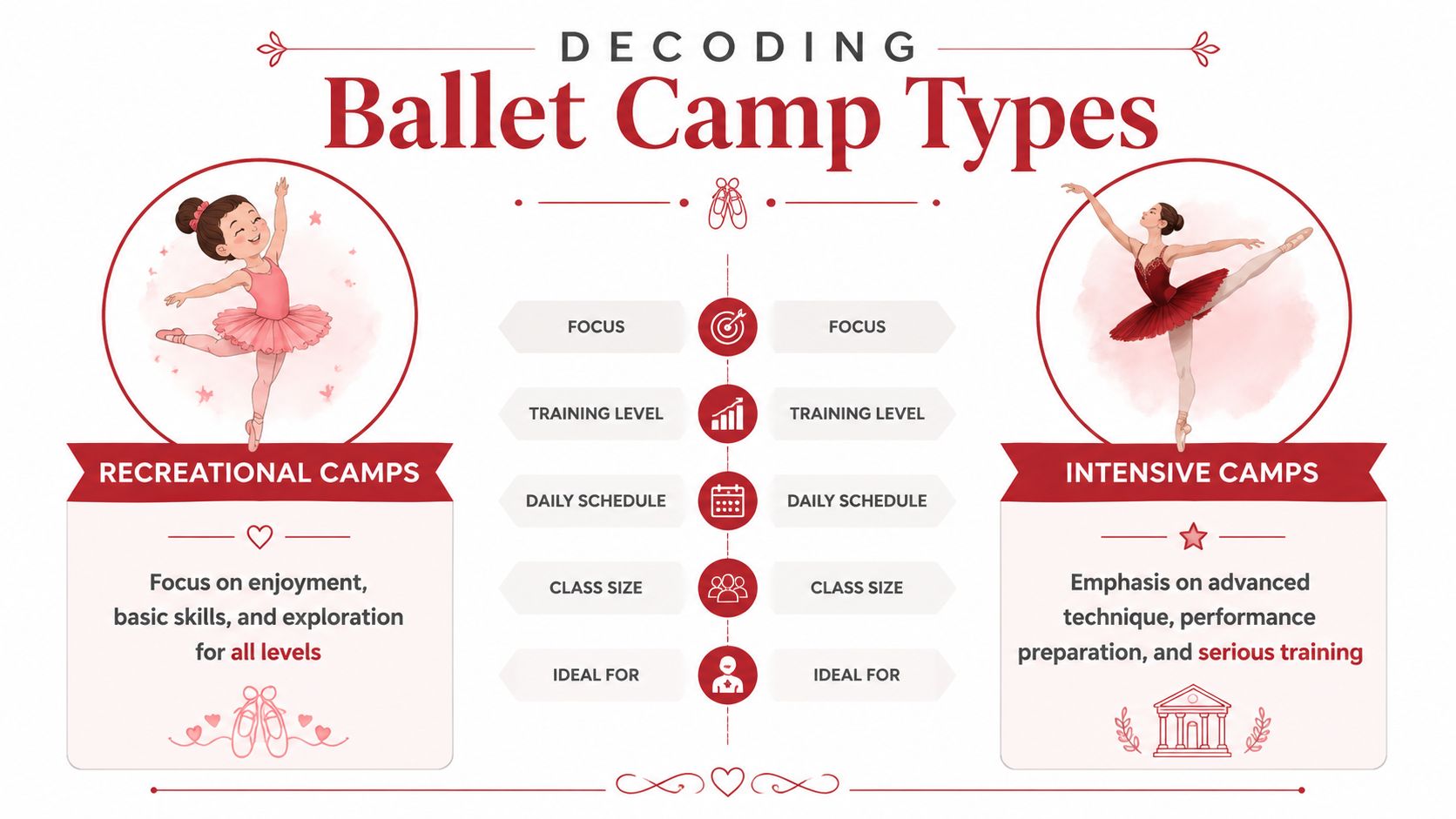
Recreational camps
Recreational ballet camps usually work best for beginners, younger children, or kids who enjoy dancing and want a cheerful summer activity. These programs often blend basic ballet with creative movement, music, storytelling, crafts, or themed games.
The goal is broad growth, not heavy specialization. A child may practice posture, rhythm, class manners, and a few beginning positions. Just as important, they get comfortable in a studio, follow directions in a group, and start to connect dance with confidence and pleasure.
For many families, this is the right first step. It gives a child room to explore without the pressure of a long training day or advanced expectations. If you are still learning how studios differ, this guide to choosing a dance studio that fits your child can help you spot the signs of a healthy environment.
Intensive programs
An intensive is built for a different stage of training. It works more like a concentrated study period than a casual camp. Dancers in these programs usually already take regular ballet classes during the year and want to keep progressing over the summer.
A common intensive model runs for 3 to 8 weeks and may include 2 to 4 classes per day in pre-professional settings. For example, Kansas City Ballet's Summer Intensive describes a schedule with substantial hours in ballet technique and additional training, which shows how focused these programs can be.
That kind of schedule asks for more than interest. It asks for stamina, body awareness, focus, and prior instruction. Many of these programs are also aimed at older dancers, which reflects physical readiness and training sequence, not just talent.
Parents sometimes hear the word intensive and assume it means “better.” It usually means “more specialized.” A child who is ready for it may thrive there. A child who is new to ballet may feel as out of place as a beginner swimmer dropped into a competitive lap lane.
Simple rule: If a program highlights themes, crafts, imagination, and trying ballet, it is usually recreational. If it highlights technique, repertory, conditioning, pointe, or placement, it is usually an intensive.
A quick side-by-side view
| Camp type | Best for | Typical feel | Main goal |
|---|---|---|---|
| Recreational | Beginners, younger children, curious dancers | Warm, playful, exploratory | Build joy, confidence, and basic skills |
| Intensive | Experienced older students | Structured, focused, demanding | Refine technique and continue serious training |
Some parents worry that a recreational camp will slow a child down. In many cases, it does the opposite. A happy first experience often lays the groundwork for steady, lasting progress later.
How to Choose the Right Camp for Your Child
Choosing well starts with one simple question: Who is this camp for, in real life? Not in the brochure. Not in the marketing photos. In practice.
A camp may look polished and still be wrong for your child if the pace, expectations, or classroom culture don't match their needs. I always tell parents to choose from the child outward, not from the program inward.
Start with your child, not the camp label
Look at three things first:
Current experience
A child who has taken weekly ballet for a short time needs a different environment than a dancer already asking for additional technique classes.Temperament
Some children love full schedules and correction. Others need room to warm up, observe, and grow gradually.Goal for the summer
Is your child hoping to have fun, make friends, and stay active? Or are they trying to maintain training and work seriously?
A very focused dancer in a low-structure camp may feel bored. A newer or sensitive dancer in a highly demanding setting may feel overwhelmed.
Why prerequisites matter
When advanced camps ask for previous training, that isn't gatekeeping for its own sake. It's usually a sign that the school is thinking about safety and sequencing.
For example, some advanced intensives require three years of ballet plus one year of pointe for dancers ages 12 and up, as shown on Mobile Ballet's summer programs page. Those prerequisites reflect the physical demands of advanced work. Pointe, long training days, and repeated technique classes require strength, control, and endurance.
That's why a “serious” camp isn't automatically a better camp. If the body isn't ready, more volume can become counterproductive.
Questions worth asking before you register
Use questions that reveal how the camp runs:
- How are students grouped? By age, level, or both?
- What does a typical day include? Ballet only, or also conditioning, choreography, and rest breaks?
- How do teachers handle correction? Clear and supportive is what you want.
- What previous experience is expected?
- What happens if a child seems placed too high or too low?
If you're comparing local programs, it also helps to review guidance on how to choose a dance studio. The same factors matter in summer. Teaching style, communication, and age-appropriate expectations all shape the experience.
If a camp can't clearly explain who it serves, that uncertainty usually lands on the child.
A simple decision filter
Try this quick match-up:
- Choose recreational if your child is young, new to ballet, or mostly wants a fun summer activity.
- Choose a structured intermediate program if your child already enjoys class routines and wants more practice without the pressure of a major intensive.
- Choose an advanced intensive only if your child has the technical background, physical readiness, and personal desire for that kind of load.
Parents often think the “right” choice is the one that sounds most impressive. In dance, the right choice is the one your child can grow in steadily.
A Day in the Life Sample Camp Schedules
Schedules tell the truth faster than brochures do. Once you see what a day looks like, it becomes much easier to picture whether your child will thrive.
This visual gives a helpful overview of how camp days can differ by age.
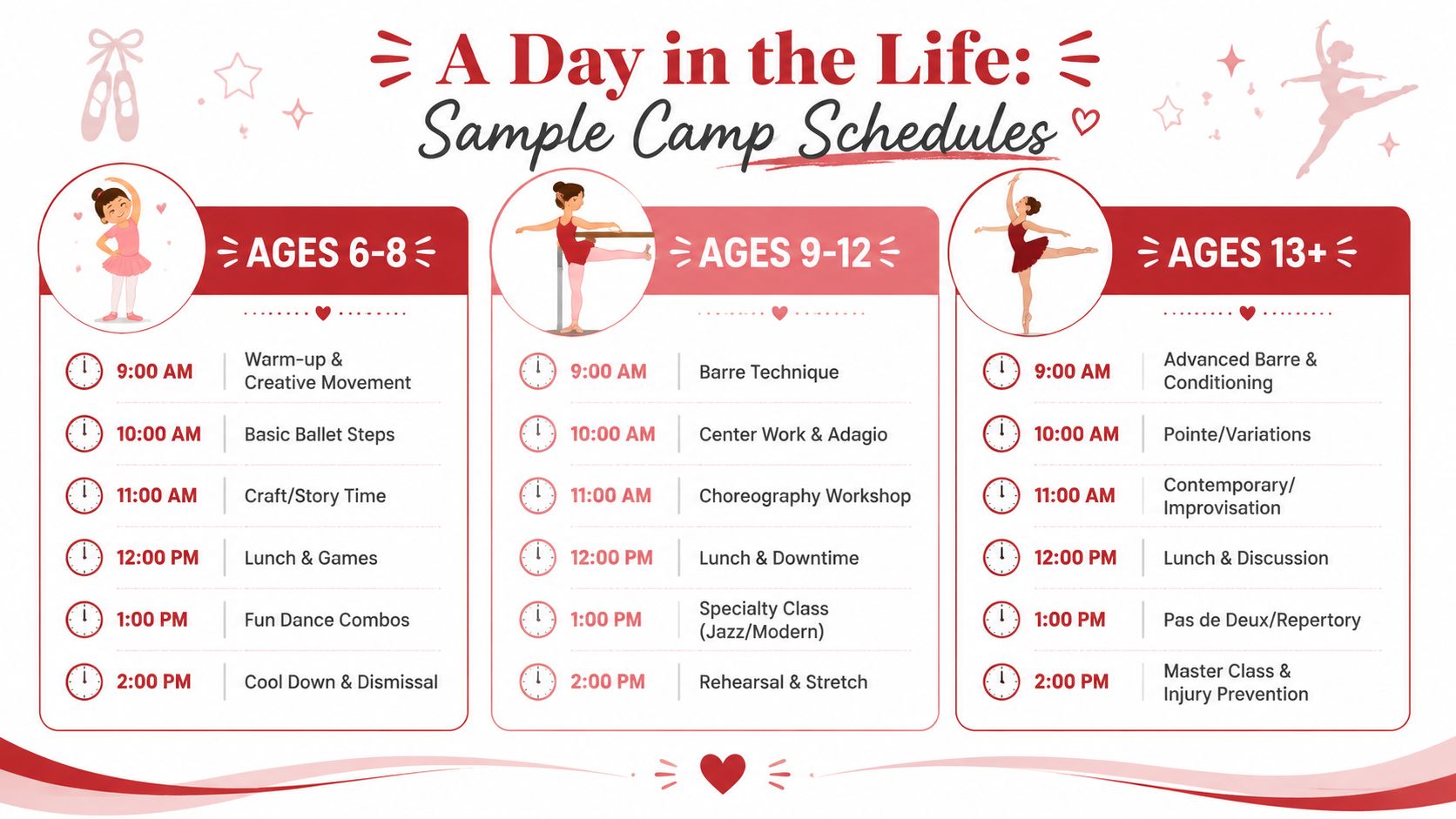
A short class block can feel refreshing for one child and insufficient for another. A full-day intensive can feel exciting to a serious teen and exhausting to a beginner. That's why looking at the rhythm of the day matters so much.
Younger dancers and first-timers
For younger children, many camps build the day around movement variety and attention span. A good beginner schedule often alternates focus and release.
A sample day for a young child might include:
- Morning welcome and warm-up: Gentle stretching, music, and movement games
- Basic ballet class: First positions, skipping, balance, and simple traveling steps
- Creative activity: Story dance, costume play, or a craft
- Snack or lunch break: Time to reset
- Short choreography or closing dance: A fun combination to practice and share
This kind of day works because young dancers learn best in short, engaging pieces. Similar to elementary reading lessons, children need repetition, but they also need variety.
Here's a video that helps bring the studio atmosphere to life:
Preteens who want more structure
For older children who already know ballet class basics, camps often become more skill-focused. The day may still be part-day, but the training gets more organized.
A junior schedule might include technique, a conditioning block, and one additional style such as jazz or modern. That combination helps students build coordination and body awareness without the intensity of a pre-professional track.
A well-designed schedule doesn't just add hours. It adds the right kind of hours.
Teens in serious training
For older students, high-quality summer ballet camps often run Monday through Friday with full-day blocks, and some pre-professional programs explicitly schedule classes from 9 a.m. to 5 p.m. to concentrate technique, conditioning, and repertory in one continuous training day, as described by Ballet RI's summer programs.
A sample teen intensive day may include:
| Time block | Typical focus |
|---|---|
| Morning | Ballet technique and barre work |
| Late morning | Pointe, men's work, or variations |
| Midday | Lunch and recovery |
| Afternoon | Conditioning, repertory, or complementary styles |
| Late afternoon | Coaching, rehearsal, or stretch |
That kind of schedule is productive for the right dancer because skills build through repetition. But it only works when the student has the preparation, interest, and stamina to handle that load.
Understanding the Full Cost and Registration Timelines
The listed tuition is rarely the whole story. Parents often compare camps using the headline price, then feel blindsided by separate fees or care options that change the actual total.
The safest approach is to build a “real cost” worksheet before you register.
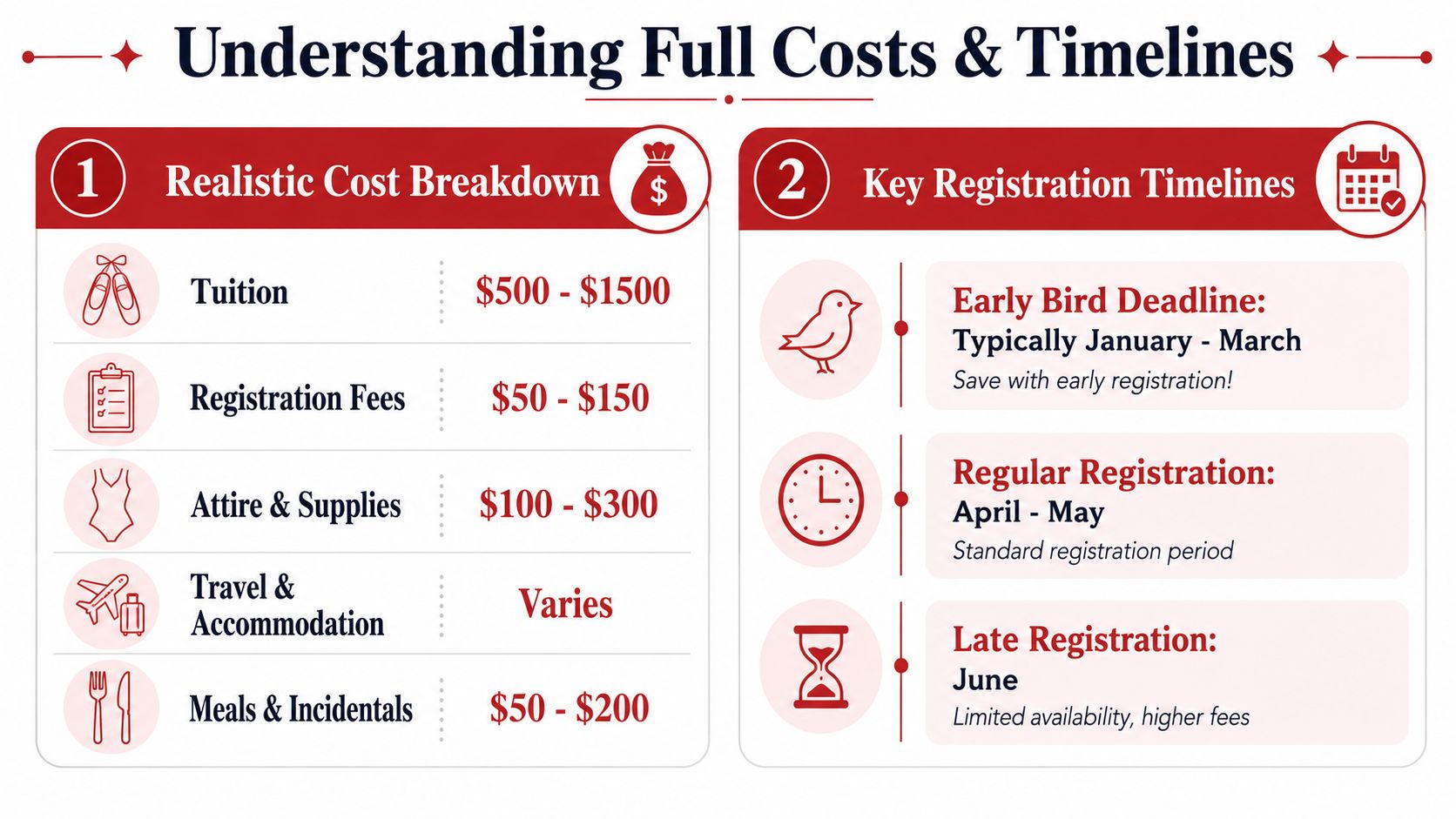
What to include in your real budget
Examples from camps show that families may encounter after-camp care at $225 per week or $50 per day, plus a 50% non-refundable deposit, according to Bay Ridge Ballet's camp information. Those details can materially change the final cost compared with the tuition number you first see.
When you compare programs, account for:
- Tuition: The base camp fee
- Deposit: Ask whether any portion is non-refundable
- Extended care: Before-care or after-care can add up quickly
- Dress requirements: Shoes, tights, leotards, or specific hair supplies
- Food and transportation: Especially if camp hours overlap work schedules
Some programs are very transparent. Others require a little detective work.
Registration timing matters too
Popular camps don't usually stay open forever. Families who plan early often have better choices for dates, session lengths, and level placement. Even if a camp accepts later registrations, your preferred week may already be full.
A practical family system is to set your own planning calendar as soon as spring activities begin. If you want help organizing school breaks, camps, and work schedules in one place, this guide to streamline your event planning can be useful for building a clear timeline.
Questions to ask before you pay
Instead of asking only “What does it cost?”, ask:
- What is included in tuition?
- Is the deposit refundable under any circumstances?
- Is extended care separate?
- Do we need to buy anything specific before the first day?
- Is there a price difference between one week and a longer enrollment?
The best budget question isn't “What's the tuition?” It's “What will my family actually spend from registration to the last day of camp?”
That one question prevents a lot of stress.
Your Essential Packing List and Safety Checklist
Once you've chosen a summer ballet camp, preparation becomes much simpler. Children do better when the first day feels familiar, predictable, and calm. Packing well is part of that. So is asking direct safety questions before camp starts.
A good rule is this: pack for movement, comfort, and routine.
What to pack
Your child usually doesn't need a fancy dance bag stuffed with extras. They need clean basics and a few dependable items.
- Dancewear that fits: Leotard, tights, and any required cover-up or warm-up layer
- Ballet shoes: Clearly labeled with your child's name
- Hair supplies: Hair ties, pins, brush, and a backup option in the bag
- Water bottle: Easy to open and refill
- Snack and lunch: If the camp requires them
- Small towel or extra shirt: Helpful for warmer days
- Any required medication: Sent according to camp policy
For advanced students, pointe shoes and related supplies may also be necessary if the program requires them.
The safety questions that matter most
Parents sometimes focus on performance opportunities and forget to ask about supervision. In my experience, class size, staffing, and injury response tell you more about a camp than a polished recital photo ever will.
Some summer ballet camp programs are intentionally small to guarantee individual attention. For example, one teen intensive caps enrollment at 10 campers ages 11 to 19 and lists defined weekly sessions such as June 8 to 12, 2026 and July 27 to 31, 2026, according to Geary Dance Center's Summer Teen Ballet Intensive page. That kind of structure usually signals supervised, cohort-based instruction.
Ask these questions directly:
- How many students are in each group?
- Who supervises children outside class time?
- What happens if a child gets hurt or feels unwell?
- Are instructors trained for emergencies?
- How does the camp manage fatigue, breaks, and hydration?
If you want a parent-friendly overview of risk reduction in dance training, this resource on dance injury prevention is a helpful place to start.
Vetting staff behind the scenes
Background policies matter, even when a program feels warm and familiar. Families who want to understand what screening standards can look like may find this guide to affordable coach background screening useful when forming questions for camp directors.
Here's the simplest test: if you ask about safety and the answers are vague, keep looking.
Small groups, clear supervision, and thoughtful injury policies are signs of a camp that takes children seriously.
That's what gives parents peace of mind, and it gives dancers a safer space to learn.
Start Your Child's Dance Journey with Confidence
The right summer ballet camp won't look the same for every child. For one dancer, it's a playful week full of movement and imagination. For another, it's a structured training experience that keeps technique strong through the summer months.
What matters most is fit. A child who feels seen, challenged appropriately, and supported will usually gain far more than a child placed in a program known only for its prestige. Happiness and growth tend to travel together.
If your child is still building confidence, foundational training can be a very smart first step before committing to a highly specialized camp. Some families prefer to strengthen posture, rhythm, classroom focus, and comfort in a studio setting first, then revisit summer options with a clearer sense of readiness.
One local option for younger students is the Young Dancers Academy, which offers structured dance learning for children in a studio environment. That can be useful for families who want steady skill-building and a chance to see how their child responds to instruction over time.

If you're unsure whether your child is ready for a full summer ballet camp, trying one lesson first can make the decision much easier. You get to observe the teaching style, your child gets to experience the classroom, and there's far less pressure than making a big summer commitment all at once.
That first experience often tells you a lot. Did your child light up? Did they follow direction well? Did they leave asking to come back? Those are strong signs you're moving in the right direction.
If you'd like a low-pressure way to explore dance before choosing a summer program, Danza Academy of Social Dance offers a free complimentary lesson that you can book through the contact page. It's a simple way to meet the instructors, see the studio environment, and find out what kind of training feels right for your child.